How to Build & Segment a High-Profile Guest List (VIP Tiers, Blacklists & Plus-Ones)
In luxury events, the guest list is not a spreadsheet. It is a power map.
The right room can elevate a brand overnight. The wrong room can dilute months of strategic positioning. In high-profile environments — whether it is a celebrity-attended launch in Mumbai, a private investor soirée in Delhi, or an ultra-luxury preview in Bengaluru — the composition of guests directly shapes perception, media coverage, security, and long-term relationship capital.
Luxury is built through controlled access. And access begins with curation.
For premium brands, founders, and event hosts in India, guest list architecture is a strategic discipline that blends public relations insight, social intelligence, risk management, and influence mapping. It is not about how many people attend. It is about who attends — and why.
Guest Lists Are a Positioning Statement
Every invitation sends a signal.
When a brand invites selectively, it communicates confidence. When it over-invites, it communicates insecurity. High-profile audiences are sensitive to the room they walk into. They assess not only the décor and hospitality, but the caliber of other attendees.
In India’s evolving luxury ecosystem, especially across emerging premium markets like Hyderabad and Jaipur, networks are tightly interwoven. media editors, celebrity managers, industrial families, designers, and digital creators often operate within overlapping circles. One misaligned invitation can create discomfort, reputational risk, or silent withdrawal of support.
This is why guest list development must align with your broader brand and PR strategy. If your event exists to amplify authority, your room must reflect authority. If your event exists to nurture high-value relationships, your guest mix must protect intimacy.
A luxury event is not a gathering. It is a curated ecosystem.
Start With Strategic Intent
Before names are written down, clarity must be established.
Is the event designed to generate media visibility? Is it a relationship-building private dinner? Is it a brand milestone celebration? A celebrity-attended launch? An investor engagement evening? Each objective demands a different balance of influence, intimacy, and amplification.
When brands skip this step, they default to reactive invitations — responding to requests rather than defining the room.
Clarity protects exclusivity.
For example, a media-driven launch requires strong editorial presence and cultural amplifiers. A private luxury preview requires fewer cameras and more high-value clients. An investor gathering demands discretion and strategic seating. Without intentional ratios, guest lists expand uncontrollably and dilute the experience.
The objective determines the architecture.
Designing VIP Tiers With Precision
Segmentation is not about hierarchy for ego. It is about operational clarity and experiential control.
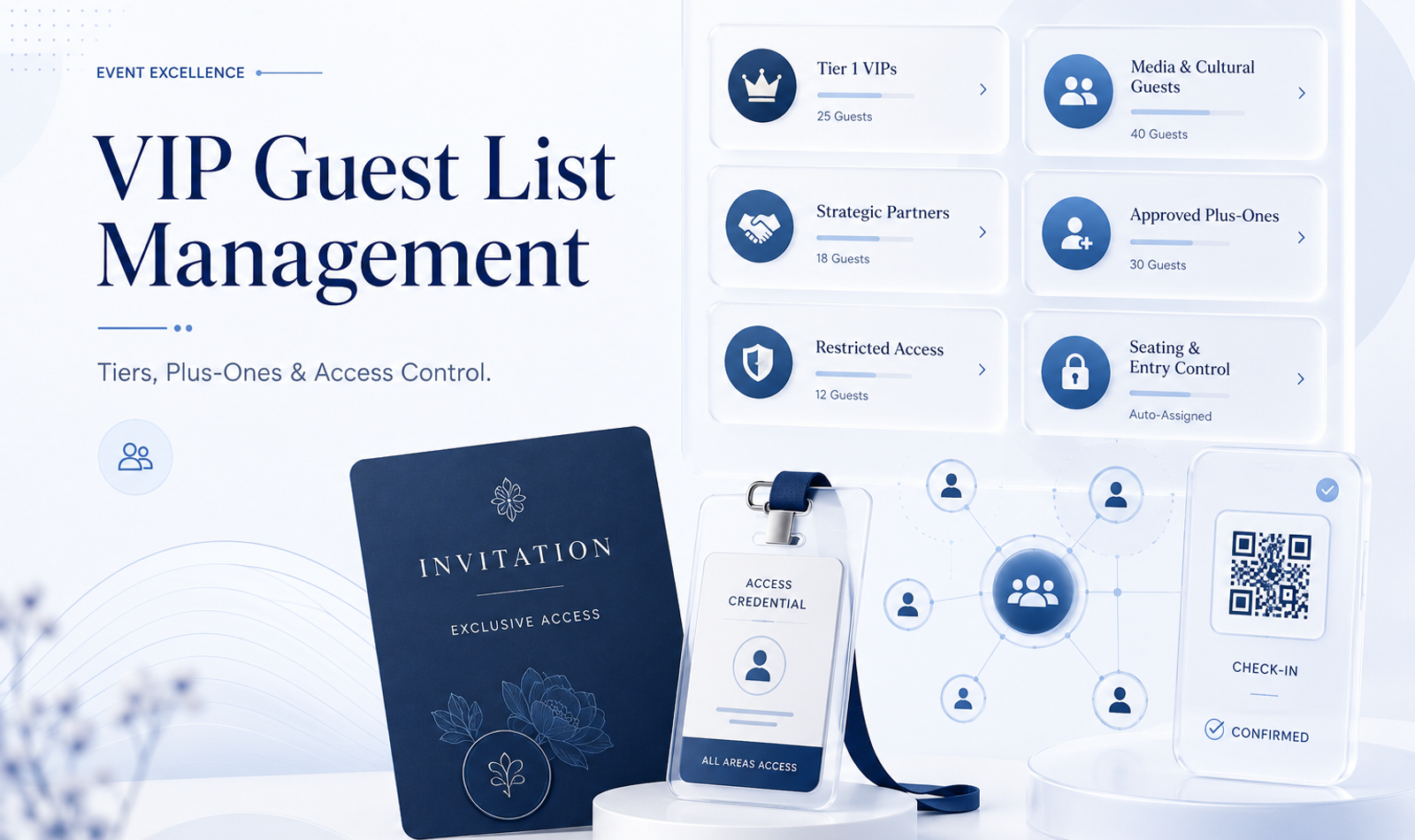
High-profile events typically operate within three to four clearly defined tiers. The first tier includes individuals whose presence alone elevates the event’s stature — celebrities, ultra-high-net-worth individuals, major investors, or industry leaders. These guests require personal outreach, controlled arrival management, and dedicated hospitality support. Their time is limited, and their expectations are refined.
The second tier usually consists of media figures and cultural amplifiers. Senior editors, respected journalists, established digital creators, and influential stylists fall into this layer. They do not merely attend; they shape public narrative. Their experience must be thoughtfully managed, but not at the expense of exclusivity.
The third tier includes brand ecosystem partners — collaborators, designers, suppliers, extended business networks. These individuals strengthen long-term relationship capital and goodwill. However, they should not dominate the room. Luxury positioning depends on perceived selectivity.
A fourth, tightly controlled tier may include extended social circles or acquaintances. This tier must remain carefully capped. When unmanaged, it becomes the primary reason luxury events lose their edge.
Structured segmentation prevents confusion at entry points, avoids hospitality imbalance, and protects experiential hierarchy.
The Unspoken Necessity of Blacklists
In high-profile environments, risk management is silent but constant.
Blacklists are not dramatic tools. They are professional safeguards. Certain individuals may carry reputational conflicts, legal disputes, media controversies, or interpersonal tensions that can disrupt the environment. In celebrity-attended launch or ultra-wealth gatherings, even a single conflicting presence can create discomfort.
Discreet screening mechanisms allow organizers to protect the room without public friction. This process remains confidential, respectful, and strategic.
Luxury brands cannot afford reactive crisis management at their own events. Prevention is the only acceptable approach.
The Delicate Politics of Plus-Ones
Few factors destabilize a premium guest list faster than uncontrolled plus-ones.
What begins as a curated 120-guest evening can quietly become a 180-person gathering. Unknown attendees dilute the room’s composition, complicate security planning protocols, and inflate budgets. More importantly, they alter the social chemistry.
In luxury settings, plus-ones should never be assumed. They must be explicitly defined within invitation language. Tier-one guests may receive pre-approved extensions. Media and influencers may be considered case-by-case. Lower tiers should not automatically include additional access.
Clear communication prevents awkward refusals.
Digital RSVP systems that require named confirmations for every attendee reduce ambiguity. In premium environments, precision protects experience.
Security and Confidentiality as Strategic Layers
High-profile guest list segmentation is inseparable from security planning.
As destination luxury events expand across India — particularly in private estates and heritage properties — security expectations have evolved. NDAs for vendors, controlled entry checkpoints, coded access credentials, and dedicated VIP holding areas are increasingly standard.
Tier segmentation must align with access permissions. Not every guest should access every zone. Privacy for high-profile attendees must be preserved without making other guests feel secondary.
This balance requires professional orchestration.
For controlled entry and digital guest verification, contactless check-in systems can support QR credentials, access permissions and real-time attendance monitoring.
Guest information should also be handled through clear guest data privacy practices so that personal details, arrival schedules and access categories remain protected.
Aligning Guest Curation With PR Strategy
A guest list should support your PR strategy, not contradict it.
If your brand positioning emphasizes exclusivity and cultural refinement, the guest mix must reflect those qualities. Media editors should be strategically briefed. Influencers should align with aesthetic and audience positioning. Key guests should reflect the emotional aspiration your brand communicates publicly.
For brands looking to integrate guest list architecture into a broader visibility ecosystem, refer to our PR, Media & Digital Marketing services.
When PR strategy and guest segmentation operate together, coverage feels organic rather than engineered. The room becomes content. The attendees become brand validators.
Seating as Influence Design
Luxury seating is psychological architecture.
Competitors should not face each other. Editors should not be isolated. Influencers should not overshadow ultra-high-net-worth clients. Founders should be positioned strategically between influence and investment.
Well-designed seating fosters organic conversation that leads to future collaborations, partnerships, or coverage.
Guests should feel natural flow — even though the ecosystem has been deliberately mapped.
A strong on-site guest flow strategy ensures that registration, entry, seating and movement support the same guest hierarchy.
Post-Event Capitalization
The guest list’s value extends far beyond the event itself.
Tier-one attendees deserve personalized acknowledgment and continued exclusivity. Media attendees require curated follow-ups and access to high-quality assets. Brand partners should be engaged for feedback and future collaboration.
Segmentation data becomes a long-term relationship database.
Events are not endpoints. They are relationship accelerators.
A structured post-event guest follow-up process helps convert attendance into ongoing relationships, future invitations, media opportunities and business conversations.
Guest attendance and engagement can also be reviewed through event guest analytics to understand confirmation patterns, attendance behaviour and guest satisfaction.
Why Luxury Guest List Architecture Requires Expertise
In premium ecosystems, one miscalculation can silently impact perception. Overexposure, social imbalance, mismanaged plus-ones, or overlooked conflicts rarely create public chaos — they create subtle dilution.
And in luxury positioning, dilution is more damaging than disruption.
Professional guest list segmentation blends discretion, cultural intelligence, media awareness, and influence mapping into one cohesive framework.
At Double Trouble Studio, high-profile guest management aligns with PR strategy, celebrity coordination, and digital amplification. Every invitation serves a strategic function. Every confirmation supports positioning.
Luxury events are not filled. They are curated.
Design Your High-Profile Guest Strategy
If you are hosting a premium launch, celebrity-attended soirée, luxury wedding, or investor evening in India, structured guest segmentation ensures exclusivity while amplifying influence.
From VIP tier design and blacklist protocols to plus-one control and PR alignment, our guest-management team builds guest ecosystems that protect perception and drive authority.
📩 info@dtsworld.in | 📞 +91 80000 06021 | 📍 Andheri West, Mumbai
Need this for your brand?
Let DTS build your next campaign.
From PR, celebrity management and events to websites, social media, SEO and AI video production — Double Trouble Studio helps brands grow with strategy and execution.
Discuss Your Requirement →