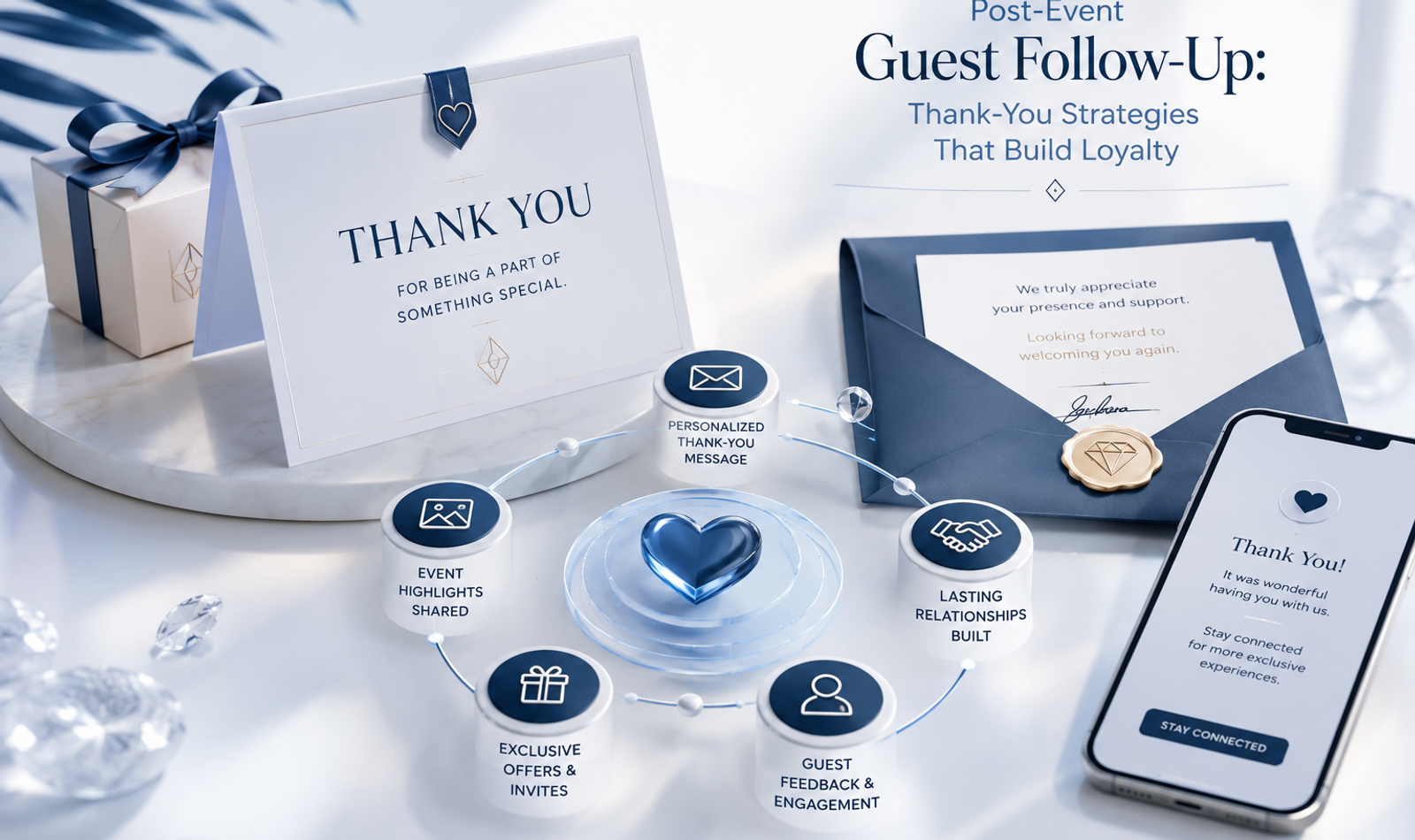
A successful event does not end when the lights are switched off, the stage is dismantled or the final guest leaves the venue. The experience continues in the guest’s memory—and the quality of the communication that follows can determine whether that memory becomes a lasting relationship.
Post-event guest follow-up is the structured process of thanking attendees, sharing relevant event content, resolving pending matters, collecting feedback and continuing valuable conversations after an event. When it is timely, personalised and relevant, it can strengthen guest satisfaction, improve brand recall, encourage referrals and create opportunities for repeat engagement.
This is particularly important for luxury weddings, corporate summits, investor gatherings, hospitality launches, private previews, celebrity appearances and premium brand experiences. In these settings, guests do not judge only the venue, décor or entertainment. They also notice whether the host remembers them, communicates with discretion and follows through on promises made during the event.
A generic bulk message may complete a task. A thoughtful follow-up system builds loyalty.
Quick answer: Send an initial thank-you within 24 to 72 hours, personalise communication according to the guest’s relationship with the host, share only relevant approved assets, record any next steps and avoid turning the first message into a sales pitch.
What Is Post-Event Guest Follow-Up?
Post-event guest follow-up refers to the communication and relationship-management activity that takes place after an event. Its purpose is to acknowledge attendance, continue important conversations and ensure that the guest experience closes with the same level of care with which it began.
Depending on the event, follow-up may include:
- A personal thank-you message from the host
- A formal email from the organisation
- A WhatsApp message from a guest-relations executive
- Approved event photographs or a private gallery
- A cinematic recap or highlight film
- Presentation decks or speaker resources
- Media notes, quotes and press assets
- Feedback requests
- Business or partnership next steps
- Confirmation of celebrity, sponsor or vendor deliverables
- Assistance with lost belongings, travel or hospitality matters
- Invitations to future events
The objective is not to contact every attendee in the same way. The objective is to continue each relationship appropriately.
A celebrity’s manager may require a concise professional message and approved photographs. A wedding guest may value a warm family note and private gallery. An investor may expect a summary of the conversation and a clear next step. A journalist may need an organised media kit rather than a promotional thank-you email.
This is why post-event communication should be designed before the event, not improvised after it.
Why Post-Event Communication Matters
Events create concentrated moments of attention. Guests meet people, experience the brand, absorb key messages and form an emotional impression within a limited period. Without follow-up, that impression can fade quickly or remain disconnected from a meaningful next step.
Strategic post-event communication helps an organisation or host achieve five important outcomes.
1. It shows that the guest’s presence mattered
Attendance should not feel like a number in a registration report. A timely message acknowledges the time, effort and attention a guest invested in attending.
For destination weddings and outstation events, this recognition is especially important because guests may have arranged travel, accommodation and personal schedules. For corporate or investor events, attendance may represent professional interest that deserves thoughtful continuation.
2. It extends emotional and visual recall
A photograph, highlight film or specific reference to the event can reactivate the emotion associated with the experience. The strongest follow-up does not merely say “thank you”; it helps the guest remember why the occasion was meaningful.
3. It converts conversations into action
Important opportunities often begin during an event but remain incomplete. A guest may request a proposal, a journalist may ask for a quote, a sponsor may discuss a future partnership or a client may express interest in a meeting. Recording and following up on these conversations prevents valuable opportunities from disappearing after the event.
4. It identifies service gaps
Follow-up gives the team an opportunity to resolve pending hospitality issues, return personal belongings, clarify photography permissions and respond to concerns. A guest whose issue is handled quickly may retain a more positive impression than one whose concern is ignored.
5. It builds a repeat-attendance and referral loop
People are more likely to stay connected with hosts and brands that communicate with relevance and consistency. Over time, considered follow-up can support repeat invitations, referrals, collaborations and brand advocacy.
The principle is simple: gratitude creates goodwill, but organised gratitude creates continuity.
Weak Follow-Up vs Strategic Follow-Up
- Weak approach: One bulk message to the entire database
Strategic approach: Messages segmented by guest type and relationship
- Weak approach: Sent too late, after the event has lost relevance
Strategic approach: Initial appreciation sent within 24–72 hours
- Weak approach: Generic wording with no personal context
Strategic approach: References the event, conversation or guest contribution
- Weak approach: Immediate sales pitch
Strategic approach: Gratitude first; commercial discussion only when relevant
- Weak approach: Every guest receives every photograph and file
Strategic approach: Curated assets shared according to need and permission
- Weak approach: No owner assigned for replies
Strategic approach: A relationship owner tracks and responds to communication
- Weak approach: Feedback collected but not reviewed
Strategic approach: Feedback linked to operational improvements
- Weak approach: No record of next steps
Strategic approach: Conversations, commitments and deadlines documented
- Weak approach: Success measured only by email opens
Strategic approach: Replies, meetings, referrals, attendance and issues tracked
The quality of follow-up is not determined by message length. It is determined by relevance, timing, tone and execution.
The GRACE Post-Event Follow-Up Framework
A premium follow-up system should be memorable enough for teams to apply consistently. The GRACE framework offers a practical five-step model.
G — Group the guests
Segment attendees according to their role, relationship and communication needs. Typical groups include:
- Hosts and family stakeholders
- VIPs and celebrities
- Celebrity managers and representatives
- Clients, investors and strategic partners
- Sponsors
- Speakers and performers
- Media and press
- Wedding and private-event guests
- General attendees
- Vendors and production partners
- Internal team members
Segmentation prevents irrelevant, duplicated or insensitive communication.
R — Record context and commitments
Immediately after the event, record information that may not appear in the registration database:
- Important conversations
- Materials requested
- Meeting commitments
- Dietary, travel or hospitality issues
- Personal belongings to be returned
- Photograph or content approvals
- Sponsor deliverables
- Media enquiries
- Compliments or complaints
- Names of relationship owners
The longer the team waits, the more context is lost.
A — Appreciate promptly
Send the first thank-you while the event is still fresh. Appreciation should lead the communication. It should not be hidden beneath promotions, download links or lengthy brand messaging.
C — Curate the next touchpoint
Decide what each guest should receive next. This may be a gallery, press note, proposal, meeting request, feedback link or simply no further message until a relevant future invitation.
More communication is not always better. Better-curated communication is better.
E — Evaluate and extend the relationship
Track responses, complete commitments, review feedback and identify relationships that require thoughtful long-term engagement. The goal is not to keep messaging every guest indefinitely. It is to continue the relationships that have genuine relevance.
The Ideal Post-Event Follow-Up Timeline
Timing should reflect the event type and urgency of the relationship. The following timeline can be adapted for premium events, weddings and corporate experiences.
Within 0–12 hours
Main objective: Internal handover
Recommended actions: Reconcile attendance, record incidents, secure data, note urgent guest matters and assign owners
Within 24–72 hours
Main objective: Appreciation
Recommended actions: Send thank-you messages, acknowledge key contributors and resolve urgent practical matters
Within 3–7 days
Main objective: Curated value
Recommended actions: Share approved photographs, recaps, presentations, media assets or useful event information
Within 7–14 days
Main objective: Feedback and next steps
Recommended actions: Request concise feedback, arrange meetings, complete sponsor or celebrity deliverables and follow up on conversations
Within 30 days
Main objective: Relationship development
Recommended actions: Share relevant updates, invite selected guests to future experiences and review measurable outcomes
Within 60–90 days
Main objective: Long-term continuity
Recommended actions: Conduct relationship-owner check-ins where appropriate and use insights to improve the next event
Within 0–12 Hours: Complete the Internal Handover
Before any mass communication is sent, the organising team should create a reliable post-event record. This should include actual attendance, priority guests, incidents, pending requests and important conversations.
Urgent matters should be separated from routine follow-up. For example:
- A guest’s passport or personal item left at the venue requires immediate action.
- A celebrity representative waiting for approved photographs may require a same-day update.
- A media outlet working to a deadline may need assets before the general gallery is ready.
- A sponsor may need evidence of agreed branding deliverables.
Operational closure should not wait for the thank-you campaign.
Within 24–72 Hours: Send the Initial Thank-You
The first message should be warm, concise and specific. It should recognise the guest’s presence and reflect the tone of the event.
Avoid including:
- A hard sales pitch
- Multiple unrelated calls to action
- Large uncompressed files
- Public photographs that have not been approved
- A long survey
- Generic language that feels copied from a mass campaign
The first communication should make the recipient feel appreciated, not processed.
Within 3–7 Days: Share Curated Content
Once photographs, videos, presentations or press coverage are ready, share only what is relevant to the recipient.
A wedding guest may receive a private gallery. A speaker may receive selected stage photographs and a recap. A journalist may receive approved high-resolution images, key facts and spokesperson details. A corporate attendee may receive a presentation summary or resource mentioned during the event.
Within 7–14 Days: Request Feedback or Continue the Conversation
Feedback should be requested only when the team is prepared to review and use it. Business follow-up should refer to the context of the event rather than beginning like a cold sales email.
This stage is suitable for:
- A short guest-experience survey
- A partnership meeting
- A sponsor review
- A media follow-up
- A proposal requested at the event
- A destination-wedding hospitality check
- Completion of outstanding contractual deliverables
Within 30–90 Days: Build Long-Term Relevance
Long-term follow-up should not become repetitive. Contact guests when there is a meaningful reason: a relevant invitation, promised update, anniversary message, requested announcement or personal relationship check-in.
Permission and relevance matter more than frequency.
How to Segment Guests Before Sending Messages
Guest segmentation is one of the most important elements of post-event communication. The following groups usually require different tones, senders and next steps.
VIP and Celebrity Guests
Communication should normally come from the host, founder, senior relationship manager or the person who personally invited the guest. Depending on the relationship, follow-up may be sent directly or through the celebrity’s manager, publicist or assistant.
It may include:
- A discreet personal thank-you
- A handwritten note or premium gesture
- Selected photographs for approval
- Confirmation of travel or hospitality closure
- Return of belongings or gifts
- Completion of agreed media or appearance deliverables
- A note to the representative confirming that requirements were met
Do not publish, tag or distribute sensitive content without the appropriate approval.
Clients, Investors and Strategic Partners
The message should acknowledge the relationship and reference any relevant conversation. Where a next step was discussed, state it clearly.
For example:
“Thank you for joining us at the launch. I appreciated our conversation regarding the hospitality expansion plan. As discussed, our team will share the concept note by Thursday.”
This feels more credible than a generic “Let us know if you would like to collaborate.”
Media and Press
Media guests need organised, accurate and usable information. A follow-up may contain:
- A concise thank-you
- A press note
- Approved photographs with captions
- Executive quotes
- Fact sheets
- Spokesperson contact details
- Embargo or usage information
- A clearly labelled download folder
Avoid repeatedly asking when coverage will be published. Support the journalist’s work without making the interaction transactional.
Speakers, Performers and Panellists
Thank them for their contribution and provide relevant materials, such as selected images, session clips, audience questions, agreed payment documentation or information about where content may be used.
A speaker should not discover their photograph in a campaign before receiving the intended usage information.
Sponsors
Sponsor communication should combine appreciation with transparent reporting. Depending on the agreement, provide:
- Branding photographs
- Audience or attendance data
- Content links
- Media mentions
- Lead-sharing details where consent and contracts allow
- Deliverable status
- A review meeting
The first message may be appreciative, followed by a structured fulfilment report.
Wedding and Private-Event Guests
Tone should remain warm and personal. Different messages may be required for close family, destination guests, friends, elders and professional contacts.
Follow-up may include:
- A message from the family or couple
- A private photo gallery
- Travel or hotel assistance
- Acknowledgement of gifts
- Information about the wedding film or album
- Return of personal items
- A personal note for guests who travelled long distances
General Attendees
A segmented email or WhatsApp broadcast may be appropriate for larger public or corporate events. Keep it relevant and easy to read. Include appreciation, one useful resource or highlight, and a clear next step only when necessary.
Vendors, Production Partners and Internal Teams
Post-event appreciation should not be limited to guests. Vendors, security personnel, artists, hospitality teams and production staff contribute directly to the experience.
A professional closure process may include:
- Thank-you messages
- Payment and invoice status
- Asset handover
- Incident review
- Performance feedback
- Future work opportunities
Strong vendor relationships improve future execution.
Choosing the Right Communication Channel
The channel should match the relationship, urgency and level of formality.
Personal call
Best used for: Senior VIPs, sensitive issues, close relationships and urgent resolution
Avoid when: The message requires a formal written record only
Best used for: Warm, quick and personal communication; wedding guests; known clients
Avoid when: The recipient has not given permission or the topic is highly confidential
Best used for: Corporate guests, media, sponsors, resources, decks and formal next steps
Avoid when: A senior personal relationship needs a more direct gesture
Handwritten note
Best used for: Hosts, VIPs, intimate weddings and high-value appreciation
Avoid when: Time sensitivity makes delivery impractical
CRM-assisted email
Best used for: Large segmented attendee groups and measurable follow-up
Avoid when: The message will still appear generic or the data is unreliable
Private gallery or portal
Best used for: Approved images, videos and personalised event assets
Avoid when: Access controls and permissions have not been checked
A channel should never be chosen only because it is convenient for the organiser. It should be appropriate for the recipient.
What Every Thank-You Message Should Include
A strong event thank-you message usually has five components.
1. A correct and personal greeting
Use the guest’s preferred name and title. Verify spellings before sending messages to VIPs, speakers, sponsors and media contacts.
2. A sincere expression of appreciation
Thank the guest for their presence, contribution, support or time. Avoid exaggerated language that does not match the relationship.
3. A specific reference
Mention the event, a meaningful moment or a conversation. Specificity is what separates personalised communication from mail merge.
4. A relevant next step
Include a gallery link, promised resource, meeting proposal or practical update only when it adds value.
5. An appropriate sign-off
The sender should be someone the guest recognises. A luxury guest-relations message signed only as “Team” can feel impersonal when the relationship was managed by a named host.
A Simple Message Formula
Greeting + appreciation + specific reference + relevant next step + warm closing
Example:
“Dear Ms Mehta, thank you for joining us for the private preview on Friday evening. It was a pleasure hosting you, and we appreciated your perspective during the conversation on contemporary Indian design. We will share the curated event photographs with you once they are approved. Warm regards, [Name].”
Ready-to-Use Event Thank-You Templates
These templates should be adapted rather than copied blindly. Replace generic phrases with real details wherever possible.
1. General Event Thank-You Email
Subject: Thank You for Joining Us at [Event Name]
Dear [Guest Name],
Thank you for being part of [Event Name] on [date]. Your presence contributed to the experience, and we were delighted to host you.
We hope you enjoyed [specific element, session or moment]. We will share selected event highlights with you shortly.
Warm regards, [Host Name] [Designation / Organisation]
2. Short WhatsApp Thank-You Message
Dear [Name], thank you for joining us at [Event Name]. It was a pleasure hosting you, and we truly appreciated your presence. We look forward to sharing the event highlights with you soon. Warm regards, [Name/Host].
3. Premium VIP Guest Message
Dear [Title and Name],
It was an honour to host you at [Event Name]. Thank you for taking the time to join us and for making the evening especially meaningful.
We will share a private selection of photographs through [representative/contact person] for your approval. Please let us know if there is anything further our team can assist with.
With warm regards, [Host / Founder Name]
4. Celebrity Representative Follow-Up
Dear [Representative Name],
Thank you for your coordination and support for [Celebrity Name]’s presence at [Event Name]. We appreciate the smooth collaboration with your team.
Our team is finalising the approved photographs and the status of the agreed deliverables. We will share the organised folder and completion note by [date]. Please let us know if any additional material or clarification is required.
Regards, [Name] [Role / Organisation]
5. Corporate Event Follow-Up Email
Subject: Thank You—and Next Steps from [Event Name]
Dear [Name],
Thank you for joining us at [Event Name]. I appreciated our discussion regarding [specific topic].
As agreed, I am sharing [presentation/resource/summary] for your review. Would [date or time window] be convenient for a short follow-up conversation?
Best regards, [Name] [Designation]
6. Media Guest Follow-Up
Subject: Approved Media Assets | [Event Name]
Dear [Name],
Thank you for attending [Event Name]. We appreciated your time and interest.
For your reference, the approved media folder includes:
- Press note
- High-resolution photographs and captions
- Executive quotes
- Key facts
- Spokesperson contact details
[Insert organised link]
Please feel free to contact [name and number/email] for any additional information.
Regards, [PR Contact]
7. Wedding Guest Thank-You Message
Dear [Name],
Thank you for celebrating [Couple’s Names] with us. Your presence, blessings and warmth made the occasion truly special for our family.
We are grateful that you could be part of these memories and look forward to sharing the wedding photographs with you soon.
With love and gratitude, [Family Names]
8. Destination Wedding Guest Message
Dear [Name],
Thank you for travelling to [destination] and joining us for [Couple’s Names]’ wedding celebrations. We deeply appreciate the time and effort you made to be with us.
We hope your journey home was comfortable. Please contact [guest-relations name/number] if you need any support regarding travel, belongings or hotel arrangements.
With warm regards, [Family / Host]
9. Sponsor Thank-You Email
Subject: Thank You for Supporting [Event Name]
Dear [Name],
Thank you for your partnership and support for [Event Name]. Your contribution helped us deliver a stronger experience for our guests and stakeholders.
Our team is compiling the agreed branding photographs, visibility report and event outcomes. We will share the complete fulfilment summary by [date] and would be pleased to schedule a review thereafter.
Warm regards, [Name / Organisation]
10. Speaker or Panellist Thank-You
Dear [Name],
Thank you for contributing to [session/event name]. Your insights on [specific topic] added meaningful value to the conversation and were greatly appreciated by the audience.
We will share selected photographs and approved clips with you by [date]. Please let us know if you would like any additional material from the session.
Best regards, [Name / Organisation]
11. Feedback Request Message
Dear [Name],
Thank you once again for joining us at [Event Name]. We are reviewing the guest experience and would value your perspective.
The feedback form takes approximately [realistic duration] to complete: [link]
Your response will help us improve future experiences. Thank you for your time.
12. Follow-Up After a Meaningful Networking Conversation
Dear [Name],
It was a pleasure meeting you at [Event Name]. I enjoyed our conversation about [specific topic], particularly your point regarding [detail].
As discussed, I am sharing [resource/information]. I would be glad to continue the conversation at a convenient time next week.
Regards, [Name]
Follow-Up Strategies for Different Event Types
Corporate Conferences and Summits
Corporate event follow-up should reinforce the intellectual and commercial value of the programme. Consider sharing:
- Session recordings or selected clips
- Presentation decks approved for distribution
- Key takeaways
- Speaker resources
- Contact details for business enquiries
- Meeting follow-ups
- A concise feedback form
Avoid sending every attendee the same sales message. A participant who attended for learning requires a different follow-up from an investor or strategic partner.
Product and Brand Launches
The follow-up should help guests remember the product, experience or announcement without repeating the launch campaign word for word.
Useful assets may include:
- Product information
- Approved launch photographs
- Demonstration videos
- Media coverage
- Purchase or enquiry details
- Founder or spokesperson comments
- Invitations to private demonstrations
The first thank-you should still feel relational. Product promotion can follow in a separate, relevant communication.
Luxury and Destination Weddings
Wedding follow-up should preserve warmth, privacy and family tone. Operational communication may also continue for several days after the celebration because guests are travelling, checking out of hotels and collecting personal items.
A well-managed closure process should include:
- Guest departure assistance
- Transport coordination
- Lost-and-found reconciliation
- Gift records and acknowledgements
- Family-specific thank-you messages
- Private gallery permissions
- Later album and film updates
Celebrity-Attended Events
These events require disciplined approval and reputation management. Follow-up should be coordinated with representatives and may include:
- Confirmation of completed appearance obligations
- Approved photo selection
- Caption or tagging approvals where required
- Media usage restrictions
- Travel and hospitality closure
- Payment or invoice completion
- A confidential incident report if necessary
Do not allow urgency for social media content to override contractual or privacy requirements.
Investor and Leadership Gatherings
These events are often relationship-led. The strongest follow-up refers directly to strategic discussions and assigns ownership for every next step.
A practical internal record may contain:
- Guest name and organisation
- Discussion topic
- Interest level
- Information requested
- Relationship owner
- Follow-up date
- Confidentiality notes
- Next meeting status
Hospitality Openings and Private Previews
The follow-up can reinforce the sensory details of the experience while making it easy for the guest to return, enquire or refer others.
Consider sharing:
- A personal thank-you from the founder or general manager
- A private booking or contact route
- Selected photographs
- Information requested during the preview
- An invitation to a future curated experience
Avoid an immediate discount-led message if the brand is positioned as premium.
Sharing Photographs, Videos and Event Assets
Visual content can extend the life of an event, but careless distribution can damage privacy, exclusivity and brand control.
Curate Instead of Broadcasting
Do not send an unorganised folder containing hundreds of files. Create recipient-specific or category-specific selections.
For example:
- VIP folder
- Media-approved folder
- Sponsor branding folder
- Speaker folder
- Family gallery
- General guest highlights
- Internal documentation
Check Permissions and Usage
Before sharing or publishing, confirm:
- Whether the event was private or public
- Whether photography notices or consents were provided
- Whether celebrity or talent approvals are required
- Whether minors appear in the content
- Whether confidential presentations or screens are visible
- Whether a sponsor or partner has usage restrictions
- Whether guests can download, repost or tag the content
Make Access Easy but Controlled
Use organised file names, functioning links, sensible expiry periods and clear access permissions. Test every link before sending it.
A polished event can feel poorly managed when the post-event gallery is inaccessible or confusing.
Add Context
Media and sponsor folders should include captions, names, designations, dates and usage notes where relevant. This reduces errors and saves time for recipients.
Collecting Feedback Without Reducing the Premium Experience
Feedback is valuable only when it is relevant, proportionate and reviewed.
A long survey sent to every guest may create friction. A focused form or personal conversation is often more useful.
Use the Right Feedback Method
- General attendees: Short digital form
- VIPs: Personal conversation through the relationship owner
- Clients: Structured debrief meeting
- Sponsors: Fulfilment and outcome review
- Wedding families: Private post-event review
- Media: Informal check on asset quality and responsiveness
- Vendors: Operational debrief
Recommended Feedback Questions
1. How would you rate your overall experience?
1. How smooth was registration and entry?
1. How satisfied were you with the hospitality and guest support?
1. Which part of the event was most valuable or memorable?
1. Was any part of the experience unclear or difficult?
1. How relevant was the programme or content?
1. Would you attend or recommend a future event from this host?
1. Is there anything you would like the team to follow up on?
Do not ask questions about areas the team cannot or will not change.
Keep the Tone Appreciative
Instead of saying, “Complete our survey,” try:
“We are reviewing the guest experience and would value your perspective. Your feedback will help us improve future events.”
The difference is small, but the tone is more respectful.
Using Automation Without Sounding Automated
Technology can improve speed and consistency, but it should support relationship management rather than replace it.
A practical system may use:
- A CRM to store guest segments, relationship owners and next steps
- An email platform for approved segmented communication
- WhatsApp Business for appropriate one-to-one or broadcast messages
- A form tool for concise feedback collection
- A secure cloud folder or gallery platform for assets
- A project-management system for ownership and deadlines
What Should Be Automated
- Message scheduling
- Segment-based recipient lists
- Delivery tracking
- Reminder tasks
- Link distribution
- Feedback collection
- Internal ownership alerts
What Should Remain Human
- VIP wording
- Sensitive issue resolution
- Celebrity and representative communication
- Important partnership follow-ups
- Personal references
- Apologies
- Negotiations
- Relationship judgement
Personalisation Fields Are Not Personalisation
Adding a first name to a generic email does not make it personal. True personalisation comes from context: the event attended, the guest’s role, a conversation, contribution or relevant next step.
The best systems combine structured efficiency with human judgement.
Turning Follow-Up Into Guest Loyalty
Loyalty does not come from repeatedly contacting guests. It develops when every interaction feels consistent with the original experience.
Begin with Gratitude, Not Conversion
The first thank-you should not be designed as a disguised sales email. When commercial follow-up is appropriate, it should emerge naturally from the guest’s interest or a conversation that already took place.
Continue the Story of the Event
A curated photograph, a speaker insight or a meaningful highlight can help the guest revisit the experience. This creates a bridge between the physical event and future engagement.
Remember Preferences and Context
Where consent and data policies allow, record useful relationship information such as preferred communication channels, areas of interest and hospitality requirements. This can improve future invitations and guest experiences.
Invite Selectively
Not every guest should receive every future invitation. Relevance protects attention and reinforces exclusivity.
Recognise Contribution
Guests who spoke, supported, referred, sponsored or travelled should receive communication that acknowledges their specific contribution.
Close Every Promise
Trust is weakened when promised decks, photographs, proposals or introductions never arrive. A reliable follow-up system should track commitments until completion.
Create a Relationship Calendar
For high-value relationships, consider appropriate future touchpoints such as:
- Relevant event invitations
- Anniversary or milestone messages
- Requested brand updates
- A relationship-owner check-in
- Personalised hospitality gestures
- Community or industry communication the guest opted to receive
Loyalty is created through repeated relevance, not repeated promotion.
Corporate Follow-Up: Converting Event Visibility Into Opportunity
For business events, follow-up can connect brand visibility with measurable commercial outcomes. The event may create interest, but the follow-up process determines whether interest becomes a conversation, meeting, proposal or partnership.
Build a Conversation Register
After the event, ask hosts, sales teams, senior leaders and guest managers to record meaningful discussions. Each entry should include:
- Contact
- Context
- Opportunity or request
- Priority
- Owner
- Deadline
- Required material
- Status
Prioritise by Relevance, Not Status Alone
A high-profile guest may require appreciation but no commercial follow-up. A less visible attendee may have a genuine project requirement. Prioritisation should consider relationship value, expressed interest and strategic fit.
Make the Next Step Easy
A good business follow-up should answer:
- Why are you contacting this person?
- What was discussed?
- What are you providing?
- What action is proposed?
- Who owns the next step?
Separate Relationship Communication From Marketing Automation
A direct conversation with an investor or client should not be followed by an unrelated mass campaign before the promised personal follow-up is completed.
Social Amplification Without Compromising Exclusivity
Post-event content can extend visibility, but it should not make guests feel used for reach.
Use Approved, High-Quality Content
Select photographs and clips that reflect the event accurately. Confirm names, designations and permissions before tagging guests.
Make Sharing Optional
Provide attractive assets and clear handles where relevant, but avoid pressuring guests to post.
Protect Private Moments
Not every premium event needs full public coverage. A private gallery or limited recap may create more value than constant public posting.
Coordinate the Release
For celebrity, corporate and media-sensitive events, align content timing with partners, publicists and internal communication teams.
The objective is to extend the experience, not to compromise trust for short-term engagement.
How to Measure Post-Event Follow-Up
Measurement should reflect the original purpose of the event. A wedding, investor gathering and public brand launch should not use the same success criteria.
Communication Metrics
- Message delivery rate
- Email open rate
- Link clicks
- Replies
- Undelivered or incorrect contacts
- Opt-outs or communication complaints
Relationship Metrics
- Replies from priority guests
- Follow-up meetings booked
- Proposals requested
- Partner conversations continued
- Sponsor renewals or review meetings
- Media enquiries
- Referrals
- Future-event acceptance
Experience Metrics
- Feedback participation
- Guest satisfaction themes
- Private-gallery engagement
- Hospitality concerns resolved
- Lost-and-found closure
- Repeat attendance
- Complaints and recovery outcomes
Operational Metrics
- Percentage of priority messages sent on time
- Percentage of promised assets delivered by deadline
- Number of unresolved commitments
- Duplicate-message incidents
- Data or permission issues
- Response ownership and closure time
Use First-Party Benchmarks
Instead of relying only on generic industry averages, compare results with your own previous events. Over time, first-party data can reveal which guest segments respond, which channels perform best and where the experience requires improvement.
A smaller number of meaningful replies may be more valuable than a high open rate from an unqualified database.
Common Post-Event Follow-Up Mistakes
1. Waiting Too Long
When the first communication arrives weeks later, the emotional connection has weakened and practical opportunities may have passed.
2. Sending the Same Message to Everyone
A sponsor, family member, journalist and celebrity manager should not receive identical communication.
3. Making the Thank-You a Sales Pitch
Gratitude loses credibility when the message immediately becomes promotional.
4. Using the Wrong Sender
A VIP invited personally by the founder should not receive only a generic message from an unfamiliar email address.
5. Failing to Record Conversations
Verbal promises made at events are easily forgotten. Every meaningful next step should have an owner and deadline.
6. Sharing Unapproved Photographs
This can create privacy, contractual and reputation issues, particularly with celebrities, children, private families and confidential corporate events.
7. Sending Unorganised Asset Folders
Poor file names, broken links and excessive content make the recipient work unnecessarily.
8. Asking for Too Much Feedback
A long survey can feel disproportionate. Ask only what will be useful.
9. Ignoring Negative Feedback
Collecting criticism without acknowledging or addressing it can reduce trust further.
10. Over-Messaging
Multiple reminders, promotions and gallery links within a short period can make a premium experience feel like a marketing funnel.
11. Forgetting Vendors and Internal Teams
Strong partnerships depend on professional closure, appreciation and payment discipline.
12. Measuring Vanity Metrics Only
Open rates are useful, but they do not show whether relationships progressed, issues were resolved or guests returned.
Complete Post-Event Follow-Up Checklist
Before the Event
- Define guest segments
- Identify VIPs and priority relationships
- Assign relationship owners
- Confirm names, titles and contact details
- Prepare message templates
- Confirm privacy and photography permissions
- Decide which assets will be created
- Establish approval workflows
- Select feedback methods
- Set up a conversation and commitment register
- Confirm data access and retention responsibilities
- Create an escalation process for sensitive issues
During the Event
- Record meaningful conversations
- Note materials or introductions requested
- Track hospitality concerns
- Update attendance accurately
- Flag photographs requiring approval
- Record lost items or travel assistance
- Identify guests requiring personal outreach
- Document sponsor and partner deliverables
Immediately After the Event
- Reconcile actual attendance
- Debrief guest-management and hospitality teams
- Record complaints, incidents and pending matters
- Assign owners and deadlines
- Secure event data and media
- Contact guests with urgent practical issues
- Confirm VIP and representative communication routes
Within 24–72 Hours
- Send initial thank-you messages
- Personalise priority communication
- Acknowledge speakers, sponsors and partners
- Resolve urgent hospitality matters
- Confirm when approved assets will be shared
- Avoid promotional overload
Within 3–7 Days
- Share curated photographs and videos
- Send press and sponsor assets
- Deliver promised decks or resources
- Confirm media and content permissions
- Check every access link
- Follow up on important conversations
Within 7–14 Days
- Send concise feedback requests
- Conduct client or sponsor debriefs
- Schedule relevant meetings
- Complete contractual deliverables
- Record feedback themes
- Close outstanding guest issues
Within 30 Days
- Review performance metrics
- Compare results with previous events
- Update relationship records
- Identify future invitation segments
- Document lessons for the next event
- Remove unnecessary sensitive information according to policy
- Confirm that all promises and replies have owners
A Practical 30-Day Post-Event Plan
Day 0: Event Closure
Reconcile attendance, record issues, collect team notes and identify urgent guest requirements.
Day 1: Priority Appreciation
Send personal messages to hosts, VIPs, celebrities, senior partners, speakers and guests requiring direct communication.
Day 2–3: Main Thank-You Communication
Send segmented messages to attendees. Continue resolving urgent matters.
Day 4–7: Asset Distribution
Share approved photographs, videos, press notes, decks and sponsor evidence according to segment.
Day 8–14: Feedback and Business Follow-Up
Request feedback, conduct sponsor or client reviews, arrange meetings and complete agreed introductions.
Day 15–21: Relationship Review
Review responses and identify relationships that require continued engagement. Avoid contacting guests who have no relevant next step.
Day 22–30: Measurement and Documentation
Measure outcomes, document lessons, update records and build improvements into the next event plan.
This approach makes follow-up part of event operations rather than an afterthought.
Frequently Asked Questions
1. What is post-event guest follow-up?
Post-event guest follow-up is the communication and relationship management carried out after an event to thank attendees, share relevant content, resolve pending matters, collect feedback and continue valuable conversations.
2. When should you send a thank-you message after an event?
For most events, send the first thank-you within 24 to 72 hours. Urgent hospitality, media or VIP matters may need same-day communication.
3. What should an event thank-you message include?
Include a personal greeting, sincere appreciation, a specific reference to the event, any relevant next step and a warm sign-off from an appropriate sender.
4. How long should an event thank-you email be?
It should be long enough to feel genuine but short enough to read easily. Most initial thank-you messages can be completed in two to four short paragraphs.
5. Should the first follow-up message include a sales offer?
Usually not. The first message should focus on appreciation. A commercial next step is appropriate only when it directly relates to an expressed interest or conversation.
6. Can WhatsApp be used for post-event follow-up?
Yes, when the relationship and communication permissions make WhatsApp appropriate. It works well for weddings, known clients and personal guest relations, but formal or asset-heavy communication may be better by email.
7. How do you personalise event follow-up?
Use the guest’s correct name, refer to their role or contribution, mention a genuine moment or conversation and send only the material relevant to them.
8. How should VIP guests be thanked?
VIPs may receive a direct message or call from the host, a handwritten note, a discreet gift or a message coordinated through their representative, depending on the relationship.
9. How should celebrities be followed up after an event?
Coordinate with the celebrity’s manager or representative, express appreciation, share approved photographs, confirm deliverables and close any travel, hospitality, media or contractual matters.
10. What should be sent to media guests?
Send an organised press note, approved photographs, captions, executive quotes, key facts and a clear media contact. Do not overwhelm journalists with irrelevant files.
11. How do you follow up after a corporate event?
Thank the attendee, reference any meaningful discussion, provide the requested material and state the agreed next step clearly.
12. What is the best wedding guest thank-you message?
The best message is warm, personal and written in the family’s natural tone. It should thank guests for their presence, blessings and any travel they undertook to attend.
13. Should wedding photographs be shared with all guests?
Share photographs through a controlled and appropriate gallery after checking privacy expectations and approvals. Different galleries may be required for family, VIPs and general guests.
14. How soon should event photographs be shared?
Share a realistic timeline in the first thank-you message. Selected highlights may be ready within days, while a complete edited gallery or film may take longer.
15. How do you ask for feedback after an event?
Explain that the team is reviewing the experience, keep the request brief and ask only questions that will guide real improvements.
16. How long should a post-event survey be?
Keep it as short as possible. A focused survey of five to eight useful questions is often more effective than a long form with low completion.
17. Should every guest receive a feedback survey?
Not necessarily. General attendees may receive a short form, while VIPs, clients, sponsors and families may be better served through a direct conversation.
18. What are the best tools for post-event follow-up?
Useful categories include CRM systems, email platforms, WhatsApp Business, form tools, secure cloud storage, private gallery platforms and project-management systems. The best choice depends on scale, privacy and workflow.
19. How many follow-up messages should be sent?
There is no universal number. Send the initial thank-you and only additional messages that deliver relevant assets, complete agreed next steps or continue a meaningful relationship.
20. How can post-event follow-up improve guest loyalty?
It makes guests feel acknowledged, reinforces positive memories, closes promises and creates relevant future touchpoints. Loyalty develops through consistent positive interactions over time.
21. How do you avoid making follow-up feel automated?
Segment recipients, use real context, vary the sender appropriately, review priority messages manually and avoid relying only on first-name fields.
22. What metrics should be tracked after an event?
Track delivery, replies, feedback, asset engagement, meetings, media responses, referrals, repeat attendance, issue resolution and completion of promised next steps.
23. What should sponsors receive after an event?
Sponsors may require a thank-you, branding evidence, fulfilment report, agreed audience information, media links and a review meeting, depending on the contract.
24. What should speakers receive after an event?
Thank speakers for their contribution and share approved photographs, clips, session information and any agreed documentation or payment updates.
25. What should you avoid in post-event communication?
Avoid delayed messages, generic wording, aggressive promotion, unapproved images, broken links, duplicate outreach, excessive surveys and promises without ownership.
26. Can post-event communication generate business leads?
Yes, especially when it follows a genuine conversation or request from the event. The message should be specific, consultative and clear about the next step rather than sounding like a cold campaign.
27. How do you follow up with guests who did not attend?
Acknowledge that they were missed without creating guilt. Where appropriate, share a brief highlight or invite them to a future relevant event.
28. Should gifts be sent after an event?
A gift may be appropriate for VIPs, speakers, hosts or strategic partners, but it should reflect the relationship and comply with corporate, cultural and ethical considerations.
29. How do luxury brands follow up with guests?
Luxury brands typically use selective, personalised communication, discreet asset sharing, senior relationship owners and relevant future invitations rather than high-frequency promotional messaging.
30. Does Double Trouble Studio provide post-event follow-up support?
Double Trouble Studio supports premium weddings, corporate events, brand launches and celebrity-attended experiences with guest segmentation, communication planning, curated content delivery, feedback workflows and relationship follow-up.
How Double Trouble Studio Supports Post-Event Guest Management
Post-event communication is most effective when it is connected to the complete guest journey—from invitation and RSVP management to registration, entry, hospitality, seating, celebrity coordination, media relations and final relationship follow-up.
Double Trouble Studio can support brands, families and organisations with:
- Guest database planning and segmentation
- VIP and celebrity guest coordination
- Personalised thank-you communication
- Corporate and sponsor follow-up workflows
- Media asset organisation
- Approved photo and video distribution
- Feedback strategy
- Relationship and next-step tracking
- Wedding guest communication
- Post-event reporting
- PR, digital content and event recap distribution
The objective is not simply to send messages after an event. It is to ensure that every important relationship receives the right communication, through the right person, at the right time.
Planning a premium event, luxury wedding, corporate gathering or celebrity-attended experience? Connect with Double Trouble Studio to design a complete guest journey—from the first invitation to the final follow-up.
Conclusion
A memorable event may create attention for a night. A disciplined post-event guest follow-up strategy can turn that attention into trust, repeat engagement and long-term loyalty.
The strongest approach is simple but deliberate:
- Segment guests before communicating
- Record conversations and commitments immediately
- Send appreciation within 24 to 72 hours
- Personalise high-value messages
- Share only relevant, approved content
- Collect feedback respectfully
- Track every meaningful next step
- Continue relationships only when communication remains relevant
Post-event follow-up is not a final administrative task. It is the closing stage of the guest experience and the opening stage of the next relationship cycle.
When gratitude is timely, personal and well managed, guests do more than remember the event. They remember how the host made them feel.
Need this for your brand?
Let DTS build your next campaign.
From PR, celebrity management and events to websites, social media, SEO and AI video production — Double Trouble Studio helps brands grow with strategy and execution.
Discuss Your Requirement →