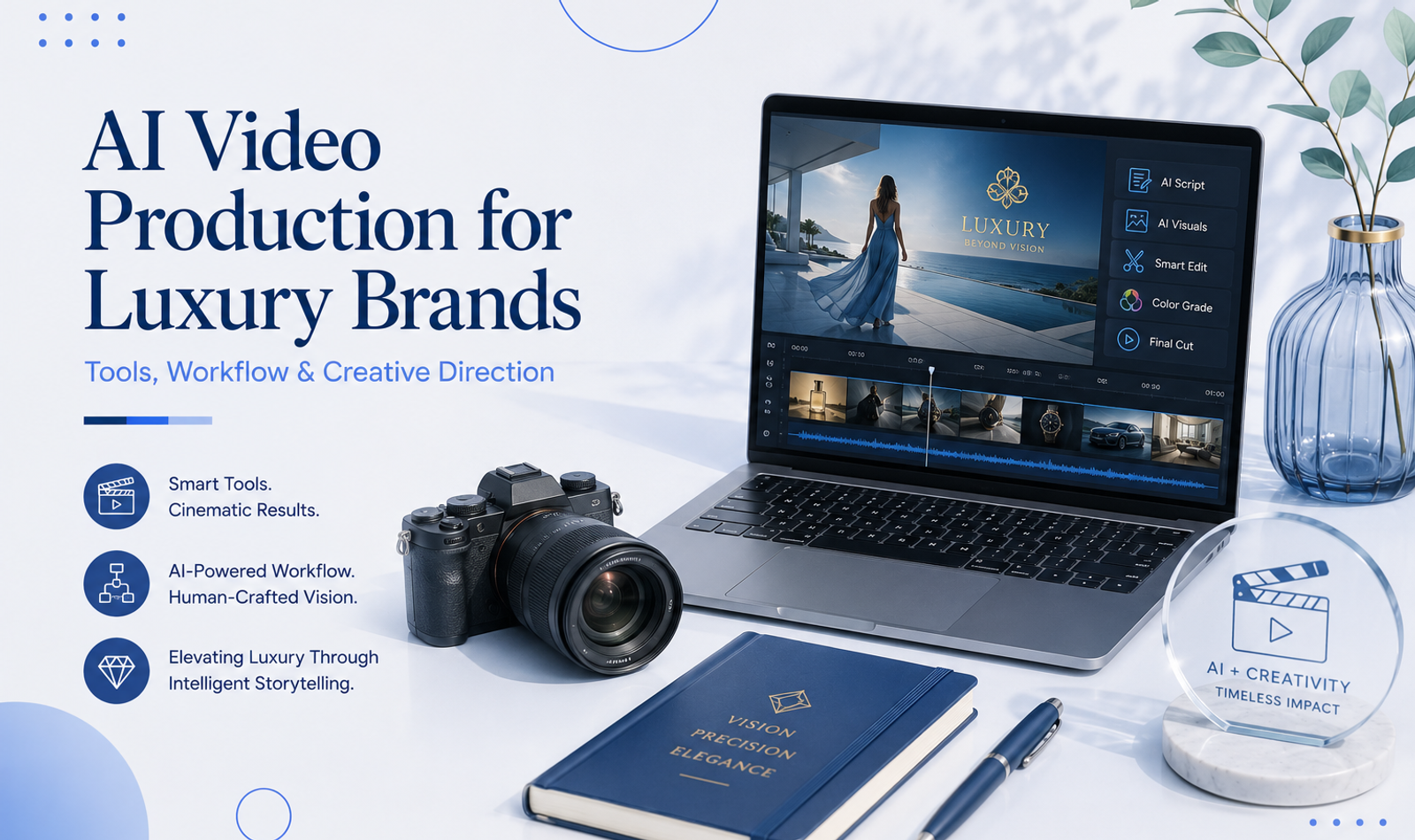
AI video production is changing how luxury brands create campaigns, social reels, product films, event teasers and digital advertisements.
A luxury brand no longer needs to wait for a large shoot before testing a visual idea. A campaign concept can now become a script, storyboard, AI-generated scene, animated product visual, cinematic reel and professionally edited ad much faster than before.
This speed is valuable.
But for luxury brands, speed is never enough.
Luxury communication depends on taste, detail, restraint, accuracy and emotional perception. A video can use the most advanced AI tool and still feel ordinary if the creative direction is weak. It can look cinematic and still damage trust if the product is inaccurate. It can be visually dramatic and still fail if the edit feels cheap, crowded or inconsistent with the brand.
This is why AI video production for luxury brands must be handled carefully.
The objective is not to create random AI effects.
The objective is to create cinematic brand communication that feels premium, controlled and aligned with the identity of the brand.
AI can help generate impossible scenes, animate still images, create visual metaphors, test campaign directions, produce social-first content and support high-impact advertising.
Professional video editing then turns these assets into a complete story.
The editor shapes pacing, music, colour, sound, typography, transitions and final platform delivery.
For luxury brands, the best results usually come from a hybrid workflow.
AI creates imagination.
Real footage creates proof.
Professional editing creates polish.
Creative direction connects everything into one premium visual language.
This complete system allows luxury brands to create faster content without losing brand value.
Why AI Video Matters for Luxury Brands
Luxury brands sell more than products.
They sell identity, emotion, craftsmanship, service, aspiration, privacy, taste and trust.
A premium watch, designer outfit, wedding experience, boutique hotel or luxury car service is not judged only by features.
It is judged by how it feels.
Video is powerful because it can communicate feeling quickly.
Lighting, camera movement, music, detail shots, silence, pacing and colour can make a brand feel elevated within seconds.
AI video adds another layer to this process.
It allows luxury brands to create visual worlds around their products and experiences.
A jewellery brand can create a cinematic world of light, reflection and shadow.
A fashion brand can animate fabric, motion and atmosphere.
A hospitality brand can visualise privacy, arrival and destination mood.
An event company can preview a luxury stage or wedding concept before it is built.
A car brand can create futuristic city visuals without a full physical production.
AI makes luxury storytelling more flexible.
But the luxury feeling still depends on creative control.
Luxury AI Video Is Not About Overusing Effects
Many brands make the mistake of using AI video like a visual trick.
They add transformations, surreal effects, exaggerated motion and dramatic scenes simply because the tool can produce them.
This may create attention, but it does not always create luxury.
Luxury often works through restraint.
A slow camera movement can be more powerful than a loud transition.
A single premium product detail can be stronger than a crowded scene.
A clean visual metaphor can feel more expensive than a heavy AI effect.
Luxury AI video should feel intentional.
Every generated scene should support the brand’s tone.
Every transition should feel refined.
Every frame should look like it belongs to the same visual world.
AI should elevate the brand, not overpower it.
The Role of Creative Direction
Creative direction is the most important part of luxury AI video production.
It defines how the video should look, feel and move.
Without creative direction, AI tools may generate inconsistent visuals.
One shot may look futuristic. Another may look cartoonish. Another may look like stock footage. Another may distort the product or create visual clutter.
Creative direction solves this.
It defines the mood, colour palette, lighting, camera movement, typography, music style and pacing before production begins.
For a luxury jewellery brand, the creative direction may be dark, intimate, reflective and minimal.
For a luxury wedding event, it may be romantic, cinematic, grand and emotional.
For a fashion campaign, it may be editorial, clean, modern and texture-led.
For a premium hospitality brand, it may be warm, serene, spacious and private.
For a luxury car service, it may be sleek, urban, confident and cinematic.
The AI tool follows direction.
The editor refines direction.
The brand benefits from consistency.
Start With Brand Positioning
Before choosing tools, prompts or visuals, the brand should define its positioning.
What does the brand stand for?
What does the customer expect from it?
Is the brand heritage-led, modern, bold, minimal, experimental, royal, youthful, private, artistic or performance-driven?
A luxury brand must know its identity before producing AI visuals.
A heritage jewellery brand should not look like a futuristic gaming ad.
A premium hotel should not look like a loud nightclub reel unless that is truly its positioning.
A luxury wedding brand should not use generic fantasy visuals if its strength is refined real-world execution.
AI video should extend the brand’s positioning.
It should not create a new personality every time.
Strong positioning protects the brand from visual inconsistency.
Define the Campaign Objective
Every AI video should have a clear objective.
The video may be created for awareness, launch promotion, product education, event marketing, social engagement, paid advertising, PR support or website storytelling.
Each objective requires a different format.
A brand awareness film may be slower, emotional and cinematic.
A paid ad may need a stronger hook and clearer CTA.
A product reel may need detail, packaging accuracy and benefit communication.
An event teaser may need anticipation and mood.
A PR video may need credibility and explanation.
A website hero video may need silent looping and visual polish.
The objective tells the production team what the video must achieve.
Without this clarity, AI video can become visually impressive but commercially weak.
Understand the Luxury Audience
Luxury audiences are sensitive to quality.
They notice poor typography, cheap transitions, fake products, strange AI faces, weak sound and inconsistent colour.
They may not describe these issues technically, but they feel them.
The video either increases trust or reduces it.
Luxury customers often respond to confidence, elegance, detail and emotional atmosphere.
They do not always need loud offers or excessive explanation.
This means AI video for luxury brands should be designed with audience psychology in mind.
The viewer should feel that the brand understands refinement.
The content should feel polished, not desperate.
Even performance ads for luxury brands should protect premium perception.
A video can generate clicks and still weaken the brand if it feels low quality.
Choosing AI Video Tools for Luxury Brands
Different AI video tools serve different needs.
A luxury brand should not choose a tool only because it is trending.
The tool should match the creative requirement.
Runway is useful for cinematic generative visuals, visual consistency, concept scenes, AI B-roll and campaign films.
Synthesia is useful for avatar-led explainers, internal training, multilingual communication and structured business videos.
Pika is useful for short-form creative motion, quick image animation, social effects and visual hooks.
Professional editing software such as Adobe Premiere Pro remains essential for final editing, pacing, sound, colour and delivery.
The best luxury workflow may use several tools together.
One tool may create the AI scene.
Another may create captions or voiceover.
Professional editing brings everything together.
The tool is only one part of the system.
Runway for Luxury AI Video
Runway is useful when luxury brands need cinematic AI visuals.
It can help generate scenes, visual worlds, stylised shots and image-to-video sequences.
For luxury brands, this is valuable because campaigns often need atmosphere.
A perfume brand may need a dream-like world of mist, flowers and light.
A fashion label may need editorial movement around a model or garment.
A car service may need a cinematic night city sequence.
A luxury event company may need a visualisation of a grand stage or immersive venue.
Runway can support these ideas by creating scenes that may be expensive or difficult to shoot traditionally.
However, the outputs should still be reviewed carefully.
Product accuracy, facial realism, motion quality and visual consistency matter.
Runway is strongest when guided by a clear script, storyboard and visual reference system.
Synthesia for Luxury Brand Communication
Synthesia is not usually the first choice for emotional luxury advertising.
Its strength is structured avatar-led communication.
Luxury brands can use it for internal training, retail education, service standards, onboarding, multilingual explainers and business communication.
For example, a luxury hotel group can create staff training videos on guest service standards.
A jewellery brand can create internal product knowledge videos for sales teams.
A premium agency can create onboarding videos for clients.
A luxury retail brand can create multilingual training content for different markets.
Avatar-led videos can be efficient when clarity and scale matter.
But they should be used carefully for customer-facing emotional storytelling.
A real founder, designer, customer or craftsperson may create more trust than an avatar.
Pika for Luxury Social Motion
Pika is useful for fast short-form creative motion.
It can animate still images, add motion to product visuals and create social-first effects.
For luxury brands, Pika can support reels, motion posters, launch teasers and campaign transitions.
A fashion campaign still can become a moving visual.
A jewellery product image can receive subtle light movement.
An event poster can become an animated countdown.
A luxury dessert or product visual can become a short reel hook.
However, Pika-style effects should be used with restraint.
Too much transformation can feel gimmicky.
Luxury brands should use fast AI motion only when it supports the brand mood.
The final edit should refine the output so it feels polished and intentional.
Professional Editing Tools Still Matter
AI video tools can generate assets, but professional editing tools create the final video.
Editing software is where real footage, AI clips, voiceover, captions, sound, music, graphics and colour come together.
Professional editing controls the viewer’s experience.
It decides when the product appears, how the story flows, how the music builds and how the final message lands.
AI-assisted editing features can speed up technical tasks.
They can help extend clips, mask objects, generate captions, clean audio and create versions faster.
But the editor still makes the creative decisions.
For luxury brands, editing taste matters more than tool novelty.
The edit should feel premium, not automated.
The Complete AI Video Workflow for Luxury Brands
A strong AI video workflow begins with strategy.
The team defines the campaign objective, target audience, brand tone and desired action.
Then the concept is developed.
The concept becomes a script or visual structure.
The script becomes a storyboard.
The storyboard defines which shots will be AI-generated, filmed, animated or edited.
AI tools create the required visual assets.
Real footage is captured where authenticity and accuracy matter.
Professional editing assembles the video.
Colour, sound, typography, captions and platform versions are added.
The final video is reviewed for brand safety, product accuracy and rights.
Only then should it be published.
This workflow protects quality while improving speed.
Concept Development
Concept development is where the creative idea begins.
For luxury brands, the concept should be simple, memorable and emotionally aligned with the brand.
A concept may focus on arrival, desire, craft, privacy, transformation, celebration, legacy or modern status.
The concept should not be a random visual idea.
It should connect with the brand’s deeper positioning.
For example, a premium wedding brand may build a concept around “every detail becomes a memory.”
A luxury fashion brand may build a concept around “movement as identity.”
A hotel brand may build a concept around “a private world within the city.”
A car service may build a concept around “arrive before you speak.”
The concept gives direction to the complete video.
Scriptwriting
Scriptwriting turns the concept into communication.
For luxury brands, scripts should often be concise.
Too many words can reduce the premium feeling.
A luxury ad may use a few strong lines instead of a long explanation.
A service video may need more clarity but should still avoid heavy jargon.
An AI-generated campaign may use visual storytelling more than voiceover.
AI can help create script options quickly.
It can generate hooks, voiceover lines, scene descriptions and alternate versions.
But human refinement is essential.
The final script should feel specific to the brand.
It should not sound like generic AI copy.
The language should match the brand’s tone, whether refined, bold, emotional, elegant or modern.
Storyboarding
Storyboarding plans the visual flow.
It shows what appears in each scene and how the video moves from beginning to end.
For luxury AI videos, storyboarding is important because it prevents disconnected visuals.
The storyboard may include product reveal, detail shot, lifestyle moment, AI environment, text frame, emotional peak and final logo.
Each scene should have a purpose.
For AI generation, the storyboard helps prompt writers create consistent visuals.
For editing, it gives the editor a clear structure.
For the client, it shows the creative direction before production begins.
A good storyboard saves time and reduces revisions.
Prompt Direction for AI Video
Prompting is part of creative direction.
A prompt should not only describe the object.
It should describe the mood, composition, lighting, movement, material, camera angle and style.
For luxury content, prompt direction should avoid clutter.
It should use words that support refinement, such as cinematic, minimal, polished, soft lighting, premium composition, realistic texture, elegant movement and controlled atmosphere.
The prompt should also define what to avoid.
For example, avoid distorted logos, unrealistic hands, excessive motion, over-saturated colours, cartoon styling or cheap effects.
Prompt direction should be consistent across scenes.
This helps the final video feel unified.
Real Footage and AI Footage Together
Luxury brands often need both AI and real footage.
AI can create mood and imagination.
Real footage creates trust.
A jewellery brand may use real macro product shots and AI-generated light environments.
A hotel may use real property footage and AI-generated campaign transitions.
An event brand may use AI concept teasers before the event and real recap footage afterward.
A fashion brand may use real model footage with AI-enhanced backgrounds or motion effects.
The key is to decide the role of each type of footage.
AI should not replace reality where proof matters.
Real footage should not limit creativity where AI can add value.
Product Accuracy
Product accuracy is critical for luxury brands.
AI can distort product shape, colour, logo, material, packaging or proportions.
This can damage trust.
A luxury customer expects the product shown in the video to reflect reality.
For jewellery, stone size, metal colour and design detail must be correct.
For fashion, garment structure, fabric and fit should be accurate.
For cars, model features and brand identity must be correct.
For hospitality, rooms, spaces and amenities should not be misrepresented.
For events, past work should not be exaggerated through synthetic visuals.
Product review should be part of the workflow before publishing.
Visual Consistency
AI-generated clips can look inconsistent if not controlled.
One scene may have different lighting, texture, colour or realism from the next.
Professional editing and art direction help solve this.
The team should use consistent references, prompts, colour grading and typography.
The editor can match tones, adjust pacing and create transitions that connect scenes.
Luxury videos should feel like one visual world.
If every frame feels like a different style, the campaign may look experimental but not premium.
Consistency creates trust.
It also makes the brand easier to remember.
Editing for Luxury AI Videos
Editing is where the luxury feeling becomes clear.
The editor decides what stays, what is removed and how the viewer experiences the video.
Luxury editing often uses slower pacing, clean transitions, refined typography and strong sound design.
But the edit should still maintain attention.
Slow does not mean boring.
It means controlled.
The editor should avoid unnecessary effects.
They should let strong visuals breathe.
They should use silence, music and detail intentionally.
A premium AI video should feel crafted, not generated.
Editing turns AI content into brand content.
Colour Grading
Colour grading helps make AI visuals and real footage feel cohesive.
It also defines mood.
A luxury brand may use deep contrast, warm highlights, neutral tones, soft shadows or clean blue-grey palettes depending on identity.
Colour should not be random.
It should support the brand’s personality.
AI clips may need correction because generated colours can vary.
Real footage may also need balancing.
The colour grade should bring everything together.
A polished grade can make the difference between a social experiment and a premium campaign asset.
Sound Design
Sound design is one of the most underrated parts of luxury video.
A video without good sound can feel unfinished.
Luxury sound design may include subtle movement, soft ambience, fabric textures, glass, footsteps, city atmosphere, nature, water, jewellery movement or cinematic transitions.
AI visuals often need sound because they are generated without natural audio.
Sound makes them feel more real and immersive.
For event videos, live sound, applause, crowd reactions and speeches add authenticity.
For product films, small details can create a sense of material and quality.
Sound makes luxury video feel expensive.
Music Direction
Music should match the brand and campaign objective.
A luxury fashion video may use editorial, ambient or cinematic music.
A wedding brand may use emotional and elegant music.
A car service may use confident, sleek sound.
A premium hotel may use soft atmospheric music.
A digital ad may need stronger rhythm.
Music also affects pacing.
The editor should select a track that supports the video structure.
Licensing is important.
Brands should use music cleared for commercial use, paid ads, social platforms and website publishing.
A good track can elevate the video.
A wrong track can make the brand feel generic.
Typography and Text
Typography is a visual signal of brand quality.
Luxury brands should use text carefully.
Too much on-screen text can make the video feel cluttered.
A few strong lines can be more effective than long explanations.
Font choice, spacing, size, placement and animation style should match the brand identity.
For social reels, text must be readable on mobile.
For website films, text may need to be minimal.
For PR videos, text can clarify the story.
For luxury ads, text should feel elegant and controlled.
Typography should support the visual experience.
It should not fight with it.
Platform-Specific Versions
Luxury AI videos should be adapted for each platform.
A 16:9 brand film may work on YouTube or a website.
A 9:16 version is needed for Instagram Reels, Stories and Shorts.
A 4:5 version may work better for feed ads.
A 1:1 version may be useful for certain placements.
A LinkedIn version may need clearer messaging and subtitles.
A website hero video may need to be short, silent and loopable.
Platform adaptation should not be simple cropping.
The edit should be redesigned where needed.
Important products, faces, text and logos should remain visible.
AI Video for Luxury Ads
Luxury ads can use AI to create cinematic worlds around a brand.
The video may include surreal settings, premium environments, atmospheric motion, abstract visual metaphors and product-led storytelling.
AI works especially well when the ad needs imagination.
However, the final ad must remain clear.
The viewer should understand the brand, product or service.
A luxury ad should not become a random visual montage.
It should create desire and memory.
Professional editing ensures the AI visuals become a focused campaign asset.
The final frame should leave a strong brand impression.
AI Video for Luxury Events
AI video is useful before and after luxury events.
Before the event, AI can create mood films, animated invitations, teaser reels, stage concept videos and sponsor previews.
These assets help build anticipation.
They also help clients visualise the event before production.
After the event, real footage should become the foundation of the recap.
AI can support titles, transitions, social cutdowns and creative enhancements.
The recap should remain truthful.
It should show the real scale, people, décor and emotion of the event.
Luxury event brands should use AI to support storytelling, not to fake execution.
AI Video for Fashion and Jewellery
Fashion and jewellery brands can use AI video for campaign teasers, editorial motion, product environments and social reels.
Fashion visuals can explore fabric movement, styling, atmosphere and identity.
Jewellery visuals can focus on light, reflection, macro detail and emotional value.
AI can help create cinematic worlds around these products.
But product accuracy is essential.
Jewellery design should not change.
Fabric should not look unrealistic.
Logos and brand elements should remain correct.
Real product footage or high-quality photography may be needed for final accuracy.
AI should enhance the campaign, not redesign the product.
AI Video for Hospitality and Travel
Luxury hospitality brands can use AI video to communicate mood before a guest visits.
AI can visualise privacy, escape, destination atmosphere, dining, wellness and architecture.
It can support seasonal campaigns, destination teasers and social ads.
However, hospitality content should not misrepresent the property.
A hotel should not show rooms, views, pools or amenities that do not exist.
AI-generated scenes should be clearly used as mood or concept when needed.
Real property footage remains important for trust.
The strongest hospitality videos combine real atmosphere with polished editing and selective AI enhancement.
AI Video for Premium Services
Premium service brands can use AI video to make intangible services visible.
A PR agency can show reputation, media visibility and brand storytelling through visual metaphors.
A digital agency can show growth, content, analytics and creative production.
An event agency can show planning, execution and guest experience.
A luxury consulting brand can show strategy, precision and transformation.
AI helps visualise abstract ideas.
Professional editing makes the message clear.
For premium services, the video should feel credible.
It should not overpromise.
It should communicate expertise with confidence.
AI Video for PR and Social Campaigns
AI video can connect PR and social media.
A press announcement can become a short explainer video.
A founder quote can become a LinkedIn clip.
A product launch can become a teaser reel.
An event recap can become PR proof.
A media feature can become a social proof video.
This creates consistency across channels.
The same campaign story appears in multiple formats.
AI helps create more assets quickly.
Professional editing ensures that every asset feels aligned.
For luxury brands, this consistency is important because visibility should feel curated, not scattered.
Brand Safety in Luxury AI Video
Brand safety is essential.
AI-generated videos should be reviewed for product accuracy, likeness rights, copyright, cultural sensitivity, claims, visual quality and platform requirements.
The team should check whether viewers could misunderstand what is real.
If synthetic content could mislead the audience, disclosure may be needed.
The brand should avoid fake testimonials, fake event footage, fake celebrity appearances and misleading product results.
Luxury brands depend on trust.
A single careless AI video can create unnecessary reputation risk.
Brand safety should be built into the workflow from the start.
Copyright and Usage Rights
AI video production must include rights management.
The team should review tool terms, music licences, stock footage, fonts, templates, reference images and voiceover permissions.
Using competitor visuals, celebrity images, copyrighted campaign references or famous artist styles can create risk.
Music should be licensed for the intended platform and use.
Talent and event guest permissions may be required.
AI outputs should be checked against the tool’s commercial-use terms.
A luxury brand should not publish content without knowing whether it has the right to use every asset.
Legal safety protects creative value.
Disclosure and Transparency
Disclosure depends on how AI is used.
AI used for internal brainstorming, captions or technical editing may not always need public disclosure.
However, realistic synthetic people, AI avatars, fake scenes, altered product demonstrations or AI-generated events may require transparency.
The brand should ask whether the viewer would interpret the video differently if they knew AI was involved.
If yes, disclosure should be considered.
Transparency does not reduce luxury value.
It protects trust.
Modern audiences are becoming more aware of AI content.
Responsible brands will use AI openly and carefully where needed.
Quality Control Before Publishing
Every luxury AI video should go through final quality control.
The team should check visuals, product accuracy, sound, colour, captions, spelling, logos, music rights, platform format and final export quality.
AI-specific issues should be checked carefully.
Look for distorted hands, strange faces, broken logos, incorrect text, unnatural motion and inconsistent product details.
A final review should involve creative, marketing and product stakeholders.
For paid ads or high-risk content, legal review may also be needed.
Quality control is not a delay.
It is protection.
Measuring AI Video Performance
AI video performance should be measured according to the objective.
For awareness, track reach, views, watch time and completion.
For engagement, track saves, shares, comments and profile visits.
For ads, track clicks, enquiries, bookings and conversions.
For PR campaigns, track media amplification, branded search, website visits and message recall.
For luxury brand films, also review qualitative response.
Does the video improve perception?
Does it feel premium?
Does it attract the right audience?
Does it support sales conversations?
Views alone do not prove success.
A luxury video should build the right kind of attention.
Common Mistakes in Luxury AI Video
One common mistake is starting with a tool instead of a strategy.
Another is overusing AI effects.
Brands may also publish distorted product visuals or inconsistent scenes.
Some videos look cinematic but have no clear message.
Others use generic scripts that do not match the brand voice.
Another mistake is ignoring editing.
Raw AI clips need professional finishing.
Luxury brands also sometimes copy trends that do not fit their positioning.
This can weaken brand identity.
AI should help the brand become more memorable, not more generic.
Practical Luxury AI Video Workflow
The process begins with brand positioning and campaign objective.
The team defines the audience, message and desired action.
A concept is developed.
The script and storyboard are created.
The team decides which shots need AI, real footage, product photography, motion graphics or professional editing.
AI scenes are generated with consistent prompt direction.
Real footage is captured where authenticity and accuracy matter.
The editor assembles the story, adds music, sound, typography, colour and captions.
Platform versions are created.
The final video is reviewed for product accuracy, brand safety, rights and quality.
The campaign is published and measured.
This workflow keeps AI creative and controlled.
How Double Trouble Studio Supports Luxury AI Video Production
Double Trouble Studio creates AI video production and professional video editing for luxury brands, premium businesses, events and digital campaigns.
Our process begins with strategy and creative direction.
We define the brand tone, campaign objective, audience and platform requirements.
Then we build scripts, storyboards, AI visual prompts, editing plans and final delivery formats.
For luxury ads, we focus on cinematic mood, product accuracy, premium pacing and polished finishing.
For event campaigns, we use AI for teasers and concept visuals while keeping real recap footage honest and emotional.
For social media, we create AI-assisted reels, campaign cutdowns and platform-ready videos that support visibility and engagement.
Our goal is to use AI with taste.
The final video should feel premium, credible and aligned with the brand.
Frequently Asked Questions
What is AI video production for luxury brands?
AI video production for luxury brands is a structured creative process that uses AI tools, real footage and professional editing to create cinematic campaign videos, social reels, product films, event teasers and advertisements. It focuses on maintaining luxury standards like taste, restraint, accuracy and premium storytelling.
Why is AI video useful for luxury brand marketing?
AI video helps luxury brands create visual concepts faster, test campaign ideas, generate cinematic scenes and produce multiple content variations for social media, PR and advertising. It allows brands to move from idea to execution quickly without waiting for full-scale shoots.
Does AI video replace traditional luxury video production?
No, AI does not replace traditional production. It supports ideation, visualisation and content creation, but luxury communication still depends on real footage, creative direction and professional editing to maintain authenticity, emotional depth and brand trust.
Why is creative direction important in AI video production?
Creative direction ensures that all AI-generated visuals follow a consistent luxury aesthetic. Without it, AI outputs can look random or inconsistent. Direction defines mood, lighting, colour palette, pacing and storytelling so the final video feels premium and controlled.
How do luxury brands maintain authenticity in AI videos?
Luxury brands maintain authenticity by using AI for concept visuals and enhancements while keeping real footage for products, testimonials, founder messages and event coverage. This hybrid approach ensures that the final video remains believable and aligned with brand reality.
What is the role of professional editing in AI video production?
Professional editing transforms AI-generated assets into a complete luxury brand film. It controls pacing, sound design, colour grading, typography, transitions and emotional flow. Editing ensures that all elements feel polished, consistent and platform-ready.
Which AI tools are best for luxury video production?
Tools like Runway are used for cinematic AI visuals, Pika for short-form motion and creative effects, and Synthesia for structured communication or training videos. However, professional editing software is essential to bring everything together into a final luxury-grade output.
How can luxury brands avoid overusing AI effects?
Luxury brands should use AI with restraint. Instead of focusing on dramatic effects, they should prioritise minimalism, elegance and emotional clarity. Every AI-generated scene should support the brand story rather than distract from it.
What are the biggest risks of AI video in luxury marketing?
The biggest risks include inaccurate product visuals, inconsistent branding, overuse of effects, lack of creative direction and reduced trust if AI is used without control. Poor execution can make a luxury brand appear cheap or inauthentic.
Can AI video be used for luxury advertising campaigns?
Yes, AI video can be used for luxury ads, but it must be carefully directed. It works best for cinematic storytelling, concept visuals and atmospheric branding. However, product accuracy and brand consistency must always be maintained.
What makes a luxury AI video successful?
A successful luxury AI video is not defined by complexity but by clarity, restraint and emotional impact. It combines strong concept development, precise creative direction, high-quality editing and a hybrid mix of AI visuals and real footage.
Conclusion
AI video production gives luxury brands a powerful way to create faster, more flexible and visually rich campaigns. It allows concepts to move quickly from idea to cinematic execution, supporting social media, PR campaigns, product launches and digital advertising.
However, luxury communication is not defined by speed alone. It is defined by taste, emotional depth, accuracy and brand perception.
For this reason, AI video must always be guided by strong creative direction. Without it, even the most advanced AI outputs can feel inconsistent or off-brand.
Luxury brands should treat AI as a creative enhancement tool, not a replacement for storytelling discipline. The real value comes from combining AI-generated imagination with real footage and professional editing.
AI provides speed and visual exploration. Real footage provides authenticity and proof. Editing provides structure, rhythm, sound, colour and emotional control.
When these three elements work together, the result is a luxury video that feels cinematic, refined and trustworthy.
The workflow must always begin with positioning and concept clarity. Every decision after that — scripting, storyboarding, generation and editing — should support the brand identity.
Luxury AI video production is not about creating more visuals. It is about creating better communication.
When used correctly, AI helps luxury brands produce campaigns that are not only faster but also more expressive, controlled and commercially effective.
Ready to Create Luxury AI Video Campaigns?
Your luxury brand deserves video content that feels cinematic, premium and strategically crafted — not just visually generated.
At Double Trouble Studio, we help luxury brands design complete AI video production workflows that combine creative direction, AI-generated visuals, real footage, and professional editing into high-impact campaign films.
We specialize in luxury brand films, AI-powered social reels, product campaigns, event teasers, digital ads, PR videos, and full-scale content systems designed for modern luxury marketing.
From concept development to final cut, every frame is crafted with precision, restraint and brand alignment.
📩 info@dtsworld.in 📞 +91 80000 06021. 📍 Andheri West, Mumbai
Need this for your brand?
Let DTS build your next campaign.
From PR, celebrity management and events to websites, social media, SEO and AI video production — Double Trouble Studio helps brands grow with strategy and execution.
Discuss Your Requirement →