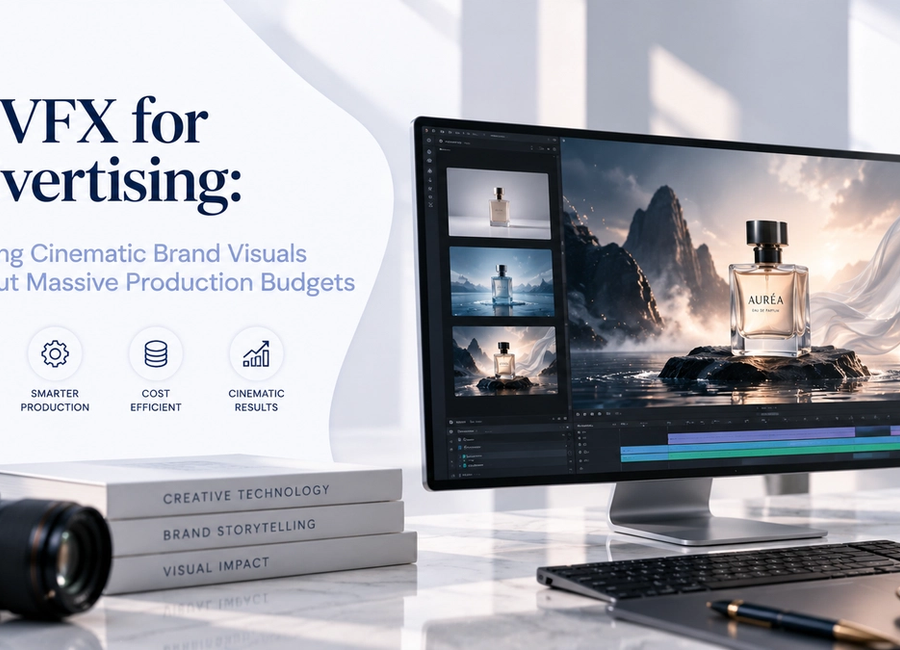
AI Product Videos: How Brands Can Create Commercials Without Traditional Shoots
Product advertising has traditionally depended on cameras, studios, lighting equipment, physical sets, models, production crews, location scouting and long post-production timelines.
A beauty brand might rent a studio to film a perfume bottle surrounded by water, flowers or reflective surfaces. An automotive company might transport a vehicle to a carefully selected location. A jewellery brand could spend days coordinating models, styling, lighting and macro photography just to produce a few seconds of polished campaign footage.
Artificial intelligence is beginning to change this production model.
Brands can now use AI product videos to transform product photographs, 3D assets, brand references and creative concepts into advertising content without organising a complete traditional shoot for every campaign.
A simple product image can potentially become a cinematic sequence. A perfume bottle can appear inside an imagined luxury environment. A watch can rotate through a futuristic architectural space. A skincare product can emerge through water, botanicals or abstract textures. A vehicle can be visualised against environments that would otherwise require expensive locations, permits and production logistics.
However, AI product video production is not simply about uploading a photograph and asking an AI tool to “make an advertisement.”
Professional results require concept development, product accuracy, storyboarding, AI generation, creative direction, editing, sound design, visual effects and brand consistency.
This guide explains how brands can create product commercials without traditional shoots, where AI fits into the production workflow, what it can and cannot replace, and how businesses can use the technology without compromising the quality of their brand.
What Are AI Product Videos?
AI product videos are advertising, marketing or branded videos created with artificial intelligence as part of the visual production process.
Instead of filming every scene using a physical camera, generative AI can help create environments, movement, transitions, lighting concepts, visual effects and complete scenes digitally.
Depending on the project, the process can start with:
- Product photographs
- Packshots
- 3D models
- Brand guidelines
- Existing campaign photography
- Product renders
- Reference images
- Creative concepts
These assets are then combined with AI generation and professional post-production to create finished video content.
The final result might be a six-second social advertisement, a 15-second product reel, a 30-second digital commercial or a complete campaign film.
Brands interested in building these workflows professionally can use AI Video & VFX services to combine AI generation with creative direction, editing and post-production.
Can Brands Really Create Commercials Without Traditional Shoots?
Yes, certain types of commercials can now be created with little or no conventional filming.
But the important word is certain.
AI is particularly effective when the campaign is highly visual and the product can be represented accurately using existing digital assets.
Imagine a fragrance company launching a new perfume.
A traditional campaign might require:
a studio,
a cinematographer,
lighting,
props,
set construction,
production assistants,
special-effects equipment,
and several hours or days of shooting.
With AI-assisted production, the brand may begin with professionally photographed product images or high-quality product renders.
The creative team can then develop different environments digitally.
The perfume bottle could appear surrounded by gold particles, suspended above water, inside an architectural environment or against an abstract cinematic landscape.
The physical product never necessarily needs to enter that environment.
This is one of the reasons AI product video is attracting attention from brands that need large volumes of digital content.
AI Product Video Production Is Not Just Prompting
One of the biggest misconceptions about AI video production is that professional work simply involves typing a prompt into an AI generator.
That may produce an interesting clip.
It does not necessarily produce a usable commercial.
A professional advertisement has to communicate:
What is the product?
Who is it for?
Why should someone care?
What should they remember?
What should they do next?
AI is therefore part of the production system rather than the complete strategy.
The strongest projects combine artificial intelligence with the fundamentals of advertising: concept, storytelling, art direction, editing and brand positioning.
This distinction is especially important for premium businesses.
A technically impressive AI effect can still be ineffective if it does not communicate the product clearly.
How AI Product Video Production Works
A professional AI product commercial generally follows several stages.
Understanding these stages also helps explain why there can be a significant quality difference between a quick AI-generated clip and a professionally produced campaign.
Step 1: Define the Commercial Objective
Production should begin with the objective rather than the AI tool.
A brand should determine what the video needs to achieve.
Is the campaign designed to:
introduce a new product,
generate awareness,
explain a feature,
promote an offer,
create desire,
support a launch,
generate ecommerce traffic,
or improve advertising performance?
A product launch film requires a different creative approach from a direct-response Meta advertisement.
Without a clear objective, AI can generate visually impressive content that has little commercial value.
Step 2: Develop the Creative Concept
The next stage is concept development.
This determines what visual world the product will inhabit.
For example, imagine a premium watch brand.
One concept might place the watch inside a minimalist architectural environment where light moves across metallic surfaces.
Another could use macro visual storytelling to focus on craftsmanship.
A third could place the watch inside a surreal environment representing precision and time.
The product remains the same.
The story changes how audiences perceive it.
This is particularly important for luxury brands, where perception can be as important as product functionality. DTS explores this relationship further in its guide to AI video production for luxury brands.
Step 3: Create the Script and Storyboard
Once the concept is approved, the commercial needs structure.
A short product advertisement might follow:
Hook → Product Reveal → Feature → Experience → Brand → CTA
Even a 10-second advertisement benefits from planning.
The storyboard defines what happens in each shot.
For example:
Scene 1: abstract environment begins forming.
Scene 2: product gradually appears.
Scene 3: macro detail highlights a key feature.
Scene 4: environment transforms around the product.
Scene 5: clean hero shot.
Scene 6: logo and CTA.
Planning these sequences before generation can reduce unnecessary experimentation later.
For brands producing content at scale, AI scriptwriting and storyboarding can help accelerate the pre-production process while maintaining a clear creative structure.
Step 4: Prepare High-Quality Product Assets
The quality of the input material matters.
Brands should ideally provide:
high-resolution product photographs,
multiple angles,
transparent PNG product images where appropriate,
packaging references,
logos,
brand colours,
typography,
and previous campaign references.
For certain projects, 3D models can provide even greater control.
AI should not be expected to guess critical product details.
If the packaging contains specific typography, labels, buttons, logos or design elements, these need to remain accurate.
This becomes particularly important for ecommerce and advertising, where customers expect the visual representation to match the real product.
Step 5: Generate the Visual Environment
Once the product and creative direction are defined, AI can begin creating the surrounding visual world.
This is where the technology becomes particularly powerful.
A product can potentially appear:
underwater,
inside futuristic architecture,
in a desert,
surrounded by flowers,
inside abstract liquid environments,
against cinematic cityscapes,
within fantasy environments,
or inside spaces that do not physically exist.
Traditional production could create many of these scenes as well.
But doing so may require extensive set design, CGI, travel or VFX.
AI can make experimentation faster and more accessible.
Step 6: Animate the Product
Static product images can sometimes be transformed into moving sequences.
Depending on the available assets and production method, AI can help create:
camera movements,
product rotations,
environment movement,
lighting transitions,
floating effects,
transformations,
and cinematic reveals.
However, product movement requires careful supervision.
AI can distort geometry, packaging or branding if it is given too much freedom.
For this reason, professional AI product videos often combine multiple techniques rather than relying on one generation model for every frame.
Step 7: Generate Multiple Shots
A polished commercial rarely consists of one continuous generated clip.
Instead, multiple shots are created.
A 20-second product commercial might contain eight, ten or even more individual sequences.
Some shots may last less than two seconds.
This gives editors greater control over pacing.
It also allows the production team to replace a weak shot without regenerating the entire advertisement.
Step 8: Professional Video Editing
AI generation creates raw material.
Editing creates the commercial.
The editor decides:
which shots stay,
which shots are removed,
how long each shot appears,
when the product is revealed,
when the music changes,
where text appears,
and how the final CTA is presented.
This stage can completely change the perceived quality of an AI video.
DTS's end-to-end AI video production and professional editing workflow explains why generation and post-production should be treated as one connected process.
Step 9: Add VFX and Motion Graphics
Some AI output may need additional post-production.
VFX and compositing can help:
correct visual inconsistencies,
enhance product reflections,
add particles,
integrate logos,
replace backgrounds,
create transitions,
improve lighting,
and combine multiple generated elements.
Motion graphics can then introduce typography, feature callouts and branded visual elements.
This is where AI-generated material starts becoming a controlled brand asset rather than an experimental clip.
Step 10: Sound Design and Music
Product commercials are not only visual experiences.
Sound can make a product feel heavier, faster, softer, cleaner, more luxurious or more technologically advanced.
A perfume bottle landing on a surface can be supported by a subtle impact.
A vehicle reveal can use carefully designed mechanical sounds.
A beauty product emerging through liquid can be supported by detailed atmospheric audio.
Music establishes the emotional rhythm of the commercial.
Premium AI video therefore requires attention to sound just as traditional advertising does.
Step 11: Create Platform-Specific Versions
One production can potentially create multiple deliverables.
A master campaign might be adapted into:
16:9 for websites and YouTube,
9:16 for Instagram Reels, Stories and YouTube Shorts,
4:5 for Instagram and Meta feeds,
and 1:1 for selected digital placements.
The production can also generate shorter cutdowns.
For example:
30-second hero commercial,
15-second advertisement,
10-second product edit,
6-second bumper,
and several social clips.
This is one of the strongest advantages of building an AI-assisted production workflow.
AI Product Videos vs Traditional Product Shoots
Traditional product production remains extremely valuable.
The difference is that brands now have another option.
A conventional product shoot might require physical equipment, location or studio rental, set construction, photographers or cinematographers, lighting technicians, production staff, props and logistics.
AI-first production may reduce many of these requirements.
The creative team instead invests more heavily in digital art direction, AI generation, compositing, editing and VFX.
The difference between the two approaches is explored in more detail in AI video production vs traditional video editing.
The best choice depends on the campaign.
Sometimes AI is more efficient.
Sometimes traditional filming is more appropriate.
And increasingly, the strongest solution may be a combination of both.
The Hybrid Production Model
Brands do not need to choose between “100% AI” and “100% traditional.”
Hybrid production can combine the strengths of both.
For example, a brand could professionally photograph its product once.
Those high-quality product assets could then become the foundation for multiple AI-generated campaigns.
Another brand could film a model traditionally but use AI to generate backgrounds and transitions.
An automotive company could photograph the real vehicle and create alternative digital environments.
A hospitality company could combine authentic property footage with AI-generated conceptual sequences.
This approach can protect authenticity while increasing creative flexibility.
What Types of Product Videos Can Brands Create With AI?
AI product video production can support a wide range of formats.
Product Launch Videos
A launch video introduces a new product through cinematic storytelling.
AI can create anticipation before revealing the product.
This can be particularly effective for beauty, fashion, technology, automotive and luxury products.
Product Reveal Videos
Reveal videos are usually shorter and visually focused.
The objective is simple: make the product entrance memorable.
Feature Videos
These videos focus on specific product benefits.
A smartphone advertisement might highlight its camera.
A skincare video might focus on ingredients.
An automobile commercial might highlight interiors or technology.
Ecommerce Product Videos
Ecommerce brands often need significantly more content than traditional advertising campaigns.
One product may require:
homepage content,
product-page video,
Meta advertisements,
Instagram Reels,
retargeting creatives,
marketplace content,
and campaign variations.
AI can help brands create more assets from the same underlying product library.
Social Media Reels
AI-generated product reels can work particularly well for Instagram and short-form platforms.
They can be visually experimental while remaining focused on the product.
Paid Advertising Creatives
Performance campaigns need creative variation.
Instead of relying on one advertisement for months, brands can test different:
hooks,
visuals,
backgrounds,
messages,
offers,
and CTAs.
This can work particularly well alongside a structured performance digital advertising strategy.
AI Product Videos for Ecommerce and D2C Brands
D2C brands face a major content challenge.
They need fresh advertising material continuously.
One product may need dozens of creative variations across its lifecycle.
Traditional shoots can still provide the core brand photography and hero campaign assets.
AI can then help expand that content library.
For example, a skincare company could start with clean product packshots.
Those assets could become:
ingredient-focused videos,
texture-inspired animations,
minimal product reveals,
festive campaigns,
seasonal campaigns,
performance advertisements,
and social reels.
The objective is not simply to avoid production.
It is to create a more scalable content system.
AI Product Videos for Luxury Brands
Luxury product advertising requires restraint.
Just because AI can create an impossible environment does not mean every luxury campaign needs one.
Luxury communication often depends on:
space,
texture,
detail,
light,
craftsmanship,
movement,
and emotion.
AI should enhance these qualities rather than overwhelm them.
A premium watch may need nothing more than controlled light moving across the metal.
A fragrance bottle may need subtle atmospheric motion.
A jewellery campaign may use macro details and elegant transitions rather than dramatic fantasy effects.
This is why creative direction matters more than the number of AI effects.
Brands can explore this further through AI video and professional editing for luxury brand storytelling.
AI Product Videos for Beauty and Skincare Brands
Beauty products are particularly suited to visual experimentation.
AI can help create environments inspired by:
water,
botanicals,
minerals,
light,
texture,
glass,
metal,
and cosmetic ingredients.
A serum can be surrounded by visual representations of hydration.
A perfume campaign can build an entire world around the fragrance's emotional identity.
A skincare product can move through abstract ingredient-inspired environments.
However, brands should avoid creating misleading representations of product performance.
Visual storytelling should remain distinct from unsupported efficacy claims.
AI Product Videos for Fashion and Jewellery
Fashion and jewellery brands can use AI to create campaign worlds that would otherwise require complex production.
Jewellery can be visualised through sophisticated macro sequences and dramatic lighting environments.
Fashion accessories can appear in editorial scenes.
Handbags, watches and footwear can move through digitally created environments.
But product accuracy remains critical.
A jewellery piece should not suddenly gain additional stones.
A handbag should not change its hardware.
A watch dial should not display incorrect branding.
The more recognisable and valuable the product, the more carefully AI output should be controlled.
AI Product Videos for Automotive Brands
Automotive advertising has traditionally been expensive because vehicles are large, reflective and difficult to film.
Production may require:
specialist rigs,
controlled roads,
large locations,
permits,
lighting,
drivers,
and extensive post-production.
AI can open new possibilities.
A real vehicle image or render can potentially be placed into multiple conceptual environments.
The same vehicle could appear in:
urban architecture,
mountain environments,
futuristic landscapes,
luxury hotel settings,
or abstract campaign worlds.
However, automotive products contain complex geometry.
Grilles, headlights, wheels, badges, body lines and proportions must remain consistent.
For commercial work, these details need careful review.
AI Product Videos for Technology Brands
Technology products are another natural fit.
Phones, laptops, headphones, smart devices and other electronics often use controlled product animation in advertising.
AI can assist with environments, transitions and campaign visualisation.
The product itself can remain clean and recognisable while the surrounding environment communicates concepts such as:
speed,
connectivity,
intelligence,
creativity,
security,
or performance.
Why Brands Are Interested in Shoot-Free Product Commercials
The attraction goes beyond cost.
Faster Creative Experimentation
Brands can explore concepts without physically building every set.
Fewer Location Restrictions
The visual environment does not always need to exist in the real world.
More Campaign Variations
One product can potentially appear in multiple creative directions.
Easier Seasonal Adaptation
An existing product asset can be adapted for festive or seasonal campaigns.
Scalable Social Content
Brands that need frequent content can create a larger number of assets.
Greater Creative Freedom
AI makes certain surreal or conceptual ideas easier to visualise.
These advantages explain why AI video ads and their business use cases are becoming increasingly relevant to modern marketing teams.
Can AI Accurately Reproduce a Real Product?
This is one of the most important questions in AI product production.
The answer is: sometimes, but not automatically.
Generative AI can introduce inaccuracies.
It may alter:
labels,
logos,
buttons,
packaging,
materials,
dimensions,
patterns,
text,
or product geometry.
For an experimental social post, minor variation may sometimes be acceptable.
For a paid advertisement representing a real product, it may not be.
Professional workflows therefore need product-locking strategies, compositing, controlled image-to-video generation, 3D assets or manual corrections where appropriate.
The objective should be to let AI create the world around the product without unnecessarily changing the product itself.
Brand Consistency Matters More Than AI Novelty
A common mistake is making AI the centre of the campaign.
Consumers generally do not need to know how complicated the generation process was.
They need to recognise the brand.
The final video should still reflect the company's:
colour palette,
typography,
tone,
visual identity,
product positioning,
and communication style.
If every AI video uses a completely different visual language, the brand can lose consistency.
This is particularly damaging for premium brands.
AI should expand the brand world, not replace it.
Role of Professional Editing and VFX
Professional post-production becomes extremely important when AI-generated material is being used commercially.
Editing controls the rhythm.
VFX improves integration.
Colour grading creates consistency.
Sound creates emotional impact.
Motion graphics communicate information.
Typography reinforces identity.
This is why the most effective AI workflows combine generation with professional production rather than treating the generated clip as the finished asset.
For brands seeking a more cinematic result, the principles discussed in creating high-impact AI videos for luxury ads and event recaps are equally relevant to product advertising.
Which AI Video Tools Can Be Used?
The AI video ecosystem is developing quickly.
Different platforms can support different parts of the workflow, including:
text-to-video,
image-to-video,
avatars,
animation,
voice generation,
lip-sync,
visual effects,
and editing assistance.
The best platform therefore depends on the objective.
A tool that works well for a corporate presenter video may not be the best choice for a cinematic perfume advertisement.
Similarly, a tool that generates beautiful environments may not provide enough control for precise product movement.
DTS's guide to the best AI video tools in 2026 explains how different AI platforms can fit into professional workflows.
The important point for brands is not to become dependent on one tool.
The commercial should determine the technology—not the other way around.
How Much Do AI Product Videos Cost in India?
There is no universal price for AI product video production.
Pricing depends on:
video duration,
creative complexity,
number of scenes,
product accuracy requirements,
AI generation workload,
editing,
VFX,
voiceover,
sound design,
number of deliverables,
revisions,
and campaign usage.
A simple short-form product animation can cost substantially less than a cinematic 30-second advertising film.
The better question is:
What production work is included in the quotation?
A professional quote should clearly define concept development, scripting, storyboarding, generation, editing, sound, revisions and final formats.
AI may remove some traditional production expenses, but it does not remove the need for creative expertise.
Is AI Product Video Cheaper Than a Traditional Shoot?
It can be.
Consider a campaign concept requiring a product to appear on a glacier, inside a futuristic city and on a luxury rooftop.
Traditional production could require travel, permits, transportation, crew and extensive VFX.
AI can potentially create these environments digitally.
The cost difference could therefore be significant.
But if the traditional concept is simply a clean tabletop product shoot, AI may not provide the same level of advantage.
Cost should therefore be evaluated against the specific creative idea rather than assuming AI is always cheaper.
How Long Does AI Product Video Production Take?
Production time depends on complexity.
Simple social content can sometimes be produced relatively quickly.
A sophisticated commercial may require considerably more time because the team needs to develop the concept, storyboard scenes, generate multiple versions, correct inconsistencies and complete post-production.
AI can speed up parts of production.
It does not eliminate creative decision-making.
In some cases, generation itself is fast while selecting and refining the correct output takes much longer.
AI Product Videos for Social Media Advertising
One of the most commercially useful applications of AI product video is creative testing.
Instead of creating one advertisement, a brand can develop several variations.
For example:
Ad A: Minimal product reveal
Ad B: Lifestyle environment
Ad C: Feature-focused
Ad D: Emotional storytelling
Ad E: Offer-led
The marketing team can then test these creatives across different audiences.
Winning creative directions can be expanded.
Weak ones can be discontinued.
This creates a feedback loop between production and marketing.
AI therefore becomes more valuable when connected with campaign strategy rather than being treated as an isolated content tool.
AI Product Videos and PR Campaigns
Product videos can also support PR.
A launch campaign might include:
media outreach,
social content,
influencer activity,
launch films,
press assets,
founder communication,
and digital advertising.
AI product visuals can provide additional campaign material around these activities.
For integrated launches, brands can combine video production with AI video integration across social and PR campaigns.
This helps one creative concept travel across multiple communication channels.
Ethical and Legal Considerations
AI video production introduces questions around transparency, copyright, likeness rights, training data, product representation and brand safety.
Brands should avoid using AI to create misleading product capabilities.
If a generated visual implies something materially untrue about the product, it can create trust issues.
The same care applies when generating identifiable people or using protected creative material.
Commercial production teams should establish clear policies around asset ownership and usage.
The DTS guide to ethical AI video production, disclosure, copyright and brand safety covers these considerations in greater detail.
Common Mistakes Brands Make With AI Product Videos
Making the AI Effect More Important Than the Product
The product should remain the hero.
Using Low-Quality Product References
Poor input assets make accurate production more difficult.
Allowing Product Details to Change
Packaging, logos and design elements should remain consistent.
Creating Visuals Without a Story
Beautiful shots alone do not make an advertisement.
Overusing Transitions
Constant transformations can quickly make premium content feel gimmicky.
Ignoring Sound
Professional audio can dramatically improve perceived production quality.
Skipping Professional Editing
Raw generated clips rarely have the pacing required for a strong commercial.
Ignoring Platform Requirements
A cinematic landscape film may not automatically work as a vertical Reel.
Creating One Video Instead of a Content System
Brands can often extract more value by planning several deliverables from the beginning.
How to Choose an AI Product Video Production Agency
Brands should evaluate more than whether an agency knows how to operate AI tools.
Look at whether the production partner understands:
advertising,
branding,
storytelling,
editing,
VFX,
social media,
and commercial objectives.
Ask to see relevant work.
Discuss how product consistency will be maintained.
Clarify revision rounds.
Confirm which deliverables are included.
Ask whether sound design, voiceover, typography and platform adaptations are part of the quotation.
Most importantly, determine whether the agency starts with a creative idea or simply starts with an AI tool.
For businesses in Mumbai, DTS AI Video & VFX services in Mumbai combine AI-led visual production with professional creative and post-production workflows.
Is AI Replacing Traditional Product Shoots?
Not entirely.
Traditional photography and filmmaking remain valuable because they capture authentic products, materials, people and environments with precision.
AI introduces another production layer.
The future is therefore unlikely to be simply:
AI versus traditional production.
It is more likely to become:
AI + traditional production + CGI + professional editing + VFX.
Brands will choose the right combination for each campaign.
A major hero campaign might still involve a physical shoot.
The resulting assets could then support months of AI-assisted content production.
This creates a more flexible production ecosystem.
The Future of AI Product Advertising
The most important development in AI product video is not simply better visual generation.
It is greater creative control.
As AI systems improve, production teams are gaining more control over:
character consistency,
product accuracy,
camera movement,
lighting,
environments,
motion,
and shot continuity.
This will make AI increasingly useful for structured commercial production.
Brands may eventually maintain digital libraries containing approved product assets, environments, characters and visual styles.
Instead of starting every campaign from zero, creative teams could build new advertisements from an established brand system.
The result could be faster campaign development and much greater content variation.
Frequently Asked Questions About AI Product Videos
What is an AI product video?
An AI product video is a marketing or advertising video that uses artificial intelligence to generate or enhance product visuals, environments, motion, animation or other parts of the production process.
Can AI create a complete product commercial?
Yes, AI can support the creation of complete product commercials, particularly when high-quality product assets are available. Professional projects generally combine AI generation with human creative direction, editing, sound design and VFX.
Can you make a product video without filming the actual product?
In many cases, yes. Brands can use product photography, renders or 3D assets as the foundation for digitally generated video scenes. Whether this approach is appropriate depends on the product and the level of visual accuracy required.
How are AI product videos created?
The typical workflow includes defining the campaign objective, developing a concept, writing a script, creating a storyboard, preparing product assets, generating scenes, editing the footage, adding VFX and sound, and exporting platform-specific versions.
Are AI product videos cheaper than traditional shoots?
They can be, especially when the concept would otherwise require expensive locations, sets, travel or large production teams. However, professional AI video still requires creative and post-production expertise.
How much does an AI product video cost in India?
The cost varies significantly according to duration, complexity, number of scenes, product accuracy, editing, VFX, sound, revisions and final deliverables. Brands should compare the complete scope of production rather than only the price per video.
Can AI product videos be used for Instagram and Meta advertising?
Yes. AI product commercials can be produced in formats such as 9:16, 4:5, 1:1 and 16:9 for Instagram, Facebook, YouTube, websites and other advertising platforms.
Can AI accurately reproduce a real product?
AI can produce highly convincing results, but it may also alter labels, packaging, geometry or other details. Professional commercial workflows should include methods for protecting product accuracy.
Are AI product videos suitable for luxury brands?
Yes, provided the production maintains strong art direction, product accuracy and brand consistency. Luxury brands should generally favour controlled, refined AI visuals rather than using effects simply because they are technically possible.
How long does an AI product commercial take to create?
Simple content can sometimes be produced within a few days, while more sophisticated campaigns may require longer for concept development, generation, refinement, editing and revisions.
What assets does a brand need for AI product video production?
High-resolution product images, transparent packshots, multiple angles, 3D models where available, logos, brand guidelines, typography and visual references can all improve the production process.
Will AI replace traditional product photography and video shoots?
AI is more likely to complement traditional production than replace it completely. Physical shoots remain valuable for authentic product representation, while AI can expand those assets into new environments, formats and campaign variations.
Final Thoughts
AI product videos are changing what is possible in commercial production.
Brands no longer need to physically construct every environment they want audiences to see.
A product can move from a clean packshot into an entire cinematic campaign world.
That can reduce certain production barriers, accelerate experimentation and make it easier to create multiple pieces of content from one creative idea.
But the technology alone does not create an effective advertisement.
The strongest AI product commercials still require strategy, storytelling, art direction, accurate product representation, professional editing, sound design and brand consistency.
For some campaigns, AI can replace much of the traditional shoot.
For others, the best solution will be hybrid production.
The real opportunity is therefore not simply to eliminate cameras.
It is to give brands more ways to create.
Create Your Next Product Commercial With AI
Double Trouble Studio helps brands develop AI-powered advertising content by combining creative direction, generative AI, professional video editing and VFX.
Whether you need an AI product launch film, social media Reel, digital advertisement, luxury product commercial or a complete set of campaign creatives, the production process can be designed around your product, audience and marketing objective.
Explore AI Video & VFX production at Double Trouble Studio or contact DTS to discuss your next AI product campaign.
📩 info@dtsworld.in 📞 +91 80000 06021 📍 Andheri (West), Mumbai
Need this for your brand?
Let DTS build your next campaign.
From PR, celebrity management and events to websites, social media, SEO and AI video production — Double Trouble Studio helps brands grow with strategy and execution.
Discuss Your Requirement →