Video has become one of the most important content formats for modern brands.
A business now needs social reels, campaign ads, product videos, founder clips, event recaps, explainer videos, website films, LinkedIn content, YouTube shorts, pitch-deck visuals and paid ad cutdowns.
The demand for video has increased, but budgets and timelines have not always increased at the same speed.
This is why many brands are comparing AI video production with traditional video editing.
AI video production promises faster output, lower production barriers and more creative flexibility.
Traditional video editing offers control, authenticity, human storytelling, product accuracy and professional finishing.
Both have value.
The question is not which one is universally better.
The question is which workflow is better for a specific objective, budget, timeline, platform and brand standard.
A luxury brand film may need real product footage and professional editing.
A social teaser may benefit from AI-generated visuals.
An event recap must rely on real footage, but AI can support titles, transitions, animated cutdowns and visual enhancements.
A corporate explainer may use AI avatars, but founder trust may still require a real person on camera.
A performance ad may combine AI hooks with professionally edited product shots.
Modern video production is no longer only AI or only traditional.
The strongest approach is often hybrid.
AI helps create ideas and visuals faster.
Traditional editing turns those visuals into a clear, polished and credible brand asset.
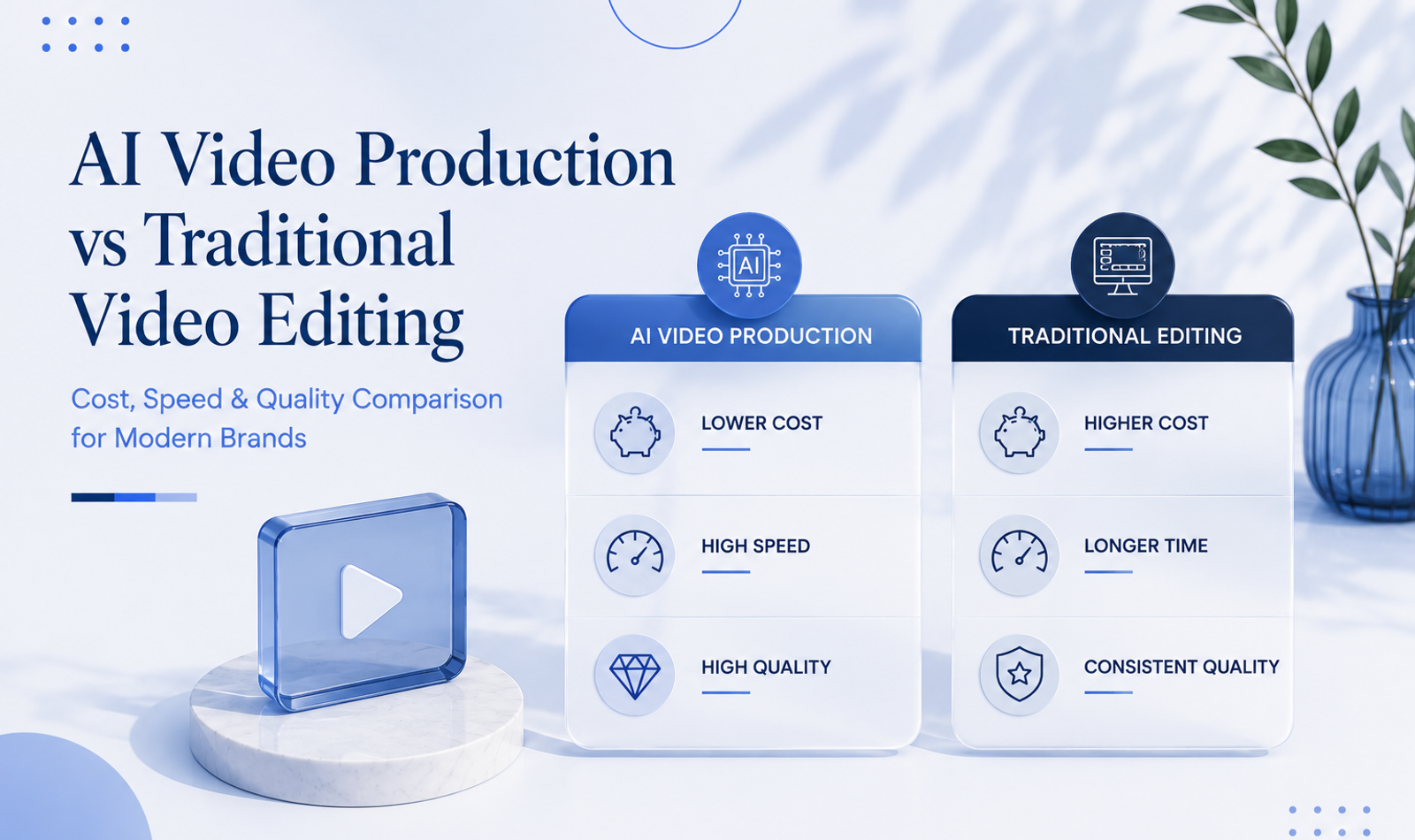
For modern brands, the comparison should be made across three major factors: cost, speed and quality.
Cost decides whether the workflow is practical.
Speed decides whether the brand can keep up with platforms and campaigns.
Quality decides whether the final video protects brand trust and creates the right perception.
What Is AI Video Production?
AI video production uses artificial intelligence tools to generate, animate, edit or support video content.
This can include text-to-video, image-to-video, AI avatars, synthetic voiceovers, automated captions, AI-generated backgrounds, motion effects, product visualisations and AI-assisted editing.
A brand can write a prompt and generate a cinematic scene.
It can upload a product image and animate it.
It can create an avatar-led explainer from a script.
It can generate short-form motion for reels and ads.
It can also use AI to clean audio, create subtitles, extend clips or produce different versions of a video.
AI video production is useful because it reduces the dependency on physical locations, large crews, expensive sets and long production cycles.
However, AI production still needs creative direction.
The tool does not automatically understand the brand’s positioning, audience or business goal.
A generated video may look impressive but still fail if the script is weak, the product is inaccurate or the final edit is unclear.
AI video production is best understood as a faster creative production layer, not a complete replacement for brand strategy.
What Is Traditional Video Editing?
Traditional video editing is the professional process of taking real footage, audio, graphics, music and brand assets and shaping them into a complete video.
It includes selecting shots, arranging sequences, improving pacing, adding music, balancing sound, colour grading, inserting captions, adding motion graphics, creating transitions and exporting final platform versions.
Traditional editing usually begins after footage has been filmed.
The footage may come from a camera shoot, event coverage, product shoot, interview, drone shoot, mobile shoot or studio production.
The editor then turns that raw material into a story.
Traditional editing is essential when the video depends on reality.
Event recaps need real event footage.
Testimonials need real customers.
Founder videos need real human communication.
Product demonstrations need accurate visuals.
Luxury brand films often need real textures, materials and details.
Traditional editing provides control, authenticity and professional polish.
Even when AI-generated clips are used, traditional editing is usually needed to make the final video feel complete.
AI Video Production and Traditional Editing Are Not Opposites
Many brands compare AI video and traditional editing as if they are opposite choices.
In reality, they often work together.
AI video can generate scenes, concepts, backgrounds, animated shots, visual metaphors and quick social assets.
Traditional editing can organise those elements into a polished story with proper pacing, sound, colour and message clarity.
A brand may use AI to create a futuristic campaign opening.
Then the editor may combine it with real product footage, music, captions and a call to action.
An event company may use AI to create a pre-event teaser.
Then it may use traditional editing to create the final recap from actual footage.
A digital agency may use AI to generate multiple ad hooks.
Then it may professionally edit the strongest version into platform-ready ads.
The best comparison is not AI against editing.
It is AI-only, traditional-only and hybrid workflows.
Each has different strengths.
Cost Comparison: AI Video Production
AI video production can reduce certain costs.
It can reduce the need for locations, set design, actors, physical production, travel, multiple shoot days and large crews.
A brand can create concept visuals, short ads, motion graphics and social-first assets with fewer resources.
This is especially useful for startups, small businesses, agencies and brands that need frequent content.
AI can also reduce pre-production costs by helping generate scripts, storyboards, visual references and campaign mock-ups faster.
Instead of planning a full shoot before seeing the idea visually, a brand can test the direction first.
However, AI video is not always cheap when done professionally.
Costs may still include creative strategy, scripting, prompt development, tool subscriptions, asset generation, multiple iterations, editing, sound design, music licensing, revisions, quality control and final exports.
A weak AI video may be inexpensive but ineffective.
A strong AI video still requires skilled people.
The savings usually come from reducing production complexity, not removing the need for creative work.
Cost Comparison: Traditional Video Editing
Traditional video editing costs depend on footage volume, video length, complexity, revisions, sound design, colour grading, motion graphics and platform deliverables.
If the footage is already available, editing can be cost-effective.
For example, a brand with event footage, product clips or founder recordings may only need professional editing to create strong content.
But if traditional editing is part of a full production, costs can increase.
The brand may need camera crew, lighting, location, talent, equipment, direction, styling, travel, production management and post-production.
This is common for luxury films, event documentation, product shoots, testimonials and high-end campaigns.
Traditional production can be more expensive because it captures reality with precision.
But that cost often creates trust.
A real customer testimonial, real founder film or real event recap may be far more valuable than a cheaper AI-generated alternative.
The cost should be judged according to the purpose.
Hidden Costs in AI Video Production
AI video can appear low-cost at first, but hidden costs may appear during production.
The team may need many generations to get one usable shot.
AI tools may distort products, faces, hands, logos, text or movement.
Additional editing may be required to fix inconsistencies.
The brand may need professional compositing to combine AI visuals with real product footage.
Music, voiceovers and stock assets still require rights management.
If the AI output is not brand-safe, the video may need to be remade.
For luxury brands, the cost of poor perception is also important.
A low-cost AI video that makes the brand look artificial, cheap or inaccurate can damage trust.
This is why AI should not be judged only by production price.
It should be judged by final quality, brand fit and business usefulness.
Hidden Costs in Traditional Editing
Traditional editing also has hidden costs.
Poorly shot footage takes longer to edit.
Missing shots may require reshoots.
Bad audio can require cleanup or replacement.
Inconsistent lighting may require heavier colour correction.
Unplanned event footage may make the recap difficult to structure.
Too many reviewers can increase revision rounds.
Unclear feedback can slow delivery.
Traditional editing works best when the production is planned properly.
A good shot list, storyboard, audio plan and brand brief reduce editing time.
When the shoot is random, editing becomes more expensive because the editor must solve problems that should have been addressed earlier.
Traditional editing is most efficient when strategy and production are organised.
Speed Comparison: AI Video Production
AI video production is often faster during ideation and asset creation.
A concept can be visualised quickly.
A still image can become motion.
Several hooks can be tested.
A product can be placed inside different creative environments.
An avatar explainer can be created without booking a studio or presenter.
This speed is useful for social media, digital ads, pitch decks, campaign testing and early creative exploration.
Brands can move from idea to draft faster.
AI also helps create multiple versions.
A single campaign line can become reels, story visuals, short teasers and ad concepts.
However, AI speed depends on the quality requirement.
A quick AI clip may be ready in minutes, but a premium brand video may require many iterations, editing, sound and review.
AI is fastest when the output is short, simple and flexible.
It becomes slower when exact product accuracy, visual consistency and luxury polish are required.
Speed Comparison: Traditional Video Editing
Traditional editing can be fast when the footage is strong and the brief is clear.
A skilled editor can create reels, event teasers, ad cutdowns and social clips quickly from organised footage.
Traditional editing becomes slower when there is too much footage, unclear direction, missing assets or excessive feedback.
A full event recap may require reviewing hours of footage.
A luxury brand film may require detailed colour grading, sound design and motion graphics.
A testimonial video may require careful selection of the strongest statements.
Traditional editing also depends on approval cycles.
If the team knows the objective and provides consolidated feedback, delivery can be efficient.
If the brief changes repeatedly, the process slows down.
Traditional editing is not automatically slow.
Poor planning makes it slow.
Speed Is Not the Same as Readiness
AI can create a video quickly, but that does not mean the video is ready to publish.
A brand must still check quality, accuracy, rights, disclosure, music, captions, claims and platform format.
Traditional editing may take longer, but it often produces a more controlled final asset.
The fastest video is not always the best video.
For modern brands, speed should be balanced with trust.
A campaign may require quick social assets, but the hero film may need deeper editing.
An event may need a same-day teaser, but the official recap may need more time.
A product launch may use AI teasers before the final real-footage campaign.
The right workflow separates urgent content from high-value content.
Quality Comparison: AI Video Production
AI video quality has improved significantly, but it still has limitations.
AI can create cinematic scenes, stylish motion, dramatic lighting and imaginative worlds.
It is strong for mood, concept, atmosphere and short-form attention.
It can make a brand look visually modern.
However, AI can struggle with consistency, exact product detail, realistic hands, readable text, logo accuracy, complex motion and long narrative continuity.
A product may look slightly different across shots.
A face may change.
A logo may distort.
A garment may move unnaturally.
A luxury item may lose detail.
These issues matter for brands.
Quality in AI video is not only about looking cinematic.
It is about looking correct, consistent and brand-safe.
AI video works best when the team uses strong references, clear prompts, human review and professional editing.
Quality Comparison: Traditional Video Editing
Traditional video editing provides quality through control.
The editor works with real footage.
The product, person, event or location actually exists.
This creates authenticity.
The editor can select the best moments, refine pacing, improve sound, balance colour and create a polished final cut.
Traditional editing is especially strong for human emotion.
A real founder speaking sincerely.
A real customer giving feedback.
A real event crowd reacting to a performance.
A real product being used.
These moments are difficult to replace with AI.
Traditional editing can also handle longer stories better.
Brand films, documentaries, event recaps and testimonials often need emotional continuity.
Professional editing gives those videos structure and depth.
Authenticity Comparison
Authenticity is one of the biggest differences between AI video and traditional editing.
AI can create a believable scene, but it may not prove that something actually happened.
Traditional footage provides proof.
For event companies, real footage proves execution.
For product brands, real footage proves product appearance.
For service brands, real founder and client videos build trust.
For luxury brands, real material, texture and experience matter.
AI can support authenticity by creating visual context or concept elements, but it should not replace proof when proof is the main purpose.
A fake event crowd, fake testimonial or unrealistic product result may create short-term attention but long-term trust issues.
Modern audiences are becoming more aware of synthetic content.
Brands should use AI transparently and strategically.
Creativity Comparison
AI video offers strong creative flexibility.
It can create visuals that are difficult or expensive to shoot.
A futuristic city, surreal product world, impossible camera movement or conceptual transformation can be generated faster than traditional production.
This makes AI valuable for creative campaigns, teasers, social hooks and speculative visuals.
Traditional editing offers creativity through storytelling.
An editor can build emotion from real moments.
They can create rhythm, suspense, excitement, elegance or intimacy through cuts, sound and pacing.
The creativity is different.
AI expands what can be imagined.
Traditional editing deepens what has been captured.
The strongest brand videos often use both.
AI creates visual possibility.
Editing creates emotional meaning.
Control Comparison
Traditional editing usually gives more control when the footage is strong.
The editor can decide exactly which frame, expression, product detail or movement appears.
AI video can be less predictable.
The output may not perfectly match the prompt.
Several generations may be needed.
Small details may change.
This matters when the brand has strict guidelines.
Luxury brands, product brands and regulated industries need control.
AI can still be used, but the workflow should include strong review and correction.
For flexible creative concepts, AI unpredictability can be useful.
For exact product communication, traditional editing is often safer.
The level of control required should guide the workflow choice.
Brand Safety Comparison
Brand safety includes accuracy, rights, tone, claims, disclosure and audience interpretation.
AI video creates new brand-safety risks because it can generate realistic but fictional content.
It can distort products.
It can create synthetic people.
It can imitate visual styles.
It can show unrealistic results.
Traditional editing also has brand-safety risks, but they are usually different.
A misleading edit can change the meaning of a testimonial.
A recap can exaggerate attendance through selective cuts.
A product video can use lighting or angles that create false expectations.
Both workflows need review.
AI video needs extra checks for synthetic content, copyright, likeness and product accuracy.
Traditional editing needs checks for truthful representation, rights, music, releases and context.
Brand safety is not optional in either workflow.
Cost, Speed and Quality for Social Media
For social media, AI video can be very useful because platforms need frequent content.
AI can quickly create hooks, animated posts, motion posters, short reels and campaign variations.
This reduces the pressure to film every piece of content.
Traditional editing is still important for platform polish.
A reel needs pacing, captions, music, framing and CTA.
AI-generated visuals without editing may feel incomplete.
For social media, the best workflow is often hybrid.
AI creates attention.
Editing creates clarity.
Real footage creates trust.
This combination allows brands to post more consistently without making the content look generic.
Cost, Speed and Quality for Paid Ads
Paid ads need performance and accuracy.
AI video can help test multiple ad hooks and creative directions quickly.
It can lower the cost of producing variations.
This is useful for Meta, YouTube, LinkedIn and display campaigns.
However, paid ads also require strong review.
The product must be accurate.
Claims must be supportable.
The CTA must be clear.
The video must comply with platform policies.
Traditional editing helps structure ads for performance.
The opening, message, proof and CTA can be sharpened.
For paid ads, AI is useful for speed and creative variation.
Professional editing is essential for conversion quality and brand control.
Cost, Speed and Quality for Luxury Brands
Luxury brands must be careful with AI video.
AI can create premium visual worlds, but it can also make content feel fake if poorly directed.
Cost savings should not come at the expense of brand perception.
Traditional editing and real footage remain important for product detail, craftsmanship, founders, events and customer trust.
AI can support mood, concept, teaser visuals and social motion.
The best luxury workflow is usually selective AI plus professional editing.
Use AI where it adds imagination.
Use real footage where accuracy matters.
Use editing to make everything feel refined.
Luxury quality depends on restraint, detail and consistency.
Cost, Speed and Quality for Event Recaps
Event recaps should primarily use real footage.
The purpose of an event recap is to prove what happened and make the viewer feel the experience.
AI cannot replace real guest reactions, real décor, real performances, real speeches or real atmosphere.
However, AI can support event content around the recap.
Before the event, AI can create teasers, animated invites and concept visuals.
After the event, AI can support title sequences, social cutdowns and creative transitions.
Traditional editing remains essential for the official recap.
The editor selects the strongest moments, builds emotion, balances music and colour grades the footage.
For event recaps, AI supports speed and presentation.
Traditional editing provides authenticity and quality.
Cost, Speed and Quality for Explainer Videos
Explainer videos can benefit from both AI and traditional editing.
AI avatars can create business explainers quickly.
AI-generated visuals and motion graphics can simplify complex ideas.
This can reduce cost and production time.
However, some explainers need real demonstrations, screen recordings, founder presence or product footage.
Traditional editing is needed to structure the explanation, keep pacing clear and make the video polished.
For internal training or simple service explanations, AI may be cost-effective.
For high-trust customer-facing explainers, a hybrid workflow may be better.
The right choice depends on whether clarity, authenticity or scale matters most.
Cost, Speed and Quality for Founder Videos
Founder videos usually benefit from traditional production and editing.
A founder’s real face, voice and personality build trust.
AI can help script the message, generate captions, clean audio and create supporting visuals.
But the core message should usually be real.
A synthetic avatar or cloned voice may feel less authentic, especially for public-facing communication.
Traditional editing can make founder content sharper by removing pauses, adding B-roll and improving sound.
AI can support speed, but real human presence supports trust.
For founder videos, traditional editing usually delivers higher credibility.
Cost, Speed and Quality for Product Videos
Product videos require accuracy.
AI can create beautiful product environments, but it may distort shape, colour, texture, packaging or logo details.
For luxury products, food, fashion, jewellery, electronics and automobiles, this matters.
Traditional footage is often safer for hero product shots.
AI can support background mood, transitions, teaser visuals and social effects.
Professional editing can combine real product footage with AI-enhanced atmosphere.
This hybrid approach offers the best balance.
The product remains accurate.
The campaign still feels creative and modern.
For product videos, quality should be prioritised over low-cost generation.
When AI Video Production Is Better
AI video production is better when the brand needs fast concept development, short social content, visual experimentation, animated still images, mood films, pre-launch teasers or creative ad variations.
It is also useful when the visual idea would be expensive to shoot traditionally.
A surreal background, futuristic world, abstract concept or animated product environment can be generated faster with AI.
AI is useful when the video does not need to prove real execution.
It works well for imagination, atmosphere and speed.
However, it should still be edited professionally before publishing.
AI-generated content becomes stronger when it is structured into a clear video.
When Traditional Video Editing Is Better
Traditional video editing is better when authenticity, accuracy and emotional trust are important.
This includes event recaps, testimonials, founder messages, product demonstrations, behind-the-scenes videos, documentary films and customer stories.
Traditional editing is also better for long-form storytelling.
It can manage real moments, natural emotion and complex narrative flow.
When the viewer needs to trust what they are seeing, real footage matters.
Traditional editing is also essential when brand guidelines are strict.
It gives more control over final output.
For high-trust content, traditional editing is usually the safer choice.
When a Hybrid Workflow Is Best
A hybrid workflow is best when the brand needs speed, creativity and trust together.
This is the most practical option for many modern brands.
AI can create concept visuals, opening hooks, animated backgrounds, social cutdowns and creative transitions.
Real footage can provide product detail, people, events and proof.
Professional editing can connect everything into one polished final video.
A luxury ad may use AI-generated atmosphere with real product shots.
An event campaign may use AI teasers before the event and real footage after it.
A founder video may use real interview footage with AI-generated visual metaphors.
A paid ad may use AI hooks with traditionally edited customer proof.
Hybrid production gives brands flexibility without sacrificing credibility.
Budget Planning for Modern Brands
Brands should not plan video budgets only around tool costs.
They should budget for strategy, scripting, storyboarding, generation, filming, editing, sound, colour, captions, revisions, rights and platform versions.
AI can reduce some costs, but it does not remove the need for production quality.
Traditional editing may cost more when filming is involved, but it can provide stronger trust and longer-term value.
A practical video budget should separate content types.
Fast social experiments can use more AI.
Hero brand films may need more traditional production.
Product and event proof should use real footage.
Campaign cutdowns can combine both.
This approach helps brands spend intelligently.
Timeline Planning for Modern Brands
Timeline planning should also separate content types.
AI-generated teasers can be produced quickly.
Social cutdowns can move faster when the workflow is clear.
Official event recaps may need more time because footage must be reviewed and edited carefully.
Luxury campaigns may need longer review cycles for product accuracy, colour and brand tone.
Paid ads may need multiple versions and performance testing.
A smart timeline includes both speed and quality checkpoints.
The brand should not rush every asset equally.
Some content needs immediate publishing.
Some content deserves deeper finishing.
A balanced timeline improves both output and brand perception.
Quality Control Checklist
Every video should be checked before publishing.
The team should review message clarity, product accuracy, brand tone, visual consistency, audio quality, colour grade, captions, typography, logo placement and CTA.
For AI videos, the team should also check distorted faces, hands, text, logos, product details, unrealistic movement and misleading scenes.
For traditional videos, the team should check continuity, shot selection, audio levels, editing context and rights.
Music, fonts, stock assets and voiceovers should be cleared.
Platform format should be correct.
Quality control protects the brand from avoidable mistakes.
A video is not finished until it is safe, polished and ready for its platform.
Measurement Comparison
AI video and traditional editing should both be measured by performance and brand value.
For awareness, track reach, views, watch time and completion.
For engagement, track saves, shares, comments and profile visits.
For ads, track clicks, enquiries, leads, bookings and conversions.
For PR or brand campaigns, track branded search, website behaviour, media amplification and sales-team feedback.
For luxury brands, qualitative response is also important.
Does the video make the brand feel more premium?
Does it attract the right audience?
Does it support trust?
A cheaper and faster video is not better if it attracts the wrong response.
Measurement should connect cost, speed and quality to real brand outcomes.
Common Mistakes in Comparing AI and Traditional Workflows
One mistake is assuming AI is always cheaper.
Another is assuming traditional editing is always better.
The real answer depends on the video’s purpose.
Brands also make the mistake of using AI for content that requires proof.
They may use synthetic visuals for testimonials, event recaps or product demonstrations where real footage is needed.
Another mistake is using traditional editing without enough planning, which increases cost and slows delivery.
Some brands focus only on speed and ignore quality.
Others focus only on quality and produce too slowly for digital platforms.
The best approach balances all three: cost, speed and quality.
Practical Decision Framework
The brand should begin by asking what the video must achieve.
If the video needs imagination and speed, AI may be useful.
If it needs authenticity and proof, traditional editing may be stronger.
If it needs both, hybrid production is best.
Next, the brand should consider product accuracy.
If the product must look exact, real footage should be included.
Then consider platform.
A fast reel may use more AI.
A website brand film may need deeper editing.
A paid ad may need several versions.
An event recap should use real footage.
Finally, consider brand perception.
Luxury and premium brands should not sacrifice trust for speed.
The right workflow is the one that supports the brand’s objective without weakening credibility.
How Double Trouble Studio Approaches the Comparison
Double Trouble Studio does not treat AI video and traditional editing as competing services.
We use both according to the brand’s objective.
For AI video production, we focus on creative concepts, campaign visuals, social reels, launch teasers, AI-assisted ads and cinematic visual storytelling.
For professional video editing, we focus on real footage, event recaps, founder videos, product films, colour grading, sound design, captions and platform-ready exports.
For luxury brands, we use AI with restraint and editing with precision.
For events, we use real footage as proof and AI as creative support.
For digital campaigns, we create multiple versions that balance speed, performance and brand quality.
The goal is not to choose the newest tool.
The goal is to create the strongest video for the business objective.
Frequently Asked Questions
Q1. Is AI video production better than traditional video editing?
AI video production is better for speed, creative experimentation and fast content creation, while traditional video editing is better for authenticity, storytelling control and brand trust. The best choice depends on the specific objective of the video.
Q2. When should a brand use AI video production?
Brands should use AI video production for social media content, campaign teasers, ad variations, concept visuals and quick creative testing where speed and imagination are more important than real-world accuracy.
Q3. When is traditional video editing the better option?
Traditional video editing is better for event recaps, testimonials, founder videos, product demonstrations and luxury brand films where real footage and emotional authenticity are required.
Q4. Can AI and traditional editing be used together?
Yes. The most effective modern workflow is hybrid. AI can create concepts, hooks and visuals, while traditional editing structures them into a polished, professional and trustworthy final video.
Q5. Does AI video reduce production costs?
AI can reduce shoot-related costs, but it still requires strategy, editing and creative direction. True cost efficiency comes when AI is used for the right type of content, not everything.
Conclusion
AI video production and traditional video editing are not competing systems — they are complementary tools.
AI helps brands create faster, explore more ideas and produce content at scale. Traditional editing ensures accuracy, emotional depth, storytelling structure and brand trust.
The strongest video strategies today are hybrid, combining AI creativity with real footage and professional editing.
AI expands creative possibilities, while traditional editing protects authenticity and meaning.
For modern brands, success comes from using both intelligently based on purpose, platform and audience expectations.
Ready to Build High-Impact Video Content Using AI + Traditional Editing?
If you want to scale your brand with video that is faster, smarter and more impactful, the right workflow matters more than the tool itself. Whether it is AI video production, traditional editing, or a hybrid approach, choosing the correct method can significantly improve your content performance, production speed and overall brand perception.
📩 info@dtsworld.in 📞 +91 80000 06021 📍 Andheri (West), Mumbai
Need this for your brand?
Let DTS build your next campaign.
From PR, celebrity management and events to websites, social media, SEO and AI video production — Double Trouble Studio helps brands grow with strategy and execution.
Discuss Your Requirement →