AI video has moved from experimental content into everyday brand production.
Businesses now use AI-generated video for social media ads, product concepts, explainer videos, training modules, event teasers, pitch decks, cinematic reels and campaign visuals.
A few years ago, creating a polished video usually required a camera crew, actors, studio time, editors, motion designers, voice artists and several rounds of post-production.
Those requirements have not disappeared, but the workflow has changed.
A brand can now generate a concept shot from a text prompt, animate a product image, create a multilingual avatar explainer, extend a missing clip, remove production gaps, generate visual references and test creative directions before a full shoot.
This has made video faster, more flexible and more accessible.
However, the rise of AI video tools has also created confusion.
Many businesses ask which tool is best. Some hear about Runway and assume it can replace a production team. Others see Synthesia avatars and believe every corporate video should now be avatar-led. Some use Pika for fast creative effects and expect the same tool to produce a full brand film.
Traditional editing is often treated as outdated, even though professional editing remains essential for control, accuracy, emotional pacing, real footage, brand standards, sound, colour and final delivery.
The correct answer depends on the purpose of the video.
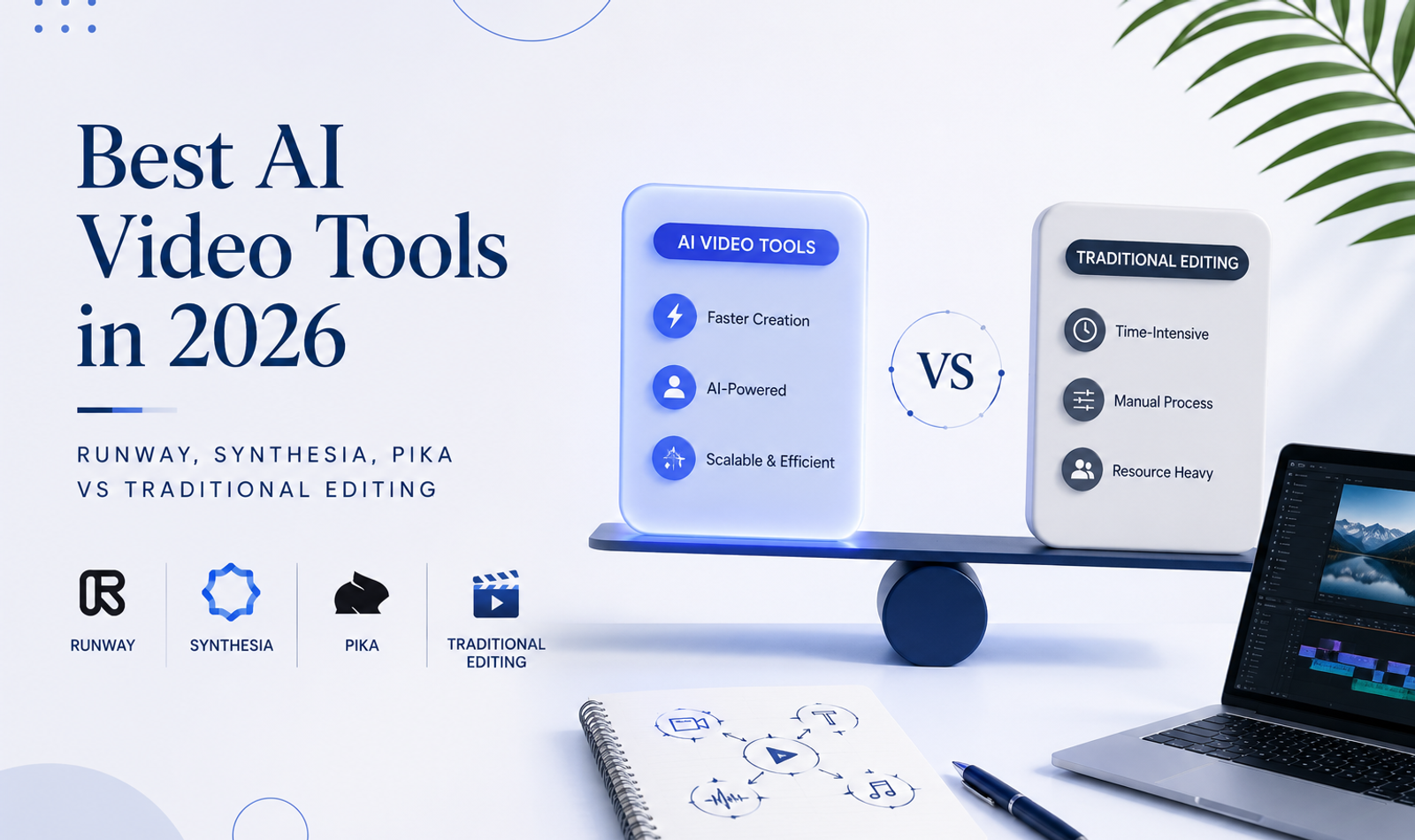
Runway, Synthesia, Pika and traditional editing are not interchangeable solutions.
They represent different production strengths.
Runway is useful when the brand needs cinematic AI visuals, stylised scenes, concept films, image-to-video shots, generative B-roll or experimental advertising visuals.
Synthesia is useful when the brand needs avatar-led training, explainers, internal communication, multilingual videos and scalable business content.
Pika is useful when the brand needs quick short-form AI animation, trend-style effects, image motion and social-first creative experiments.
Traditional editing is useful when the brand needs precise storytelling, real customer footage, interviews, event films, product accuracy, high-trust communication and final professional polish.
The best 2026 workflow is often hybrid.
AI generates or supports specific assets, while human creative direction, scripting, editing, sound, colour and brand judgement shape the final video.
Understanding AI Video Tools in 2026
AI video tools use machine learning models to generate, edit, animate or personalise video content.
Some tools create video from text prompts.
Some animate still images.
Some generate avatars that speak from a written script.
Some assist traditional editors by extending clips, masking objects, improving audio or generating visual assets.
The category is broad, which is why direct comparison can be misleading.
A text-to-video tool and an avatar-training platform do not solve the same problem.
A tool designed for viral effects may not produce a boardroom presentation video.
A professional editing suite may not generate a cinematic fantasy scene from scratch.
The first step is therefore to understand the production requirement.
The brand should ask whether it needs original footage, generative visuals, an avatar presenter, short social effects, professional editing or a combination of these.
Why AI Video Matters for Brands
Video has become one of the most important communication formats for brands.
Customers expect visual proof, short-form discovery, product demonstrations, explainers, testimonials, event films and platform-specific content.
The challenge is that video production can be expensive and time-consuming.
AI tools reduce some of that friction.
A campaign idea can be tested visually before a full shoot.
A product image can be turned into motion for a reel.
A founder script can become a multilingual avatar video.
A missing transition shot can be supported through AI-assisted editing.
A brand can create multiple versions for different platforms faster than before.
This does not mean quality becomes automatic.
AI video still requires scripting, creative direction, prompting, editing, review, compliance and brand control.
The tool makes production faster, but the idea still matters.
AI Video Does Not Replace Strategy
The most common mistake brands make is beginning with the tool instead of the message.
They ask whether they should use Runway, Synthesia or Pika before deciding what the video needs to achieve.
A video designed to generate leads needs a different structure from a cinematic brand teaser.
A training video needs clarity and consistency.
A luxury product film needs mood, detail and restraint.
A performance ad needs a strong hook, benefit, proof and call to action.
AI cannot solve a weak message.
It can make production faster, but it cannot decide the correct brand positioning, customer insight or campaign objective.
The strategy should come first.
The tool should be selected after the creative direction is clear.
Runway: Best for Cinematic AI Video and Generative Visuals
Runway is one of the strongest tools for generative AI video.
It is especially useful for text-to-video, image-to-video, stylised visual sequences, cinematic concepts and creative experimentation.
A brand can use Runway to generate scenes that would otherwise require sets, locations, actors, visual effects or stock footage.
For example, a luxury car rental brand may create a futuristic city-mobility concept.
A fashion label may animate campaign visuals into cinematic motion.
A digital agency may create AI-generated ad sequences for social campaigns.
An event company may visualise premium stage concepts, guest-flow scenes or surreal campaign teasers.
Runway is especially attractive for brands that need visual imagination beyond ordinary footage.
It can help create moods, worlds, camera movement and scenes that would be expensive to shoot traditionally.
However, Runway still requires direction.
Prompts must be clear.
References must be chosen carefully.
Outputs may require multiple generations, selection and editing.
The final result still needs human judgement.
Strengths of Runway
Runway’s biggest strength is visual creativity.
It allows teams to generate scenes that may not exist in their footage library.
It can create cinematic B-roll, visual metaphors, animated concepts, mood films and stylised campaign assets.
This makes it useful for advertising, concept development, music videos, luxury visuals, social campaigns, AI films and speculative creative pitches.
Another strength is speed.
Instead of waiting for a full shoot, the creative team can generate several visual directions quickly.
This is useful during ideation.
A brand can test whether a futuristic, luxury, documentary, surreal or editorial direction feels suitable before investing in production.
Runway can also help smaller teams compete visually.
A boutique agency or brand can produce ambitious concepts that would previously require large production budgets.
Limitations of Runway
Runway is powerful, but it is not perfect.
AI-generated shots may contain visual inconsistencies, strange hand movements, distorted objects, unnatural physics or continuity errors.
Brand products may not appear accurately unless controlled through references and post-production.
Text inside generated video is often unreliable.
Long storytelling across many scenes requires careful consistency management.
Runway is better for generative shots than for complete, factually precise brand videos.
A luxury product film showing the exact design of a jewellery piece may still require real footage or 3D production.
A testimonial video requires real people and authentic speech.
An event recap requires actual event footage.
Runway is therefore strongest when used for concept visuals, campaign effects and imaginative sequences, not as a complete replacement for production.
Best Use Cases for Runway
Runway works well for AI-generated brand films, cinematic social ads, surreal campaign visuals, luxury mood films, music-video concepts and futuristic product storytelling.
It is useful for creating B-roll when no suitable footage exists.
It can help animate still images for reels and campaign teasers.
It can support pitch decks by visualising ideas before the final shoot.
It can also help creative teams explore art direction, camera movement and mood.
Runway is especially useful when the brand wants visual impact, imagination and cinematic experimentation.
It is less suitable when exact product detail, legal accuracy, customer authenticity or long-form documentary control is required.
Synthesia: Best for Avatar Videos and Business Communication
Synthesia is different from Runway.
It is not mainly designed for cinematic generative scenes.
It is strongest for avatar-led videos where a digital presenter speaks from a script.
This makes it useful for training, onboarding, internal communication, product explainers, customer education, HR videos, learning modules and multilingual business communication.
A company can create a professional-looking video without hiring actors, booking studios or recording voiceovers for every language.
The script can be updated when information changes.
The same message can be produced in multiple versions.
For businesses with recurring communication needs, this is a major advantage.
Synthesia is particularly useful for enterprise teams, SaaS companies, education, healthcare communication, corporate training, internal policy videos and customer-support explainers.
Strengths of Synthesia
Synthesia’s main strength is scalability.
A business can produce many videos quickly using scripts, avatars and templates.
This is useful when the content is information-heavy and needs frequent updates.
For example, a company can create onboarding videos for new employees, product tutorials for customers, compliance training modules or multilingual internal announcements.
Another strength is consistency.
A brand can maintain a standard presenter style, tone and format across many videos.
This can be useful for corporate communication where clarity matters more than cinematic experimentation.
Synthesia is also useful when a real spokesperson is unavailable or when the brand needs language versions at scale.
Instead of reshooting the same video several times, the script can be adapted and produced through the platform.
Limitations of Synthesia
Synthesia is not ideal for every brand video.
Avatar videos can feel formal, template-based or less emotionally rich than real human footage.
They may not be suitable for luxury storytelling, emotional brand films, hospitality experiences, event recaps or founder-led personal communication where authenticity is essential.
An AI avatar cannot fully replace the trust created by a real founder speaking sincerely to camera.
It also cannot show the atmosphere of a venue, the texture of a product or the emotion of a live event.
Synthesia is strongest when the communication is structured, educational and repeatable.
It is weaker when the brand needs sensory storytelling, high emotion, cultural nuance or real-world proof.
Best Use Cases for Synthesia
Synthesia works well for training videos, HR onboarding, compliance explainers, software tutorials, sales enablement, product education, internal updates and multilingual knowledge content.
It is useful for companies that need a large volume of clear communication.
It is also useful for teams that want video but do not have regular access to presenters, studios or voice artists.
For digital agencies, Synthesia can support client onboarding videos, process explainers, proposal walkthroughs and training materials.
For luxury brands, it may be useful for internal staff training, retail product knowledge, service standards and operational communication.
It is usually not the first choice for emotional luxury advertising or cinematic brand films.
Pika: Best for Short-Form Creative AI Effects
Pika is often used for fast, playful and visually striking AI video creation.
It can animate images, create surreal effects, generate short clips and support social-first experimentation.
Its appeal comes from speed and creativity.
A brand can use Pika to create quick reels, trend-style animations, image motion, visual hooks and experimental content.
For example, a product image can be animated into a short motion clip.
A campaign visual can be given a surreal transformation.
A social post can become a moving creative asset.
Pika is especially useful when the brand wants to test creative directions quickly or produce short attention-grabbing videos.
It works well for social media where brief, visually surprising content can perform strongly.
Strengths of Pika
Pika’s biggest strength is accessibility.
Teams can produce short videos quickly without complex production knowledge.
This makes it useful for social teams, content creators and small brands that need frequent motion content.
It is also strong for creative effects.
A still image can become animated.
A visual can be transformed into something more dynamic.
Short AI clips can be created for reels, stories, teasers and campaign experiments.
Pika can help brands make static assets more engaging.
This is useful when a business already has product photography, campaign images or graphics but needs motion for social platforms.
Limitations of Pika
Pika is not usually the best solution for complex brand films, long-form video, detailed editing or exact product storytelling.
Short AI clips can be impressive, but they may not provide enough narrative depth.
Like other generative tools, outputs may include inconsistencies.
The brand may need several attempts to achieve the desired look.
Some effects may feel too playful for premium or luxury positioning if not directed carefully.
A luxury brand should use Pika with restraint.
The objective should be to create polished motion and visual interest, not random effects that weaken brand tone.
Pika is strongest for short creative assets and social experimentation, not complete production systems.
Best Use Cases for Pika
Pika works well for image-to-video reels, product animations, social hooks, motion posters, teaser clips, experimental effects and quick campaign visuals.
It can support fashion, beauty, food, lifestyle, music, events and digital marketing content.
It is useful when the brand needs motion quickly and does not require a full shoot.
It can also help agencies create options for clients during the concept stage.
For example, a still blog image, product image or campaign poster can become an animated teaser.
This makes Pika useful for fast content calendars and social-first campaigns.
Traditional Editing: Still Essential in 2026
Traditional editing remains the foundation of professional video production.
It includes selecting footage, arranging scenes, shaping rhythm, improving sound, correcting colour, adding graphics, balancing music, refining transitions and preparing final exports.
Professional editing turns raw material into a story.
Even when AI-generated shots are used, they usually need traditional editing to become part of a complete video.
A brand film may include AI visuals, real footage, voiceover, logo animation, text, sound design and colour grading.
An editor is still needed to assemble these elements correctly.
Traditional editing is also essential when the footage must be authentic.
Client testimonials, event recaps, founder interviews, behind-the-scenes videos, product demonstrations and documentary stories require real material.
AI can assist the workflow, but it should not replace the truth of the footage.
Strengths of Traditional Editing
Traditional editing provides control.
The editor can decide exactly which moment to use, how long to hold a shot, where to cut, how to build emotion and how to guide the audience.
This is essential for storytelling.
Traditional editing also supports accuracy.
A real product can be shown exactly as it is.
A real event can be documented truthfully.
A real client can provide a testimonial.
A real founder can communicate personal conviction.
Traditional editing also provides professional polish.
Colour grading, audio mixing, pacing, transitions, subtitles and export settings all affect perceived quality.
AI tools can generate assets, but editing makes them usable.
Limitations of Traditional Editing
Traditional editing depends on available footage.
If the footage is weak, missing or poorly shot, the editor has limited options.
Traditional production may also require more time, crew, locations, talent and budget.
A scene that requires a futuristic city, surreal transformation or complex visual effect may be expensive to create traditionally.
For fast social content, traditional workflows may feel slow when many versions are needed.
This is where AI tools provide real value.
They help fill gaps, create visual alternatives, generate B-roll and speed up repetitive tasks.
The best approach is not to reject traditional editing but to enhance it intelligently.
Traditional Editing Is Becoming AI-Assisted
In 2026, traditional editing tools are increasingly AI-powered.
Editors now use AI for transcript-based editing, object masking, clip extension, audio cleanup, caption generation, translation, background removal and media search.
This does not eliminate editing skill.
It changes where the editor spends time.
Instead of manually performing every technical task, the editor can focus more on story, rhythm, sound, visual consistency and brand detail.
AI-assisted editing is especially useful for agencies and content teams managing high-volume output.
It can speed up revisions, format changes and platform-specific versions.
However, the editor still needs to make creative decisions.
Runway vs Synthesia
Runway and Synthesia serve very different needs.
Runway is better when the brand needs cinematic generative visuals.
Synthesia is better when the brand needs a presenter-led business video.
Runway helps create worlds, moods, scenes and visual imagination.
Synthesia helps communicate information clearly through avatars.
A fashion campaign, AI ad, surreal reel or concept film may use Runway.
A training module, onboarding video, product tutorial or multilingual explainer may use Synthesia.
Runway is more visually experimental.
Synthesia is more structured and business-focused.
The choice depends on whether the video needs cinematic atmosphere or clear avatar communication.
Runway vs Pika
Runway and Pika both support generative video, but their strengths differ.
Runway is usually better for more cinematic, controlled and concept-driven outputs.
Pika is often better for fast, short-form creative effects and image animation.
A brand may use Runway for a premium AI film sequence and Pika for quick social experiments.
Runway may require more direction and iteration.
Pika may be faster for playful motion and trend-style content.
For luxury brands, Runway may be better when the output needs a cinematic finish.
Pika may be useful when the brand wants short motion teasers or creative effects, provided the style remains aligned with brand positioning.
Synthesia vs Pika
Synthesia and Pika are even more different.
Synthesia creates avatar-led videos from scripts.
Pika creates short AI motion, effects and animated visuals.
Synthesia is practical, structured and business-focused.
Pika is visual, playful and social-first.
A company might use Synthesia to explain a service and Pika to animate a campaign poster.
Synthesia supports clarity.
Pika supports attention.
Neither tool replaces the other because their production roles are different.
AI Video vs Traditional Editing
AI video tools can create assets that did not exist before.
Traditional editing shapes assets into a coherent final video.
AI can help generate ideas, scenes, avatars and motion.
Traditional editing provides story control, timing, brand consistency and delivery quality.
For short social content, AI tools may create a large part of the video.
For serious brand communication, traditional editing remains essential.
The best workflow often combines AI generation with human editing.
The AI tool creates or supports raw material.
The editor turns it into a final asset that feels intentional, branded and usable.
Which Tool Is Best for Social Media Reels?
For social media reels, the best tool depends on the reel type.
Pika is useful for quick image animation, visual effects and short motion content.
Runway is useful for cinematic reels, AI scenes and visually ambitious concepts.
Synthesia is useful when the reel is an avatar explainer or educational short.
Traditional editing is required when the reel uses real footage, testimonials, event clips, product demos or precise brand storytelling.
Most social teams will benefit from a hybrid workflow.
AI tools can create hooks and visuals.
Traditional editing can combine those visuals with captions, music, timing and call to action.
Which Tool Is Best for Ads?
For digital ads, the best workflow depends on the campaign objective.
Runway can produce cinematic AI ad visuals and attention-grabbing scenes.
Pika can create fast short-form hooks and motion from static assets.
Synthesia can produce direct explainer-style ads or business education videos.
Traditional editing is essential for performance ads that require clear structure, product accuracy, offer communication and platform-ready versions.
A strong ad is not only visually attractive.
It must communicate the problem, benefit, proof and next action.
AI can help create the visual environment, but editing and strategy determine performance.
Which Tool Is Best for Luxury Brands?
Luxury brands should choose tools carefully because tone and detail matter.
Runway can create premium cinematic visuals when directed well.
It is useful for mood films, fashion concepts, hospitality teasers, surreal campaign visuals and high-end AI ads.
Pika can be useful for motion posters, short teasers and social animations, but the effects should not feel gimmicky.
Synthesia is less suitable for emotional luxury advertising, but it can support internal staff training, product-knowledge videos and operational communication.
Traditional editing remains essential for real product films, craftsmanship videos, event recaps, founder stories, hospitality films and testimonials.
Luxury brands usually need a hybrid approach that protects taste, accuracy and brand equity.
Which Tool Is Best for Corporate Training?
Synthesia is usually the strongest option for scalable corporate training.
It allows teams to create consistent avatar-led videos from scripts and update them when policies change.
It is useful for onboarding, compliance, process explanations, product training and multilingual employee communication.
Traditional editing may still be needed when training includes real demonstrations, screen recordings, interviews or location footage.
Runway and Pika are less central for training unless the brand needs creative examples, simulations or visual explanations.
The goal of training is clarity, not cinematic experimentation.
Synthesia’s structured format suits that requirement.
Which Tool Is Best for Event Videos?
Traditional editing is still the foundation for event videos.
A real event film must use actual footage of guests, stage, atmosphere, performances, venue and key moments.
AI cannot replace authentic event documentation.
However, AI tools can support event marketing.
Runway can generate pre-event concept teasers or futuristic visual sequences.
Pika can animate invite graphics, posters and countdown visuals.
Synthesia can create event briefing videos for internal teams or sponsors.
After the event, traditional editing remains essential for recaps, highlight films and case studies.
Which Tool Is Best for Website and Service Explainers?
Synthesia is useful when the explainer is presenter-led and information-heavy.
It can explain services, onboarding steps, product features and internal processes.
Traditional editing is useful when the explainer includes real footage, screen recordings, motion graphics, brand visuals and voiceover.
Runway can support visual metaphors or AI-generated B-roll.
Pika can create small animated moments.
For a premium service brand, the best explainer may combine clear scriptwriting, real brand visuals, motion graphics and traditional editing.
An avatar may be suitable when scale and speed are more important than personal emotion.
Which Tool Is Best for AI Product Visuals?
Runway and Pika are useful for AI product visuals, but they require careful control.
Pika can animate product images quickly.
Runway can create more cinematic product environments and concept scenes.
Traditional editing or motion design may still be needed to maintain exact product accuracy.
For luxury products, the product shape, material, logo, colour and detail must remain correct.
If the AI tool distorts these details, the final output may harm credibility.
Real product footage, 3D modelling or professional photography may be better when accuracy is essential.
Which Tool Is Best for Founder Videos?
Traditional editing is usually best for founder videos.
A founder’s real face, voice and emotion create trust.
The audience wants authenticity, not a synthetic replacement.
AI tools can support founder content through subtitles, translations, audio cleanup, background enhancement and clip formatting.
Synthesia may be useful for internal communication when the founder is unavailable, but it should not replace personal messages where authenticity matters.
Runway and Pika may support visual cutaways or creative openings.
The core founder message should usually remain real.
Which Tool Is Best for Multilingual Content?
Synthesia is very strong for multilingual avatar content.
It is useful when a company needs the same message across several languages and markets.
Traditional editing can also support multilingual content through subtitles, voiceovers and dubbing, but production may take longer.
AI translation and voice tools can speed the process.
Runway and Pika do not primarily solve multilingual communication.
They may create visuals, but they do not replace structured localisation workflows.
For training, onboarding and corporate communication, Synthesia is often the most efficient multilingual choice.
Which Tool Is Best for High-Trust Communication?
High-trust communication includes founder statements, crisis responses, customer testimonials, legal explanations, product safety updates, financial communication and serious public announcements.
Traditional video is usually strongest here because authenticity matters.
Audiences need to see real people and real evidence.
AI avatars may feel inappropriate in sensitive contexts.
AI-generated visuals may create doubt if the topic requires factual precision.
AI can still assist with captions, editing, translation and accessibility.
The core message should remain human, accurate and transparent.
Workflow: AI-First Production
An AI-first workflow begins with AI-generated assets.
The team writes prompts, creates images, generates video clips, selects outputs and edits them into a final piece.
This workflow works well for concept films, surreal ads, social visuals, music videos, pitch decks and experimental campaigns.
It can be faster and less expensive than traditional production for imaginary scenes.
However, it requires strong creative direction.
Without a clear script, shot list and style guide, the output can feel random.
AI-first production is best when realism is not required to prove an actual product or event.
Workflow: Traditional-First Production
A traditional-first workflow begins with real footage.
The team shoots interviews, products, events, locations or demonstrations.
AI tools are then used to assist editing, create supporting visuals, extend clips, generate captions or produce additional versions.
This workflow works well for brand films, testimonials, event recaps, product demos, hospitality videos and founder stories.
It protects authenticity while improving speed and flexibility.
For most premium brands, this remains the safest and most reliable approach.
AI enhances the production rather than replacing the real evidence.
Workflow: Hybrid Production
A hybrid workflow combines AI-generated visuals, real footage and traditional editing.
This is often the best workflow in 2026.
A brand film may begin with real founder footage, include AI-generated visual metaphors, use traditionally edited product shots and finish with motion graphics.
A social campaign may use real customer clips, AI-generated B-roll and Pika animations.
A training programme may use Synthesia avatars, screen recordings and edited real demonstrations.
The hybrid model allows each tool to perform its strongest role.
It also helps brands balance speed, authenticity, creativity and control.
How to Choose the Right AI Video Tool
The brand should begin with the video objective.
Is the video meant to educate, entertain, sell, train, inspire or document?
Next, the brand should define the audience.
A luxury customer, employee, investor, student and social viewer all need different communication.
The team should then define the content type.
Does the video need real people, exact products, cinematic imagination, avatar narration or short-form motion?
The choice of tool becomes clearer after these questions.
Runway suits cinematic AI visuals.
Synthesia suits avatar-led business videos.
Pika suits quick short-form creative motion.
Traditional editing suits controlled storytelling and final polish.
Budget Considerations
AI video can reduce some production costs, but it is not free when done professionally.
Costs may include subscriptions, prompting time, creative direction, scriptwriting, editing, revisions, upscaling, voiceover, music, licensing and human review.
Traditional production may include crew, camera, location, talent, equipment, editing, sound and colour.
The best choice depends on value, not only cost.
A low-cost AI video that damages brand trust is expensive in the long term.
A higher-cost real shoot may be justified when authenticity drives conversion.
Brands should evaluate the complete production requirement.
Time Considerations
AI tools can dramatically reduce production time for certain assets.
A product image can become an animated clip quickly.
An avatar training video can be produced faster than a studio shoot.
A concept scene can be generated without scouting locations.
However, AI can also require many iterations.
The team may spend time correcting prompts, selecting outputs and editing inconsistencies.
Traditional editing may be faster when strong footage already exists.
The timeline depends on complexity, quality expectations and approval requirements.
Brand Safety Considerations
AI video requires brand safety review.
The team should check whether the output misrepresents the product, people, location or claim.
It should avoid using likenesses, voices, copyrighted assets or sensitive references without rights.
AI-generated content should not be used to create false testimonials or misleading proof.
For regulated categories, claims require special care.
Luxury brands should also review whether the style aligns with brand equity.
A viral effect may attract attention but weaken premium perception.
Legal and Usage Considerations
Brands should review licensing, commercial usage rights, model terms, music rights, stock assets, avatar consent, voice rights and data privacy.
An AI output may be usable for social content but not suitable for advertising depending on tool terms and source materials.
Avatar videos require clear consent when using real people’s likenesses.
Generated voices and synthetic presenters should be handled transparently.
Traditional footage also requires releases, location permissions, music licences and talent agreements.
AI does not remove the need for rights management.
Quality Control
Every AI video should pass a quality review before publication.
The team should check faces, hands, logos, product shapes, text, background objects, movement, audio, subtitles and brand tone.
It should also check whether the video communicates the intended message clearly.
AI visuals can be attractive while failing to explain the brand.
The final asset should be reviewed by creative, marketing and compliance stakeholders where necessary.
Quality control is especially important for ads, luxury content and customer-facing campaigns.
Human Creative Direction Still Matters
AI tools respond to direction.
The quality of the output depends heavily on the quality of the idea, prompt, reference material and edit.
A skilled creative director understands composition, pacing, customer psychology, brand tone and platform behaviour.
A skilled editor understands rhythm, emotional flow, sound and visual continuity.
A strategist understands the audience and conversion goal.
AI can generate options, but humans decide what belongs in the final story.
This is why agencies and production teams still matter.
Runway, Synthesia, Pika and Editing in One Agency Workflow
A modern agency may use all these tools together.
Runway can generate cinematic AI scenes for campaign hooks.
Pika can animate social assets and create short visual effects.
Synthesia can produce training videos, explainer content and internal communication.
Traditional editing can combine real footage, AI visuals, motion graphics, voiceover and sound design into finished videos.
This allows the agency to create multiple content types without treating one tool as the entire solution.
The result is a flexible production system.
Each tool supports a different layer of the brand’s video ecosystem.
Common Mistakes With AI Video Tools
One common mistake is using AI video without a script.
Another is choosing a tool because it is trending rather than because it fits the objective.
Brands may overuse effects that make the content look gimmicky.
They may publish distorted products, unnatural faces or unclear messages.
Some use avatars for emotional topics where real human presence would be better.
Others use AI-generated visuals for claims that require real proof.
Another mistake is ignoring editing.
Raw AI outputs rarely create a complete brand video by themselves.
Professional selection, sequencing, sound and finishing are still required.
A Practical Decision Guide
Use Runway when the brand needs cinematic AI visuals, creative concept films, generative B-roll, futuristic ad scenes or imaginative campaign storytelling.
Use Synthesia when the brand needs clear avatar-led training, explainer, onboarding, internal communication or multilingual business videos.
Use Pika when the brand needs quick image animation, social-first effects, motion posters, short reels and creative experiments.
Use traditional editing when the brand needs real footage, founder authenticity, event documentation, testimonial trust, product accuracy, long-form storytelling and final professional polish.
Use a hybrid workflow when the brand needs creativity, speed, authenticity and control together.
This is the most practical approach for most businesses in 2026.
Frequently Asked Questions
What is the best AI video tool in 2026?
The best AI video tool in 2026 depends on the purpose of the video. Runway is strong for cinematic AI visuals and generative scenes. Synthesia is best for avatar-led explainers, training and multilingual business communication. Pika is useful for short-form motion, social effects and quick image animation. Traditional editing is still essential for real footage, storytelling, sound, colour and final professional polish.
Is Runway better than Synthesia?
Runway and Synthesia are built for different needs. Runway is better for cinematic AI visuals, image-to-video shots, concept films and creative campaign scenes. Synthesia is better for avatar-led training, onboarding, internal communication, product explainers and multilingual videos. The better choice depends on whether the brand needs visual imagination or structured business communication.
Is Pika good for brand videos?
Pika can be useful for brand videos when the requirement is short-form motion, image animation, teaser clips, motion posters or social-first creative effects. It is especially helpful for reels and quick content experiments. However, premium brands should use Pika carefully so that the output does not feel gimmicky or disconnected from the brand tone.
Does AI video replace traditional editing?
No, AI video does not fully replace traditional editing. AI tools can generate visuals, animate images, create avatars and speed up production, but professional editing is still needed for story structure, pacing, sound, colour, subtitles, transitions, brand consistency and final delivery. The strongest workflow often combines AI generation with human editing.
Which tool is best for social media reels?
For social media reels, Pika is useful for quick effects and animated visuals, while Runway is better for cinematic AI scenes and more ambitious creative concepts. Synthesia can work for educational avatar reels. Traditional editing is needed when the reel includes real footage, product demos, event clips, testimonials, captions, music and CTA structure.
Which AI video tool is best for luxury brands?
For luxury brands, Runway is usually strong for cinematic visuals, fashion concepts, hospitality teasers, high-end AI ads and mood films. Pika can support short teasers and motion posters when used with restraint. Synthesia is more suitable for internal training or product knowledge videos. Traditional editing remains essential for real product films, founder stories, event recaps and premium brand documentaries.
Which tool is best for corporate training videos?
Synthesia is one of the strongest options for corporate training videos because it can create avatar-led videos from scripts and produce multilingual versions quickly. It is useful for HR onboarding, compliance training, product education, process explainers and internal communication. Traditional editing may still be useful when training requires real demonstrations, screen recordings or interviews.
Which tool is best for event videos?
Traditional editing is best for event videos because event films require real footage of guests, venue, performances, stage moments, atmosphere and interactions. AI tools can support event marketing through pre-event teasers, animated invites, countdown visuals or briefing videos, but the final event recap should usually be edited from authentic footage.
Can AI video be used for product visuals?
Yes, AI video can be used for product visuals, especially when animating still images, creating concept environments or producing social teasers. Runway and Pika can both support this. However, exact product shape, colour, logo, texture and material details must be checked carefully. For high-value products, real footage, professional photography or 3D production may still be more reliable.
Why is a hybrid AI video workflow useful?
A hybrid workflow is useful because it combines the speed of AI with the control of professional editing. AI can generate scenes, avatars, motion assets and creative options quickly. Traditional editing can then refine the story, sound, pacing, brand style, colour and final delivery. This helps brands produce more content without losing quality or credibility.
What are the biggest mistakes brands make with AI video?
The biggest mistakes are starting with the tool instead of the strategy, using AI without a script, publishing distorted visuals, overusing gimmicky effects, using avatars where real human trust is needed and ignoring final editing. AI video works best when it is guided by strong creative direction, clear messaging, brand safety checks and professional finishing.
Is AI video good for high-trust communication?
AI video can assist high-trust communication through captions, translation, audio cleanup, formatting and editing support. However, for founder messages, customer testimonials, crisis communication, financial updates or serious public announcements, real human footage is usually stronger. High-trust communication depends on authenticity, accuracy and transparency.
Conclusion
The best AI video tool in 2026 depends on the purpose of the video.
Runway, Synthesia, Pika and traditional editing are not direct replacements for one another.
Each solves a different production challenge.
Runway is strongest for cinematic AI visuals, generative scenes, creative campaigns and concept-led storytelling.
It is useful when the brand needs imagination, atmosphere and visual experimentation.
It should be used carefully when exact product detail, human authenticity or long narrative continuity is required.
Synthesia is strongest for avatar-led business communication.
It is ideal for training, onboarding, internal videos, explainers, product education and multilingual communication at scale.
It is less suitable for emotional brand films, luxury storytelling and videos where real human trust is essential.
Pika is strongest for short-form creative motion.
It can animate images, create fast social assets and add visual effects to content calendars.
It is useful for reels, teasers, motion posters and experimental creative.
It should be used with restraint by premium brands because playful effects can become gimmicky if they do not match the brand tone.
Traditional editing remains essential.
It provides narrative control, authenticity, sound, colour, pacing, product accuracy and final delivery.
Real interviews, event films, testimonials, product demonstrations and brand documentaries still require human editing skill.
AI can enhance these workflows, but it does not replace the need for judgement.
The strongest video production strategy in 2026 is hybrid.
AI tools can generate scenes, animate assets, create avatars, speed up revisions and support multilingual production.
Traditional editing can assemble, refine, correct and finish the story.
Human strategists and creative directors decide what the video should communicate and how the audience should feel or act.
Brands should therefore stop asking which AI video tool is universally best.
The better question is which tool fits the objective, audience, message, platform and trust requirement.
A social teaser may need Pika.
A cinematic campaign may need Runway.
A training module may need Synthesia.
A founder film may need traditional shooting and editing.
A full digital campaign may need all of them.
AI video is not a shortcut around strategy.
It is a production advantage when used with clear direction, strong scripting, brand discipline and professional finishing.
When brands combine the speed of AI with the control of traditional editing, they can produce more content, test more ideas and create stronger video systems without sacrificing credibility.
That balance is what makes AI video valuable in 2026.
Ready to Create High-Impact AI Videos for Your Brand?
Your brand videos should do more than look futuristic. They should communicate the right message, match your audience, protect your brand identity and deliver polished content across social media, ads, websites, campaigns and presentations.
At Double Trouble Studio, we help brands create AI video, professional video editing, cinematic reels, campaign visuals, product videos, event teasers, training content, social media ads and complete creative growth solutions.
For AI video production, professional video editing, Runway-style cinematic visuals, avatar explainers, short-form reels, brand films, digital marketing, PR, SEO and creative strategy, connect with us today.
📩 info@dtsworld.in 📞 +91 80000 06021 📍 Andheri West, Mumbai
Need this for your brand?
Let DTS build your next campaign.
From PR, celebrity management and events to websites, social media, SEO and AI video production — Double Trouble Studio helps brands grow with strategy and execution.
Discuss Your Requirement →