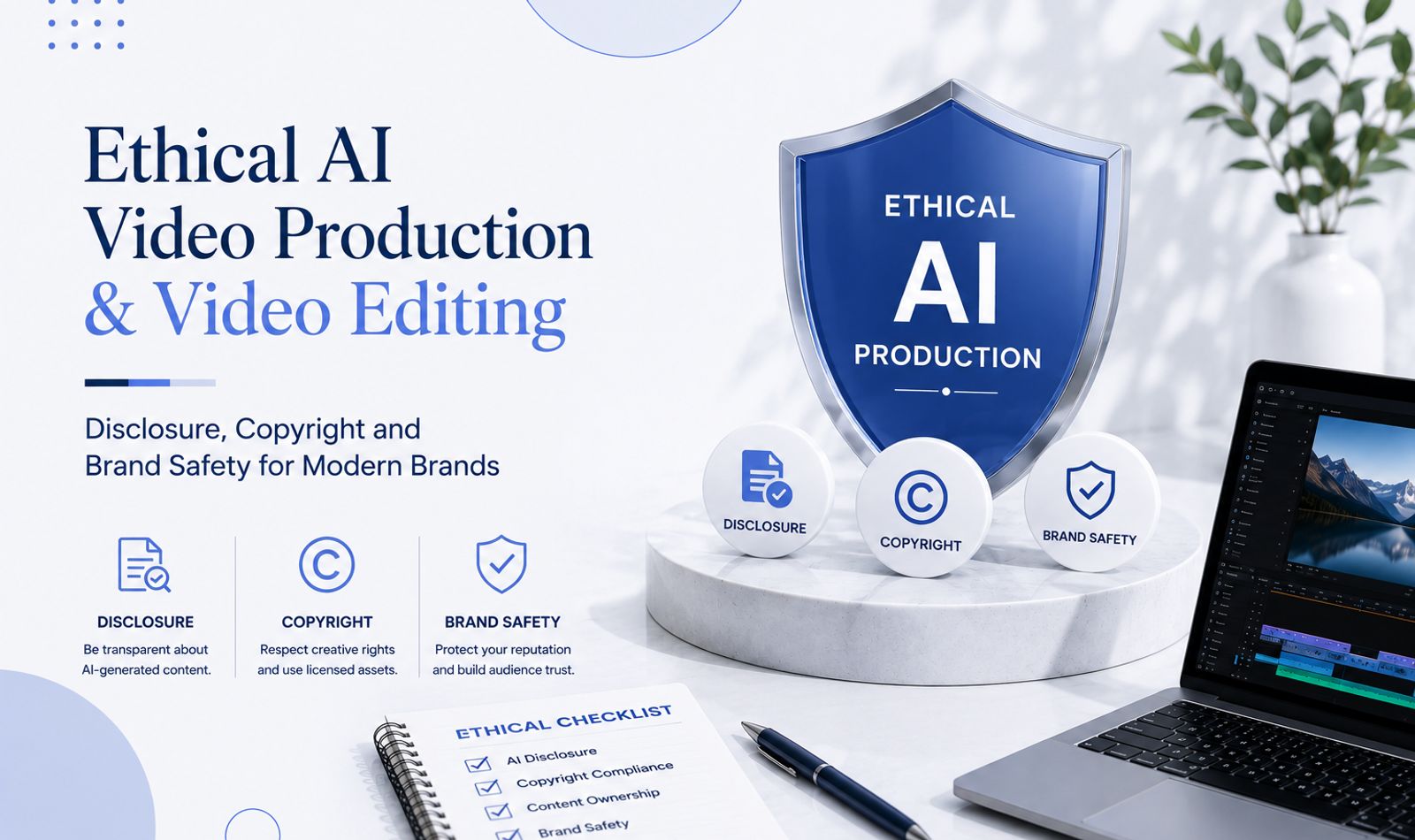
AI Video Production & Professional Editing Ethics: Disclosure, Copyright & Brand Safety
AI video production has opened a new creative chapter for modern brands.
Businesses can now create cinematic scenes, animated product visuals, social reels, avatar-led explainers, event teasers, campaign mock-ups and video ads faster than ever before.
A fashion brand can turn a still campaign image into motion.
A hospitality brand can create a destination teaser before the final shoot.
A digital agency can produce AI-assisted ad visuals for multiple platforms.
An event company can visualise stage concepts, animated invitations and post-event social cutdowns with greater speed.
At the same time, professional video editing continues to shape the final quality of these videos.
Editors refine pacing, sound, colour, graphics, transitions, subtitles and final exports.
AI may create assets, but editing decides how the final story feels.
This combination of AI video and VFX production and professional editing is powerful.
But it also creates new responsibilities.
A brand must now ask more than “Does this video look good?”
It must ask whether the video is accurate, transparent, legally safe, ethically produced and aligned with brand trust.
AI can generate people who do not exist.
It can imitate voices.
It can alter products.
It can create scenes that look real but never happened.
It can unintentionally use visual styles, music, faces, logos or references that create copyright, likeness or reputation risks.
Professional editing can also create ethical issues when footage is cut in a misleading way, testimonials are manipulated, results are exaggerated or disclosure is hidden.
For brands, the question is no longer whether AI video should be used.
The real question is how it should be used responsibly.
Ethical AI video production protects the audience, the brand, the creator, the client and the platform.
It helps brands use new technology without damaging trust.
It also makes the final content more credible.
A beautiful AI-generated ad can still fail if customers feel misled.
A cinematic product video can damage reputation if the product shown does not match reality.
A testimonial-style AI avatar can create backlash if viewers believe they are watching a real customer.
A brand-safety mistake can turn a creative experiment into a public problem.
This is why disclosure, copyright and brand safety must be part of the video production workflow from the beginning.
What Is Ethical AI Video Production?
Ethical AI video production means using artificial intelligence in a way that is transparent, lawful, respectful, accurate and brand-safe.
It does not mean brands cannot use AI.
It means AI should be used with clear boundaries.
The audience should not be misled about what they are watching.
Creators and rights holders should not be exploited.
Real people’s faces, voices and identities should not be used without permission.
Products should not be shown inaccurately.
Claims should not be exaggerated.
Video editing should not distort truth in a way that creates false impressions.
For brands, ethical AI video production is also a business decision.
Trust is one of the most valuable brand assets.
A short-term creative shortcut can create long-term reputation damage if the content appears deceptive or careless.
Ethical production protects both creativity and credibility.
Why Ethics Matter in AI Video and Editing
Video is emotionally persuasive.
People believe what they see and hear.
When AI makes synthetic scenes look realistic, the responsibility of the brand increases.
A viewer may not know whether a person, place, event or statement is real.
This matters especially in advertising, testimonials, political content, health communication, luxury products, financial services, education, recruitment, hospitality and public announcements.
Even when the content is creative, the brand should consider how audiences may interpret it.
A surreal fashion film may not need the same disclosure as a realistic fake customer testimonial.
An AI-generated fantasy city may be acceptable when clearly stylised.
A fake founder statement or synthetic event crowd is far more risky.
Ethics matter because AI can blur the line between imagination and evidence.
Brands must protect that line.
AI Video Is Not Automatically Unethical
AI video is a tool.
It can be used responsibly or irresponsibly.
A brand can ethically use AI to create mood films, concept visuals, animated invitations, stylised backgrounds, captions, editing support and social-first creative.
AI can help small businesses produce better content.
It can help agencies test ideas faster.
It can make video production more accessible.
It can reduce unnecessary reshoots and support multilingual communication.
The issue is not the existence of AI.
The issue is whether the content misleads, copies, manipulates or violates rights.
A responsible brand can use AI creatively while still being transparent and careful.
The goal is not to avoid AI.
The goal is to use it with standards.
Brands can also integrate responsible AI production into a broader web development and digital marketing strategy, ensuring that video, website content, SEO and campaign communication all reinforce the same brand standards.
Disclosure in AI Video Production
Disclosure means telling the audience when AI has been used in a way that could affect how they understand the content.
Not every internal use of AI requires a public label.
For example, using AI to brainstorm a script, generate captions, clean audio or organise footage may not materially change what the viewer sees.
However, disclosure becomes important when AI creates or changes realistic people, places, actions, events, testimonials, endorsements or product demonstrations.
A viewer should not believe a real customer spoke when the person was generated.
They should not believe a real event happened when the crowd was synthetic.
They should not believe a product can do something when the effect was AI-created.
Disclosure protects audience trust.
It also protects the brand from accusations of deception.
When Brands Should Disclose AI Use
Brands should strongly consider disclosure when AI creates or alters realistic content in a way that could influence consumer understanding.
This includes AI-generated humans, AI avatars, synthetic voices, deepfake-style content, fictional customer testimonials, altered product demonstrations, artificial event crowds, fake locations, synthetic before-and-after results and realistic scenes that did not happen.
Disclosure is also important when AI materially changes real footage.
For example, if a video removes important context, changes a person’s appearance, modifies a product or creates a fake environment around a real subject, the audience may need to know.
The key question is simple.
Would the viewer understand the content differently if they knew AI was used?
If the answer is yes, disclosure is usually the safer and more ethical choice.
When AI Disclosure May Not Be Necessary
Not every AI-assisted workflow needs public disclosure.
AI may be used for internal brainstorming, spelling correction, editing timelines, automatic captions, colour matching, audio cleanup, background noise reduction, file organisation or rough storyboarding.
These uses support production but do not necessarily change the viewer’s understanding of the message.
YouTube has stated that creators do not need to disclose generative AI used for productivity purposes such as scripts, content ideas or automatic captions, and it also excludes unrealistic or inconsequential synthetic changes from required disclosure.
Still, brands should not use this as an excuse to hide meaningful AI use.
The decision should be based on audience impact, not only technical process.
A small editing assist is different from a realistic synthetic spokesperson.
Disclosure for AI Avatars
AI avatars are useful for explainers, training videos, onboarding, internal updates and multilingual content.
But brands should be clear when the presenter is synthetic.
This is especially important when the avatar appears to be a real employee, expert, customer or public figure.
An AI avatar should not be used to imply personal experience that does not exist.
For example, an AI avatar should not say, “I used this service and loved the results,” unless the statement is clearly fictional or based on an actual approved testimonial presented transparently.
Avatar videos are safest when used for neutral explanation.
They can explain a process, introduce a training module or present general brand information.
They should be handled carefully when trust, expertise or personal experience is central to the message.
Realated Guide:- AI avatars vs real models for brand advertising
Disclosure for AI Influencers
AI influencers are synthetic personalities created for social media or brand campaigns.
They may look like real people, wear products, attend fictional events or speak on behalf of brands.
This creates serious transparency questions.
If the audience believes the influencer is a real person with real experiences, they may be misled.
Brands using AI influencers should disclose that the personality is virtual or AI-generated.
They should also avoid presenting fake lived experiences as real.
A virtual character can be part of a creative campaign.
It should not pretend to be a real customer, journalist, doctor, guest or independent reviewer.
For campaigns involving real creators, public personalities or artists, brands can instead build a properly managed celebrity management strategy with appropriate approvals and usage rights.
Disclosure for AI Testimonials
Testimonials carry trust because they appear to come from real customer experience.
This makes AI use especially sensitive.
Brands should not create fake customer testimonials using AI-generated people, voices or scripts.
They should not use synthetic avatars to represent fictional satisfied customers without clear disclosure.
They should not edit real testimonials in a way that changes meaning.
A testimonial should be based on genuine customer experience and permission.
AI can help edit, subtitle or translate testimonial content, but it should not fabricate the underlying experience.
Trust-based content should remain honest.
A false testimonial can damage reputation far more than it helps conversion.
Disclosure for AI Product Demonstrations
Product demonstrations must be accurate.
AI should not show a product doing something it cannot do.
A skincare product should not be shown creating instant unrealistic transformation.
A car should not be shown with features it does not have.
A luxury item should not appear in a colour, shape or material that differs from the real product unless clearly presented as a concept.
An event setup should not be shown as completed work if it is only a speculative AI visual.
AI can create concept films and visualisations, but the brand should label them appropriately when needed.
Words like “concept visual,” “AI-generated visualisation,” or “creative representation” can help prevent confusion.
Disclosure for Event Videos
Event brands should be careful when using AI in event videos.
A real event recap should show what actually happened.
AI can enhance titles, transitions, graphics, cutdowns and visual polish, but it should not create fake guest attendance, fake celebrity presence, fake stage scale or fake crowd reactions.
Pre-event concept videos can use AI to show a proposed theme or mood.
These should not be presented as past execution.
The difference between “we created this event” and “we can imagine this event” must remain clear.
For event companies, credibility depends on proof.
AI concept visuals can sell ideas, but real recaps should remain truthful.
Brands producing weddings, launches, celebrations and experiential campaigns can combine AI visualisation with professional events and weddings management so the creative promise remains connected to real-world execution.
Copyright in AI Video Production
Copyright is one of the most important legal and ethical issues in AI video.
AI-generated content can raise questions about training data, prompts, reference images, music, visual style, logos, characters, artworks and final ownership.
A brand should not assume that every AI-generated output is automatically safe for commercial use.
The team should review the terms of the AI tool being used.
Some tools allow commercial use under certain plans.
Some have restrictions.
Some may provide indemnity only for enterprise users.
Some may require specific conditions.
The brand should also review whether prompts or references include copyrighted material.
Using another artist’s work, competitor campaign, film still, celebrity image or brand logo as a reference can create risk.
Copyright and Reference Material
AI tools often work better when given references.
But references must be used carefully.
A brand should avoid uploading copyrighted images, campaign films, music videos, celebrity photographs, editorial shoots or competitor assets unless it has rights to use them.
Using a reference to copy another brand’s style can also create ethical and reputation risk.
A luxury brand should not ask AI to create a video “in the exact style” of a living artist, director, photographer or competitor campaign.
Inspired creative direction is different from imitation.
The safer approach is to describe visual qualities in general terms.
For example, use “soft cinematic lighting, minimal luxury composition, slow camera movement and refined colour palette” instead of naming a specific artist or copying a particular campaign.
Copyright and Music
Music is a major risk area in video production.
Brands should use music that is licensed for the intended platform and campaign type.
A track available for personal use may not be cleared for paid advertising.
A trending sound on a social platform may not be safe for commercial campaigns outside that platform.
Event recap videos often use popular songs because they feel emotional or recognisable.
This can create copyright problems when the video is posted publicly, boosted as an ad, uploaded to YouTube or used in brand presentations.
Professional production should use licensed music, original music or approved platform sounds according to the intended use.
Music rights should be checked before editing begins.
Copyright and Stock Footage
Stock footage can support brand videos, but licensing matters.
The team should confirm whether the footage is allowed for commercial use, paid ads, social media, website publishing and client work.
Some licences restrict sensitive use, reselling, modification or high-volume distribution.
AI-generated stock-style visuals should also be reviewed.
If the content includes recognisable locations, logos, artworks, trademarks or people, additional rights may be needed.
Stock footage should also match the brand honestly.
A hotel brand should not use unrelated stock footage in a way that makes viewers believe it shows the actual property.
Copyright and Professional Editing Assets
Video editing often uses fonts, templates, motion graphics, overlays, plugins, LUTs and sound effects.
These assets also have licences.
A template downloaded from the internet may not be cleared for client advertising.
A font may require a commercial licence.
A sound effect may be royalty-free only under certain conditions.
Ethical video editing includes rights management for every element in the final video.
A brand-safe workflow keeps records of music licences, font licences, stock assets, AI tool terms, talent releases and final approvals.
This may feel administrative, but it protects the brand.
Likeness Rights and Consent
AI makes it easier to recreate faces, voices and bodies.
This creates serious consent issues.
A person’s likeness should not be used without permission.
This applies to celebrities, influencers, employees, customers, models, founders, speakers and guests.
A brand should not use AI to make a person appear in a video they did not approve.
It should not clone a voice without written consent.
It should not use an employee’s face as an avatar without clear agreement.
It should not create fake celebrity endorsements.
When real celebrities or public figures are involved, structured celebrity management can help ensure appearances, communication and brand associations are managed professionally.
Likeness rights are not only legal concerns.
They are ethical concerns.
People should control how their identity is used.
Consent for Employees and Founders
Brands may assume they can use employee images freely because the person works for the company.
This is not always safe.
If an employee’s face, voice or performance is used in video content, the brand should have clear permission.
This is especially important if the content will be used in advertising, AI avatars, internal training, recruitment videos or long-term campaigns.
Founders should also define how their likeness can be used.
An AI-generated founder voice or avatar may seem efficient, but it can feel misleading if audiences believe the founder personally recorded the message.
Synthetic founder content should be used carefully and transparently.
Consent for Event Guests
Event videos often include many guests.
A brand should consider consent, privacy and context.
For public events, recording may be expected, but privacy should still be respected.
For private luxury events, weddings, corporate gatherings and celebrity events, consent becomes more sensitive.
Guests may not want their faces used in public ads.
Children require extra care.
VIPs and celebrities may have strict image-use restrictions.
Professional guest management services can help event brands build more organised guest journeys where access, VIP handling and communication are treated as part of the wider experience.
An event recap should be edited responsibly.
A guest’s private moment should not be used out of context for promotion.
AI should not be used to add guests, alter attendance or exaggerate crowd size.
Consent for Voice Cloning
Voice cloning can save time, but it carries high risk.
A cloned voice can make it appear that someone said something they never recorded.
Brands should never clone a voice without explicit permission.
The agreement should define where the voice can be used, for how long, in which languages and for what type of content.
Voice cloning should not be used for sensitive statements, crisis communication, customer testimonials or legal announcements without careful review.
Even with permission, disclosure may be necessary depending on the context.
A synthetic voice can be useful, but it should not replace honesty.
Brand Safety in AI Video
Brand safety means protecting the brand from content that creates legal, ethical, reputational or commercial risk.
In AI video, brand safety includes product accuracy, visual quality, disclosure, rights, platform policy, audience interpretation and public reaction.
A video can be technically impressive but unsafe.
It may show a product incorrectly.
It may resemble a competitor’s campaign.
It may create unrealistic results.
It may use a synthetic person without disclosure.
It may include accidental bias, offensive symbols or distorted body features.
It may place the brand in an unsuitable context.
Brand safety should be checked before publishing.
The review should include creative, legal, marketing and leadership perspectives when the campaign is important.
For brands managing reputation across multiple channels, PR, media and marketing should also be connected to the AI-content approval process.
Product Accuracy and AI Risk
AI can distort products.
It may change logos, colours, packaging, proportions, materials, buttons, labels or features.
This is risky for luxury, fashion, jewellery, food, automobiles, real estate, beauty and technology brands.
Customers expect the product shown in the video to match reality.
Brands should not rely on AI output without product review.
A product expert should check the final video before it goes live.
Claims and Results
AI video should not exaggerate product or service results.
A beauty brand should not show unrealistic skin transformation.
A fitness brand should not show impossible body changes.
A digital agency should not show fake analytics.
An event company should not show fictional attendance as real.
A luxury service brand should not show outcomes it cannot deliver.
Claims should be supportable.
If the video is conceptual, it should be clear.
If the result is simulated, the audience should not mistake it for proof.
Professional editing should also avoid misleading before-and-after sequences.
The edit should not remove context in a way that creates false expectations.
Brand Tone and AI Overuse
AI effects can quickly become excessive.
Brands may use dramatic transformations, surreal visuals and fast transitions because the tool makes them easy.
But luxury and premium communication often requires restraint.
Too many AI effects can make a brand look gimmicky.
A high-end brand should use AI to elevate the story, not overwhelm it.
The content should still feel aligned with the brand’s voice, colours, typography, product category and customer expectations.
Brand safety includes taste.
A video can be legally safe but visually wrong for the brand.
Brands can review examples of completed creative and digital projects through the Double Trouble Studio work portfolio when considering how visual execution supports broader positioning.
Platform Rules and AI Content
Platforms are increasingly adding AI disclosure and synthetic media policies.
YouTube requires disclosure for certain realistic altered or synthetic content and says disclosure is not required for productivity uses such as scripts or automatic captions.
Meta also provides disclosure and labelling mechanisms around AI-generated or AI-edited media.
Brands should not assume platform rules are static.
Policies change as AI tools develop.
Before launching important campaigns, teams should review the latest requirements for YouTube, Instagram, Facebook, LinkedIn, TikTok, Google Ads and any other platform being used.
A video approved for organic posting may require different treatment when used as paid advertising.
AI Advertising Disclosure in India
Indian brands should also monitor advertising standards and applicable regulations as AI advertising guidance develops.
Brands should verify the current position before publishing major AI-led campaigns.
Even where rules are developing, transparency remains good practice.
If AI materially changes what the audience believes about a product, person, result or endorsement, disclosure should be considered.
For influencer and creator campaigns, material connections such as payment, gifts, travel or other benefits should also be disclosed according to applicable advertising standards.
A broader PR and media marketing strategy can help brands ensure creator communication, campaign messaging and reputation management remain aligned.
Paid Ads and AI Video
Paid ads need extra care because they are designed to influence consumer decisions directly.
An AI-generated ad should be reviewed for disclosure, accuracy, targeting, claims, rights and platform policy.
The brand should also check automatic platform enhancements.
Some ad platforms may offer AI-generated variations, backgrounds, image adjustments or creative optimisations.
These settings can save time, but they can also change creative assets in unexpected ways.
The brand should review all generated variants before approval.
AI-assisted ad tools should not be allowed to modify product visuals, claims or brand identity without human review.
Performance should never come at the cost of accuracy.
AI-led advertising should also be integrated with the brand’s wider website and digital marketing ecosystem, so traffic generated by creative campaigns reaches accurate, trustworthy and conversion-ready pages.
Editing Ethics
Ethical video editing is just as important as ethical AI generation.
Editors can change meaning through cuts, sequencing, music, captions and context.
A testimonial can be edited to sound more positive than intended.
A speech can be shortened in a way that changes meaning.
An event recap can exaggerate attendance by repeatedly showing the same crowd from different angles.
A before-and-after video can mislead through lighting, camera angle or timing.
Ethical editing means preserving the truth of the material.
Creative polish is acceptable.
Misrepresentation is not.
The final video should communicate the strongest version of reality without creating a false version of it.
Ethical Editing for Testimonials
Testimonials should be edited carefully.
The editor can remove pauses, repetition and unclear sections.
But the meaning should remain accurate.
A customer should not appear to endorse a product feature they did not mention.
Their words should not be rearranged to create a stronger claim.
If subtitles are added, they should match the spoken words.
If translation is used, it should preserve meaning.
Testimonials work because they are trusted.
That trust should not be weakened through over-editing.
Ethical Editing for Event Recaps
Event recaps should show the real event.
The editor can choose the most beautiful and energetic shots.
They can use music, colour grading and motion graphics to make the recap cinematic.
But they should not misrepresent scale, attendance, celebrity presence, sponsor participation or guest experience.
AI should not be used to add fake crowds or fictional décor to a real recap.
If AI is used to create concept visuals, those visuals should be separated from real event documentation.
Future clients rely on recaps as proof of execution.
That proof must remain honest.
For professional celebrations and experiential campaigns, the content should remain connected to the actual standards delivered through events and weddings management.
Ethical Editing for Luxury Ads
Luxury advertising often uses mood, aspiration and stylisation.
This is acceptable when the audience understands the creative nature of the ad.
But the product should still be represented responsibly.
A jewellery video should not make a stone appear much larger than reality.
A hotel video should not imply access to amenities that do not exist.
A car rental video should not show a model unavailable in the fleet.
A beauty product should not show impossible results created entirely through editing or AI effects.
Luxury advertising can be aspirational.
It should not be deceptive.
Brand Approval Workflow
A responsible AI video workflow needs clear approval stages.
The first approval should cover the concept and script.
The second should cover AI-generated visuals or storyboard frames.
The third should cover the rough edit.
The fourth should cover final quality, disclosure, rights and platform delivery.
Each stage should include the right people.
Creative teams review style and storytelling.
Marketing teams review message and CTA.
Product teams review accuracy.
Legal or compliance teams review claims, rights and risk.
Leadership reviews major campaigns.
This workflow prevents last-minute problems.
It also makes the production team more confident before publishing.
Documentation and Record Keeping
Brands should document the AI and editing process.
This can include prompts, source images, licences, music tracks, font licences, stock footage receipts, consent forms, talent releases, avatar permissions, voice permissions, platform settings and final approvals.
Documentation helps if questions arise later.
It also supports consistency across campaigns.
For agencies, documentation protects both the agency and the client.
For brands, it creates a responsible production record.
AI video should not be treated casually simply because it is fast.
Professional workflows need professional records.
Internal AI Video Policy
Modern brands should create an internal AI video policy.
The policy should define what AI can and cannot be used for.
It should explain disclosure requirements, consent rules, copyright checks, product accuracy review and approval stages.
It should identify who can approve synthetic people, voice cloning, AI influencers, AI product demos and paid ads.
It should also explain what types of content are prohibited.
For example, the brand may prohibit fake testimonials, undisclosed deepfakes, synthetic customer reviews, competitor imitation and unlicensed celebrity likeness use.
A clear policy helps teams work faster without guessing.
Working With AI Video Agencies
Brands should choose AI video partners carefully.
The agency should understand not only tools, but also ethics, editing, rights and brand safety.
A strong partner should ask about usage rights, disclosure, product accuracy, platform placement and approval processes.
They should not promise that anything can be generated without risk.
They should be able to explain when real footage is better than AI.
They should also know when AI visuals need disclosure or when a concept should be labelled as a visualisation.
Brands exploring this production model can review dedicated AI video and VFX services to understand how generative production can be combined with professional post-production and brand-led creative direction.
Ethical production partners protect the brand.
They do not simply create impressive visuals.
Questions Brands Should Ask Before Publishing
Before publishing an AI-assisted video, the team should ask several questions.
Does the video show real events, or does it include synthetic scenes?
Could viewers misunderstand what is real?
Does the video use any real person’s face, voice or likeness?
Do we have permission?
Does the product look accurate?
Are claims supportable?
Is the music licensed?
Are stock assets cleared?
Does the platform require disclosure?
Does the brand tone feel appropriate?
Has the final edit changed meaning in any misleading way?
These questions should be part of the workflow, not an afterthought.
Brand Safety Checklist
A practical brand-safety review should include product accuracy, disclosure, copyright, music licensing, likeness consent, platform rules, claims, testimonials, AI distortions, competitor similarity, cultural sensitivity, privacy, accessibility and final export quality.
The review should be completed before publishing.
For paid campaigns, it should be even stricter.
Once an AI video enters public distribution, errors can spread quickly.
A careful review may take time, but it protects the brand from bigger problems later.
AI Video for Luxury Brands
Luxury brands need special care because their value depends heavily on trust, detail and perception.
A luxury customer expects quality.
If an AI video distorts a product, overuses effects or feels visually cheap, the brand can lose prestige.
Luxury AI video should be controlled, refined and aligned with the brand’s identity.
Disclosure should be considered when synthetic content could influence interpretation.
Copyright and music should be handled professionally.
The final edit should feel premium and polished.
For luxury brands, ethical AI use is not only about compliance.
It is about protecting desirability.
AI Video for Events
Event brands can use AI for teasers, concept films, moodboards, animated invites, sponsor visuals and social cutdowns.
But real event recaps should remain truthful.
AI should not invent attendance, guest reactions, venue scale or celebrity presence.
Private events also require privacy review.
Guests, children, VIPs and sponsors may have different levels of consent.
AI should not be used to alter people’s appearance or create synthetic participation without permission.
For event companies, the recap is proof.
That proof should be beautiful, but honest.
For projects involving high-profile guests and public personalities, celebrity management services can also form part of the wider planning and approval process.
AI Video for Digital Ads
AI video can be powerful for digital ads because it allows faster creative testing.
Brands can test different hooks, backgrounds, visuals, voiceovers and calls to action.
But ads require careful review because they directly influence consumer behaviour.
The product should be accurate.
Claims should be supportable.
Synthetic presenters should be disclosed when appropriate.
Generated visuals should not create false expectations.
Platform settings should be reviewed to prevent unwanted AI modifications.
Digital ads should be creative, but they must remain truthful.
AI Video for Internal Communication
Internal videos may seem lower risk, but ethics still matter.
AI avatars, voiceovers and training videos should not create confusion among employees.
If a message appears to come from a leader but is actually synthetic, employees should understand that clearly.
Training content should be accurate and current.
Employee likeness should not be used without consent.
Internal AI videos may not face the same public scrutiny as ads, but they still affect trust inside the organisation.
AI Video for Public Announcements
Public announcements, crisis statements and sensitive communication should be handled carefully.
In many cases, real human communication is better than AI-generated presentation.
A founder, spokesperson or leader speaking directly can create trust.
Synthetic avatars or cloned voices may feel inappropriate when the subject is serious.
If AI is used for accessibility, translation or captions, the core message should remain accurate.
Brands should avoid using AI to create distance from accountability.
In sensitive moments, authenticity matters.
The Role of Professional Editing in Brand Safety
Professional editors are not only creative technicians.
They are also final guardians of brand quality.
They can identify awkward AI distortions, poor pacing, weak claims, mismatched visuals, unclear subtitles and unsafe creative choices.
Editors can also preserve truth by avoiding misleading cuts.
A responsible editor understands that the final video represents the brand.
They should feel empowered to flag risks before publishing.
Good editing protects both aesthetics and ethics.
Building Trust Through Transparency
Transparency does not weaken creativity.
It can strengthen trust.
Audiences are becoming more aware of AI-generated content.
Many viewers do not object to AI when it is used honestly.
They object when they feel tricked.
A brand that labels AI visualisations clearly may appear more responsible than a brand that hides them.
A transparent workflow also helps internal teams feel more confident.
They know what was created, what was edited and what rights were cleared.
Trust grows when brands are clear about what they are showing.
Responsible Innovation
Modern brands should not avoid innovation because of risk.
They should innovate responsibly.
AI video can make production faster, more imaginative and more scalable.
It can help brands create visuals that were previously impossible.
It can support storytelling, social content, campaign testing and event marketing.
But responsible innovation means setting boundaries.
Not every idea should be generated.
Not every generated output should be published.
Not every technically possible edit is ethically acceptable.
The best brands will be the ones that combine creativity with judgement.
Brands can continue building this knowledge through the Double Trouble Studio blog, where strategy, digital marketing, events, AI production and brand-growth topics can support a broader content ecosystem.
Common Mistakes in Ethical AI Video
One common mistake is assuming AI-generated content is automatically copyright-free.
Another is using AI avatars or synthetic people without disclosure.
Brands may use unlicensed music, imitate competitor campaigns or alter products without review.
Some teams publish AI visuals with distorted hands, faces, logos or product details because they are focused only on speed.
Others use AI to create fake testimonials, fake event scale or unrealistic results.
Another mistake is allowing platform AI tools to automatically modify ads without checking the final result.
These mistakes can damage trust quickly.
Ethical production requires review, not just generation.
A Practical Ethical AI Video Workflow
The workflow begins with strategy.
The brand defines the objective, audience, platform and message.
The team then decides where AI will be used and whether disclosure may be required.
Scripts and storyboards are reviewed for truthfulness, claims and brand tone.
AI visuals are generated using approved references and safe prompts.
Real people, voices, music, stock footage and brand assets are checked for rights.
The editor assembles the video and reviews accuracy, pacing and meaning.
Product teams confirm that products and services are represented correctly.
Legal or compliance teams review sensitive claims, likeness permissions and platform requirements.
The final video is checked for disclosure, copyright, subtitles, audio, visuals and export format.
Only then should the video be published.
This process may sound detailed, but it saves brands from larger reputation problems later.
How Double Trouble Studio Approaches Ethical AI Video
Double Trouble Studio creates AI videos and professionally edited content for brands, events, luxury businesses and digital campaigns.
Our approach combines creative storytelling with responsible production.
Through our AI video and VFX capabilities, we use AI where it adds imagination, speed and visual impact.
We use professional editing to create rhythm, emotion, quality and platform-ready delivery.
For luxury ads, we review product accuracy, visual tone, music, typography and brand safety.
For event recaps, we protect the truth of the event while creating cinematic impact.
For AI-assisted campaigns, we consider disclosure, rights, likeness, references, platform formats and final review.
The goal is not simply to create videos that look impressive.
The goal is to create videos that brands can publish with confidence.
Conclusion
Ethical AI video production and professional video editing are now essential for modern brands.
AI has made video faster, more imaginative and more accessible, but it has also created new responsibilities around disclosure, copyright, likeness, truthfulness and brand safety.
A brand should not judge an AI video only by how cinematic it looks.
It should also ask whether the video is accurate, transparent and safe to publish.
Disclosure matters when AI materially changes what the audience believes they are seeing.
Synthetic people, AI avatars, cloned voices, fake testimonials, altered product demonstrations and realistic fictional scenes should be handled carefully.
Viewers should not be misled into believing something real happened when it did not.
Copyright also needs serious attention.
Brands should review AI tool terms, reference images, music licences, stock footage, fonts, templates and editing assets before publishing.
Using AI does not remove the need for rights management.
Likeness and consent are equally important.
Real people’s faces, voices and identities should not be used without permission.
This applies to celebrities, employees, founders, customers, guests, influencers and event attendees.
Voice cloning and synthetic avatars require especially clear consent and responsible use.
Brand safety must be built into the workflow.
AI can distort products, exaggerate results, imitate competitors, create inaccurate visuals or place the brand in unsuitable contexts.
Every AI-assisted video should be reviewed for product accuracy, claims, tone, platform rules and audience interpretation.
Professional video editing also carries ethical responsibility.
Editors can shape meaning through cuts, captions, music and sequencing.
A strong edit should polish the story without misleading the viewer.
Testimonials, event recaps, luxury ads and product videos should remain truthful even when they are cinematic.
The safest approach is a structured workflow.
Brands should define where AI is used, check disclosure requirements, verify rights, secure consent, review claims, approve final edits and document the process.
This protects the brand, the audience and the creative team.
Ethical AI video does not reduce creativity.
It makes creativity more trustworthy.
Modern audiences are becoming more aware of synthetic content, and brands that use AI responsibly can stand out for both innovation and integrity.
The future of AI video production is not careless automation.
It is responsible creativity supported by professional editing, clear disclosure, legal awareness and strong brand judgement.
When brands combine AI imagination with ethical controls, they can create videos that are not only visually impressive but also credible, safe and aligned with long-term trust.
To discuss AI video production, professional editing or digital campaign requirements, connect with Double Trouble Studio.
📩 info@dtsworld.in 📞 +91 80000 06021 📍 Andheri (West), Mumbai
Need this for your brand?
Let DTS build your next campaign.
From PR, celebrity management and events to websites, social media, SEO and AI video production — Double Trouble Studio helps brands grow with strategy and execution.
Discuss Your Requirement →