PR Strategy for a New Brand Launch in India: 90-Day Framework
Launching a new brand in India is not simply about announcing that the business exists. A successful launch requires the market to understand what the brand represents, why it matters, who it is for and why people should pay attention now.
India is an especially complex market for new brands. Audiences differ across cities, languages, income groups, industries and digital behaviours. Media publications receive hundreds of pitches. Consumers move between Instagram, Google, YouTube, news publications, creators and offline conversations before developing trust in a new company.
This is why a new-brand launch requires more than a press release.
A structured PR, media and marketing strategy should create a sequence of credible stories before, during and after launch.
The first 90 days are particularly important because they establish the foundation of the brand's public reputation.
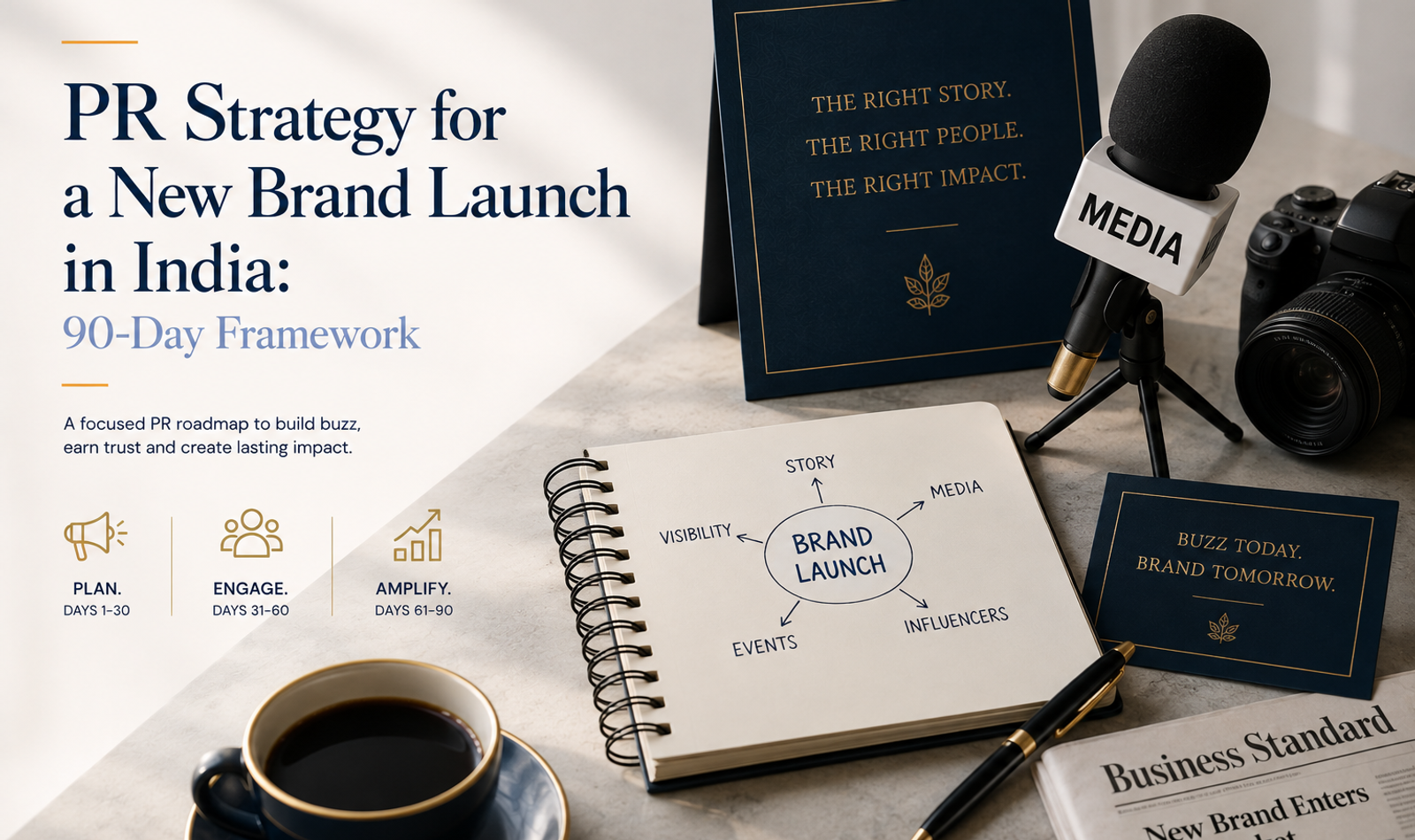
During the first 30 days, the focus should be on positioning, storytelling, media preparation and launch planning.
Days 31–60 should create concentrated visibility through media outreach, creators, interviews, events and digital amplification.
Days 61–90 should convert launch attention into longer-term authority through thought leadership, milestones, follow-up stories and continued media relationships.
The objective is not to make the brand visible for one week.
The objective is to make the right audience understand, trust and remember the brand.
What Is a Brand Launch PR Strategy?
A brand launch PR strategy is a structured communication plan designed to introduce a new company, product, service or brand identity to relevant audiences through credible third-party and owned communication channels.
It may combine:
- Media relations
- Press releases
- Founder interviews
- Thought leadership
- Influencer outreach
- Product seeding
- Launch events
- Celebrity participation
- Digital PR
- Industry commentary
- Social media amplification
- Partnerships
- Community engagement
- Brand content
PR is different from advertising.
Advertising allows a company to purchase visibility. The business controls the advertisement, audience, creative and media budget.
Earned PR works differently.
A journalist, editor, creator, industry platform or other independent voice decides whether the story is relevant enough to feature.
That independence can create credibility that advertising alone cannot provide.
However, PR should not operate separately from the wider marketing ecosystem.
A strong launch connects earned media with the brand's website and digital marketing infrastructure, social channels, content, search visibility, events and sales journey.
Why the First 90 Days Matter
A common mistake is concentrating almost the entire PR budget around launch day.
The company announces the brand, distributes a press release, invites people to a launch event, posts photographs for several days and then communication becomes quiet.
This creates a temporary spike rather than sustained momentum.
A 90-day framework creates several communication opportunities.
The first story may introduce the brand.
The second may introduce the founder.
The third may explain the market problem.
The fourth may focus on a product, collaboration or innovation.
The fifth may present early customer response.
The sixth may establish the founder as an industry voice.
PR therefore becomes a narrative rather than an announcement.
For brands combining physical experiences with communication, event and wedding management expertise can also help turn a launch into an environment where media, creators, customers and partners experience the brand directly.
Phase 1 — Days 1–30: Build the PR Foundation
The first month should primarily be about preparation.
Trying to generate coverage before the positioning, assets and messaging are ready can create inconsistent communication that becomes difficult to correct later.
1. Conduct a Brand Audit
Before asking journalists to understand the brand, the company must understand itself clearly.
A launch audit should examine:
- Brand purpose
- Target customer
- Category
- Competitors
- Pricing
- Product or service
- Differentiators
- Founder story
- Visual identity
- Tone of voice
- Market opportunity
- Existing digital presence
- Potential reputation risks
The audit should also identify gaps between how the founders describe the business and what customers are likely to understand.
If five members of the leadership team describe the company in five completely different ways, the brand is probably not ready for aggressive media outreach.
PR amplifies existing positioning.
It cannot permanently solve unclear positioning.
2. Define the Brand Narrative
A brand narrative explains the larger meaning behind the company.
A weak launch message might say:
“XYZ announces the launch of its innovative new platform in India.”
Thousands of launch announcements sound similar.
A stronger narrative answers:
What changed in the market?
What problem exists?
Why has the existing solution become insufficient?
What insight led to this brand?
How is the company approaching the problem differently?
Why is this relevant now?
A useful structure is:
Market Problem → Customer Insight → Brand Solution → Evidence → Future Vision
This structure gives journalists and customers context.
The company stops being merely "a new brand" and becomes part of a larger market story.
3. Define the Target Audience
PR should not begin with the question:
“Which publications can cover us?”
It should begin with:
“Who needs to know about us?”
A consumer brand may need to reach customers, lifestyle media, creators and retail partners.
A technology startup may prioritise founders, investors, CIOs, business publications and technology journalists.
A luxury company may target high-net-worth consumers, designers, luxury publications, hospitality professionals and relevant creators.
A wedding company may need to reach couples, families, luxury planners, hospitality partners and destination audiences.
Audience definition determines the media strategy.
Trying to be visible everywhere usually creates generic communication.
4. Research the Competitive Media Landscape
Before pitching, analyse how competitors and adjacent brands are being discussed.
Review:
- Which publications cover the category?
- Which journalists write those stories?
- Which topics receive attention?
- What founder stories are common?
- Which market statistics are frequently referenced?
- Which competitors dominate media coverage?
- Which topics appear underdeveloped?
This helps identify white space.
For example, if every competitor talks about affordability, a premium brand may differentiate through craftsmanship, service or customer experience.
PR positioning should give the media a reason to describe the company differently.
5. Develop Multiple PR Story Angles
One company should not depend on one story.
The launch itself is only the first angle.
Potential PR angles include:
Brand Launch
Why the company has entered the market.
Founder Story
The experience, insight or personal journey that led to the business.
Market Trend
A larger change in consumer or industry behaviour.
Innovation
A new technology, process, product or business model.
Indian Story
Local manufacturing, craftsmanship, culture, design or entrepreneurship.
Luxury Story
Premium positioning, exclusivity, design or experience.
Business Story
Funding, growth plans, expansion or market opportunity.
Partnership Story
A significant collaboration with another company, institution or personality.
Data Story
Original research or customer data revealing an interesting market trend.
Different stories allow the PR campaign to remain active after the initial launch announcement.
6. Build a Relevant Media List
A media database should not simply contain hundreds of email addresses.
It should be organised strategically.
Potential categories include:
- National business media
- Startup publications
- Lifestyle publications
- Luxury media
- Technology media
- Fashion media
- Hospitality media
- Marketing and advertising media
- Trade publications
- Regional publications
- Podcasts
- Newsletters
- Creator-led media platforms
Each journalist should be researched according to their actual beat.
A journalist covering venture capital should not automatically receive a beauty-product pitch simply because they work for a major publication.
A smaller niche publication with the correct audience can sometimes create more commercial value than a large but irrelevant media mention.
7. Create a Professional Media Kit
Journalists should be able to understand the brand quickly.
A complete launch media kit can contain:
- Company profile
- Founder biography
- Press release
- Fact sheet
- Product information
- Frequently asked questions
- Founder photographs
- Product photographs
- Brand logo
- Brand film
- Relevant statistics
- Website
- Social handles
- Media contact
High-resolution visual assets are particularly important for lifestyle, hospitality, fashion, design and luxury publications.
Video assets can also become valuable for digital publications and social amplification. Brands planning a visual-first launch can integrate professional content with AI video and VFX production to create launch films, campaign variations and digital storytelling assets.
8. Prepare the Founder for Media Interviews
Founders frequently become the public face of new companies.
They should therefore be prepared to explain the business clearly without depending on memorised marketing language.
Media preparation should cover:
- Company purpose
- Market opportunity
- Customer problem
- Competitive differentiation
- Pricing
- Business model
- Growth plans
- Funding
- Industry challenges
- Future vision
Difficult questions should also be anticipated.
A journalist may ask why customers need another company in an already crowded category.
They may question pricing.
They may ask about competitors.
They may challenge market claims.
Good media preparation helps founders answer confidently while remaining accurate.
9. Prepare the Website Before PR Begins
PR can create immediate search behaviour.
Someone sees the founder in an article, searches the company name and visits the website.
If the website is slow, unfinished or unclear, valuable PR attention is lost.
Before launch, the web development and marketing foundation should include:
- Clear homepage positioning
- Product/service pages
- About page
- Founder information
- Contact information
- Mobile optimisation
- Fast loading
- Search metadata
- Analytics
- Conversion tracking
- Enquiry paths
The website is where earned attention frequently becomes owned traffic.
10. Begin Controlled Pre-Launch Communication
Not every story needs to wait until launch day.
Pre-launch activity can build context through:
- Founder commentary
- Industry observations
- Behind-the-scenes content
- Select journalist briefings
- Private product demonstrations
- Creator previews
- Teaser campaigns
- Industry networking
The objective is not necessarily to reveal everything.
It is to begin establishing relevance.
Phase 2 — Days 31–60: Launch and Maximum Visibility
Once the foundation is prepared, communication can move into a more aggressive launch phase.
This is when media, creators, events, digital content and brand channels should work together.
11. Create a Strong Launch Announcement
A press release should provide clear factual information.
It should answer:
- What has launched?
- Who founded it?
- What customer problem does it solve?
- How is it different?
- Where is it available?
- Who is the target customer?
- Why is the launch relevant?
- What happens next?
Avoid filling the release with exaggerated phrases such as "revolutionary," "game-changing" or "industry-leading" unless those claims can genuinely be supported.
Facts usually create stronger journalism than adjectives.
12. Personalise Journalist Outreach
The press release is a resource.
The pitch is the reason a journalist should care.
A strong pitch should be concise and relevant to the journalist's beat.
Instead of sending identical emails to 300 people, divide outreach according to story angle.
A business journalist might receive the market and growth story.
A lifestyle editor may receive the consumer experience angle.
A technology journalist may receive the product innovation angle.
A founder-focused podcast may receive the entrepreneurial journey.
Personalisation increases relevance without requiring unnecessarily long emails.
13. Consider Strategic Exclusives
Some launch stories may benefit from an exclusive.
A selected publication could receive:
- First founder interview
- First product access
- Exclusive market data
- Behind-the-scenes access
- Launch-day interview
- Detailed business profile
Exclusivity can create stronger editorial interest because the publication receives something competitors do not.
However, exclusivity should be handled carefully.
Do not promise the same exclusive story to several publications.
14. Integrate Influencers and Creators
Media coverage builds credibility.
Creators can build relatability and conversation.
The strongest launch strategy may use both.
Creator selection should consider:
- Audience relevance
- Geography
- Content quality
- Engagement
- Credibility
- Brand fit
- Previous collaborations
- Audience demographics
A micro-influencer with a highly relevant community can sometimes produce more useful engagement than a celebrity creator with millions of unrelated followers.
The creator should also understand the brand story rather than simply receive a script.
15. Use Product Seeding Strategically
For consumer products, product seeding can introduce the brand to journalists, stylists, creators and industry professionals.
The experience should reflect the positioning.
A luxury product should not arrive in packaging that feels mass-produced or careless.
Include enough information for the recipient to understand:
- What the product is
- Why it exists
- What makes it different
- How it should be used
- Where additional information is available
However, product gifting should not automatically be treated as guaranteed editorial coverage.
16. Use a Launch Event When It Adds Strategic Value
A launch event should have a communications purpose.
It can create direct interaction between the brand and:
- Media
- Creators
- Customers
- Industry leaders
- Investors
- Partners
- Celebrities
Professional event management can turn the brand narrative into a physical experience through venue selection, stage design, hospitality, entertainment, product interaction and content moments.
The event should give guests something worth experiencing rather than simply providing a backdrop for photographs.
17. Build the Right Launch Guest List
A successful event is not defined only by the number of attendees.
The guest list should support the launch objective.
Invitees might include:
- Relevant journalists
- Editors
- Creators
- Customers
- Industry leaders
- Retail buyers
- Business partners
- Investors
- Celebrities
For premium events, professional guest management can also support invitations, RSVPs, hospitality, transport and on-ground coordination.
The objective is to bring the right people into the room.
18. Use Celebrity Participation Strategically
A celebrity appearance can create significant attention, but celebrity involvement should make sense within the brand story.
Possible roles include:
- Brand ambassador
- Campaign face
- Launch guest
- Performer
- Speaker
- Product collaborator
- Host
Professional celebrity management becomes important for negotiations, availability, contracts, logistics, technical requirements and appearance coordination.
For brands launching from India's entertainment and media hub, celebrity management in Mumbai can be particularly relevant when coordinating talent-led launch campaigns.
The most famous person is not automatically the correct person.
Audience relevance matters more.
19. Design the Launch for Content Creation
A launch event should produce content that remains valuable after the event ends.
Plan opportunities for:
- Founder interviews
- Media interactions
- Product demonstrations
- Guest reactions
- Creator content
- Photography
- Short-form videos
- Behind-the-scenes footage
- Customer testimonials
- Brand films
The physical event may last three hours.
Its digital life can last several months.
20. Amplify Earned Media Through Owned Channels
When coverage begins appearing, the brand should distribute it strategically.
Coverage can be shared through:
- Website
- Sales presentations
- Founder profiles
- Investor decks
- WhatsApp communication
The objective is to extend the credibility of earned media.
A customer who never reads the original publication may still see that the company was featured there through the brand's own communication.
Phase 3 — Days 61–90: Turn Visibility Into Authority
By the third month, simply repeating "we launched" becomes less interesting.
The PR narrative should mature.
The brand now needs to demonstrate progress, knowledge and relevance.
21. Move From Launch News to Industry Authority
The communication should evolve from:
"We are here."
to:
"Here is what we understand about this market."
This is where thought leadership becomes valuable.
Founders can contribute commentary on:
- Consumer trends
- Industry changes
- Technology
- Entrepreneurship
- Market challenges
- Luxury consumption
- Sustainability
- Design
- Marketing
- Future predictions
The objective is not to insert the company name into every paragraph.
Useful insight builds authority more effectively than constant promotion.
22. Develop Founder Thought Leadership
A strong founder can become a recurring source for journalists.
This requires having informed opinions on relevant industry developments.
When an important market story emerges, the PR team can offer the founder as an expert commentator.
Over time, journalists may begin approaching the founder directly.
That transition is significant.
The company is no longer constantly asking for media attention.
The media begins recognising the founder as a useful source.
23. Create Second-Wave PR Stories
Launch coverage should be followed by new developments.
Possible second-wave stories include:
- Customer milestones
- New partnerships
- Geographic expansion
- New products
- Major clients
- New hires
- Funding
- Awards
- Market research
- Customer behaviour data
For example, a brand beginning in Mumbai may later create regional stories as it expands into Delhi, Bengaluru or other markets.
The story changes from launch to growth.
24. Turn Early Customer Response Into Insight
The first customers can provide useful information.
What are they buying?
Which features matter most?
Which cities are responding?
Which use cases were unexpected?
Are customers using the product differently from what the company predicted?
When aggregated responsibly, these observations can become interesting PR stories.
Original data gives journalists something beyond company promotion.
25. Build Case Studies
For B2B and professional service companies, case studies can become powerful PR and marketing assets.
A useful case study explains:
Problem → Strategy → Execution → Result
Avoid vague statements such as "the campaign was extremely successful."
Provide evidence where appropriate.
Case studies can support media pitching, sales, LinkedIn, website content and digital campaigns.
Selected projects can also be presented through a dedicated work portfolio so prospects can evaluate actual experience after discovering the brand through PR.
26. Maintain Journalist Relationships
PR should never become:
Pitch → Coverage → Thank You → Disappear.
Journalists are professional relationships, not distribution channels.
Continue communicating when there is genuine relevance.
You may share:
- Useful research
- Market data
- Expert commentary
- Significant company developments
- Industry insights
Do not send a press release every time something minor happens.
Relevance protects the relationship.
PR + Social Media: Create a Connected Launch System
PR becomes significantly more powerful when combined with social media.
A journalist article can become a LinkedIn founder post.
A founder interview can become short-form video.
A launch event can generate Instagram content.
A creator review can become retargeting material where permissions allow.
A customer question can become educational content.
This creates a cycle:
PR → Social Proof → Engagement → Search → Website → Enquiry → Customer
Each channel strengthens another.
PR + SEO: Turn Media Attention Into Search Visibility
PR and SEO increasingly overlap.
When credible digital publications mention a company, people may search for the brand.
Relevant editorial backlinks can also support the website's authority.
A good digital PR strategy should therefore work alongside search and website strategy.
The brand can create:
- Founder pages
- Press pages
- Research
- Guides
- Original data
- Case studies
- Expert articles
This creates useful destinations for media links while strengthening the website's content ecosystem.
Readers discovering the company through coverage can then explore further insights through the Double Trouble Studio blog.
PR + Events: Create Experiences Worth Talking About
Some brand stories become significantly stronger when people experience them physically.
This is especially relevant for:
- Fashion
- Beauty
- Hospitality
- Automobiles
- Luxury
- Food and beverage
- Technology
- Lifestyle products
A launch can include demonstrations, immersive installations, private previews, performances, founder interactions or curated hospitality.
But the event should remain connected to the communication strategy.
The question should not be:
"How do we make this event look expensive?"
It should be:
"What should guests understand and remember after experiencing the brand?"
PR + Celebrity: Borrow Attention Without Losing the Brand
Celebrity involvement can rapidly increase launch visibility.
However, there is a risk.
If the celebrity becomes more memorable than the company, the campaign may generate attention without building brand recall.
The brand should therefore ensure:
- Clear relevance between talent and product
- Visible brand integration
- Defined content rights
- Media opportunities
- Social deliverables where applicable
- Strong messaging
- Planned amplification
Celebrity participation should strengthen the story rather than replace it.
Measuring a 90-Day PR Campaign
PR should be measured through several layers.
Media Quality
Track:
- Number of relevant articles
- Publication quality
- Journalist relevance
- Message inclusion
- Founder mentions
- Product mentions
- Sentiment
Ten strong articles in relevant publications may be more valuable than fifty low-quality syndications.
Digital Impact
Track:
- Referral traffic
- Branded search
- Website visits
- Backlinks
- Social mentions
- Follower growth
- Video views
- Content engagement
A spike in branded search after a major media feature can indicate that PR generated genuine curiosity.
Business Impact
Track:
- Enquiries
- Qualified leads
- Retail interest
- Partnership opportunities
- Investor conversations
- Sales
- Customer acquisition
- Event invitations
- Speaking opportunities
Not every result can be attributed perfectly to one article.
PR often influences the customer journey indirectly.
A Practical 90-Day PR Framework
Period
Objective
Main Activities
Days 1–15
Strategy
Brand audit, positioning, competitor analysis and audience definition
Days 16–30
Preparation
Narrative, media list, media kit, founder preparation, website and pre-launch communication
Days 31–45
Launch
Press announcement, personalised pitching, interviews and creator outreach
Days 46–60
Amplification
Launch event, influencer activation, celebrity participation, product seeding and content distribution
Days 61–75
Authority
Founder thought leadership, expert commentary, case studies and industry stories
Days 76–90
Momentum
Milestones, second-wave media outreach, regional stories, PR amplification and campaign reporting
Common PR Mistakes During a New Brand Launch
Starting PR Too Late
Contacting journalists two days before launch creates unnecessary pressure and limits opportunities.
PR preparation should begin weeks earlier.
Sending the Same Pitch to Everyone
Business, technology, fashion and lifestyle journalists have different audiences.
The story should reflect their beat.
Depending Only on a Press Release
A press release provides information.
It does not automatically create interest.
Story angles and personalised pitching are still necessary.
Chasing Only Large Publications
National publications are valuable, but relevant trade, regional and niche media can also influence highly valuable audiences.
Selecting Creators Only by Followers
Audience fit, credibility and content quality are more important than raw follower numbers.
Having a Poor Website
PR generates curiosity.
If users cannot understand the company after searching for it, that attention is wasted.
Expecting Guaranteed Editorial Coverage
Independent editorial coverage cannot legitimately be guaranteed.
Journalists and editors decide what they publish.
Stopping After Launch Week
The launch announcement is only the beginning.
Authority develops through sustained communication.
Frequently Asked Questions
Q1. When should PR start before launching a new brand in India?
PR preparation should ideally begin several weeks before launch. This provides time to develop positioning, prepare assets, research journalists, build story angles and train founders before outreach begins.
Q2. Does every new brand need a press release?
Not necessarily, but a press release is useful when there is a genuine announcement requiring a clear factual reference. It should normally be supported by personalised pitches rather than distributed alone.
Q3. How long should a launch PR campaign run?
A 90-day framework provides a useful starting structure because it covers preparation, launch and post-launch momentum. PR should continue beyond 90 days as the company develops new stories.
Q4. Should a startup use influencers for its launch?
Influencers can be useful when they reach the right customer community. Creator selection should focus on relevance, credibility, audience quality and brand alignment.
Q5. Can PR guarantee coverage?
Earned editorial coverage cannot be guaranteed because independent journalists and editors control publication decisions. Paid partnerships and sponsored media are separate activities and should be identified appropriately.
Q6. Does every brand need a launch event?
No. A launch event is valuable when physical experience, demonstrations, networking, media access or content creation meaningfully support the launch strategy.
Q7. Should a new brand hire a celebrity for its launch?
Only when there is a strategic fit between the celebrity, audience, product and brand positioning. Celebrity attention without brand relevance can create visibility without meaningful recall.
Q8. Can PR improve SEO?
Digital PR can support SEO through genuine editorial mentions, referral traffic, brand searches and relevant backlinks from credible publications.
Q9. How should PR success be measured?
Measure media relevance and quality alongside branded searches, website traffic, backlinks, social conversation, enquiries, partnerships and commercial opportunities.
Q10. What happens after the first 90 days?
The strategy should shift from launch communication towards sustained reputation building, founder thought leadership, customer stories, business milestones, research, partnerships and industry commentary.
Conclusion
A successful new-brand launch in India is not created by one press release, one influencer campaign or one launch party.
It requires a communication system.
The first 30 days establish the story.
The next 30 days create visibility.
The final 30 days turn that visibility into authority and momentum.
Throughout those 90 days, media relations, founders, creators, events, digital marketing, website experience, SEO and social communication should reinforce the same positioning.
The strongest launch does not necessarily create the highest number of mentions.
It ensures that the right people hear the right story from credible sources at the right time.
When that happens consistently, PR moves beyond publicity.
It begins building reputation.
Build a PR Launch Strategy That Continues Beyond Launch Day
A new brand gets only one opportunity to enter the market for the first time, but the story surrounding that launch can continue evolving for months.
At Double Trouble Studio, we integrate PR, media and marketing with digital strategy, events, creator communication, celebrity management, content and web experiences to build launch campaigns around both visibility and long-term brand value.
Explore Double Trouble Studio, discover our service locations across India, or contact our team to discuss your upcoming brand launch.
📩 info@dtsworld.in 📞 +91 80000 06021 📍 Andheri (West), Mumbai
Need this for your brand?
Let DTS build your next campaign.
From PR, celebrity management and events to websites, social media, SEO and AI video production — Double Trouble Studio helps brands grow with strategy and execution.
Discuss Your Requirement →