"How do we know PR is actually working?" is one of the most common questions marketing leaders ask, and one of the hardest for PR teams to answer well. Unlike a paid ad campaign, PR doesn't come with a click-through rate baked into the platform. For years, the default answer was a clip count and a vague reference to "brand awareness," which satisfied almost no one.
That's finally changing. Industry-wide surveys of PR professionals now consistently show leadership asking for a clearer line of sight into PR's actual business impact, not just activity reports. At the same time, measurement practices are shifting — from counting placements toward understanding sentiment, share of voice, and downstream business outcomes.
This guide breaks down the metrics that actually matter, how to calculate them, and how to build a reporting structure that proves PR's value in language leadership actually trusts.
Why Old PR Measurement Habits Don't Hold Up Anymore
For a long time, the standard PR report was built around two numbers: total placements, and Advertising Value Equivalency (AVE) — a calculation estimating what the equivalent ad space would have cost.
Both numbers are still common in reports today. Industry surveys show placement volume and reach remain the two most-tracked PR metrics, even as more strategic measures like share of voice and sentiment lag behind in actual adoption.
The problem is that neither number says much about impact. A hundred low-quality placements in irrelevant outlets can outnumber ten placements in exactly the right publications, while contributing far less real value. AVE, for its part, has been formally discredited by the PR industry's own professional bodies for years, because it measures what space would have cost as an ad — not what earned coverage is actually worth, which is a fundamentally different thing.
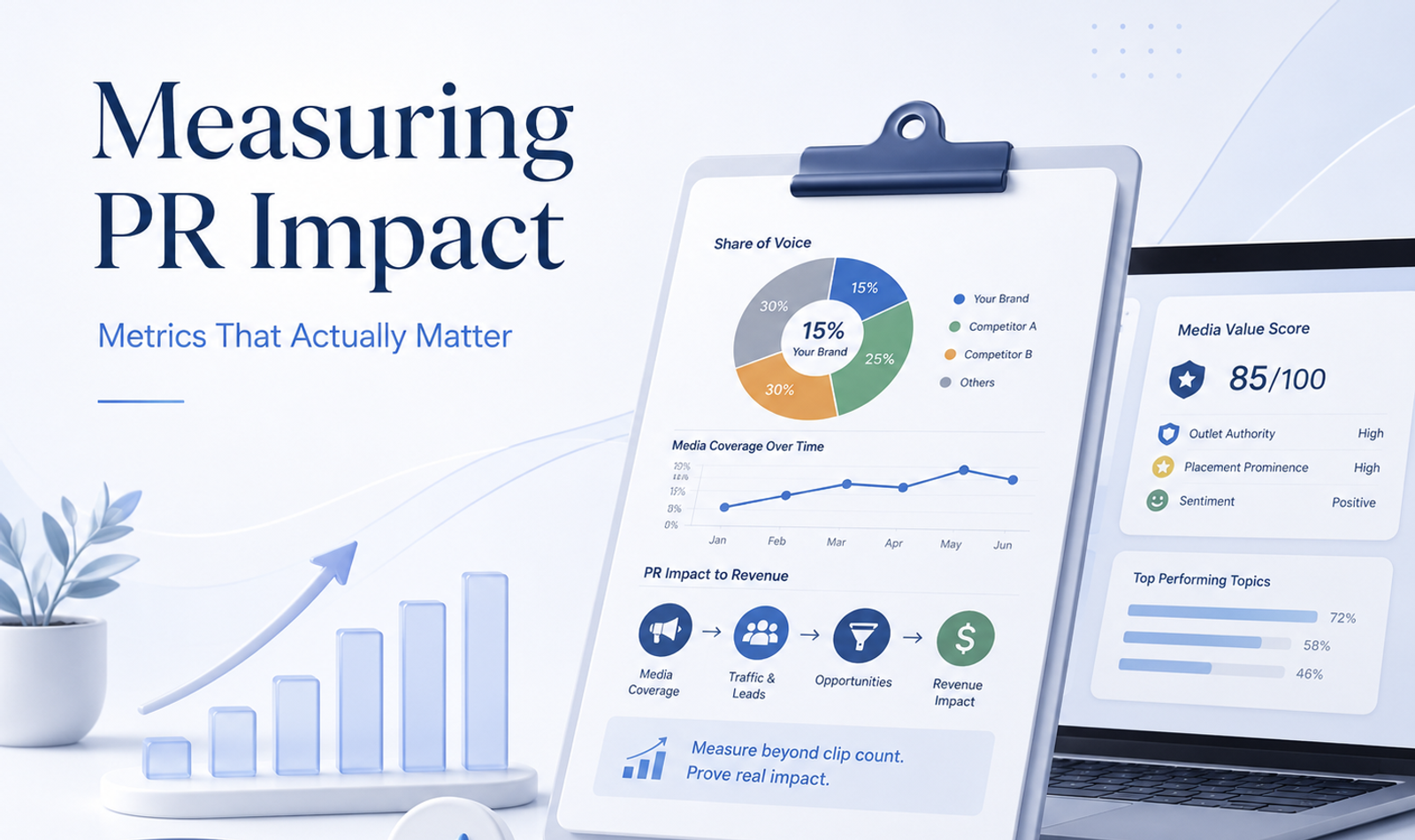
Modern PR measurement replaces this with a framework built around four connected layers: media value, share of voice, lead and revenue attribution, and brand impact. Each layer answers a different question, and together they give a far more honest picture than a clip count ever could.
Layer One: Media Value

Media value asks a simple question: how much is the coverage actually worth, based on where it appeared and how it was framed?
This starts with outlet tier and credibility. A mention in a widely trusted, high-authority publication carries more weight than the same words appearing in a low-traffic blog, even if both technically count as "a placement." Serious measurement frameworks weight coverage by outlet authority rather than treating every mention as equal.
Placement quality matters just as much as the outlet. A feature where the brand is central to the story, quoted directly, and framed positively is worth far more than a passing one-line mention buried in a longer article about the broader industry. Two placements in the same publication can have wildly different value depending on prominence and framing.
Sentiment is the third piece. Coverage that's neutral or negative doesn't add positive brand value just because it mentions the company — in fact, ignoring negative coverage in a report can quietly inflate a team's apparent success while masking a real reputational problem that deserves attention.
A practical way to build a Media Value score is combining these three factors — outlet authority, placement prominence, and sentiment — into a single weighted score per piece of coverage. This gives a far more honest number than a simple placement count, and it's a number leadership can track over time to see whether coverage quality is actually improving, not just increasing in volume.
Layer Two: Share of Voice
Share of voice measures how much of the total conversation in a category belongs to a brand, relative to competitors.
The core formula is straightforward: take the brand's media mentions and divide them by the total mentions across all competing brands in the same market, then convert that to a percentage. A brand appearing in 15 of 100 total category mentions holds a 15% share of voice.
This metric matters because it's relative rather than absolute. A brand might celebrate getting more coverage than it did the previous quarter, without realizing competitors grew their coverage even faster during the same period. Share of voice catches that blind spot, since it's measured against the category as a whole, not just against the brand's own past performance.
Despite its usefulness, most PR teams still don't track it consistently — industry data suggests only around a third of PR professionals actively measure share of voice, even though it's considered a leading indicator of future market share by many senior practitioners. Brands that do track it get a real competitive advantage simply because most of their competitors aren't looking at the same data.
Share of voice also works well as an early-warning tool. A sudden competitor spike in coverage, or a steady erosion in a brand's own share over several months, shows up here well before it would show up in harder business metrics like sales or lead volume.
Layer Three: Leads, Traffic, and Revenue Attribution
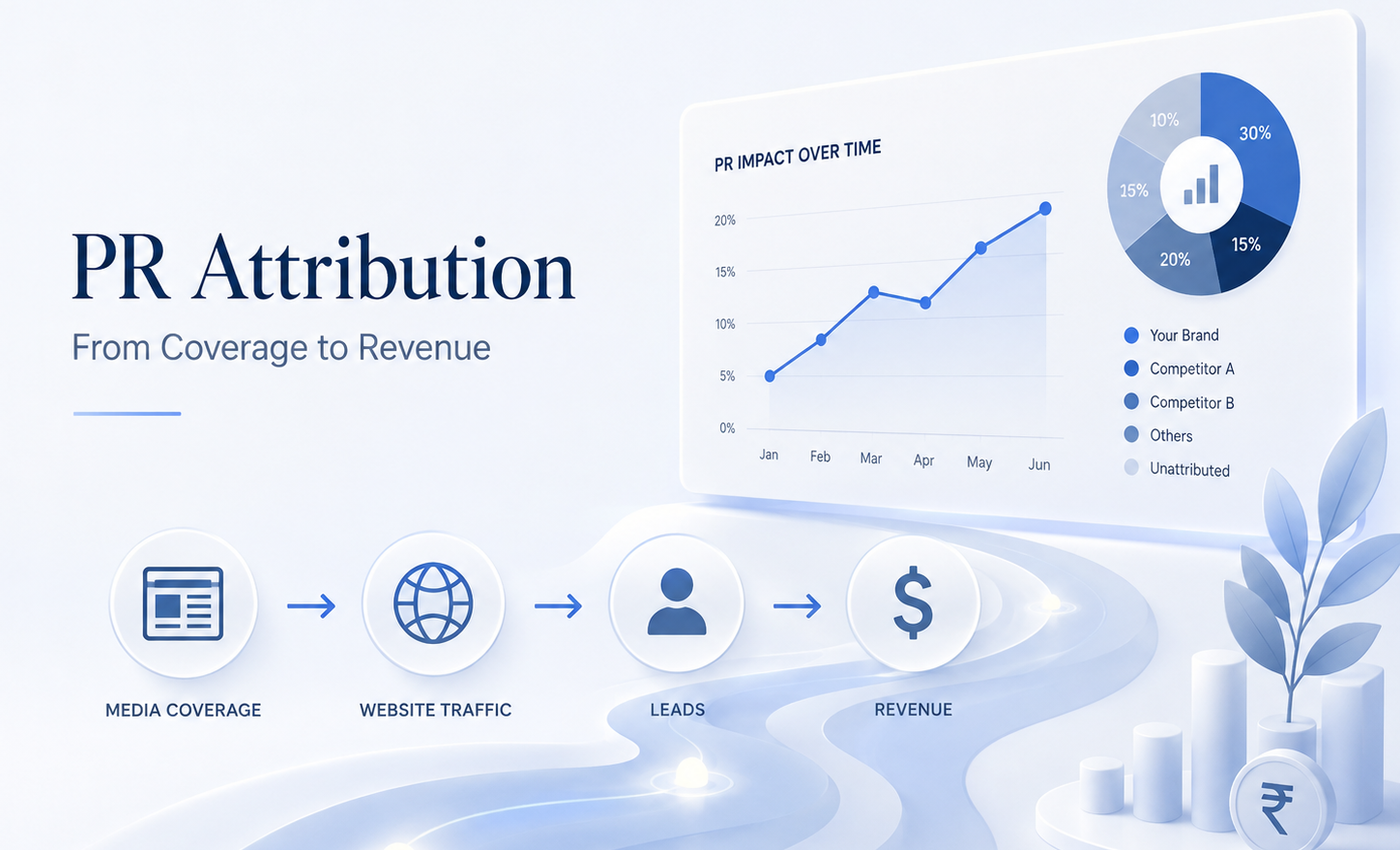
This is the layer most PR teams struggle with, largely because PR's influence on a sale is rarely the last touchpoint before conversion — it's often an earlier trust-building step in a longer buyer journey.
Even so, direct attribution is more achievable than most teams assume. Tracking website traffic that arrives specifically following a piece of coverage — through referral traffic, branded search spikes, or UTM-tagged links when a publication includes one — gives a reasonably clear signal of a specific placement's pull.
Lead volume can be tracked the same way, especially when a sales or demo request form includes a simple "how did you hear about us" field, or when the marketing team cross-references lead timing against the publication dates of major coverage. A noticeable lead spike in the days following a significant placement is a strong, defensible signal, even without perfect individual-level attribution.
Revenue attribution is the hardest layer, but not impossible. Some teams build a simple model estimating the dollar value of leads or customers that can reasonably be traced to a PR-driven spike in traffic or branded search, then compare that value against the PR investment for the period. Industry benchmarks suggest a healthy PR ROI often falls somewhere in the range of two to four dollars in value generated per dollar invested, though this varies significantly by industry and by how directly attribution is calculated.
It's worth being honest with leadership about the limits here. PR rarely closes a deal on its own, and pretending otherwise erodes credibility. The more defensible framing is that PR moves people further along a journey that other channels — sales, retargeting, direct outreach — ultimately close, and the data should be presented that way rather than overclaiming direct causation.
Layer Four: Brand Impact
Brand impact captures the metrics that don't show up in a lead form but still matter enormously to the business over time.
Brand awareness lift is typically measured through before-and-after surveys asking a target audience whether they recognize or have heard of the brand. Research on PR campaign performance suggests the strongest campaigns can lift awareness by twenty to thirty percent, while an average, reasonably well-executed campaign more typically produces a five to ten percent lift — useful context for setting realistic expectations with leadership before a campaign begins.
Trust is an increasingly important dimension of brand impact, particularly as more consumers now use AI tools to research and compare brands before buying. Research from major trust-tracking studies has found that the majority of people who use generative AI platforms for shopping-related research are effectively being shown a summary shaped by a brand's existing reputation, credibility, and clarity online — all of which are heavily influenced by the volume and quality of earned media a brand has accumulated over time.
SEO impact is a related, often overlooked benefit. Earned media coverage frequently comes with backlinks from high-authority news sites, which meaningfully support a brand's organic search visibility over time — a benefit that compounds well after the initial news cycle around a placement has faded.
Sentiment trends over time are the final piece of brand impact worth tracking. A brand whose coverage sentiment is trending more positive quarter over quarter is building reputational capital, even in quarters where placement volume itself was lower than usual — this is exactly the kind of nuance a simple clip count would completely miss.
Building a PR Reporting Dashboard That Leadership Actually Trusts
Pulling these four layers together into a single, consistent reporting structure is what separates PR reporting that gets taken seriously from PR reporting that gets politely ignored in a leadership meeting.
A strong monthly or quarterly dashboard typically tracks a consistent core set of numbers every single period: total placements by tier, weighted media value, share of voice relative to named competitors, sentiment breakdown, PR-attributed traffic and leads, and an estimated ROI figure where attribution is reasonably defensible.
Consistency matters more than complexity here. A dashboard that changes its metrics every quarter makes it impossible to spot real trends, while a stable, simple structure — even a modest one — builds trust over time because leadership can see the same numbers move in a consistent direction.
It's worth adding supplementary metrics selectively, rather than burying the core numbers under too much additional data. Sentiment detail, message pull-through (whether coverage actually reflects the brand's intended key messages), and thematic alignment with major industry trends are valuable additions, but they should sit alongside the core metrics, not replace them.
Being transparent about negative coverage, rather than quietly excluding it, is one of the fastest ways to build credibility with leadership. A dashboard that only ever shows good news starts to look curated rather than accurate, and leadership tends to notice that pattern eventually.
What's Changing in PR Measurement Right Now
A few shifts are actively reshaping how sophisticated teams measure PR heading further into 2026, and they're worth watching even for smaller teams not yet using advanced tooling.
AI-assisted measurement tools are increasingly able to track trust and sentiment trends over time at a scale manual monitoring never could, and some can now flag early reputational risk signals well before they'd surface in a traditional media monitoring alert.
Message pull-through — whether a brand's actual intended talking points show up in published coverage, not just the brand's name — is becoming a more common metric among more mature PR teams, since it measures message effectiveness rather than just visibility.
There's also a growing emphasis on connecting PR data to harder business signals like changes in customer acquisition cost, or a noticeable shift in investor or recruiting interest that follows a significant piece of coverage — moving PR measurement further into the same language finance and leadership teams already use elsewhere in the business.
Setting Up Attribution Before a Campaign Starts, Not After
One of the most common measurement mistakes is treating attribution as an afterthought — trying to reconstruct it once a campaign has already run and the data is messy or incomplete.
The stronger approach is deciding upfront, before outreach even begins, exactly which metrics will be tracked and how. That means agreeing on UTM tagging conventions for any links shared with journalists, setting a baseline for branded search volume and website traffic before the campaign starts, and briefing sales or customer success teams to note when a new lead specifically mentions a piece of coverage.
This upfront setup takes very little time compared to the alternative — trying to piece together attribution weeks later from incomplete records, which usually produces a much weaker, less defensible report.
It's also worth agreeing on realistic expectations with leadership before the campaign launches, not after. Sharing benchmark ranges for awareness lift or ROI upfront prevents an uncomfortable conversation later where a genuinely solid campaign gets judged against an unrealistic number nobody actually agreed to.
Choosing the Right Tools for the Team's Size
Media monitoring and share of voice tracking can be done at very different levels of sophistication, and the right choice depends heavily on team size and budget, not just what's technically available.
Larger teams with dedicated PR or communications functions often use enterprise media monitoring platforms that pull mentions from print, broadcast, and online sources automatically, generate AI-assisted sentiment scoring, and produce ready-made share of voice reports. These tools save significant manual effort but come with meaningful subscription costs that only make sense once coverage volume is high enough to justify them.
Smaller teams and individual founders can get a surprising amount of value from simpler, largely manual approaches — a shared spreadsheet logging every placement with its outlet, sentiment, and estimated reach, combined with free tools like Google Alerts for basic mention tracking and native analytics for referral traffic. It's less automated, but it captures the same core data points, just with more manual effort per report.
The right choice isn't about using the most sophisticated tool available — it's about consistently tracking the same core metrics every period, whichever tool makes that sustainable for the team actually doing the reporting.
Frequently Asked Questions
Is AVE (Advertising Value Equivalency) still a valid PR metric? No. It's been widely discredited across the PR industry because it measures the cost of equivalent ad space, not the actual value or credibility of earned coverage. Media value scores weighted by outlet authority, placement quality, and sentiment are a far more accurate replacement.
How often should PR ROI be reported? Monthly reporting works well for tracking activity and short-term trends, while quarterly reporting is usually better suited for evaluating real ROI and brand impact, since some effects — SEO lift, trust shifts, share of voice changes — take longer than a month to show clearly.
What's a realistic PR ROI to expect? Industry benchmarks commonly cite a range of roughly two to four dollars in value generated per dollar spent, though this varies significantly by industry, attribution method, and how conservatively "value" is calculated. It's more useful as a directional benchmark than an exact target.
Can small businesses measure PR ROI without expensive monitoring tools? Yes, to a meaningful extent. Manual tracking of placements, referral traffic, branded search trends, and a simple "how did you hear about us" field on lead forms can get a small team most of the way there, even without enterprise media monitoring software.
Should share of voice be measured against every competitor, or just a few? A focused set of three to five direct, relevant competitors usually produces a more useful number than trying to track the entire category. A narrower, well-chosen comparison set makes month-to-month shifts easier to interpret and act on.
The Bottom Line
Proving PR's value doesn't require pretending it works like paid advertising, with clean, immediate attribution for every dollar spent. It requires a measurement framework honest enough to show media value, share of voice, and business impact clearly, while being transparent about what genuinely can and can't be directly attributed.
Teams that build this kind of reporting consistently, quarter after quarter, tend to stop having to defend PR's budget every year — the data starts making that case on its own.
Want help building a PR reporting dashboard that actually holds up in front of leadership? Reach out to talk through what that looks like for your brand.
Need this for your brand?
Let DTS build your next campaign.
From PR, celebrity management and events to websites, social media, SEO and AI video production — Double Trouble Studio helps brands grow with strategy and execution.
Discuss Your Requirement →