
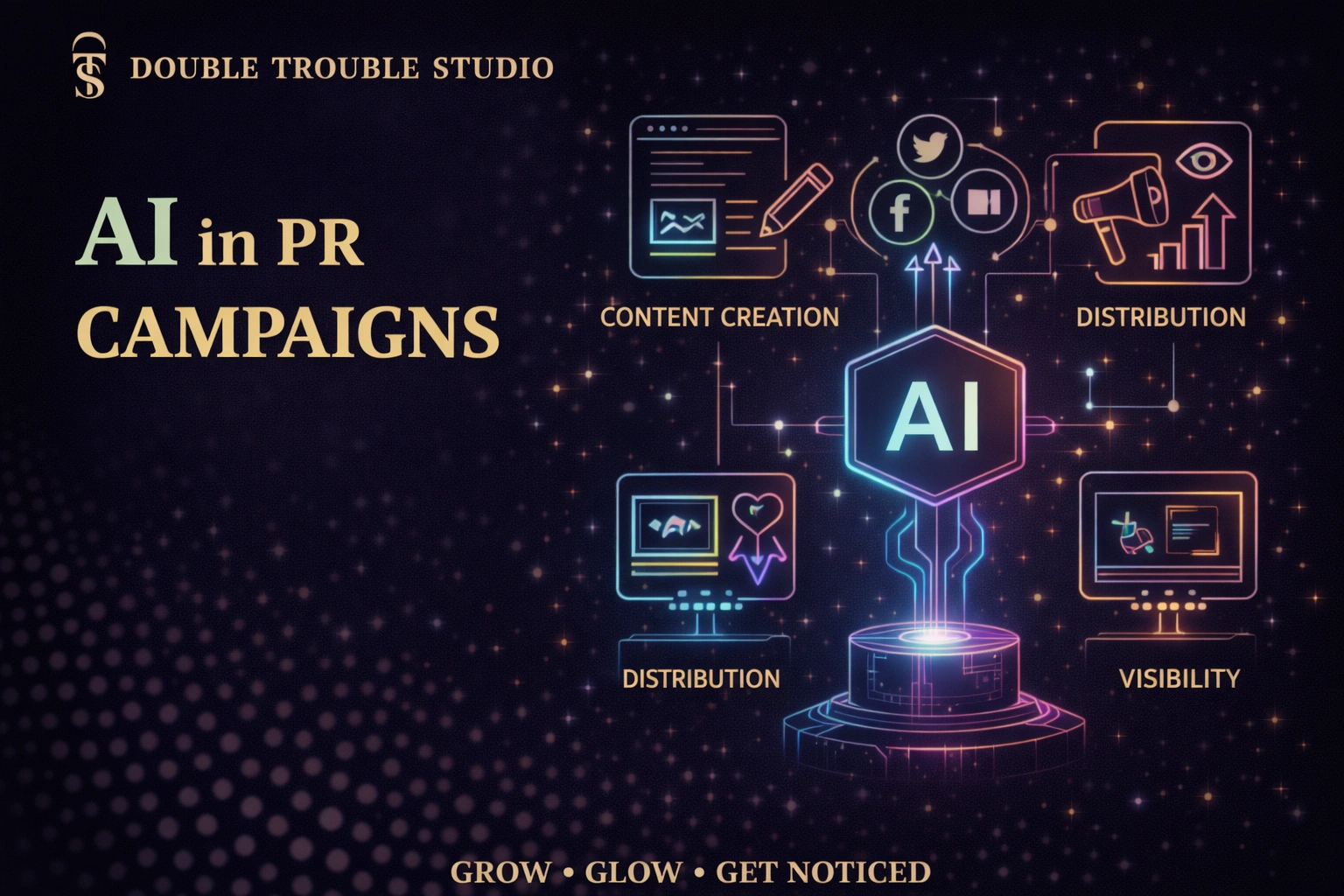
AI in PR Campaigns (Content Creation, Distribution & Visibility)
In 2026, public relations is no longer limited to media outreach and press coverage. It has evolved into a multi-layered system where content, distribution, and perception operate together to shape how a brand is understood, as explained in integrated PR and digital strategies. The integration of artificial intelligence into PR campaigns has significantly expanded the capabilities of this system, enabling brands to create, distribute, and amplify narratives with greater precision and speed than ever before.
However, this transformation introduces a critical shift in how PR must be approached. AI makes it easier to generate content, identify media opportunities, and optimize distribution channels, but it also increases the risk of overproduction, inconsistency, and loss of narrative control, especially when compared to structured brand narrative strategies. For luxury and premium brands, where perception is carefully constructed and maintained, this risk is particularly significant.
AI in PR is not about automating communication. It is about enhancing how communication is structured, delivered, and sustained over time. The true value lies not in the technology itself, but in how it is integrated into a strategic framework that prioritizes clarity, consistency, and credibility.
Because in premium markets, visibility alone does not define success.
Perception does.
Content Creation in AI-Driven PR Campaigns
Content has always been the foundation of public relations, but the role of content has expanded significantly in the AI era. Traditionally, PR content was limited to press releases, media kits, and occasional editorial features. Today, content operates across multiple formats, including digital storytelling, visual assets, video narratives, and real-time updates, aligned with content strategy frameworks. AI has made it possible to produce this content at scale, but scale must be managed carefully in luxury branding.
AI tools enable rapid generation of written content, visual assets, and even multimedia narratives. Press releases can be drafted efficiently, story angles can be explored quickly, and content variations can be created for different platforms, similar to approaches in media pitching strategies. This allows PR teams to respond to opportunities faster and maintain a consistent flow of communication.
However, the ease of content creation introduces a key challenge. When content becomes abundant, its value can decrease. Luxury brands rely on selectivity. Every piece of communication must feel intentional and aligned with the brand’s identity. Overproduction can create noise, reducing the impact of individual messages.
This is why content creation in AI-driven PR campaigns must be guided by a clear narrative framework, similar to luxury PR positioning strategy. Before any content is generated, the brand must define what it wants to communicate and why.
Another important aspect is tone and voice. Luxury PR content requires a specific level of refinement. Language must be precise, controlled, and consistent with the brand’s positioning.
Visual content also plays a critical role. AI can generate images, videos, and design elements that support PR narratives. However, these visuals must be evaluated for authenticity and consistency.
Content creation becomes a balance between efficiency and intention.
Distribution Strategy: From Broad Outreach to Targeted Precision
Distribution has traditionally been one of the most resource-intensive aspects of PR. AI has transformed this process by enabling more precise targeting and faster execution.
AI-driven tools can analyze media landscapes, identify relevant journalists, and predict which outlets are most likely to engage with a particular story, similar to media relationship strategies.
However, precision must not replace judgment.
Luxury PR relies heavily on context. The choice of where a story appears influences how it is perceived.
Distribution in luxury PR is not about maximizing reach.
It is about maximizing relevance.
Another important shift is the integration of digital platforms into PR distribution. Social media, owned channels, and influencer collaborations have become essential components of PR campaigns, often supported by PR and digital marketing services.
AI also enables real-time monitoring of distribution performance, aligned with performance measurement strategies.
Visibility and Amplification in the AI Era
Visibility has always been a key objective of PR campaigns, but its meaning has evolved.
AI plays a significant role in amplifying visibility. It enables brands to extend reach and maintain continuous presence across platforms, similar to performance digital strategies.
However, increased visibility introduces challenges.
In luxury branding, visibility must be controlled. Overexposure can reduce exclusivity.
Each piece of content must feel curated rather than routine.
Another important aspect is narrative consistency, aligned with integrated roadmap strategies.
Visibility is not just about presence.
It is about perception.
Integration of AI Across PR Campaign Lifecycle
The true value of AI in PR campaigns lies in its integration across the entire lifecycle.
During planning, AI provides insights into audience behavior and trends, similar to competitive strategy insights.
In execution, AI supports content creation and distribution.
In evaluation, AI provides performance insights aligned with measurement frameworks.
AI should be embedded into the PR framework.
Challenges in AI-Driven PR Campaigns
While AI offers advantages, it also introduces challenges.
Content saturation, loss of authenticity, and misalignment are key risks.
Addressing these requires strategic oversight, similar to crisis management strategies.
AI must be used as a tool, not a replacement.
Frequently Asked Questions (FAQs)
What is AI in PR campaigns?
Ans: It refers to the use of artificial intelligence tools to enhance content creation, distribution, and performance analysis in public relations.
How does AI improve PR content creation?
Ans: AI enables faster drafting, idea generation, and content adaptation while maintaining efficiency.
Can AI replace traditional PR strategies?
Ans: No, AI supports PR processes but does not replace human relationships, judgment, and strategic planning.
What are the risks of AI in PR?
Ans: Risks include overproduction, loss of authenticity, and potential misalignment with brand identity.
How can brands maintain quality in AI-driven PR?
Ans: By combining AI capabilities with strong narrative frameworks and human oversight.
Conclusion: Intelligence with Intention
AI has transformed PR campaigns.
However, for luxury brands, value lies in strategic clarity.
When integrated thoughtfully, AI enhances communication without compromising identity.
Because in premium markets, PR is not about how much you communicate.
It is about how clearly you are understood.
Design Your AI-Driven PR Strategy
If you are planning a PR campaign, integrating AI requires both technical expertise and strategic alignment.
From content development and media targeting to distribution and performance analysis, our team ensures that your campaigns deliver visibility without compromising perception.
📩 hello@dtsworld.in
📞 +91 80000 06021
📍 Andheri East, Mumbai
👉 Design Your PR Strategy