
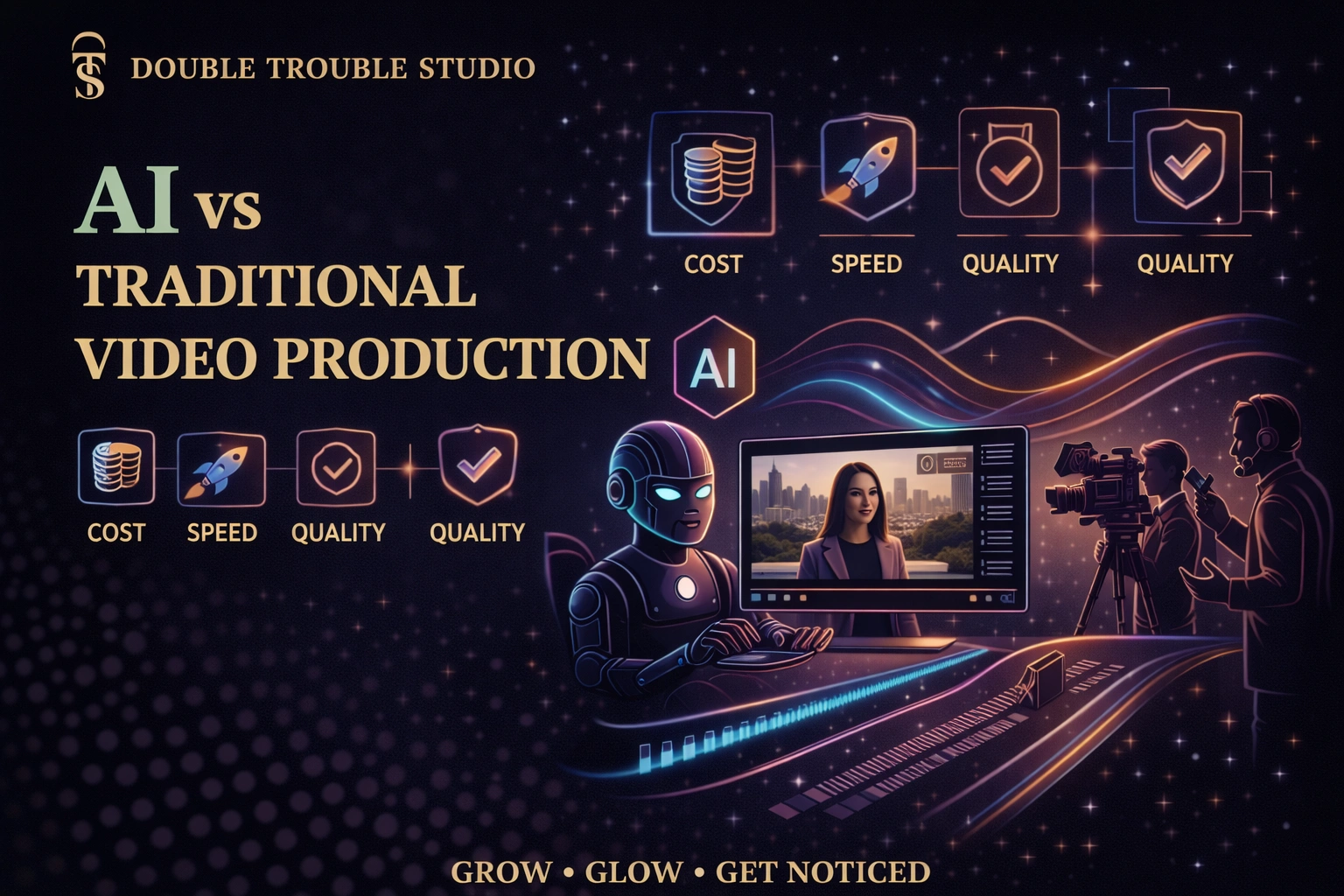
AI vs Traditional Video Production (Cost, Speed & Quality Comparison)
In 2026, the conversation around video production is no longer about choosing between technology and creativity. It is about understanding how different production systems influence outcomes.
Artificial intelligence has redefined how content can be created, edited, and distributed, as explained in AI in PR campaigns. Traditional production, on the other hand, continues to represent craftsmanship, control, and cinematic depth. Both approaches offer distinct advantages, but they operate on fundamentally different principles.
For brands — particularly luxury and premium brands — the decision is not simply about cost or speed. It is about perception, similar to luxury brand positioning strategy. It is about how the final output aligns with identity, how efficiently it can be produced without compromising quality, and how the process itself influences consistency.
AI and traditional production are not direct replacements for each other.They are different systems.
Understanding their differences requires a deeper analysis of how cost, speed, and quality operate within each approach — not as isolated metrics, but as interconnected elements that define the production outcome.
Understanding the Structural Difference Between AI and Traditional Production
Before comparing cost, speed, and quality, it is essential to understand the structural difference between AI-driven production and traditional video production.
Traditional production is resource-intensive and sequential. It involves concept development, scripting, storyboarding, pre-production planning, physical shooting, and post-production refinement, aligned with AI scriptwriting & storyboarding. Each stage depends on human expertise, and each transition requires time, coordination, and resources.
AI production, in contrast, is modular and iterative. It allows multiple stages to overlap. Concepts can be visualized instantly, edits can be automated, and outputs can be refined in real time, similar to AI video production workflows. The process becomes less linear and more flexible.
This structural difference influences every aspect of production.
In traditional workflows, decisions are often finalized before execution. Changes during production can be costly and time-consuming. In AI workflows, decisions can evolve continuously. Iterations are faster and less resource-intensive.
However, flexibility comes with trade-offs.Traditional production offers depth and control. AI production offers speed and adaptability.For premium brands, the challenge is not choosing one over the other.It is understanding how each system aligns with their objectives.
Cost Dynamics: Investment vs Optimization
Cost is often the most immediate factor in comparing AI and traditional production. However, cost must be understood in terms of structure rather than absolute value.
Traditional production involves significant upfront investment. Equipment, locations, crew, talent, and post-production resources contribute to high costs. These expenses are often justified by the level of control and quality achieved.
Each element of traditional production adds to the final output. Cinematography, lighting design, set construction, and human performance create a layered experience that is difficult to replicate through automation alone.
AI production reduces many of these costs.Virtual environments eliminate the need for physical locations. Automated editing reduces labor. Generative tools replace certain aspects of design and visual effects, similar to AI-driven production systems. This creates a more efficient cost structure.
However, lower cost does not always translate to higher value.
For luxury brands, cost is not the primary concern. Value perception is. A production that feels less refined, even if cost-effective, can weaken positioning.
At the same time, AI allows for more efficient allocation of resources. Budgets can be redirected towards creative direction, high-quality assets, and strategic refinement rather than logistical expenses, aligned with integrated brand strategies.
This creates a shift in how cost is perceived.Traditional production is investment-heavy but controlled.AI production is cost-efficient but requires strategic oversight.The decision is not about spending less.It is about spending intelligently.
Speed as a Production Variable: Acceleration vs Precision
Speed is one of the most significant advantages of AI-driven production.
Traditional workflows require time at every stage. Pre-production planning, scheduling, and coordination can take weeks. Shooting schedules depend on availability, logistics, and environmental conditions. Post-production involves detailed editing, color grading, and visual effects that can extend timelines further.
AI compresses these timelines.Concepts can be generated within hours. Edits can be automated. Visual effects can be applied instantly, aligned with digital execution strategies. The entire production cycle becomes significantly faster.
This acceleration is particularly valuable in environments where content needs to be produced frequently or adapted quickly.
However, speed introduces a challenge.Luxury content is not defined by how quickly it is produced.It is defined by how carefully it is refined.
Traditional production allows for deliberate pacing. Each stage is executed with attention to detail.
AI production, with its rapid iteration, can sometimes lead to premature finalization.
This is where discipline becomes critical.Speed should enhance efficiency, not replace precision.
Quality: Cinematic Depth vs Algorithmic Output
Quality is the most complex aspect of this comparison.
Traditional production offers a level of depth that is rooted in physical reality. Lighting interacts naturally with environments. Camera movement captures subtle imperfections. Human performance adds emotional nuance.
These elements create authenticity.They produce visuals that feel organic and immersive.
AI production, while capable of generating high-quality visuals, operates differently. It relies on algorithms to simulate environments, textures, and motion.
However, AI excels in consistency.It can maintain uniform visual standards across multiple outputs, aligned with content consistency strategies.
Quality, therefore, is not a single dimension.It is a combination of realism, consistency, and emotional impact.
Creative Control: Direction vs Generation
Creative control is a critical factor in production.
Traditional workflows place control in the hands of directors, cinematographers, and editors.
AI introduces a different dynamic.It allows for generation rather than creation, similar to brand storytelling strategies.
Without strong direction, AI-generated content can become inconsistent.
Creative direction must remain central.
Scalability: Volume Without Dilution
One of the strongest advantages of AI production is scalability.
Content can be produced in multiple formats, variations, and adaptations without significant additional cost.
However, scalability introduces a risk.Excessive output can reduce exclusivity.For luxury brands, this is a critical consideration, aligned with competitive differentiation strategies.
AI enables scale.But scale must be controlled.
Integration: Hybrid Production as the Future
The comparison between AI and traditional production is not about choosing one over the other.
The future lies in integration.Hybrid workflows combine the strengths of both systems, similar to integrated brand roadmap strategies.
This integration creates balance.
Frequently Asked Questions (FAQs)
What is the main difference between AI and traditional video production?
Ans: AI production is faster and more flexible, while traditional production offers greater control and realism.
Is AI production cheaper than traditional production?
Ans: Generally yes, but value depends on how well the output aligns with brand positioning.
Which method provides better quality?
Ans: Traditional production offers more realism, while AI provides consistency and scalability.
Can AI replace traditional production completely?
Ans: No, both systems have unique strengths and are best used together.
What is the best approach for luxury brands?
Ans: A hybrid approach that combines AI efficiency with traditional craftsmanship.
Conclusion: Choosing Systems, Not Tools
The comparison between AI and traditional video production is not about superiority.
It is about alignment.Each system offers distinct advantages.
Because in premium markets, production is not just about creating content.It is about shaping perception.
Design Your Video Production Strategy
If you are planning high-end video content, choosing the right production approach requires both strategic clarity and creative expertise.
From AI integration and workflow design to traditional production and hybrid execution, our team ensures that your content reflects precision, consistency, and premium quality.
📩 hello@dtsworld.in
📞 +91 80000 06021
📍 Andheri East, Mumbai
👉 Design Your Video Production Strategy