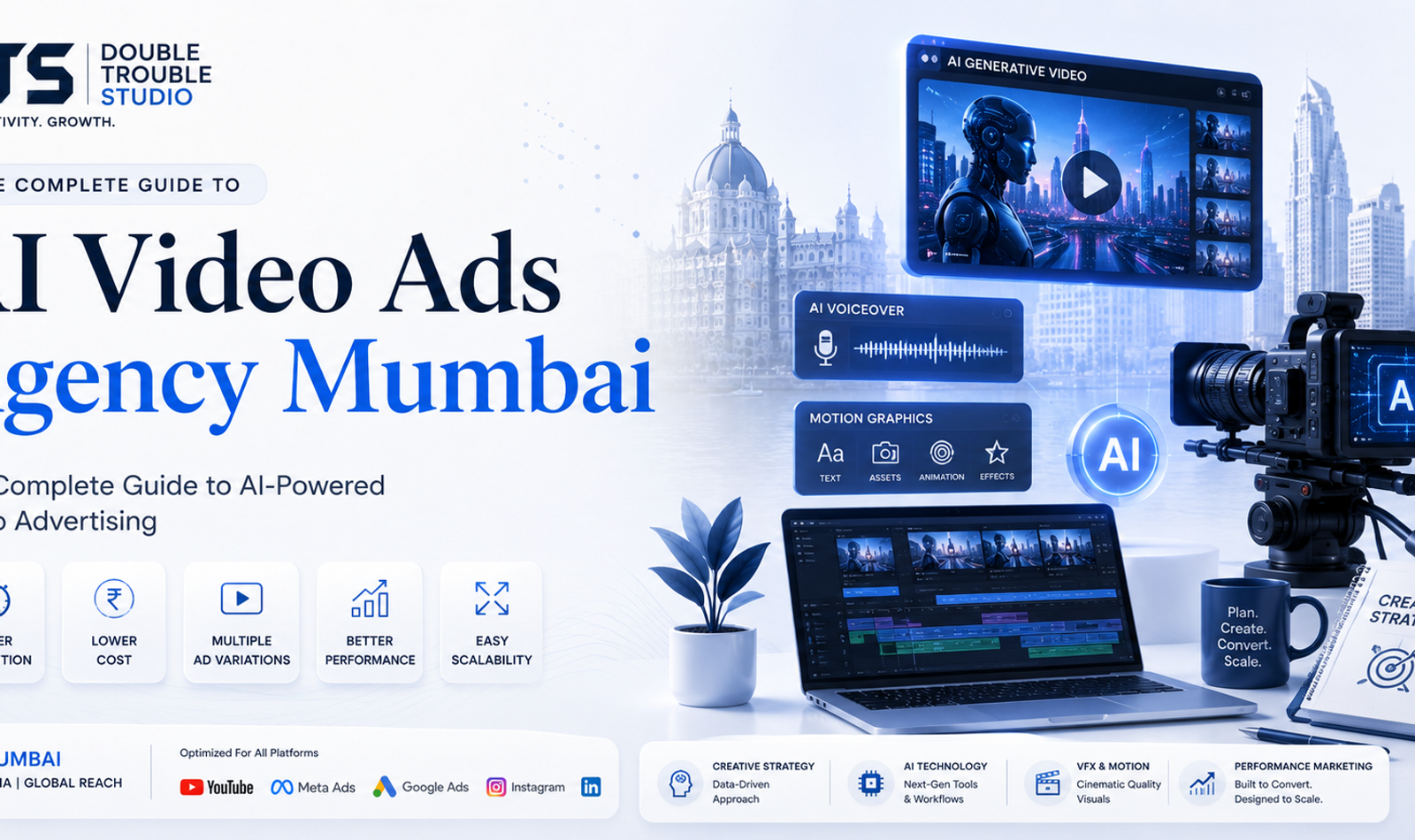
The Complete Guide to AI-Powered Video Advertising
Most businesses in Mumbai looking for video ads still start their search the old way — asking for a "video production house" and expecting a quote built around shoot days, crew size, and equipment rental. That model isn't wrong, exactly. It's just no longer the only one, and for a growing number of brands, it isn't the smart one either.
Double Trouble Studio (DTS) works with founders, D2C brands, real estate developers, restaurants, healthcare providers, and luxury and fashion labels across Mumbai to build video ad campaigns using AI-assisted production — a workflow that blends generative AI tools with real creative direction, VFX, and performance marketing strategy. This guide explains exactly what that means, how the process works, what it costs, and why it's changed what's possible for brands that don't have a traditional commercial production budget.
1. What Is an AI Video Ads Agency?
Featured Snippet Answer: An AI video ads agency creates video advertising content using artificial intelligence tools — for scripting, voiceovers, visuals, and video generation — combined with human creative direction and performance marketing strategy. It produces commercial-grade ads faster and at lower cost than traditional shoot-based production, optimized for platforms like Meta, Google, and YouTube.
The distinction that matters here isn't "AI vs no AI." It's workflow. A traditional video production agency in Mumbai plans a shoot: location, crew, talent, equipment, multiple days on set, then weeks of editing. An AI video production agency builds the ad using generative video tools, AI voice synthesis, motion graphics, and compositing software — with a human creative director steering every decision.
Double Trouble Studio's process treats AI as a production accelerant, not a creative shortcut. The strategy, scripting, brand voice, and final polish are still handled by people who understand advertising — the AI simply removes the physical constraints (location, crew, weather, reshoots) that make traditional production slow and expensive.
1.1 What Are AI Video Ads?
Featured Snippet Answer: AI video ads are advertising videos created partly or fully using generative artificial intelligence — including AI-generated visuals, AI avatars, synthetic voiceovers, and automated motion graphics — instead of relying solely on a physical camera shoot. They are typically used for social media, search, and connected TV advertising.
They range from fully AI-generated product visualizations to hybrid ads that combine real footage with AI-enhanced VFX, backgrounds, or voiceover layers.
2. Why Mumbai Businesses Are Switching to AI Video Ads
Mumbai's advertising market has always been competitive and cost-sensitive at the same time — brands need premium-looking creative, but budgets rarely match what a full crew and studio day actually cost. Three shifts have made AI video production the practical answer:
Ad platforms reward volume. Meta and Google's algorithms perform best when they have multiple ad variations to test. Traditional shoots make 8–10 variations expensive; AI-assisted production makes it routine.
Iteration cycles are shorter. A script change used to mean a reshoot. Now it can mean regenerating a scene or re-recording an AI voiceover the same day.
Regional language and localization is easier. AI voice synthesis tools can produce ad voiceovers in Hindi, Marathi, and English from the same script without booking separate voice artists.
None of this makes creative strategy less important — if anything, it raises the bar, because the barrier to producing more video means the differentiator becomes producing better video.
3. How AI Video Ads Work: The Complete Production Process
3.1 Discovery & Strategy
Every project starts with the brand, not the tool. DTS maps the campaign objective, target audience, platform mix (Google Ads, Meta Ads, Instagram Ads, YouTube Ads, LinkedIn Ads), and the specific action the ad needs to drive — install, purchase, enquiry, or booking.
3.2 Scripting & Storyboarding
A performance-oriented script is written with the hook, core message, and CTA mapped to the platform's viewing behavior — a 6-second Reel hook is written differently from a 30-second YouTube pre-roll.
3.3 AI-Assisted Visual Generation
This is where generative video tools come in. Depending on the brief, this stage may draw on text-to-video and image-to-video platforms (the category includes tools such as Runway, Google Veo, Kling AI, Luma AI, and Pika) to build scenes, product visualizations, or stylized brand sequences that would otherwise require a full shoot.
3.4 AI Voice & Sound Design
AI voice synthesis (from providers such as ElevenLabs) generates natural-sounding voiceovers in multiple languages and tones, paired with licensed or custom sound design.
3.5 Compositing, VFX & Motion Graphics
Generated elements are composited, animated, and polished using professional editing and VFX software — Adobe Premiere Pro, After Effects, Cinema 4D, and Blender are typical tools in this stage — to bring everything to a single cohesive, broadcast-ready commercial.
3.6 Platform Optimization
The final ad is formatted, cropped, and captioned per platform: vertical for Reels and Shorts, square or horizontal for feed placements, with platform-specific safe zones and caption timing.
3.7 Testing & Iteration
Because AI-assisted production allows fast variation, DTS typically delivers multiple hook/visual/CTA combinations for A/B testing rather than a single finished ad — this is often the single biggest performance lever in the entire campaign.
4. AI Video Ads vs Traditional Production, Animation & Motion Graphics
4.1 AI Video Ads vs Traditional Production
Factor
AI Video Ads
Traditional Video Production
Turnaround time
Days
Weeks
Cost per ad variation
Low
High
Ability to test multiple hooks
High
Limited by budget
Location/crew dependency
None
Required
Authenticity for testimonials
Moderate
High
Best for
Performance marketing, social ads, product video
Brand films, live testimonials, on-location storytelling
4.2 AI vs Live Shoot
Factor
AI Video
Live Shoot
Weather/location risk
None
Present
Reshoot cost if script changes
Minimal
High
Real human presence/authenticity
Simulated
Genuine
Speed to multiple variations
Fast
Slow
4.3 AI Video Ads vs Animation
Factor
AI Video Ads
Traditional Animation
Production time
Faster
Slower (frame-by-frame or rigged)
Visual style control
Good, improving fast
Very high, fully custom
Cost
Lower for most use cases
Higher for detailed 2D/3D animation
Best for
Product ads, social content, explainer ads
Character-driven storytelling, mascots
4.4 AI Video Ads vs Motion Graphics
Factor
AI Video Ads
Motion Graphics
Use case
Full scene/product generation
Text, data, and graphic overlays
Combined use
Frequently layered together
Frequently layered together
Skill dependency
AI tool direction + creative oversight
Design and animation expertise
In practice, most strong campaigns don't pick one lane — they blend AI-generated visuals with motion graphics overlays and, where useful, real footage.
5. Industry Statistics & Market Trends
AI video production has moved from experimental to mainstream faster than most marketing categories:
The global AI video generator market was valued at roughly $717–789 million in 2025 and is projected to grow at a CAGR between 18.8% and 20.3% over the next several years, according to Fortune Business Insights and Grand View Research.
Monthly active users across AI video platforms surpassed 124 million in early 2026, per industry tracking from Pictory and Ngram.
More than half of marketers surveyed now report using AI for some part of video creation or editing, with adoption having roughly doubled since 2023.
Retail and e-commerce accounts for a significant and fast-growing share of AI video adoption, driven by the need to produce product video at catalog scale, according to Luma's 2026 industry data.
The broader takeaway for Mumbai brands: AI video production isn't a novelty tactic anymore — it's becoming a standard part of how performance marketing teams produce and test creative.
6. Case Study: An AI Video Ad Campaign From Brief to Results
Problem: A Mumbai-based D2C skincare brand needed a fresh set of Meta ad creatives for a new product launch but had a two-week runway and a limited production budget — not enough for a full studio shoot with multiple product angles and lifestyle scenes.
Strategy: Rather than one hero video, the plan was to produce five short-form ad variations testing different hooks (problem-agitation, ingredient-led, before/after framing, founder-style narration, and UGC-style) using an AI-assisted production workflow so all five could be built within the timeline and budget.
Execution: DTS scripted all five hooks against the same core offer, generated product visualization sequences and lifestyle backdrops using AI video tools, layered in AI-voiced narration for two of the five variants, and finished everything with consistent brand-aligned motion graphics and captions in Premiere Pro and After Effects.
Result: The variations were live on Meta Ads within the two-week window, giving the brand's performance marketing team five distinct creatives to test simultaneously instead of one — surfacing a clear top-performing hook within the first testing cycle that then became the basis for further creative iterations.
7. AI Video Ads by Industry
7.1 AI Video Ads for Real Estate
Property videos benefit enormously from AI-assisted walkthroughs, staging visualization, and location-highlight sequences — especially for under-construction properties where a physical shoot isn't even possible yet.
7.2 AI Video Ads for Restaurants
Short-form AI video ads work well for menu highlights, ambience storytelling, and promotional offers, produced quickly enough to keep pace with weekly offers and seasonal menus.
7.3 AI Video Ads for Healthcare
Explainer and awareness content — procedure explanations, patient education, facility introductions — can be produced with AI voice and visuals while staying within the more careful compliance and tone requirements healthcare content demands.
7.4 AI Video Ads for Luxury Brands
Luxury and premium brands can use AI-generated cinematic sequences for brand films and product showcases, though these campaigns typically need heavier human creative direction to protect brand tone and visual premium-ness.
7.5 AI Video Ads for Fashion
Fashion brands use AI video for lookbook-style content, seasonal campaign ads, and rapid social content refresh — categories where volume and visual variety matter as much as any single hero video.
7.6 AI Video Ads for Startups
Startups get the clearest cost advantage: broadcast-quality-looking ad creative without a broadcast-level budget, which matters most in the earliest, most budget-constrained growth stage.
7.7 AI Video Ads for E-commerce
Product video at catalog scale — multiple SKUs, multiple angles, multiple offer variants — is one of the strongest use cases for AI-assisted production, since reshooting every SKU physically simply isn't viable for most catalogs.
8. What It Costs & How Long It Takes
Featured Snippet Answer: AI video ad production typically costs less than traditional shoots because it removes location, crew, and equipment expenses. Exact pricing depends on length, number of variations, voice/language needs, and platform specs. A simple AI social ad can often be produced within days rather than the weeks a traditional shoot requires.
Featured Snippet Answer (Effectiveness): AI video ads are effective when built on strong creative fundamentals — a clear hook, message, and CTA. AI's real advantage is enabling more ad variations to be tested faster, which improves performance marketing outcomes over time rather than through novelty alone.
Featured Snippet Answer (Can AI replace traditional production): No — AI video production is best used alongside traditional production rather than as a full replacement. Live-action shoots still lead for testimonials, on-location authenticity, and brand films requiring real human presence; AI leads for speed, volume, and cost-efficient testing.
Featured Snippet Answer (Timeline): A straightforward AI-generated ad can often be completed in a matter of days, compared to the multi-week timeline of location scouting, crew scheduling, and shoot days required for traditional commercial production.
DTS scopes every project individually — a single AI social ad costs meaningfully less than a fully custom AI brand film with heavy VFX, multiple languages, and a large set of test variations.
9. Why Double Trouble Studio
Double Trouble Studio isn't a video vendor bolted onto a marketing agency — video, PR, celebrity management, events, web development, and performance marketing sit under one roof, which means every AI video ad is built with a working knowledge of how it will actually perform once it's live.
What that looks like in practice:
Creative direction rooted in brand strategy, not just technical execution of AI tools
A blended AI + VFX + motion graphics workflow, using the right combination of generative tools and traditional editing software for each brief
Deep familiarity with performance marketing, so every ad is built to be tested, not just delivered
Full-funnel support — AI Video & VFX, PR, Media & Digital Marketing, and Web Development — so video ads plug into a broader growth Strategic Roadmap instead of sitting as a standalone deliverable
Ready to build your AI video ad campaign? Contact Double Trouble Studio to scope your first set of AI-powered video ads.
10. People Also Ask
- What does an AI video ads agency actually do? It plans, scripts, and produces video advertising content using AI generation tools combined with human creative direction, then optimizes it for ad platforms.
- Is AI video advertising only for big brands? No — one of its main advantages is making quality video ads accessible to startups and small businesses with limited budgets.
- Do AI video ads look fake or robotic? Quality varies by tool and execution; with strong creative direction and finishing (grading, sound design, motion graphics), AI video ads can look fully commercial-grade.
- Can I use AI video ads on Instagram and Facebook? Yes, AI-generated video is commonly used for Meta Ads, Instagram Reels, and Facebook feed placements.
- What's the difference between AI video ads and deepfakes? AI video ads use generative tools for legitimate branded content with disclosed AI involvement; deepfakes typically involve deceptive impersonation of real people without consent — DTS's work falls entirely in the former category.
- How many ad variations should I test? Most performance marketing teams start with 3–5 hook variations per campaign to identify a winning angle before scaling spend.
- Do AI video ads work for B2B? Yes, particularly for LinkedIn Ads — explainer-style and product-demo AI videos perform well in B2B contexts.
- Can AI generate voiceovers in Hindi and Marathi? Yes, modern AI voice synthesis tools support Hindi, Marathi, and other Indian languages alongside English.
- What file formats do AI video ads come in? Typically MP4, formatted per platform specs (vertical 9:16, square 1:1, horizontal 16:9).
- Do I need a scriptwriter if I'm using AI video tools? Yes — script quality is still the single biggest driver of ad performance, AI or not.
- Can AI video ads include real product footage? Yes, hybrid ads combining real footage with AI-generated backgrounds or effects are common.
- How is AI video pricing different from traditional production pricing? AI video removes location, crew, and equipment costs, so pricing is driven more by creative complexity and number of variations than logistics.
- What's the biggest mistake brands make with AI video ads? Treating AI as a substitute for strategy — a weak script produces a weak ad regardless of the tools used to generate it.
- Can AI video ads be localized for different cities? Yes, visuals and voiceovers can be adapted per region or language without a full reshoot.
- Are AI video ads suitable for festival/seasonal campaigns? Yes, and the faster turnaround is particularly useful for time-sensitive seasonal and festival campaigns.
- Do AI video ads need a human voice actor at all? Not necessarily, though many brands still prefer a real voice for brand consistency, layered with AI-generated visuals.
- What's the typical length of an AI video ad? Most social ad variations run 6–30 seconds; YouTube pre-rolls can run longer.
- Can AI generate product demo videos? Yes, this is one of the strongest use cases, especially for e-commerce and SaaS products.
- How do I know if AI video is right for my brand? If your priority is speed, volume, and testing multiple creative angles cost-effectively, AI video is a strong fit; if your priority is a single premium brand film with real human testimonials, traditional production may still lead.
- Do AI video ads perform better than traditional ads? Performance depends on creative quality, not the production method — AI's advantage is enabling more tests, which improves the odds of finding a winning creative faster.
- What industries use AI video ads the most? E-commerce, real estate, startups, healthcare, fashion, and hospitality are among the most active adopters.
- Can DTS manage the ad campaign as well as the video? Yes — Double Trouble Studio's performance marketing team can manage the media buying and optimization alongside video production.
- How much creative control do I have over AI-generated visuals? Full creative direction sits with the human team — AI tools are directed toward a specific brief rather than left to generate freely.
- Are there compliance concerns with AI video for healthcare or finance? Yes, and DTS accounts for industry-specific messaging and disclosure requirements during scripting and review.
- Can AI video ads be updated quickly after launch? Yes, this is one of the format's core advantages — visuals, voiceover, or CTA text can often be revised without a reshoot.
- What's needed from the client to start an AI video ad project? Brand guidelines, campaign objective, target audience details, and any existing brand assets (logo, product images, past creative).
- Do AI video ads work for luxury or premium brands? Yes, with heavier human creative direction to protect the premium tone that luxury audiences expect.
- Can AI create animated explainer videos? Yes, AI-assisted animation and motion graphics are well suited to explainer-style content.
- What ad platforms does DTS optimize AI videos for? Google Ads, Meta Ads, Instagram Ads, Facebook Ads, YouTube Ads, and LinkedIn Ads.
- Where is Double Trouble Studio based? Double Trouble Studio is based in Mumbai, Maharashtra, and works with brands across India.
11. FAQ
- What is an AI video ads agency? An agency that produces video advertising using AI generation tools combined with human creative direction and performance marketing strategy.
- What is Double Trouble Studio? A Mumbai-based creative and digital agency offering AI video & VFX, PR and digital marketing, web development, and events services.
- Are AI video ads good for small businesses? Yes — lower production costs make quality video advertising accessible to smaller budgets.
- How fast can an AI video ad be produced? Often within days, depending on complexity and number of variations.
- Can AI video ads include voiceovers in regional languages? Yes, including Hindi and Marathi alongside English.
- Do AI video ads cost less than traditional shoots? Generally yes, since location, crew, and equipment costs are removed.
- Is AI video advertising effective? Yes, when built on a strong script and creative strategy — AI enables more testing, which improves results over time.
- Can AI fully replace a video production crew? Not entirely — live-action authenticity and testimonials still often benefit from traditional shoots.
- What tools are used in AI video production? A mix of generative video platforms, AI voice synthesis, and professional editing/VFX software.
- Does DTS offer performance marketing alongside video? Yes, video production is integrated with the agency's broader digital marketing services.
- Can AI video ads be used for e-commerce product launches? Yes, this is one of the most common and effective use cases.
- Are AI video ads suitable for real estate marketing? Yes, particularly for walkthroughs and pre-construction visualization.
- Can healthcare brands use AI video ads? Yes, with attention to compliance and appropriate tone.
- What's the minimum budget for an AI video ad? It varies by scope; a single simple social ad costs meaningfully less than a multi-variant campaign with custom VFX.
- How many variations should a campaign include? Most teams start with 3–5 hook variations for initial testing.
- Can AI video ads be edited after delivery? Minor revisions are usually possible; larger changes may require re-generation of specific scenes.
- Does DTS work with startups? Yes, startups are one of DTS's core client segments for AI video production.
- Can luxury brands maintain a premium look with AI video? Yes, with strong human creative direction guiding tone, pacing, and visual polish.
- What platforms can AI video ads run on? Meta, Google, YouTube, LinkedIn, and other major ad platforms.
- Is AI video ad content disclosed as AI-generated? DTS follows platform disclosure requirements where applicable for AI-generated content.
- Can AI video ads include real footage of my product? Yes, hybrid approaches combining real and AI-generated elements are common.
- What's the typical turnaround for a full campaign? Depends on scope; simple campaigns can launch within one to two weeks.
- Does DTS handle scriptwriting? Yes, scripting and creative strategy are part of the core service.
- Can restaurants use AI video ads for offers and menus? Yes, the fast turnaround suits frequently changing promotions.
- Is AI video ad production available for fashion brands? Yes, including lookbook-style and seasonal campaign content.
- Does DTS provide analytics or reporting on ad performance? Yes, as part of its performance marketing services when campaigns are managed by DTS.
- Can I request specific AI tools be used? Client preferences are considered, though DTS selects the tool best suited to each brief by default.
- Are AI video ads accessible for non-English speaking audiences? Yes, through multilingual AI voice synthesis and localized scripting.
- What industries does DTS primarily serve? D2C, real estate, healthcare, hospitality, fashion, luxury, and startups, among others.
- Can AI video be used for LinkedIn B2B campaigns? Yes, especially for explainer and product-demo style content.
- Is there a difference between AI video ads and AI animation? Yes — AI video ads generate scene-based visuals, while animation is typically more stylized and illustrative.
- Does Double Trouble Studio offer web development too? Yes, alongside AI video & VFX, PR, digital marketing, celebrity management, and events.
- How do I get started with DTS? By reaching out through the Contact page to scope your project.
- Where is DTS located? Mumbai, Maharashtra, India.
- Can AI video ads be scaled across multiple markets? Yes, localization and multiple variations make multi-market scaling more efficient than traditional production.
12. Conclusion
AI video advertising isn't replacing good creative work — it's removing the production constraints that used to limit how much of it a brand could actually make. For Mumbai businesses competing for attention on Meta, Google, and YouTube, that shift matters: more variations, faster iteration, and lower cost per test all compound into better-performing campaigns over time.
Double Trouble Studio brings the same creative and strategic discipline as traditional production to this new workflow — AI accelerates the making, but strategy, scripting, and finishing still decide whether an ad actually works.
Get in touch with Double Trouble Studio to start scoping your AI video ad campaign.
Related reading: AI video ads agency in Mumbai · AI video ads benefits and costs.
Need this for your brand?
Let DTS build your next campaign.
From PR, celebrity management and events to websites, social media, SEO and AI video production — Double Trouble Studio helps brands grow with strategy and execution.
Discuss Your Requirement →