Luxury brands are remembered through emotion before they are judged by features.
A customer may notice the design, price, packaging or service, but the deeper connection usually begins with a feeling.
A luxury watch can communicate legacy.
A jewellery piece can communicate intimacy and celebration.
A premium hotel can communicate privacy, escape and calm.
A luxury car service can communicate confidence, arrival and status.
A couture outfit can communicate identity, craft and presence.
This is why storytelling matters so much in luxury branding.
Luxury storytelling is not only about explaining what the brand sells.
It is about making the audience feel why the brand matters.
AI video and professional video editing now give luxury brands a powerful way to create this feeling faster and more visually.
AI can generate cinematic scenes, animate campaign stills, create visual metaphors, test story directions, build launch teasers, support social reels and help brands create premium video concepts before a full shoot.
Professional video editing then turns these visuals into a clear and polished story.
Editing controls rhythm, sound, colour, typography, emotion and final delivery.
The two work best together.
AI brings imagination.
Professional editing brings structure.
AI creates possibility.
Editing creates impact.
For luxury brands, this balance is essential because the audience notices detail.
A video can use advanced AI and still feel weak if the story is unclear.
A video can look expensive and still feel empty if it has no emotional direction.
A video can be visually dramatic and still damage trust if the product looks inaccurate.
Luxury video storytelling needs more than technology.
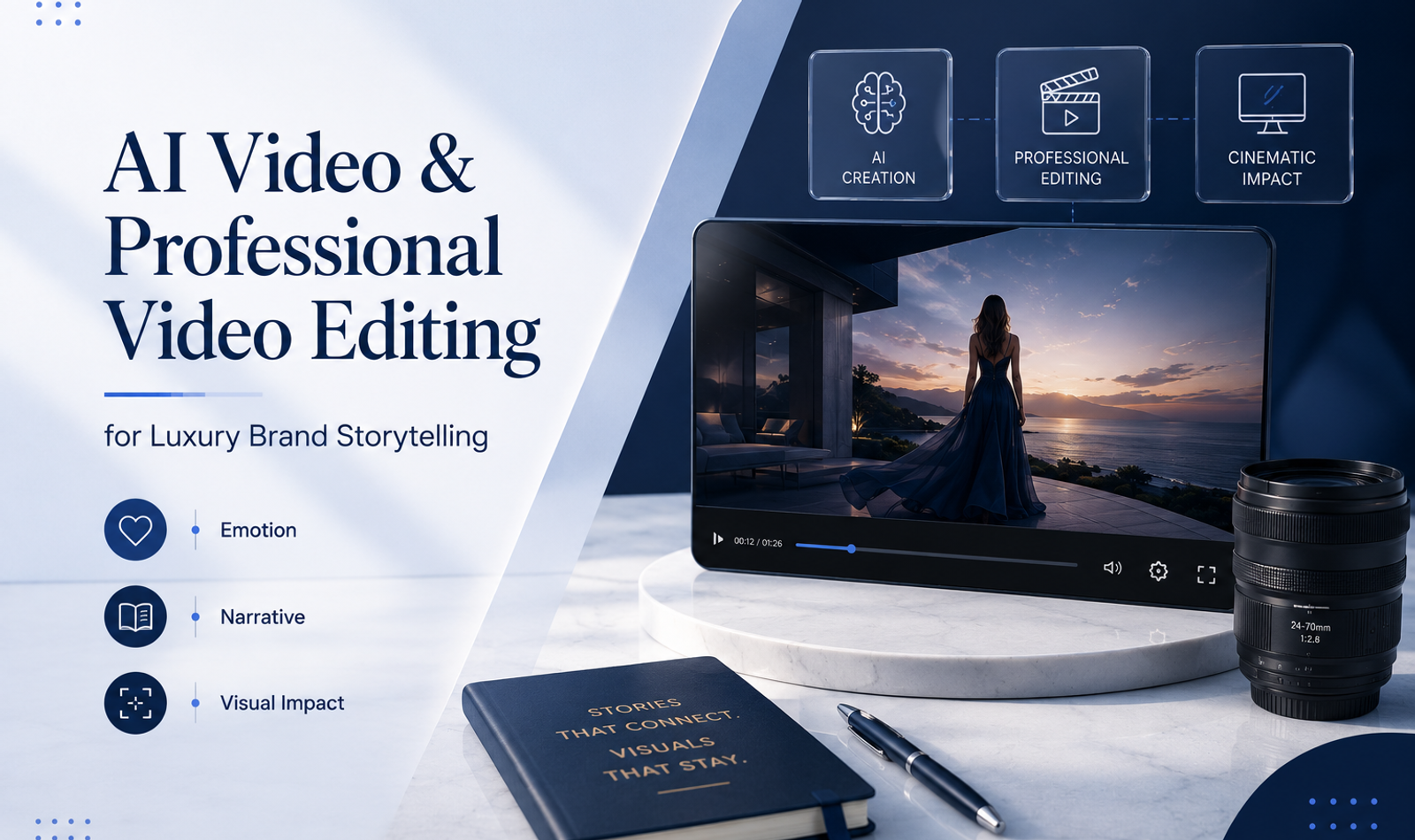
It needs emotion, narrative and visual control.
AI can support all three, but only when guided by strong creative direction and finished through professional editing.
What Is Luxury Brand Storytelling?
Luxury brand storytelling is the process of turning a brand’s identity, values, product, service, heritage or experience into a meaningful narrative.
It gives the audience a reason to remember the brand beyond price, category or function.
A strong luxury story may focus on craft, rarity, personal transformation, cultural identity, celebration, privacy, design, trust, status or memory.
It should not feel like a hard sales pitch.
It should feel like a world the audience wants to enter.
For a jewellery brand, the story may be about moments that become permanent memories.
For a hotel, it may be about entering a private world away from noise.
For a luxury event company, it may be about turning details into unforgettable experiences.
For a fashion label, it may be about expressing identity through fabric, silhouette and movement.
For a premium agency, it may be about shaping how the brand is seen before the customer speaks to anyone.
Luxury storytelling must feel intentional.
Every image, word, sound and cut should support the same emotional direction.
Why Emotion Comes First
Emotion is central to luxury because luxury decisions are rarely based only on practical comparison.
A customer may choose a premium brand because it makes them feel confident, admired, understood or emotionally connected.
A bride may choose a luxury event planner because she wants the celebration to feel once-in-a-lifetime.
A customer may choose a designer label because it reflects identity.
A traveller may choose a luxury hotel because it promises privacy, comfort and a sense of escape.
A founder may invest in premium brand films because they want the company to look credible and aspirational.
AI video can help visualise these emotional states.
It can create dream-like spaces, soft camera movement, cinematic light, symbolic details and mood-driven scenes.
But AI cannot decide the emotion for the brand.
The creative team must define it first.
Should the viewer feel desire?
Should they feel calm?
Should they feel prestige?
Should they feel nostalgia?
Should they feel power?
Should they feel intimacy?
Should they feel wonder?
Once the emotion is clear, AI visuals and professional editing can build around it.
Without emotional clarity, AI video becomes decoration.
With emotional clarity, AI becomes storytelling.
Why Narrative Matters
Narrative gives structure to emotion.
A luxury video should not be only beautiful shots placed together.
It should move the viewer through a journey.
The journey can be simple.
It may begin with mystery, move into desire and end with brand memory.
It may begin with a problem, show transformation and close with confidence.
It may begin with heritage, reveal craft and end with modern relevance.
It may begin with an empty venue, show design coming alive and end with celebration.
A narrative does not always need heavy voiceover.
It can happen through visuals, music, pacing, detail and sequence.
For example, a jewellery film may begin with darkness, reveal a stone through light, show a hand wearing the piece and end with a quiet brand line.
A luxury event film may begin with a blank ballroom, move through design details and end with guests experiencing the finished celebration.
A hospitality film may begin with city noise, move into quiet arrival and end with a private dining or room moment.
Narrative gives the visuals meaning.
AI can generate scenes, but the brand must define what those scenes represent.
Why Visual Impact Matters
Luxury is often felt before it is understood.
The viewer makes quick judgements from lighting, composition, movement, texture, colour and sound.
A video with weak visual direction can make a premium brand feel ordinary.
A video with strong visual impact can create desire within seconds.
Visual impact does not always mean loud effects or fast transitions.
For luxury brands, impact often comes from restraint.
A slow reveal can feel more premium than a dramatic transformation.
A close-up of material can communicate more value than a crowded scene.
A clean frame can feel more expensive than a heavy visual effect.
AI can create cinematic environments, symbolic scenes and visual worlds that would be difficult to shoot traditionally.
Professional editing then refines those visuals.
It decides when to hold a shot, when to cut, when to introduce the brand and when to let silence create emotion.
The visual should not only impress.
It should make the brand feel more valuable.
AI Video as a Storytelling Tool
AI video should be treated as a storytelling tool, not the story itself.
The audience should remember the brand, not only the fact that AI was used.
A jewellery video should make the viewer feel the value of the piece.
A hotel video should make the viewer feel the atmosphere of the stay.
An event teaser should make the viewer feel anticipation.
A fashion film should make the viewer feel identity and movement.
A premium agency video should make the viewer feel confidence in the brand’s capability.
AI helps create these feelings when used with purpose.
It can generate visual metaphors, mood scenes, abstract transitions, campaign worlds and social-first motion.
But when AI becomes the main attraction, the story can become weak.
If people remember only the effect and not the brand, the video has not done enough.
The brand must remain the hero.
Professional Editing as the Final Story Layer
Professional video editing is where AI visuals become brand communication.
Raw AI clips may look interesting, but they rarely form a complete story by themselves.
Editing controls the viewer’s experience.
It decides the opening frame, emotional build-up, music rhythm, shot length, colour consistency, sound design, typography and final call to action.
For luxury storytelling, editing must feel controlled.
It should avoid unnecessary transitions, loud effects, cluttered captions and rushed pacing.
The editor must know when to let a shot breathe.
A premium product needs space.
A luxury moment needs time.
A cinematic reveal needs rhythm.
Professional editing also connects AI visuals with real footage.
This is important because many luxury stories need both imagination and authenticity.
AI can create the atmosphere.
Real footage can provide proof.
Editing brings them together.
Start With Brand Identity
Before creating AI visuals or editing footage, the brand should define its identity.
Is the brand classic or modern?
Minimal or grand?
Soft or bold?
Heritage-led or future-facing?
Private or expressive?
Editorial or emotional?
Indian luxury, global luxury, boutique luxury and modern premium brands may all require different storytelling styles.
A royal heritage jewellery brand should not look like a futuristic gaming ad.
A premium hotel should not look like a loud club reel unless that is truly its positioning.
A luxury wedding brand should not use generic fantasy visuals if its strength is refined real-world execution.
AI video should extend the brand’s identity.
It should not create a new personality every time.
Strong identity protects the brand from visual inconsistency.
Define the Emotional Territory
Every luxury brand should know the feeling it wants to own.
This is the brand’s emotional territory.
For one brand, the emotional territory may be quiet confidence.
For another, it may be celebration.
For another, it may be intimacy, rarity, comfort, freedom, cultural pride or creative power.
This territory guides every creative choice.
It influences lighting, music, camera movement, colour, voiceover, pacing and typography.
If the emotional territory is quiet confidence, the video may use clean frames, slow movement, soft shadows and minimal text.
If the territory is celebration, the video may use people, movement, warm light and rhythmic editing.
If the territory is cultural pride, the video may use craft, material, place and human detail.
AI prompts should be written around this emotional territory.
Editing should protect it from the first frame to the final logo.
Build the Core Narrative
A luxury brand story should have one strong narrative idea.
Trying to say too much weakens the video.
A jewellery brand may focus on “crafted for moments that become memory.”
A hospitality brand may focus on “privacy in the heart of the city.”
A luxury event company may focus on “from concept to unforgettable experience.”
A fashion label may focus on “identity in motion.”
A premium agency may focus on “how your brand looks before your customer speaks to you.”
This core narrative becomes the creative anchor.
The script, storyboard, AI visuals, music and edit should all support it.
When the narrative is clear, even a short reel can feel memorable.
When the narrative is unclear, even a long cinematic film may feel empty.
Use AI for Visual Metaphors
AI is especially useful for visual metaphors.
A visual metaphor turns an idea into an image.
Luxury brands often need this because much of their value is emotional and symbolic.
A watch brand can use moving shadows to represent time.
A jewellery brand can use light to represent memory.
A hotel can use doors, curtains and open spaces to represent escape.
A fashion brand can use flowing fabric to represent identity.
An event brand can use an empty venue transforming into a glowing celebration to represent creative execution.
These scenes may be expensive or difficult to film traditionally.
AI can create them faster.
But the metaphor must remain clear.
If the image is too abstract, the viewer may not understand the story.
A good visual metaphor feels poetic but still connected to the brand.
Use AI for Mood Films
Mood films are short videos designed to express atmosphere.
They are useful for luxury brands because they create emotion before the full product, campaign or event is revealed.
AI can help create mood films for pre-launch campaigns, client presentations, event proposals and creative testing.
A luxury wedding mood film may show candlelight, floral movement, fabric, jewellery, architecture and soft music.
A fashion mood film may show silhouette, shadow, fabric and editorial camera movement.
A hospitality mood film may show water, curtains, quiet corridors, dining details and warm light.
A luxury car service mood film may show city lights, reflections, leather interiors and arrival moments.
Mood films help teams align on creative direction.
They also work well as social teasers.
Use AI for Pre-Launch Storytelling
Pre-launch storytelling is one of the strongest uses of AI video.
A brand may not yet have final footage, product campaign material or event visuals.
AI can help create anticipation early.
A teaser may show mood, symbols, movement and a few words without revealing everything.
This works for fashion collections, jewellery drops, hotel openings, luxury events, product launches and digital campaigns.
The pre-launch video should create curiosity.
It should not overpromise.
If AI creates a world that the final launch cannot match, the audience may feel disappointed.
The teaser must remain emotionally aligned with the real campaign.
AI should build expectation, not false expectation.
Use AI for Product Storytelling
Luxury product storytelling needs both emotion and accuracy.
AI can create cinematic worlds around a product, but the product itself must remain correct.
A perfume bottle can be shown in a world of mist, light and soft floral motion.
A watch can be placed inside a visual story about time and shadow.
A jewellery piece can be surrounded by reflections and close light movement.
A premium dessert can be shown through texture, layers and indulgent motion.
However, AI can distort product details.
It may change shape, colour, logo, packaging, material or proportion.
For luxury brands, this is risky.
The best workflow is often hybrid.
Use real product photography or footage for accuracy.
Use AI for atmosphere, background, transitions or symbolic scenes.
Use professional editing to connect everything into one polished story.
Use AI for Event Storytelling
Luxury events are emotional experiences.
They are remembered through people, atmosphere, design, performance, hospitality and scale.
AI can support event storytelling before and after the event.
Before the event, AI can create concept films, animated invitations, stage previews, mood teasers and theme visualisations.
These assets help build anticipation and help clients imagine the final experience.
After the event, real footage should become the foundation.
The recap should show what actually happened.
AI can support titles, transitions, social cutdowns and creative enhancements.
It should not fake attendance, celebrity presence, décor scale or guest reactions.
For event storytelling, AI builds anticipation.
Real footage builds proof.
Editing builds memory.
Use AI for Founder and Heritage Stories
Luxury brands often depend on founder vision, legacy or heritage.
AI can help visualise timelines, archival references, craft processes and brand evolution.
A founder video may combine a real interview with AI-generated visual metaphors.
A heritage story may use animated textures, old photographs, slow transitions and cinematic motion.
However, real human presence should remain central when trust matters.
A founder’s actual voice, expression and emotion often create stronger connection than a synthetic version.
AI should support the founder’s story, not replace the founder.
Heritage content should also remain accurate.
AI should not invent historical claims or scenes unless clearly presented as creative interpretation.
Use AI for Craftsmanship Stories
Craftsmanship is one of the most powerful themes in luxury storytelling.
Customers value the skill, time and human attention behind the product or experience.
AI can support craft storytelling by enhancing details, materials and process.
A jewellery brand can show macro reflections and symbolic light.
A fashion brand can show fabric movement and stitching details.
A hospitality brand can show plating, linen, architecture and service flow.
An event company can show the transformation from planning to execution.
Real footage is often important because craft is about human skill.
AI can enhance the atmosphere around the craft, but the hands, materials and process should feel real.
The story should celebrate human excellence.
It should not hide it behind synthetic visuals.
Use AI for Social Storytelling
Social media needs short, memorable storytelling.
AI can help turn one luxury campaign into multiple social assets.
A hero brand film can become teaser reels, motion posters, behind-the-scenes clips, story assets, paid ad cutdowns and website loops.
AI can help generate hooks, animated frames and visual variations.
Professional editing ensures each version remains aligned with the brand.
For luxury social storytelling, the content should not become too loud or trend-dependent.
A short video can still feel premium.
A strong social reel may use one powerful visual, one emotional line and one clean brand moment.
AI helps increase output.
Creative direction and editing protect quality.
Use AI for PR Storytelling
PR campaigns need stories that journalists and audiences can understand quickly.
AI video can support PR by making the story more visual.
A brand announcement can include a short explainer.
A founder quote can become a LinkedIn video.
A launch concept can become a teaser film.
An event recap can become proof of execution.
A media kit can include a short brand story video.
For PR, AI video should support credibility.
It should not replace evidence.
If the story involves real achievements, products, people or events, those facts must remain clear.
AI can make the narrative more engaging, but it should not turn PR into fiction.
Creative Direction for Emotional Impact
Emotional impact comes from precise creative choices.
Lighting, pacing, sound, colour and camera movement all affect feeling.
Soft light can create intimacy.
Deep shadows can create mystery.
Slow movement can create elegance.
Fast cuts can create energy.
Silence can create tension.
Warm tones can create comfort.
Cool tones can create modernity.
AI prompts should include these emotional directions.
Professional editing should then refine them.
A luxury brand should not rely on default AI outputs.
Every frame should be guided by the intended emotion.
Emotion is designed, not accidental.
Creative Direction for Narrative Clarity
A luxury story can be poetic, but it should not be confusing.
The audience should understand the feeling and remember the brand.
Narrative clarity comes from structure.
The video should have a clear beginning, middle and end.
The product, service or experience should appear at the right moment.
The brand should not be hidden until too late.
The final message should land clearly.
AI visuals can sometimes become too abstract.
Professional editing solves this by arranging them into a logical emotional sequence.
A viewer may not need every detail explained, but they should understand the brand world.
Creative Direction for Visual Impact
Visual impact should match the luxury category.
For jewellery, impact may come from macro detail and light.
For hospitality, it may come from space and atmosphere.
For fashion, it may come from movement, styling and identity.
For events, it may come from scale, emotion and transformation.
For cars, it may come from motion, reflection and arrival.
AI should be used according to the category.
A single AI style does not fit every luxury brand.
The visual system should be built around the product, audience and emotional goal.
This is how AI visuals become brand-specific rather than generic.
Professional Editing Makes AI Storytelling Premium
AI-generated visuals often need professional editing to feel complete.
Editing controls the rhythm of the story.
It decides which shot opens the video, where the emotional peak happens and how the final brand moment appears.
Editing also adds sound, colour, typography, captions and transitions.
This is where luxury polish is created.
A raw AI clip may feel experimental.
A professionally edited AI film can feel like a premium campaign asset.
The editor removes weak frames, matches colours, improves pacing and adds brand design elements.
Editing turns AI possibility into luxury storytelling.
Colour Grading for Luxury Storytelling
Colour grading helps create mood and consistency.
It also makes AI visuals and real footage feel part of the same world.
A luxury jewellery film may use deep contrast and soft highlights.
A hospitality film may use warm tones and natural shadows.
A fashion film may use clean editorial colour.
A car film may use cooler tones, reflections and night contrast.
An event film may use warm emotional grading or glamorous stage colour depending on the mood.
Colour should not be random.
It should support the brand’s identity.
A strong colour grade makes the video feel finished, premium and intentional.
Sound and Music in AI Luxury Storytelling
Sound is essential for emotional storytelling.
AI visuals without sound can feel unfinished.
Music and sound design create atmosphere.
For luxury storytelling, sound should be selected carefully.
A jewellery film may use delicate sound textures.
A fashion film may use editorial rhythm.
A hospitality film may use soft ambience.
An event film may use crowd reactions and musical build-up.
A car film may use engine sound, road texture and cinematic bass.
Sound should not overpower the visuals.
It should make the viewer feel the story more deeply.
Professional sound design can make AI visuals feel more believable and immersive.
Typography and Language
Luxury language should feel refined.
The words should not be generic or overly promotional.
A single strong line can carry more impact than a long paragraph.
Typography should also feel premium.
Font choice, spacing, placement and animation style affect perception.
AI-generated text inside video frames can be unreliable, so final text should usually be added during editing.
For luxury storytelling, fewer words often work better.
The video should allow the visuals and emotion to breathe.
Language should support the story, not over-explain it.
Avoiding Generic AI Luxury Content
Many AI luxury videos look similar because they use the same visual clichés.
Gold lighting, marble rooms, glossy reflections, slow-motion fabric, futuristic cars and dramatic close-ups can quickly become generic.
A luxury brand should not use AI to copy common premium aesthetics without a unique story.
The content should include brand-specific elements.
This may include heritage, location, craft process, customer lifestyle, founder vision, cultural references, product detail or service philosophy.
AI should help express what makes the brand different.
Generic beauty is not enough.
Luxury storytelling needs distinctiveness.
Protecting Authenticity
Authenticity remains important even in AI storytelling.
Luxury customers want to believe in the brand world.
If the content feels fake, trust may weaken.
AI should not invent customer experiences, testimonials, event scale or product qualities.
It should not create fake founder statements or synthetic celebrity participation.
Where the story depends on reality, real footage should be used.
Where the story is symbolic or conceptual, AI can be used more freely.
The brand should be clear about the difference between concept and proof.
Authenticity protects long-term reputation.
Disclosure and Transparency
AI storytelling should consider disclosure when the content is realistic and could be mistaken for real people, places, events or actions.
Not every AI-assisted process needs public disclosure.
Using AI for script ideas, captions or internal storyboards may not materially change audience understanding.
But realistic synthetic scenes, AI-generated people, fake event moments or altered product demonstrations may require transparency.
For luxury brands, transparency should not be seen as a weakness.
It protects trust.
A brand can be innovative and responsible at the same time.
If a viewer may misunderstand what is real, the safer approach is to clarify.
Copyright and Visual Rights
AI storytelling must respect copyright and usage rights.
Brands should avoid using competitor campaigns, celebrity images, artist styles, editorial shoots or copyrighted visuals as references without permission.
Music, fonts, templates, stock footage and voiceovers should be properly licensed.
If real people appear in the video, likeness and consent may be required.
AI-generated content should also be reviewed according to the tool’s commercial-use terms.
Luxury brands should treat AI rights management seriously.
A visually beautiful campaign can become a problem if rights were not cleared.
Ethical production supports premium brand trust.
Product Accuracy and Brand Safety
Luxury products must be represented accurately.
AI can distort jewellery stones, watch faces, fabric textures, car models, packaging, hotel spaces and event scale.
This can create confusion or damage trust.
Product accuracy review should happen before publishing.
The team should check logos, colours, shapes, labels, proportions, materials and claims.
For service brands, the video should not exaggerate outcomes.
For events, AI should not fake past execution.
For hospitality, AI should not show spaces or amenities that do not exist.
Brand safety is part of storytelling because trust is part of luxury.
Measuring Emotional Storytelling
Luxury AI storytelling should be measured through more than views.
Views show reach, but they do not always show emotional impact.
Brands should also look at watch time, saves, shares, comments, branded search, website visits, enquiry quality and sales conversations.
Qualitative feedback matters.
Are viewers describing the brand as premium, elegant, cinematic, desirable or trustworthy?
Are the right customers responding?
Is the video strengthening brand perception?
AI storytelling should support both emotion and business outcomes.
A visually impressive video is not successful if it attracts the wrong audience or weakens brand identity.
Common Mistakes in AI Luxury Storytelling
One common mistake is starting with AI tools before defining the story.
Another is using too many effects.
Luxury brands may also create visuals that look premium but say nothing specific.
Some videos distort the product or create unrealistic expectations.
Others use generic scripts that do not match the brand voice.
Another mistake is ignoring editing.
AI visuals need pacing, sound, colour and typography to become a complete story.
Brands also risk copying visual trends that make them look similar to everyone else.
Luxury storytelling should be distinctive.
AI should not make the brand feel replaceable.
Practical AI Video and Editing Workflow for Luxury Storytelling
The workflow begins with brand identity.
The team defines the emotional territory, audience and campaign objective.
A core narrative is developed.
The script and visual direction are created.
A storyboard maps the emotional journey.
The team decides which parts should use AI and which need real footage.
AI visuals are generated with consistent prompt direction.
Real product, founder, event or customer footage is captured where authenticity matters.
Professional editing brings everything together through pacing, colour, sound, typography and final platform versions.
The final video is reviewed for emotion, clarity, product accuracy, rights, disclosure and brand safety.
Then the campaign is distributed across social, PR, ads, website and sales channels.
This workflow keeps AI storytelling creative, premium and controlled.
How Double Trouble Studio Uses AI and Editing for Luxury Storytelling
Double Trouble Studio uses AI video production and professional editing to help luxury brands, premium businesses and event companies tell stronger visual stories.
Our process begins with brand strategy and emotional direction.
We identify what the brand should make audiences feel and remember.
Then we build scripts, storyboards, AI visual concepts and editing plans around that feeling.
For luxury ads, we focus on cinematic mood, product detail, premium pacing and visual restraint.
For event storytelling, we use AI to build anticipation and real footage to prove emotion and execution.
For social and PR campaigns, we turn one narrative into multiple platform-ready assets.
Our goal is not only to make videos look impressive.
The goal is to create videos that feel meaningful, premium and aligned with long-term brand value.
Conclusion
AI video and professional video editing give luxury brands a powerful way to create emotional, cinematic and visually memorable storytelling.
AI helps brands generate ideas faster, visualise abstract emotions, create mood films, animate still images, build pre-launch teasers and produce social campaign assets at greater speed.
Professional editing turns those assets into a complete brand story.
It controls rhythm, sound, colour, typography, pacing and final visual polish.
Luxury storytelling, however, still depends on human creative direction.
A brand must know what it wants the audience to feel before generating visuals.
It must understand its emotional territory, narrative direction and visual identity.
AI can support the story, but it should not replace the story.
The strongest luxury videos combine emotion, narrative and visual impact.
Emotion makes the audience care.
Narrative gives the emotion structure.
Visual impact makes the story memorable.
AI can enhance each of these elements when used with discipline.
It can create cinematic worlds, symbolic scenes, product atmospheres and campaign variations.
But without professional editing, these visuals may feel disconnected.
Editing is what transforms AI outputs into premium communication.
Authenticity must also remain central.
Luxury brands should not use AI to fake testimonials, product results, event scale, founder statements or customer experiences.
Where proof matters, real footage should remain the foundation.
AI can enhance the atmosphere, but it should not replace truth.
Brand safety is equally important.
Every AI-assisted video should be reviewed for product accuracy, rights, music, likeness, disclosure, visual consistency and audience interpretation.
A luxury brand’s reputation depends on trust as much as beauty.
The best workflow is hybrid.
AI provides imagination and speed.
Real footage provides proof and authenticity.
Professional editing provides polish and emotional control.
Creative direction connects everything to the brand’s identity.
When these elements work together, luxury brands can create videos that feel cinematic, refined, emotional and commercially meaningful.
📩 info@dtsworld.in 📞 +91 80000 06021 📍Andheri (West), Mumbai
Need this for your brand?
Let DTS build your next campaign.
From PR, celebrity management and events to websites, social media, SEO and AI video production — Double Trouble Studio helps brands grow with strategy and execution.
Discuss Your Requirement →