
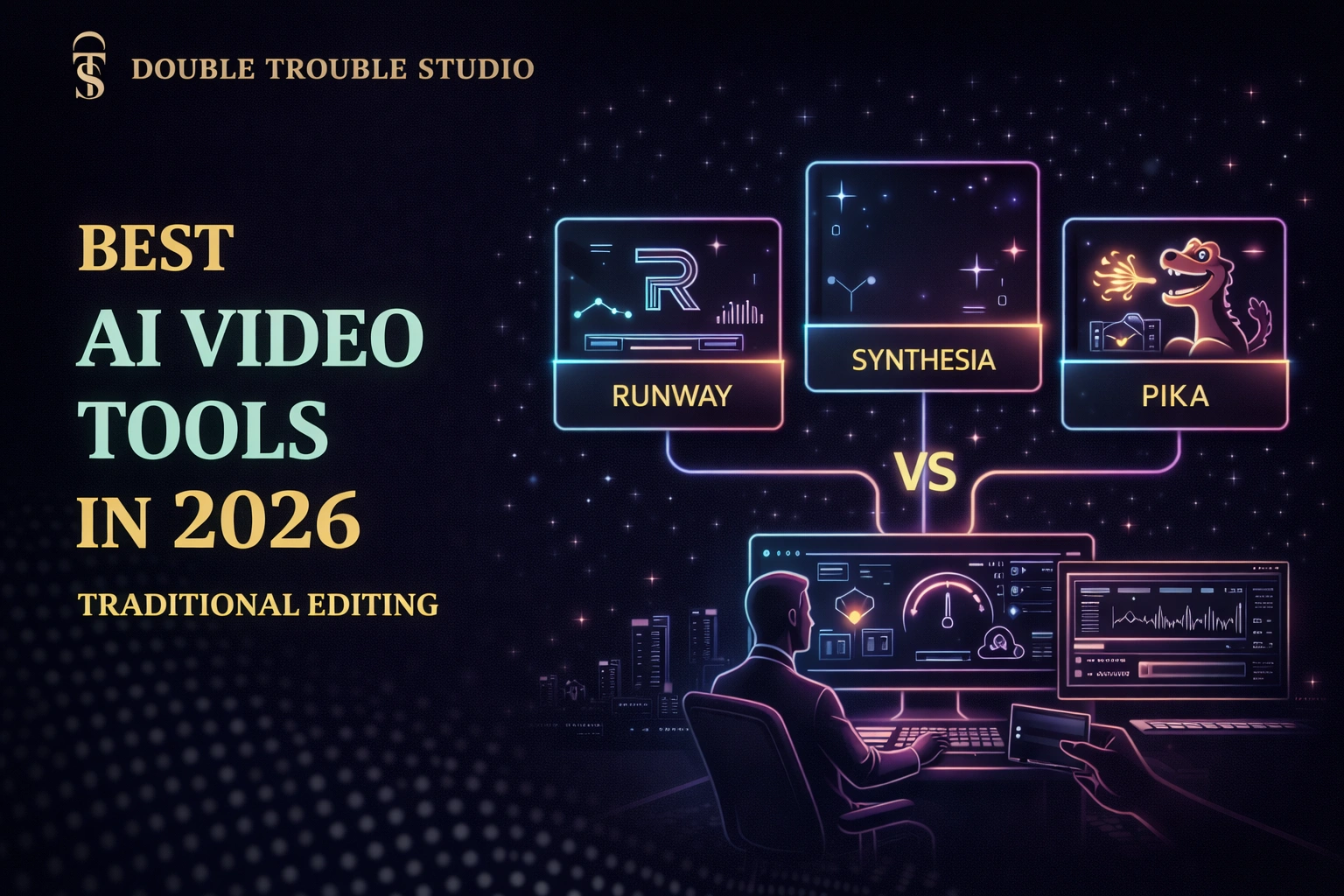
Best AI Video Tools in 2026: Runway, Synthesia, Pika vs Traditional Editing
In 2026, video content has become the central pillar of digital communication. Across industries — from luxury brands and hospitality to automotive and corporate sectors — video is no longer an optional marketing format. It is the primary medium through which brands communicate identity, emotion, and value.
However, what has fundamentally transformed is not just the importance of video, but the way it is created. Artificial intelligence has introduced a new production paradigm where speed, scalability, and automation redefine traditional workflows. Tools such as Runway, Synthesia, and Pika are enabling creators and brands to generate content in ways that were previously resource-intensive and time-consuming.
At the same time, traditional video editing continues to remain relevant, particularly in high-end production environments where precision, storytelling depth, and visual refinement are essential. This coexistence has created a new strategic landscape.
The decision is no longer about choosing between AI and traditional editing.
It is about understanding how each contributes to the overall content strategy.
Because in modern video ecosystems, effectiveness is defined not by the tool, but by the intent behind its use.
The Transformation of Video Production in 2026
The evolution of video production has been driven by a growing demand for content across platforms. Social media, performance marketing, brand storytelling, and digital campaigns require continuous video output. Traditional production methods, while effective, often struggle to keep up with this demand due to their reliance on structured processes and resource-heavy execution.
Artificial intelligence addresses this challenge by compressing production timelines. What once required scripting, shooting, and editing can now be initiated through prompts and automated workflows. This shift has democratized video creation, allowing smaller teams to produce content at scale while enabling larger organizations to operate more efficiently.
However, this transformation also introduces a critical consideration. As production becomes easier, differentiation becomes more difficult. When multiple brands have access to the same tools, the competitive advantage shifts from production capability to creative direction.
Technology enables production.
Strategy defines distinction.
Runway: Redefining Creative Flexibility
Runway has emerged as one of the most influential AI video tools in 2026 due to its versatility and creative depth. It operates at the intersection of automation and control, allowing users to generate, edit, and enhance video content through AI-powered features.
What distinguishes Runway is its ability to support multiple stages of production within a single platform. It allows creators to generate visuals from text, manipulate existing footage, and apply advanced effects without relying on traditional editing software. This flexibility makes it particularly valuable for creative teams that need to experiment rapidly.
In practical applications, Runway is often used during the ideation phase, where concepts are explored and visualized quickly. It also plays a role in social media content creation, where speed and visual impact are critical.
However, its effectiveness depends heavily on creative input. Without clear direction, outputs can feel inconsistent or generic. This highlights an important principle in AI-driven workflows.
The tool provides capability.
The creator provides intention.
Synthesia: Structured Communication at Scale
Synthesia represents a different dimension of AI video production. Instead of focusing on visual creativity, it emphasizes communication and scalability. By enabling the creation of videos with AI-generated avatars, it eliminates the need for on-camera recording and simplifies content production.
This approach is particularly effective in environments where consistency and clarity are more important than cinematic storytelling. Corporate training, internal communication, and educational content benefit significantly from this model. The ability to produce multilingual videos without repeated production processes adds another layer of efficiency.
For brands operating across diverse markets, this scalability is invaluable. Content can be adapted quickly, ensuring that messaging remains consistent while reaching different audiences.
However, Synthesia’s limitations lie in its emotional range. While avatars are increasingly realistic, they do not fully replicate the nuance and depth of human expression. This makes the tool less suitable for high-end storytelling where emotional engagement is critical.
Its strength lies in precision.
Not in performance.
Pika: Expanding the Boundaries of Visual Creation
Pika introduces a more experimental approach to AI video generation. It allows creators to produce dynamic visuals directly from prompts, opening up new possibilities for storytelling and design.
This capability is particularly relevant in creative industries where originality and innovation are valued. Pika enables the generation of visuals that would otherwise require extensive resources, making it a powerful tool for concept development and short-form content.
The appeal of Pika lies in its ability to translate abstract ideas into visual form. It allows creators to explore unconventional concepts, pushing the boundaries of traditional production.
However, this freedom comes with challenges. Achieving consistency and precision can be difficult, especially when working with brand-specific requirements. Outputs may require refinement to align with professional standards.
Pika functions best as a creative catalyst.
It accelerates imagination rather than replacing execution.
The Enduring Relevance of Traditional Editing
Despite the rapid advancement of AI tools, traditional video editing remains a cornerstone of high-quality production. Its value lies in the level of control it offers over every aspect of the video.
From color grading and sound design to narrative pacing and visual composition, traditional editing allows for meticulous refinement. This is particularly important in luxury branding, where every detail contributes to perception.
High-end campaigns, brand films, and cinematic storytelling rely on this precision. The ability to control lighting, frame composition, and post-production elements ensures that the final output aligns perfectly with the intended narrative.
Traditional editing is not defined by efficiency.
It is defined by craftsmanship.
Strategic Comparison: AI and Traditional Workflows
The distinction between AI video tools and traditional editing is not merely technical. It is strategic.
AI tools excel in speed and scalability. They enable rapid content creation, making them ideal for environments where volume and adaptability are required. Traditional editing, on the other hand, excels in depth and refinement, making it indispensable for premium productions.
This contrast highlights the importance of context. The choice of approach must align with the objective of the content. For high-frequency digital campaigns, AI provides efficiency. For high-impact storytelling, traditional editing ensures quality.
The most effective strategies recognize this distinction.
They do not treat these approaches as competitors.
They treat them as complementary.
The Rise of Hybrid Production Models
In 2026, the integration of AI tools with traditional workflows has become the dominant approach. Hybrid production models combine the strengths of both, creating a balanced system that supports both efficiency and quality.
AI is often used in the early stages of production, where ideas are generated and initial content is created. This reduces the time required for concept development and allows teams to iterate quickly. Traditional editing then refines the output, ensuring that it meets professional standards.
This integration creates a workflow that is both flexible and controlled. It allows brands to respond to market demands without compromising on quality.
Hybrid models represent the evolution of production.
They align speed with precision.
SEO and the Growing Importance of Video Content
Video content plays a critical role in search engine optimization in 2026. Search engines increasingly prioritize multimedia content, recognizing its ability to engage users and enhance experience.
Websites that incorporate video tend to have higher engagement metrics, including longer session durations and lower bounce rates. These factors contribute to improved search rankings.
AI tools enable brands to produce video content at scale, supporting SEO efforts by increasing content volume. However, relevance and quality remain essential. Videos must align with user intent and provide meaningful value.
SEO is not driven by content quantity alone.
It is driven by content relevance.
Frequently Asked Questions (FAQs)
What are the best AI video tools in 2026?
Ans: Runway, Synthesia, and Pika are among the most advanced AI video tools, each serving different purposes such as creative generation, communication, and visual experimentation.
Can AI replace traditional video editing completely?
Ans: No, AI cannot fully replace traditional editing. It supports and accelerates workflows, but high-end production still requires human creativity, control, and refinement.
Which tool is best for marketing content?
Ans: Runway and Pika are highly effective for creative marketing and social media content, while Synthesia is better suited for structured communication and explainer videos.
Are AI-generated videos effective for SEO?
Ans: Yes, AI videos can improve SEO by increasing engagement, time on page, and multimedia relevance, provided the content is high-quality and aligned with user intent.
Should luxury brands use AI video tools?
Ans: Yes, but strategically. AI should be used for scaling and experimentation, while traditional editing ensures premium quality and brand consistency.
Conclusion: The Future Is Strategic Integration
The landscape of video production in 2026 is defined by flexibility, speed, and creative possibility. AI tools such as Runway, Synthesia, and Pika have opened new avenues for content creation, enabling brands to operate with greater efficiency and scale.
At the same time, traditional video editing continues to set the benchmark for quality, storytelling, and precision. It remains essential for projects where brand perception and emotional engagement are critical.
The most effective approach lies in integration. AI accelerates production and expands creative exploration, while traditional methods refine and elevate the final output.
This balance ensures that content remains both impactful and aligned with brand identity.
Because in modern video production, success is not determined by the tools alone.
It is determined by how strategically those tools are used.
Design Your Video Strategy
If you are exploring AI video tools or planning premium video production for your brand, a structured approach is essential.
From AI-driven workflows and content scaling to high-end production and post-editing, our team ensures that your video strategy delivers both efficiency and creative excellence.
📩 hello@dtsworld.in 📞 +91 80000 06021 📍 Andheri East, Mumbai
👉 Design Your Video Content Strategy