
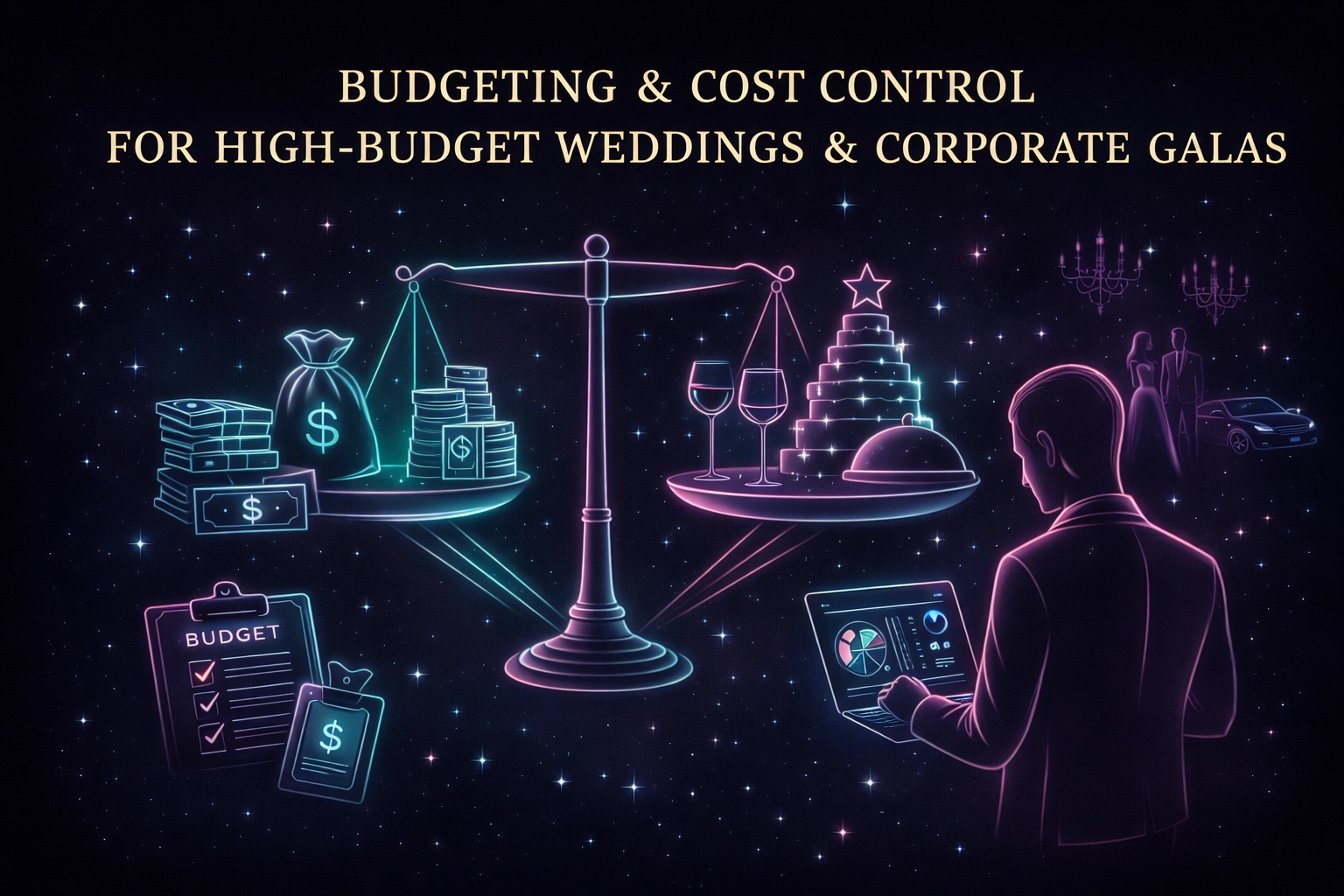
Budgeting & Cost Control for High-Budget Weddings & Corporate Galas
In luxury weddings and corporate galas, budget is often perceived as a number. In reality, it is a framework that shapes every decision, every experience, and every outcome. Contrary to common assumptions, high-budget events are not easier to manage financially. They are more complex, layered, and sensitive to misallocation.
In 2026, as premium events in India continue to grow in scale and sophistication, budgeting has evolved into a strategic discipline. It is no longer about limiting spend. It is about directing investment toward impact while maintaining control over execution.
Because in luxury environments, overspending does not create value.
Precision does.
Understanding Budget as a Strategic Tool
A well-structured budget is not restrictive. It is directional. It defines priorities, aligns expectations, and ensures that every element of the event contributes to the overall vision.
In high-budget weddings and corporate galas, spending is often distributed across multiple categories — venue, décor, catering, entertainment, logistics, guest management, and production. Each of these categories carries its own cost dynamics and potential for variation.
Without a strategic framework, budgets can become reactive. Decisions are made in isolation, leading to imbalances where certain elements are overemphasized while others are underfunded.
A structured budget creates clarity. It ensures that every allocation supports the intended experience.
Cost Allocation: Balancing Impact and Efficiency
One of the most critical aspects of budgeting is allocation. Not all elements contribute equally to guest perception. Some create immediate visual and emotional impact, while others operate in the background.
Understanding this distinction allows for smarter distribution of funds. Investment can be directed toward high-impact areas while maintaining efficiency in less visible components.
For example, guest experience elements such as hospitality, flow, and comfort often have a stronger influence on perception than purely decorative excess. Similarly, seamless logistics can enhance experience more effectively than additional visual layers.
Cost allocation, therefore, is not about reducing spend.
It is about optimizing value.
The Hidden Layers of Event Costs
Luxury events often involve costs that are not immediately visible during initial planning. These hidden layers can significantly impact the overall budget if not accounted for early.
Additional service charges, extended-hour fees, logistical complexities, and vendor-specific requirements can all contribute to budget expansion. Changes in guest count, last-minute enhancements, or design modifications can further increase costs.
Understanding these variables allows for better forecasting. It also enables planners to build contingency buffers that absorb unexpected expenses without disrupting the overall structure.
In premium environments, financial clarity prevents operational stress.
Vendor Negotiation and Financial Structuring
Negotiation plays a key role in cost control, but it must be approached strategically. In luxury markets, direct price reduction is often limited. Instead, value-based negotiation becomes more effective.
This may involve optimizing deliverables, adjusting timelines, or bundling services to create efficiency. Payment structures can also be designed to align with project milestones, ensuring better financial control.
Working with experienced vendors who understand the scale and expectations of premium events can also reduce risk. Their ability to anticipate challenges often prevents costly last-minute adjustments.
Negotiation, in this context, is not about minimizing cost.
It is about maximizing clarity.
Managing Scope Creep and Decision Drift
One of the most common challenges in high-budget events is scope creep. As planning progresses, new ideas emerge, enhancements are added, and initial boundaries begin to expand.
While creativity is essential, uncontrolled expansion can disrupt budget balance. Each addition, even if minor, contributes to cumulative cost increases.
Maintaining discipline in decision-making ensures that the original vision remains intact. Every new element must be evaluated not only for its appeal but also for its impact on the overall budget structure.
Control is not about limitation.
It is about consistency.
Real-Time Cost Monitoring During Execution
Budgeting does not end once allocations are defined. It must be monitored continuously throughout the planning and execution phases.
Real-time tracking allows for adjustments as needed. If one area exceeds its allocation, compensatory decisions can be made in others. This dynamic approach ensures that the overall budget remains balanced.
In high-budget events, where multiple transactions occur simultaneously, this level of monitoring becomes essential. Without it, small deviations can accumulate into significant overruns.
Visibility creates control.
The Role of Contingency Planning
No event is entirely predictable. External factors, last-minute changes, or unforeseen requirements can introduce additional costs. Contingency planning ensures that these situations are managed without disrupting the overall financial structure.
A well-defined contingency buffer provides flexibility. It allows for adjustments without compromising key elements of the event.
In luxury environments, preparedness is part of planning.
Post-Event Financial Closure and Analysis
The budgeting process extends beyond execution. Post-event analysis provides insights into how funds were allocated and utilized.
Reviewing actual spend against planned budgets helps identify areas of efficiency and improvement. It also strengthens future planning by providing data-driven insights.
Financial closure is not just an administrative step.
It is a learning process.
Conclusion: Control Creates Confidence
Budgeting and cost control in high-budget weddings and corporate galas are not about restriction. They are about precision, alignment, and foresight. When managed effectively, budgets become enablers of creativity rather than constraints.
In India’s premium event landscape, where expectations are high and experiences are carefully curated, financial discipline plays a critical role in delivering seamless execution. It ensures that every element is supported, every decision is intentional, and every outcome aligns with the original vision.
Because in luxury events, success is not defined by how much is spent.
It is defined by how well it is managed.
Frequently Asked Questions (FAQs)
Why is budgeting important in luxury events?
It ensures that resources are allocated strategically, supporting both experience and execution.
What are the biggest hidden costs in events?
Service charges, logistical expenses, last-minute changes, and vendor-specific requirements often add to the budget.
Can high-budget events still face cost overruns?
Yes. Without proper control and monitoring, even large budgets can exceed planned limits.
How can scope creep be managed?
By maintaining clear priorities and evaluating every addition against the overall budget structure.
What is the role of contingency in budgeting?
It provides a buffer for unexpected expenses, ensuring stability during execution.
Design Your Event Budget Strategy
If you are planning a luxury wedding, corporate gala, or high-profile celebration in India, budgeting requires more than estimation — it requires structured planning and continuous control.
From cost allocation and vendor negotiation to real-time monitoring and financial closure, our team ensures that your event is executed with precision while maintaining complete budget clarity.
📩 hello@dtsworld.in 📞 +91 80000 06021 📍 Andheri East, Mumbai
👉 Design Your Event Budget Strategy