
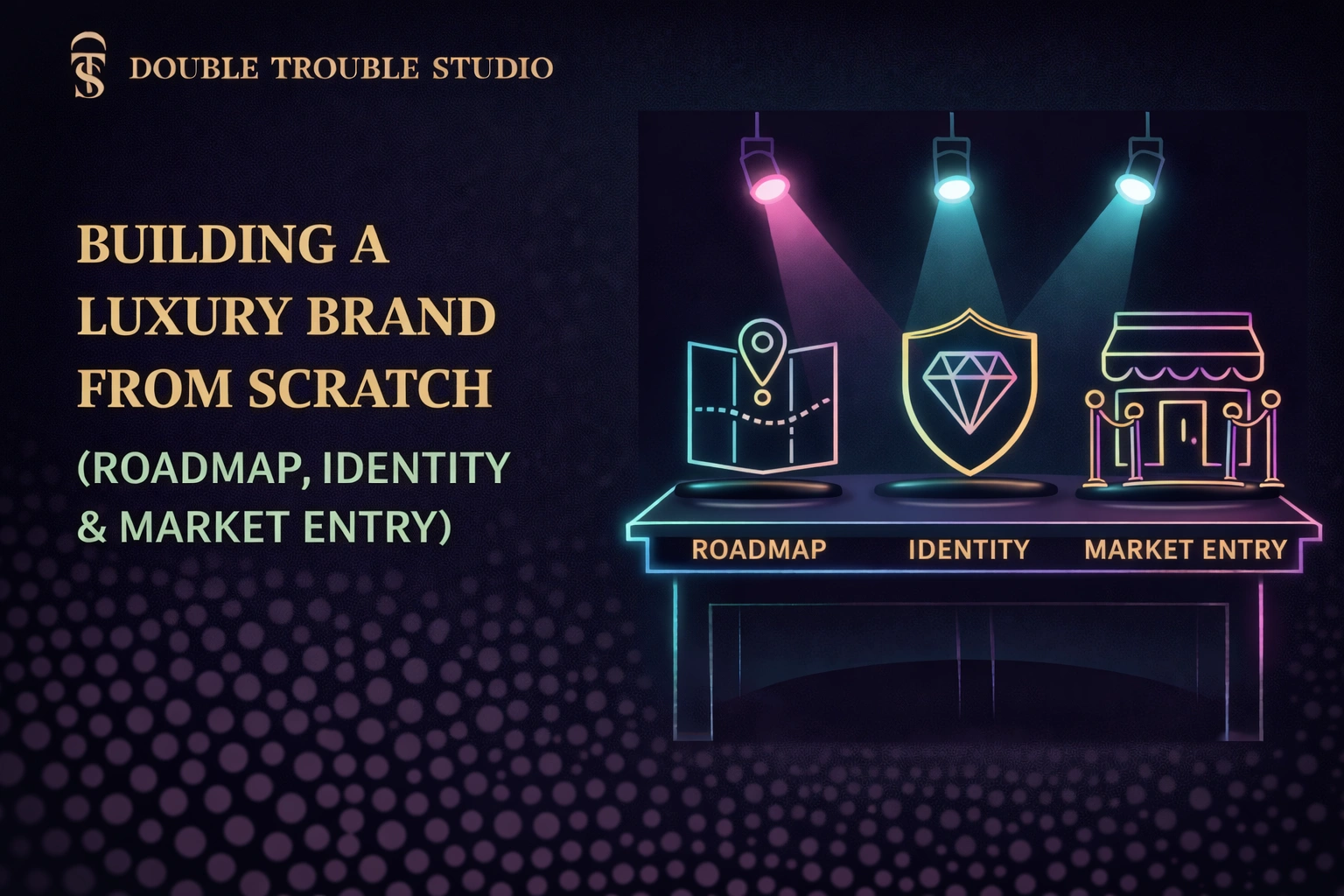
Building a Luxury Brand from Scratch (Roadmap, Identity & Market Entry)
Building a luxury brand from scratch in 2026 is not an exercise in aesthetics or pricing.
It is an exercise in precision.
The assumption that luxury can be created by combining premium visuals, high pricing, and aspirational messaging is one of the most common misconceptions in modern branding. While these elements may contribute to perception, they do not define it.
Luxury is constructed through alignment.
Alignment between identity, audience, experience, and communication.
Brands that succeed in premium markets are not those that appear luxurious on the surface, but those that operate with clarity at every level. From the way they define themselves to the way they enter the market, every decision is intentional.
This is why building a luxury brand requires a structured roadmap.
It requires a clear identity.
And it requires a strategic approach to market entry.
Because in premium markets, you do not grow into luxury.
You enter it deliberately.
Establishing the Strategic Foundation Before Creation
The first stage of building a luxury brand does not involve design, product development, or marketing execution.
It begins with definition.
Before a brand can be seen, it must be understood internally. This involves defining the space it intends to occupy, the audience it seeks to engage, and the perception it aims to create.
Without this clarity, execution becomes fragmented. Visual identity may appear refined, but messaging may lack depth. Pricing may suggest exclusivity, but experience may not support it.
A strategic foundation ensures that every future decision is aligned.
This stage involves defining core elements such as positioning, values, and differentiation. It requires an understanding of the market landscape, identifying not just competitors but also gaps.
In luxury branding, entering an existing category without distinction often results in invisibility. The brand must either redefine the category or occupy a unique space within it.
This is not about innovation for the sake of novelty.
It is about clarity of intent.
The foundation determines whether the brand will be perceived as premium or simply priced that way.
Designing Identity Beyond Visual Expression
Once the strategic foundation is established, the next step is identity creation. However, identity in luxury branding extends far beyond visual elements.
While logos, color palettes, and typography are important, they are only expressions of a deeper system.
Identity is the sum of how the brand behaves, communicates, and is experienced.
This includes tone of voice, narrative style, and interaction design. It also includes decisions related to accessibility, visibility, and audience engagement.
For example, a brand positioned around exclusivity may limit its visibility, appearing only in curated environments. A brand positioned around modern luxury may adopt a more visible and dynamic presence.
These decisions must be consistent.
Inconsistency creates confusion.
Identity must also align with experience. A refined visual identity must be supported by equally refined interactions. From website navigation to customer service, every touchpoint must reflect the same level of quality.
In luxury branding, identity is not created through design alone.
It is created through behavior.
Structuring the Roadmap for Controlled Growth
With identity defined, the focus shifts to execution. This is where the roadmap becomes critical.
A luxury brand cannot rely on rapid, unstructured growth. Visibility must be controlled. Exposure must be timed. Every stage of development must contribute to perception.
A structured roadmap divides the process into phases.
The initial phase focuses on preparation. This includes refining identity, developing assets, and aligning internal teams. It also involves building relationships with key stakeholders such as media, influencers, and collaborators.
The next phase focuses on introduction. This is where the brand becomes visible. However, this visibility must be managed carefully. Overexposure can reduce exclusivity, while insufficient visibility can limit impact.
The final phase focuses on reinforcement. This ensures that the initial perception is sustained over time.
Each phase must be aligned with the brand’s positioning.
The roadmap is not just a timeline.
It is a sequence of perception-building steps.
Market Entry as a Positioning Decision
Entering the market is not a logistical step.
It is a strategic statement.
The way a brand enters the market influences how it is perceived. A poorly executed entry can undermine even the strongest identity.
Market entry must therefore be designed carefully.
This includes selecting the right channels, platforms, and partnerships. It also involves defining the narrative through which the brand is introduced.
For luxury brands, entry often involves controlled visibility. Instead of broad exposure, the focus is on targeted presence.
This may include curated events, selective media coverage, and strategic collaborations.
The objective is not to reach everyone.
It is to reach the right audience.
Because in premium markets, perception spreads through influence, not volume.
Pricing Strategy as a Signal of Intent
Pricing is one of the most visible indicators of positioning. However, it must be approached strategically.
Setting a high price does not automatically create luxury perception. The price must align with identity, experience, and narrative.
If pricing exceeds perceived value, it creates skepticism. If it falls below, it reduces exclusivity.
This balance requires careful consideration.
Pricing must reflect the brand’s intended position in the market. It must also act as a filter, defining who the brand is for.
In luxury branding, price is not just a number.
It is a signal.
Building Credibility Through Early Interactions
The initial interactions between the brand and its audience play a critical role in establishing perception.
These interactions may occur through events, digital platforms, or media coverage. Regardless of the channel, they must reflect the brand’s identity.
For example, a launch event must be designed with the same precision as the brand’s visual identity. Digital platforms must provide a seamless and refined experience.
Credibility is built through consistency.
Every interaction reinforces perception.
Sustaining Momentum After Market Entry
A successful market entry is only the beginning. Sustaining momentum requires continuous effort.
Content, PR, and engagement must be structured to maintain visibility and reinforce identity. This does not mean constant activity, but consistent presence.
The brand must remain relevant without becoming overexposed.
This requires a balance between visibility and restraint.
Momentum is not maintained through frequency.
It is maintained through consistency.
Managing Growth Without Diluting Identity
As the brand grows, new opportunities emerge. Expanding into new markets, introducing new offerings, or collaborating with other brands can enhance visibility.
However, growth must be managed carefully.
Every new initiative must align with the brand’s identity. Deviations can weaken perception.
Maintaining this alignment requires discipline. Decisions must be evaluated not just for their potential impact, but for their consistency with positioning.
Growth should strengthen identity.
Not dilute it.
Common Challenges in Building a Luxury Brand
Building a luxury brand from scratch involves several challenges. One of the most common is lack of clarity. Without a defined positioning, execution becomes inconsistent.
Another challenge is overexposure. Attempting to accelerate growth through excessive visibility can reduce exclusivity.
Imitation is also a risk. Replicating existing brands may create familiarity, but it does not create distinction.
Finally, misaligned pricing can undermine perception.
Addressing these challenges requires a structured approach.
Strategy must guide execution.
Frequently Asked Questions (FAQs)
What is the first step in building a luxury brand?
Ans: Defining the brand’s positioning, identity, and target audience before any execution begins.
Is visual identity enough to create a luxury brand?
Ans: No, identity must include behavior, communication, and experience, not just design.
How important is pricing in luxury branding?
Ans: Pricing is a key signal of positioning and must align with perception and experience.
What makes a successful market entry?
Ans: Controlled visibility, targeted audience engagement, and consistent narrative.
Can a brand become luxury over time?
Ans: Yes, but it requires deliberate positioning and consistent execution.
Conclusion: Building with Intent, Not Assumption
Creating a luxury brand from scratch is not about assembling elements.
It is about aligning them.
From roadmap design to identity creation and market entry, every stage must be guided by a clear understanding of positioning.
In 2026, where audiences are highly aware and competition is intense, clarity becomes the defining factor.
Brands that succeed are those that define themselves precisely and execute consistently.
Because in premium markets, luxury is not created by chance.
It is built with intent.
Design Your Luxury Brand Roadmap
If you are planning to build a luxury brand from the ground up, a structured roadmap ensures clarity, alignment, and long-term success.
From positioning and identity design to market entry and growth strategy, our team helps you create a brand that is defined with precision and executed with consistency.
📩 hello@dtsworld.in 📞 +91 80000 06021 📍 Andheri East, Mumbai
👉 Build Your Luxury Brand Strategy