Building Conversion-Focused Marketing Funnels on Your Site
A website should do more than look professional. It should guide visitors towards a meaningful action.
A potential customer may discover your brand through Google Search, Instagram, paid advertising, PR coverage, an influencer recommendation, an event, a blog article or an AI-assisted search result. But reaching your website does not mean that person is immediately ready to buy.
They may first want to understand your business, explore your services, compare alternatives, review previous work, check credibility and decide whether they trust you.
This is where a conversion-focused marketing funnel becomes important.
A website marketing funnel creates a structured journey from first discovery to enquiry, consultation, booking, purchase and eventually retention. Instead of allowing visitors to move randomly through the site, the funnel gives them the right information, proof and call to action at each stage of their decision-making process.
For premium, luxury, hospitality, lifestyle, event, real estate, fashion, digital and service-led businesses, funnel strategy is especially important because high-value customers often require multiple interactions before making a decision.
A well-designed website development and digital marketing strategy should therefore combine design, user experience, SEO, content, trust signals and conversion optimisation rather than treating them as separate activities.
This guide explains how to build conversion-focused marketing funnels on your site that attract the right audience, build trust and turn website traffic into qualified business opportunities.
What Is a Conversion-Focused Marketing Funnel?
A conversion-focused marketing funnel is a structured customer journey designed to move website visitors from awareness to action.
The final conversion depends on the business.
It may be:
- Submitting an enquiry
- Booking a consultation
- Requesting a proposal
- Making a purchase
- Sending a WhatsApp message
- Calling the business
- Registering for an event
- Joining a waitlist
- Downloading a resource
- Visiting a physical location
The purpose of the funnel is not to force every visitor to convert immediately.
Instead, it should provide the next most relevant step according to the visitor's level of awareness and purchase intent.
For example, someone discovering your company through an educational blog may want to explore your expertise before contacting you. Someone searching directly for a specific service may already be much closer to conversion.
The website should support both journeys.
Why Your Website Needs a Marketing Funnel
Many websites function like digital brochures.
They contain a homepage, About page, service pages, portfolio and contact information, but there is no clear journey connecting these pages.
A visitor may arrive through Google, read one article and leave.
Another visitor may explore a service but never see relevant proof.
Someone may visit your portfolio but have no clear next step towards an enquiry.
This creates unnecessary conversion leakage.
A strong funnel connects:
Traffic → Information → Trust → Consideration → Action → Follow-up
The objective is to ensure that each important page contributes to the customer's journey.
Businesses should therefore think beyond simply "building a website." The site should become part of the wider digital growth system.
A clear About page, relevant portfolio of work, focused service pages and accessible contact experience can work together to move customers towards a decision.
Understand the Customer Journey Before Building the Funnel
Before designing landing pages or adding CTAs, understand how customers actually make decisions.
Ask:
Where do customers first discover the brand?
What questions do they ask before enquiring?
Which concerns prevent them from converting?
What proof do they need?
Which pages do they visit before contacting the business?
How long does the buying decision usually take?
What information does the sales team repeatedly explain?
These answers help determine the structure of the funnel.
For premium and service-led businesses, the customer journey may be longer because the purchase involves higher cost, personal trust or multiple decision-makers.
A luxury wedding client, for example, may discover an agency through social media, explore its events and weddings services, review previous projects, read educational content and then request a consultation.
The funnel should support that complete journey.
The Four Main Stages of a Website Marketing Funnel
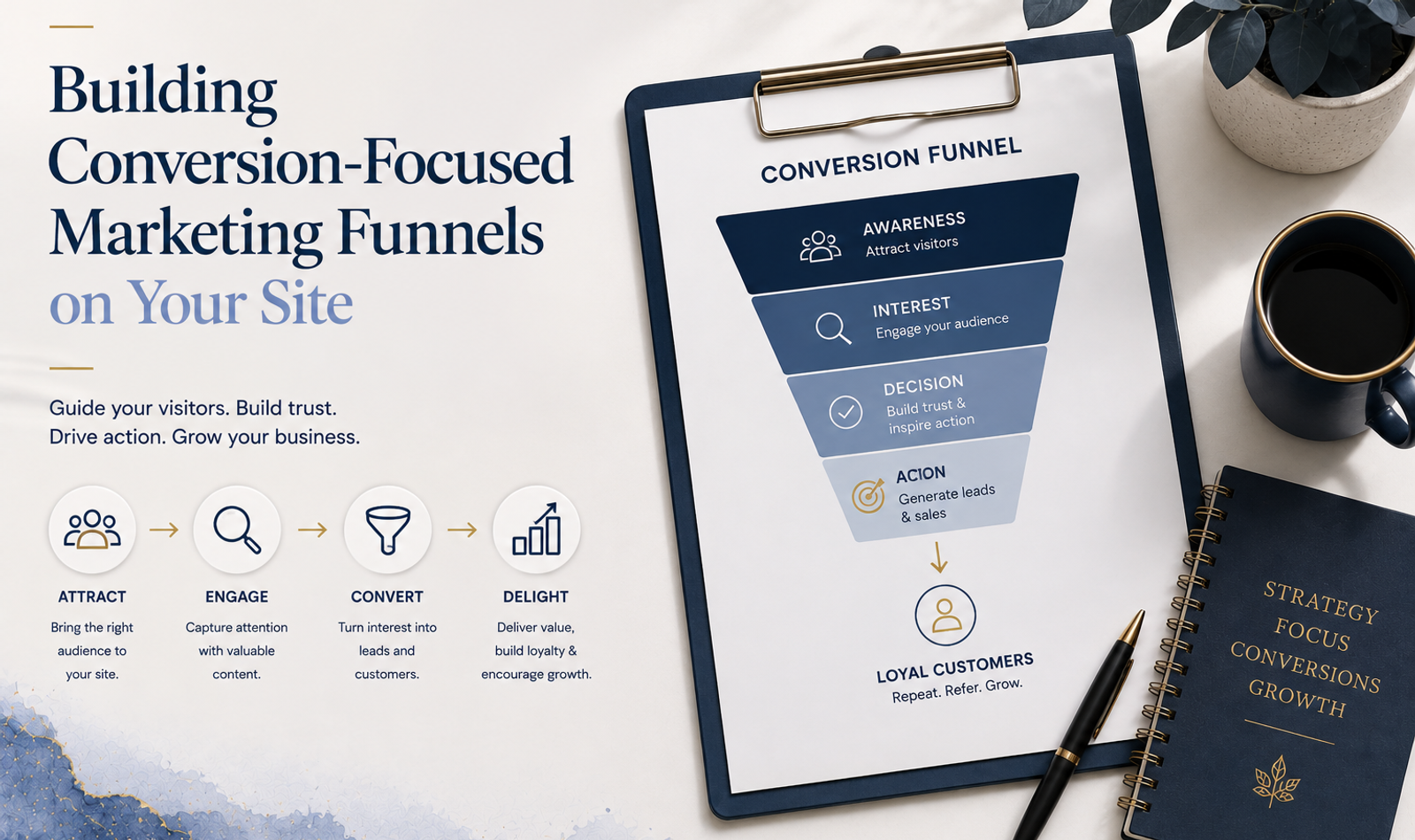
A practical conversion funnel can be divided into four stages:
Awareness → Consideration → Conversion → Retention
Each stage requires different information, content and calls to action.
Stage One: Awareness
Awareness is where customers first discover the brand.
Website traffic may come from:
- Organic search
- Social media
- Paid advertising
- PR coverage
- Influencer campaigns
- YouTube
- Referrals
- Events
- Backlinks
- Direct traffic
- AI-assisted search
At this stage, visitors need immediate clarity.
Your website should quickly answer three questions:
What do you do?
Who do you help?
Why should someone continue exploring?
This is particularly important on the homepage.
Complex animations and luxury visuals may create interest, but they should not hide the business proposition.
Strong branding and clear communication should work together.
Stage Two: Consideration
Once visitors understand what the brand offers, they begin evaluating whether it is right for them.
This is the consideration stage.
Customers may explore:
- Service pages
- Case studies
- Portfolio work
- Testimonials
- FAQs
- Blog articles
- Founder profiles
- Client logos
- Processes
- Media coverage
- Pricing information
This stage is about reducing uncertainty.
For a creative or digital agency, a strong work portfolio can demonstrate execution quality instead of simply claiming expertise.
Similarly, educational content published through the DTS blog can demonstrate category knowledge and build organic authority.
The more expensive or complex the purchase, the more important this trust-building stage becomes.
Stage Three: Conversion
Conversion happens when the visitor takes the action the business wants.
For a service-led business, this may be requesting a proposal or booking a consultation.
For an event company, it may be discussing an upcoming celebration.
For ecommerce, it may be purchasing a product.
For a hospitality business, it may be making a reservation or requesting availability.
The conversion path should be simple.
Visitors should not have to search repeatedly for contact details or complete unnecessarily long forms.
Your contact page should provide clear options and make the next step obvious.
Stage Four: Retention
A strong funnel continues after conversion.
Existing customers can become repeat buyers, long-term clients, referral sources and brand advocates.
Retention strategies may include:
- Customer onboarding
- Email communication
- Educational resources
- Repeat booking options
- Related services
- Loyalty programmes
- Referral systems
- Customer communities
- Post-purchase support
For service businesses, a satisfied customer can create future revenue through repeat projects and recommendations.
The website funnel should therefore support both acquisition and long-term relationships.
Match Search Intent With the Funnel
Not every website visitor has the same intention.
Consider these three searches:
"What is SEO?"
"Best SEO services for luxury brands"
"SEO agency Mumbai"
The first user is researching.
The second is comparing solutions.
The third may be actively looking for a provider.
These visitors should not receive identical experiences.
Informational visitors can be directed towards educational content.
Commercial visitors should see relevant services, proof and case studies.
High-intent visitors should have an easy route towards enquiry.
This is where SEO and funnel strategy become closely connected.
Build SEO Into the Funnel
SEO should not simply increase website traffic.
It should attract visitors with relevant intent and guide them towards appropriate next steps.
Informational blog content can attract early-stage customers.
Service pages can target commercial searches.
Location pages can support geographically relevant searches.
Case studies and work pages can build consideration.
Contact pages support conversion.
For businesses operating across multiple locations, a structured locations section can also help customers discover geographically relevant services.
The objective is not simply to rank.
It is to bring the right visitors into the right stage of the funnel.
Use Blogs as Funnel Entry Points
Blog articles often attract customers before they are ready to purchase.
This makes content an important top- and middle-of-funnel asset.
A useful blog should answer a genuine customer question and then naturally provide a next step.
For example, a customer reading about website conversion may be directed towards website development and digital marketing.
Someone researching event planning can explore event and wedding management.
Someone researching publicity or media visibility can explore PR and media marketing.
This is why internal linking matters for both SEO and conversion.
Links should help the reader continue their journey rather than being added randomly.
Create Dedicated Landing Pages
One of the biggest funnel mistakes is sending every marketing campaign to the homepage.
The homepage has to serve many audiences.
A landing page can focus on one.
If you are running a campaign for website development, send the visitor to a page focused on website development.
If you are promoting PR, direct them towards PR and media marketing services.
If you are running a luxury wedding campaign, the destination should relate directly to events and weddings.
If the campaign is built around celebrity collaborations or appearances, visitors should be able to explore relevant celebrity management services.
This creates message continuity.
Ad promise → Landing page → Proof → CTA
When the advertisement and landing page communicate different messages, conversion becomes harder.
What Should a High-Converting Landing Page Include?
A strong landing page should provide enough information to make the next decision easier.
Clear Headline
Explain the main offer or value immediately.
Supporting Message
Give the visitor enough context to understand why the service is relevant.
Customer Benefits
Explain outcomes instead of only listing features.
Visual Proof
Use relevant photography, videos, projects or demonstrations.
Credibility
Include testimonials, client work, case studies, experience or results.
Process
Explain how working with the business actually happens.
FAQs
Answer common objections.
Strong CTA
Tell the visitor what to do next.
The landing page should have a focused purpose.
Too many competing CTAs can weaken decision-making.
Create Better Calls to Action
Calls to action should be specific and relevant.
Instead of:
Submit
consider:
Request a Proposal
Discuss Your Project
Book a Consultation
Plan Your Event
Explore Our Work
Speak With Our Team
Get Started
Different pages can use different CTAs.
A visitor reading an educational article may be better suited to Explore Our Services.
Someone reviewing a commercial service page may be ready for Request a Proposal.
The CTA should match intent.
Place CTAs Strategically
A CTA should not appear only at the bottom of a long page.
Consider placing CTAs:
- Near the hero section
- After explaining major benefits
- After important proof
- Near testimonials
- After FAQs
- At the end of the page
However, repetition should not feel aggressive.
For premium brands, conversion design should remain refined.
The visitor should always know what to do next without feeling pressured.
Build Trust Throughout the Funnel
High-value customers rarely convert without trust.
The website should provide evidence that supports the brand's claims.
Trust signals may include:
- Real client work
- Testimonials
- Case studies
- Client logos
- Media features
- Founder expertise
- Years of experience
- Awards
- Certifications
- Detailed processes
- Real contact information
- Clear FAQs
For a service-led company, the About Double Trouble Studio page can help customers understand the people, positioning and expertise behind the business.
Trust should also be contextual.
If someone is considering event management, show event-related proof.
If someone is considering web development, show relevant digital work.
Generic proof is less persuasive than relevant proof.
Turn Your Portfolio Into a Conversion Asset
A portfolio should do more than display beautiful images.
It should demonstrate capability.
Where possible, structure projects around:
Challenge → Strategy → Execution → Outcome
Explain what the customer needed.
Show how the problem was approached.
Demonstrate what was delivered.
Highlight meaningful results where appropriate.
Your selected work then becomes part of the sales funnel rather than simply a gallery.
Marketing Funnels for Premium and Luxury Brands
Premium brands should approach funnel design differently from high-volume businesses.
Aggressive tactics such as constant discount banners, countdown timers, repeated pop-ups and excessive urgency can weaken luxury positioning.
A premium funnel may look more like:
Discovery → Desire → Expertise → Proof → Personalisation → Conversation
For high-value services, the conversion is often not an instant transaction.
It is the beginning of a relationship.
A customer considering guest management services, for example, may want to understand the level of hospitality, coordination and personal attention before making contact.
Premium funnel design should therefore communicate confidence rather than desperation.
Reduce Friction in Enquiry Forms
Every unnecessary form field creates additional friction.
A first enquiry usually does not require every possible customer detail.
Consider asking for:
- Name
- Email or phone
- Required service
- Short project description
For high-value services, one or two qualification fields can also be useful.
These may include:
- Budget range
- Event date
- Location
- Project timeline
Qualification can intentionally reduce lead volume while improving lead relevance.
The goal should not always be to generate the maximum number of leads.
The goal should be to generate qualified leads.
Use WhatsApp Strategically
For Indian customers, WhatsApp can reduce friction significantly.
A visitor may be more comfortable sending a message than completing a formal enquiry form.
WhatsApp CTAs can therefore be useful on service and contact pages.
However, the funnel does not end when someone clicks WhatsApp.
The response must be:
- Fast
- Professional
- Relevant
- Consistent with the brand tone
If a premium website creates a sophisticated experience but the WhatsApp response is generic or delayed, trust can disappear quickly.
Marketing and sales must be connected.
Connect Marketing With Sales
Website funnels should not end at lead generation.
The complete commercial funnel is closer to:
Website Visitor → Engaged Visitor → Lead → Qualified Lead → Proposal → Customer → Repeat Customer
This requires marketing and sales teams to share information.
Sales should know where leads originated.
Marketing should know which leads eventually became customers.
Without this connection, a campaign may appear successful because it generates 500 leads even though only a handful are commercially relevant.
Lead quality matters.
Use CRM Tracking
A CRM can help businesses track:
- Lead source
- Service interest
- Campaign source
- Customer profile
- Sales stage
- Follow-up status
- Proposal status
- Conversion
- Lost reason
- Revenue
This information allows marketing teams to understand which channels produce actual business.
For example, social media may generate the highest volume of enquiries while SEO produces fewer but more qualified opportunities.
Without tracking, the business may never discover this difference.
Build Better Thank-You Pages
The customer journey should continue after form submission.
Instead of displaying only:
"Thank you. We will contact you."
use the thank-you page to explain what happens next.
It can include:
- Expected response time
- Next steps
- Relevant work
- Useful resources
- Related services
- Contact options
This reduces uncertainty and continues the premium customer experience.
Use Retargeting to Recover Interested Visitors
Most website visitors will not convert on their first visit.
They may be:
- Comparing providers
- Waiting for approval
- Discussing internally
- Researching pricing
- Planning for later
- Simply not ready yet
Retargeting can bring these visitors back.
But do not show every visitor the same advertisement repeatedly.
Use their behaviour to determine what they need next.
A visitor who viewed a service page may need a case study.
Someone who viewed multiple projects may need a consultation CTA.
Someone who abandoned an enquiry may need reassurance.
Retargeting should move the customer forward rather than repeating the same message.
Use PR as Part of the Funnel
PR can also contribute to website conversion.
A media article may introduce the brand to an audience that has never encountered it before.
When readers search the brand afterwards, the website should reinforce the credibility created by that coverage.
For brands investing in PR and media marketing, media visibility should therefore connect back to strong website pages, founder information, services, work and conversion opportunities.
PR builds third-party trust.
The website should convert that trust into deeper consideration.
Celebrity and Influencer Traffic Needs a Funnel Too
Celebrity and influencer collaborations can generate sudden spikes in attention.
But visibility alone does not guarantee business.
When a campaign involving a celebrity, creator or high-profile guest sends users towards the website, the landing experience should explain the connection and provide a clear next step.
Brands planning high-profile collaborations can connect these campaigns with a structured celebrity management strategy.
Campaign traffic should never arrive at an unrelated generic page.
The website experience should continue the story that generated the click.
Use AI Video and Visual Content Within the Funnel
Video can support different funnel stages.
Awareness videos can create attention.
Educational videos can explain complex services.
Case-study videos can provide proof.
Testimonials can build trust.
Product videos can support consideration.
Retargeting videos can bring interested customers back.
Brands using AI video and VFX can also create campaign variations, explainers and social-first assets that connect different stages of the funnel.
However, the video should always have a purpose.
A visually impressive video that does not move the visitor towards understanding or action may add production value without improving conversion.
Mobile Optimisation Is Funnel Optimisation
A large percentage of visitors may encounter the funnel on mobile.
Every important conversion path should therefore be tested on smaller screens.
Check:
- Menu usability
- Text readability
- CTA visibility
- Form length
- Button size
- Image loading
- Video performance
- WhatsApp buttons
- Contact actions
A desktop funnel can perform well while the mobile journey remains frustrating.
This can create significant conversion loss.
Website Speed Affects Conversion
Traffic is valuable only if visitors can access the page quickly.
Heavy hero videos, oversized images, excessive scripts, third-party widgets and poor technical implementation can slow down the website.
Brands should monitor page performance alongside design.
A conversion-focused website should balance visual richness with technical efficiency.
This is especially important for luxury websites where large photography and video assets are common.
SEO, GEO and AI Search in the Funnel
Search discovery is evolving.
Customers may discover brands through traditional Google results, local results, social search and AI-assisted answer systems.
This makes clear website structure increasingly important.
The site should explain:
- Who the company is
- What it does
- Who it serves
- Where it operates
- What makes it different
- How its services work
- What proof it has
- How customers can contact it
Service pages, FAQs, blogs, case studies and location pages can collectively create stronger search visibility.
The objective is not to write robotic content for search engines.
It is to create useful, structured information that both customers and search systems can understand.
Measure the Entire Funnel
Traffic alone does not tell you whether the website works.
Brands should track metrics across the complete journey.
Awareness Metrics
- Organic traffic
- New visitors
- Search impressions
- Branded searches
- Campaign traffic
Engagement Metrics
- Time on page
- Scroll depth
- Video engagement
- Pages per session
- Return visits
Consideration Metrics
- Service page views
- Portfolio views
- Case-study engagement
- Pricing interactions
- Repeat visits
Intent Metrics
- CTA clicks
- Form starts
- WhatsApp clicks
- Phone clicks
- Email clicks
Conversion Metrics
- Form submissions
- Consultation bookings
- Qualified enquiries
- Purchases
- Registrations
Sales Metrics
- Qualified lead rate
- Proposal rate
- Lead-to-sale conversion
- Average customer value
- Revenue by source
A website should ultimately be measured against business outcomes, not simply page views.
Conversion Rate Optimisation
Conversion Rate Optimisation, or CRO, is the process of improving the percentage of visitors who take desired actions.
CRO can involve testing:
- Headlines
- CTA language
- Form length
- Hero sections
- Testimonials
- Page layouts
- Visuals
- Offers
- Proof points
- Landing-page structure
Testing should be based on evidence.
If analytics shows that visitors reach the enquiry section but rarely complete the form, investigate the form.
If users leave immediately from a landing page, examine the message, loading speed and traffic relevance.
If visitors repeatedly view the portfolio but do not enquire, stronger CTAs or service connections may be required.
Optimisation should solve identifiable problems.
Common Marketing Funnel Mistakes
One major mistake is focusing only on traffic.
More traffic does not automatically produce more customers.
Other common mistakes include:
- Sending all campaigns to the homepage
- Using the same CTA everywhere
- Creating long enquiry forms
- Hiding important proof
- Ignoring mobile users
- Using unclear headlines
- Having weak service pages
- Publishing blogs without next steps
- Failing to track lead sources
- Ignoring sales feedback
- Not retargeting interested visitors
- Measuring only vanity metrics
Another major mistake is trying to make every visitor convert immediately.
Different customers need different amounts of information.
A good funnel respects the buying journey.
Conversion Funnel Checklist
Before launching or improving your website funnel, review the following:
- Is the target customer clearly defined?
- Does each important page have a purpose?
- Are campaign visitors reaching relevant landing pages?
- Is the value proposition immediately understandable?
- Are benefits explained clearly?
- Is sufficient proof available?
- Are CTAs matched to visitor intent?
- Are forms simple?
- Is WhatsApp available where appropriate?
- Is the mobile journey smooth?
- Is the website fast?
- Are blogs internally linked to relevant services?
- Are conversions being tracked?
- Are lead sources connected to sales?
- Are qualified leads measured separately from total leads?
- Is retargeting being used strategically?
- Are funnel results reviewed regularly?
A funnel should continuously improve as the business learns more about customer behaviour.
Frequently Asked Questions
What is a conversion-focused marketing funnel?
A conversion-focused marketing funnel is a structured customer journey that guides website visitors from initial awareness through consideration and trust towards an enquiry, booking, purchase or another valuable action.
Why does a website need a marketing funnel?
A marketing funnel prevents visitors from navigating without direction. It connects content, service pages, proof, CTAs and conversion points so users have a logical path towards action.
What are the main stages of a website funnel?
The main stages are awareness, consideration, conversion and retention.
What makes a website conversion-focused?
A conversion-focused website combines clear messaging, relevant content, strong UX, trust signals, strategic CTAs, simple forms, fast performance and measurable conversion paths.
How does SEO support a marketing funnel?
SEO attracts potential customers at different stages of their buying journey. Informational content creates awareness, commercial pages support consideration and high-intent service or location pages can support conversion.
What is the role of landing pages in a funnel?
Landing pages create focused experiences for specific audiences, campaigns, services or offers. They reduce distraction and guide visitors towards one primary action.
How can premium brands improve website conversion?
Premium brands should focus on trust, expertise, proof, personalisation, strong customer experience and clear consultation pathways rather than depending heavily on discounts or aggressive urgency.
Should every blog have a CTA?
Most commercially relevant blogs should provide a logical next step. The CTA should relate naturally to the subject rather than forcing an unrelated sales message.
How do you measure website funnel performance?
Measure traffic, engagement, service-page activity, CTA clicks, form starts, enquiries, qualified leads, sales conversions, revenue and retention.
How often should a marketing funnel be optimised?
Performance should be monitored regularly and meaningful changes should be made when analytics, customer feedback or sales data identifies a clear problem or opportunity.
Conclusion
A high-performing website is not simply a collection of pages.
It is a connected customer journey.
Conversion-focused marketing funnels help businesses turn awareness into interest, interest into trust and trust into meaningful action.
The strongest funnels begin with customer intent.
They connect SEO, content, service pages, landing pages, portfolio work, PR, digital campaigns, retargeting and sales into one structured journey.
For premium and luxury businesses, conversion does not need to feel aggressive.
The website should create confidence, communicate expertise, demonstrate proof and make the next step easy.
The objective is not always to generate the largest possible number of enquiries.
It is to generate better-quality opportunities from customers who understand and value what the brand offers.
Double Trouble Studio helps premium, luxury, hospitality, lifestyle, event, real estate, fashion, digital and service-led brands build conversion-focused websites and digital marketing systems designed around visibility, customer journeys, qualified lead generation and long-term growth.
Explore Double Trouble Studio, discover our website development and digital marketing services, review our work, or contact our team to discuss your website and conversion strategy.
📩 info@dtsworld.in 📞 +91 80000 06021 📍 Andheri (West), Mumbai
Need this for your brand?
Let DTS build your next campaign.
From PR, celebrity management and events to websites, social media, SEO and AI video production — Double Trouble Studio helps brands grow with strategy and execution.
Discuss Your Requirement →