Strong media relationships are not built through one successful pitch, one press event or one favourable article.
They are built through repeated professional interactions in which journalists learn that a brand or PR representative is accurate, relevant, accessible and respectful of editorial independence.
This trust develops gradually.
A journalist may first encounter the brand through a concise pitch. The next interaction may involve a quick expert comment, an interview arrangement or a fact-checking request. Over time, the journalist begins to understand whether the source responds reliably, provides useful information and avoids exaggeration.
This is the foundation of a long-term media relationship.
The relationship does not guarantee coverage.
It does not allow a brand to demand positive reporting or control the final article.
It creates confidence that communication with the brand will be useful, professional and worth the journalist’s time.
For companies seeking sustained visibility, this trust can become one of the most valuable assets within public relations.
A brand that contacts journalists only when it wants promotion may struggle to build meaningful familiarity. Its outreach may feel transactional, especially when every email asks for a product feature, founder interview or event attendance.
A brand that regularly provides relevant data, credible experts, timely access and accurate information becomes more useful.
Journalists may return when they need a source. Editors may consider the company for future trend pieces. Producers may invite the spokesperson into broader discussions. Freelancers may remember the brand while developing new feature ideas.
This creates strategic visibility.
Strategic visibility is different from constant publicity.
It means appearing in the right conversations, through the right outlets, for reasons that reinforce the brand’s expertise and reputation.
The objective is not to dominate every news cycle.
It is to become a trusted and relevant participant in the subjects that matter to the business and its audiences.
Long-term media relationships therefore depend on three connected qualities: trust, access and consistency.
Trust tells journalists that the information is credible.
Access gives them the people, data, experiences and materials required to build a story.
Consistency ensures that the brand remains useful and visible beyond isolated launches.
When these qualities work together, media relations becomes more than a pitching function.
It becomes a long-term reputation and authority system.
What Is a Long-Term Media Relationship?
A long-term media relationship is a sustained professional connection between a journalist, editor, producer or contributor and a brand representative, spokesperson or public relations team.
The relationship develops through repeated interactions around information, expertise, interviews, events, data, access and editorial opportunities.
It should remain professional rather than dependent on personal favour.
The journalist’s responsibility remains with their audience and publication.
The PR professional’s responsibility is to provide accurate, relevant and accessible information while representing the organisation honestly.
A productive relationship helps both sides work efficiently.
The journalist knows whom to contact for reliable information.
The PR team understands the journalist’s subject area, format and deadlines.
Neither side wastes time explaining basic expectations during every interaction.
This familiarity can make communication faster without reducing editorial independence.
Media Relationships Are Not Coverage Guarantees
One of the most important principles in media relations is that relationships do not guarantee publication.
A journalist may know and respect a PR professional while deciding that a particular story is unsuitable.
The timing may be wrong.
The angle may not fit the current editorial calendar.
Another development may become more important.
The publication may require independent evidence that the brand cannot provide.
A professional PR team should accept these decisions.
Attempting to use familiarity, hospitality or previous cooperation to pressure the journalist can damage the relationship.
The value of the relationship lies in trust and access, not control.
Why Long-Term Media Relationships Matter
Media relationships create value beyond one article.
A journalist who understands the brand may identify future story opportunities more quickly.
They may contact the company for expert commentary, background information or data.
They may include the founder in a larger industry feature.
They may recommend the organisation to another writer covering a related subject.
Long-term relationships also improve communication during difficult situations.
When a crisis or controversial issue develops, established journalists are more likely to know where to seek the brand’s verified position.
This does not guarantee favourable coverage.
It reduces confusion and increases the likelihood that accurate information will be considered.
For high-value brands, professional services, hospitality, fashion, events and emerging companies, this continuing familiarity can strengthen authority significantly.
Trust Is the Foundation
Trust in media relations develops when the source consistently provides accurate information.
The journalist should not need to verify every basic fact because the PR representative regularly exaggerates claims.
Dates, titles, figures, quotations, names and product information should be checked before they are shared.
When the team does not know something, it should say so.
An honest statement that information is still being confirmed is more valuable than a confident but incorrect answer.
Trust also depends on consistency between private and public communication.
A journalist should not receive one version of events while the brand publishes another.
Contradictions make the source appear unreliable.
Accuracy Builds Relationship Capital
Every accurate interaction contributes to relationship capital.
A PR team may provide a statistic with methodology, a founder quotation with clear approval or an image with correct credits.
These details may appear small, but they affect how easily the journalist can use the material.
Errors create additional work.
A wrong title may require corrections.
An unsupported market claim may undermine the article.
An incorrect photograph credit can create legal and professional problems.
Journalists remember sources who make their work easier.
They also remember sources who create avoidable risk.
Avoid Overclaiming
Brands often want to describe themselves as the first, largest, leading, fastest-growing or most innovative.
These claims should not be included automatically.
The team should confirm whether independent evidence supports them.
If the evidence is unavailable, the language should be more precise.
The company may be among the first in a defined market rather than the first in the entire country.
It may be a rapidly growing business without claiming to be the fastest-growing.
It may have developed a distinctive approach without describing every update as revolutionary.
Specific and supportable language strengthens credibility.
Correct Mistakes Quickly
Even careful teams make mistakes.
The important question is how the organisation responds.
When incorrect information has been provided, the PR professional should contact the journalist quickly, explain the correction and provide the accurate detail.
The team should not hope that the mistake will remain unnoticed.
Early correction gives the journalist time to adjust the story and protects the relationship.
The communication should remain clear and responsible.
Blaming an internal department does not remove the PR team’s obligation to correct the information.
Respect Editorial Independence
A healthy media relationship recognises that journalists control their editorial work.
The brand may propose a story, provide evidence and offer interviews.
It cannot demand the final headline, tone or conclusion.
The journalist may include competitors, customers, critics or independent experts.
They may ask questions the brand did not expect.
This is part of earned media.
A brand requiring complete control should use owned content or paid communication rather than attempting to turn editorial coverage into advertising.
Respecting this independence is essential for long-term trust.
Do Not Demand Article Approval
Fact-checking and article approval are different processes.
A journalist may ask the brand to confirm dates, technical details or quotations.
This does not necessarily mean the organisation can rewrite the article.
The team should separate factual corrections from preferences about tone.
It may dislike the headline while recognising that it is accurate.
It may want a longer company description, but the editor may choose to focus on the wider issue.
Attempting to control every element can make future collaboration difficult.
Understand the Journalist’s Role
Journalists are not an extension of the brand’s marketing department.
Their role is to report, analyse, explain or interpret information for an audience.
They evaluate several potential stories and sources.
They may work with limited time, tight deadlines and changing editorial priorities.
Understanding this environment helps PR teams communicate more effectively.
A long email containing every company detail may create more work.
A concise source offer with verified facts and immediate access may be far more useful.
The relationship improves when the brand respects the realities of editorial production.
Research the Journalist’s Beat
A journalist’s beat is the area they cover regularly.
This may include fashion, travel, hospitality, business, technology, culture, luxury, healthcare, real estate or regional affairs.
The PR team should understand this focus before making contact.
A writer covering restaurant reviews may not handle corporate hospitality news.
A journalist covering venture capital may not be interested in a routine product launch.
Recent work provides the most reliable indication of current interests.
Media databases can support research, but roles change.
The team should verify the journalist’s publication, title and recent coverage before important outreach.
Study the Journalist’s Style
Two journalists covering the same subject may approach stories differently.
One may write detailed reported features.
Another may focus on interviews.
A third may produce product roundups or service journalism.
One may prefer data and expert analysis.
Another may prioritise human experience and cultural context.
Understanding these differences helps the PR team offer relevant material.
The same development can be pitched differently according to the journalist’s format and audience.
Personalisation should reflect genuine research rather than generic praise.
Build a Strategic Media Map
A media map organises relationships according to audience, subject, geography, authority and campaign role.
It may include national publications, premium lifestyle titles, business media, trade outlets, regional platforms, broadcasters, newsletters, podcasts and independent contributors.
The map should identify why each contact matters.
A regional journalist may be valuable for market-entry stories.
A trade reporter may influence industry partners.
A lifestyle editor may strengthen customer perception.
A business writer may support leadership and growth positioning.
This strategic view prevents the media list from becoming a collection of famous names without relevance.
Segment Media Relationships
Media contacts should not receive the same communication.
The PR team can segment relationships by category, seniority, geography, format and level of familiarity.
An editor who has covered the brand previously may receive a more contextual update.
A journalist being contacted for the first time needs a concise explanation of the brand’s relevance.
A broadcast producer may require visual and spokesperson information.
A freelancer may need enough detail to pitch the story to an editor.
Segmentation improves both efficiency and relevance.
Prioritise Quality Over Database Size
A large media database can appear impressive, but its value depends on accuracy and relevance.
Old email addresses, incorrect roles and unrelated contacts create poor outreach.
A smaller list of carefully researched journalists often produces stronger results.
The team should update the database continuously.
Contacts who change publications should be reviewed.
New writers should be added based on current coverage.
The goal is not to possess the largest list.
It is to maintain the most useful and current relationship network for the brand.
Make the First Interaction Relevant
The first interaction shapes the journalist’s initial perception of the brand and PR team.
A personalised and useful pitch can establish professionalism.
An irrelevant mass email can create the opposite impression.
The opening contact should explain why the story may matter to the journalist’s audience.
It should include only the necessary facts and a clear next step.
The brand should avoid introducing itself through an oversized attachment, several follow-up calls or an invitation with little editorial context.
The journalist should understand the value quickly.
Lead With Editorial Relevance
The strongest outreach begins with the story rather than the agency introduction.
A journalist needs to know what has changed and why it matters.
The company background can follow.
For example, a luxury hotel opening is not automatically relevant because the property is premium.
The angle may involve a new destination, unusual architecture, regional cuisine or a changing model of private travel.
A fashion collection may become relevant through material innovation, craftsmanship or cultural identity.
Editorial relevance creates the reason for the relationship to begin.
Personalise Without Performing Familiarity
Personalisation should feel professional.
The PR representative may refer to a relevant article or subject area.
The reference should explain why the current idea fits the journalist’s work.
It should not pretend that a close relationship exists when the people have never interacted.
Expressions such as “I am your biggest fan” or “I love everything you write” can appear artificial.
Specific relevance is more credible than exaggerated appreciation.
Provide Value Before Requesting Value
Long-term relationships improve when the brand provides useful support outside its own promotional needs.
A journalist may require a quick expert comment for a trend story.
The company can respond even when the article will not focus entirely on the brand.
The PR team may introduce a credible independent specialist, customer or partner.
It may provide background information that helps the journalist understand an issue.
This value should be offered honestly.
The team should not hide the source’s commercial connection or expect guaranteed future coverage in return.
Become a Useful Source
A useful source has direct experience, clear expertise and the ability to communicate quickly.
The brand should identify several potential spokespeople rather than relying only on the founder.
A designer may discuss creative process.
An operations head may explain service systems.
A technical specialist may discuss innovation.
A regional leader may speak about local markets.
Different sources allow the organisation to support a wider range of stories.
Each person should be prepared to speak within their real knowledge.
Create an Expert Source Directory
An internal expert directory helps the PR team respond quickly.
It can include each spokesperson’s role, areas of expertise, language ability, location, interview availability and previous media experience.
The directory should also identify topics they should not discuss.
This makes source matching more accurate.
A journalist asking about technical product safety should not automatically receive the founder if another specialist is more qualified.
Providing the right expert strengthens credibility.
Offer Access That Matters
Access is a major part of media relationships.
It may include access to leaders, designers, customers, craftspeople, properties, products, data, events or operational processes.
The value depends on the story.
A fashion journalist may need sample access and a designer interview.
A hospitality writer may need a property visit and chef conversation.
A business reporter may need leadership, financial context and market information.
The brand should offer access it can genuinely provide.
Promising unavailable people or confidential information damages trust.
Prepare Leaders for Accessibility
Some founders want extensive media visibility but remain difficult to schedule.
This creates a gap between communication ambition and operational availability.
Leadership should understand that relevant opportunities may require quick responses.
A journalist working on a deadline may need a comment within hours.
The company should decide which leaders can respond quickly and which require more planning.
Prepared talking points and clear approval processes can reduce delays.
The journalist should not be asked to wait indefinitely after expressing interest.
Provide Meaningful Behind-the-Scenes Access
Behind-the-scenes access can create strong editorial depth.
A journalist may observe design development, service preparation, production, rehearsals, research or craftsmanship.
The experience should reveal something useful about the brand’s approach.
It should not be a staged tour with little genuine information.
Access also requires boundaries.
Privacy, customer information, unreleased products and confidential processes should be protected.
The team should explain clearly what can be observed, photographed and quoted.
Create Responsible Customer Access
Customer stories can strengthen media features, but access should be handled carefully.
The customer must understand the publication, subject and possible use of their experience.
Consent should be clear.
The brand should not pressure customers to provide only positive comments.
Luxury, healthcare, finance, hospitality and B2B clients may require additional privacy.
Some customer experiences can be discussed anonymously.
The journalist should know any limitations before beginning the interview.
Use Data to Strengthen Relationships
Original data can make the organisation a valuable media source.
The brand may analyse customer behaviour, bookings, market trends, event preferences or operational patterns.
Journalists often need credible evidence for broader stories.
The methodology should be documented.
Sample size, period, geography and limitations should be clear.
Internal data can be useful without being presented as a complete representation of the market.
Reliable recurring data may encourage journalists to return to the brand for future commentary.
Build Recurring Media Assets
Recurring assets create regular reasons for media interaction.
These may include annual reports, quarterly trend reviews, customer surveys, seasonal indexes or expert briefings.
The asset should offer genuine insight rather than function as a disguised brochure.
Consistency allows journalists to anticipate useful information.
Over time, the brand may become associated with a particular area of knowledge.
This creates strategic visibility because media attention is connected with authority rather than isolated announcements.
Make Research Media-Friendly
A report should be easy for journalists to understand and use.
Key findings should be supported by methodology and context.
Charts, summaries and spokesperson access can help.
The PR team should identify which findings are genuinely surprising or relevant.
It should avoid presenting every result as equally important.
A short media summary can direct journalists towards the strongest insights while the complete report remains available for review.
Respect Deadlines
Reliability is demonstrated most clearly under deadline pressure.
When a journalist provides a deadline, the team should confirm whether it can meet it.
If the spokesperson is unavailable, the PR professional should say so quickly.
The journalist may then use another source.
Promising information and failing to deliver can disrupt the article.
Repeated missed deadlines reduce the likelihood of future requests.
Quick, accurate responses strengthen the relationship significantly.
Create a Fast-Response System
Brands seeking regular expert visibility should create an internal fast-response process.
The journalist’s question is received by one communications contact.
The correct expert is identified immediately.
The response is drafted or recorded.
Necessary factual and legal review occurs through defined channels.
The answer is delivered before the deadline.
This process should be proportionate.
A short industry comment should not require the same approval process as a major crisis statement.
Keep Quotations Useful
Media quotations should provide perspective, explanation or evidence.
They should not sound like advertisements.
A weak quotation may say that the company is delighted and committed to excellence.
A stronger quotation explains what is changing, why it matters and what the brand has observed.
Journalists are more likely to use comments that advance the story.
The spokesperson should provide concise language that can stand independently.
Avoid Excessive Approval Layers
Long approval chains can make media relations unresponsive.
A comment may move through leadership, legal, marketing and several agencies before it is approved.
By then, the deadline may have passed.
The organisation should define which topics require which level of review.
Routine expert commentary can use pre-approved boundaries.
Sensitive financial, legal or crisis issues may require senior approval.
A clear system protects accuracy without making every interaction impossible.
Build Relationships Between Campaigns
Media relationships should not become active only around launches.
The PR team can maintain professional contact through occasional relevant updates, useful research and source offers.
The communication should remain meaningful.
Sending monthly emails with no editorial value may create fatigue.
The team can also attend industry events, media panels and professional discussions where genuine networking occurs.
The objective is familiarity based on relevance, not constant visibility in the journalist’s inbox.
Share Relevant Updates Selectively
A journalist who covers one category may appreciate significant developments in that area.
They do not need every internal milestone.
The PR team should distinguish major news from routine company activity.
A new market entry, research finding or leadership change may be relevant.
An office celebration or minor product update may not be.
Selective communication protects attention.
When every email is labelled important, genuinely strong stories lose impact.
Use Informal Check-Ins Carefully
An occasional professional check-in can maintain familiarity, especially when a relationship already exists.
It should not become an indirect demand for coverage.
The message may share a relevant update, ask whether a subject remains within the journalist’s beat or offer help on a current theme.
The PR professional should avoid sending vague messages such as “anything you are working on?” to a large number of people.
A more useful approach references specific expertise the brand can provide.
Attend Media and Industry Events Professionally
Events can create natural opportunities to meet journalists.
The PR representative should understand that journalists may be working and have limited time.
A concise introduction is more appropriate than a complete pitch in a crowded setting.
The team can follow up later with relevant information.
The relationship should not depend on excessive entertainment or hospitality.
Professional respect matters more than expensive gestures.
Understand Ethical Boundaries
Journalists and publications may have policies regarding gifts, travel, hospitality and samples.
The brand should understand and respect these boundaries.
An invitation or product should not be offered in exchange for positive coverage.
Hosted travel should include transparent terms and editorial independence.
Expensive gifts can create ethical discomfort or prevent the journalist from accepting.
The best relationship is built through useful information and access rather than influence attempts.
Manage Press Trips Transparently
Press trips can support travel, hospitality, automotive and event coverage.
The invitation should explain what is hosted, the itinerary, access and expectations.
Attendance should not guarantee publication.
Journalists should have sufficient freedom to experience the offering and report independently.
The schedule should allow genuine observation rather than continuous staged content.
Safety, expenses, companions and cancellation policies should be clear.
Handle Product Samples Professionally
Product samples may be gifts, loans or review units.
The arrangement should be defined.
Loaned items require tracking, insurance and return instructions.
The journalist should not be pressured to publish because a sample was provided.
The brand should ensure that products are available for customers if coverage appears.
Promoting an unavailable item can frustrate both readers and editorial teams.
Protect Exclusives
When a journalist receives an exclusive, the brand should honour the agreement.
The scope and timing should be clear.
The team should not offer the same exclusive to another outlet because the first publication has not confirmed its exact schedule.
Breaking exclusivity damages trust quickly.
The brand can agree on a date after which broader outreach begins.
All agencies and internal teams should understand the restriction.
Manage Embargoes Correctly
An embargo allows journalists to prepare coverage before a specified release time.
The journalist should agree to the embargo before confidential information is sent.
The date, time and time zone should be explicit.
Embargoes should be used when they genuinely support reporting.
They should not be attached automatically to ordinary announcements.
The brand must also ensure that its own teams, creators and partners do not publish early.
Do Not Leak Around a Relationship
A brand may be tempted to provide information to another journalist when the first outlet is taking longer than expected.
This should not be done when exclusivity or agreed confidentiality applies.
Even without a formal agreement, the team should communicate honestly.
It can ask whether the journalist remains interested and explain the wider campaign timeline.
Transparent discussion protects the relationship better than secret parallel outreach.
Support Journalists During Fact-Checking
Fact-checking should be handled efficiently.
The team should confirm names, dates, figures, locations and technical details quickly.
It should not treat the process as a chance to add promotional paragraphs.
When a fact is uncertain, the brand should verify it rather than guessing.
A clear response helps the publication maintain accuracy.
Repeatedly changing approved facts creates confusion and may delay the story.
Maintain One Source of Truth
The organisation should keep one current document containing approved background, leadership titles, figures, timelines and product information.
Different agencies and departments should not distribute conflicting versions.
The source of truth should be updated when facts change.
This is particularly important for large brands with several markets or divisions.
Journalists may compare information across channels.
Inconsistency can create doubt even when the differences are accidental.
Prepare a Digital Newsroom
A digital newsroom gives journalists quick access to current information.
It may include company background, leadership biographies, recent announcements, fact sheets, images, reports and contact information.
The newsroom should remain current and easy to navigate.
It should not require journalists to complete unnecessary forms to access basic assets.
High-resolution files, captions and credits should be clearly organised.
A good newsroom supports relationships by reducing repeated administrative requests.
Keep Media Assets Current
Founder photographs, biographies and company descriptions can become outdated quickly.
The team should review them regularly.
Leadership changes, new markets, updated figures and revised brand positioning should appear consistently.
Images should reflect the current organisation.
Using an old portrait or incorrect designation can create editorial errors.
Current assets show that the company takes media communication seriously.
Build Relationships With Freelance Journalists
Freelancers often contribute to several publications and specialise deeply in particular subjects.
They can be valuable long-term contacts.
The PR team should understand which outlets and formats they currently work with.
A freelancer may need to pitch the idea to an editor before confirming interest.
The brand should provide enough information to support that process without assuming guaranteed publication.
Deadlines and payment relationships remain between the journalist and publication.
Build Relationships With Producers and Researchers
Broadcast, podcast and video opportunities often involve producers, researchers and booking teams.
These professionals may identify guests, verify expertise and coordinate logistics.
They should receive the same professional attention as visible hosts or editors.
A responsive booking process can lead to repeated opportunities.
The brand should provide biographies, talking points, technical requirements and availability quickly.
Build Regional Media Relationships
Regional journalists can provide strong relevance and local trust.
The relationship should be based on genuine understanding of the region.
The brand should provide local data, spokespeople, examples and language support.
A generic national release with the city name changed is unlikely to build credibility.
Regional media may also identify issues and opportunities that national teams overlook.
Long-term regional relationships are particularly valuable for hospitality, events, real estate, retail, education and public initiatives.
Respect Regional Languages
Communication in the journalist’s preferred language can improve clarity and trust.
Translation should preserve meaning rather than reproduce English wording mechanically.
Names, places and cultural references should be accurate.
A local spokesperson may be more useful than a national executive with limited regional knowledge.
The organisation should also prepare approved regional-language terminology for important brand and technical concepts.
Build Relationships With Trade Media
Trade publications influence professionals, partners, suppliers and decision-makers within an industry.
Their audiences may be smaller than general consumer media but commercially significant.
The PR team should provide technical detail, data, operational insight and access to specialists.
Trade journalists often recognise generic promotional language quickly.
The relationship strengthens when the company contributes real category knowledge.
Build Relationships With Premium Lifestyle Media
Premium lifestyle journalists require strong visual, cultural and customer relevance.
The brand should understand whether the contact covers fashion, design, travel, food, beauty, culture or luxury business.
High-quality assets and access matter.
However, visual presentation cannot replace the editorial story.
The journalist needs a reason the subject matters to readers now.
Long-term relationships grow when the brand consistently offers distinctive and well-prepared material.
Build Relationships With Business Media
Business journalists may focus on leadership, markets, strategy, investment, customer behaviour and industry change.
They generally need more than lifestyle positioning.
The brand should prepare credible figures, market context and leadership access.
Financial claims should be supportable.
The spokesperson should be ready to discuss challenges as well as achievements.
The relationship becomes stronger when the company provides useful industry understanding rather than only growth announcements.
Build Relationships With Digital Creators and Newsletter Writers
The media ecosystem includes independent newsletter writers, podcasters, analysts and digital creators.
Some influence highly valuable niche communities.
The brand should evaluate their credibility, audience and editorial approach.
A commercial collaboration should be handled transparently.
An independent editorial relationship should not be treated as paid influence.
These contacts may require different formats, including audio, video, data visualisation or long-form commentary.
Use Social Media to Understand Journalists
Social platforms can help the PR team understand journalists’ current interests, recent work and public requests for sources.
The team should use this information professionally.
It should not monitor personal activity in a way that feels intrusive.
Engagement can include reading, sharing and responding to relevant professional content.
The relationship should not begin with immediate promotional direct messages after every post.
Email or the journalist’s stated professional channel remains appropriate for formal pitches.
Avoid Excessive Public Tagging
Brands sometimes tag journalists repeatedly in promotional posts.
This can create pressure and clutter.
A journalist should be tagged when they have published relevant work or participated publicly, according to context.
They should not be tagged merely to attract attention to a pitch.
Professional boundaries support stronger relationships.
Use Media Requests Responsively
Journalists may publish source requests through social media, newsletters or professional networks.
The PR team should respond only when it has a genuinely relevant expert or case study.
The response should explain the person’s expertise and availability quickly.
Sending unsuitable sources wastes the journalist’s deadline.
A history of useful responses can establish the PR team as a dependable resource.
Understand Access Versus Influence
Providing access does not give the brand influence over the final story.
A journalist may attend a private event and still write critically.
They may interview the founder and choose only one quotation.
They may experience the product and decide not to publish.
The brand should accept this risk within earned media.
Access is offered to support informed reporting, not to purchase a particular conclusion.
Handle Critical Coverage Professionally
A long-term relationship may include critical coverage.
The brand should evaluate whether the reporting is factually accurate.
If a material error exists, it can request a correction with evidence.
If the organisation simply dislikes the interpretation, it should avoid attacking the journalist.
Professional disagreement can be communicated respectfully.
How the brand responds to critical coverage may influence the relationship more than the original article.
Do Not Punish Journalists for Unfavourable Coverage
Removing access, making threats or publicly criticising a journalist because coverage was not positive can damage the brand’s wider reputation.
Other media professionals may become cautious about engaging.
The company can limit communication when there are serious ethical or factual concerns, but the decision should not be emotional retaliation.
A mature media strategy accepts that independent coverage will not always be promotional.
Learn From Editorial Feedback
Journalists may explain that a story lacks data, timing or distinction.
This feedback is valuable.
The PR team should not argue automatically.
It can review whether the angle needs improvement or whether another outlet is more suitable.
Repeated feedback across several journalists may reveal a genuine weakness in the story.
Media relationships provide insight into how the external world understands the brand.
Make Follow-Ups Useful
A follow-up should add value.
It may include newly confirmed access, fresh data, updated visuals or a relevant development.
It should not simply ask whether the journalist saw the previous email.
The timing should reflect the story.
A breaking source offer may require quick follow-up.
An evergreen profile idea can allow more space.
One or two respectful follow-ups are generally sufficient.
Know When to Step Back
Repeated contact after silence or rejection can damage the relationship.
The team should understand when to stop.
The journalist may not have room, interest or time.
The story can be adapted for another relevant outlet.
The relationship should remain open for future opportunities.
Professional restraint is part of trust.
Build Visibility Through Consistent Expertise
Strategic visibility develops when a brand contributes repeatedly to relevant conversations.
The organisation may become known for luxury hospitality, customer experience, technology, design, regional growth or event operations.
This requires consistency.
The company should avoid commenting on every trending subject.
Media visibility becomes stronger when the audience and journalists understand what the brand genuinely knows.
The objective is association with a defined area of expertise.
Create a Thought-Leadership Calendar
A thought-leadership calendar identifies the subjects, seasons and industry developments where the brand can contribute.
It may include reports, commentary, opinion articles, events, interviews and research.
The calendar should remain flexible enough to respond to current developments.
It should also connect with business and communication objectives.
Thought leadership should provide insight rather than disguised sales messages.
Balance Proactive and Reactive Media Relations
Proactive media relations involves pitching original stories, research and interviews.
Reactive media relations involves responding to journalist requests and current developments.
Both are important.
Proactive outreach shapes the brand’s narrative.
Reactive commentary places the company within wider conversations.
A mature media programme prepares systems for both.
The team should not depend entirely on launches for visibility.
Build Strategic Visibility Around Key Themes
The brand should identify several core themes where it wants sustained visibility.
A luxury events company may focus on guest experience, operational precision, destination planning and event technology.
A hotel may focus on design, destination culture, culinary travel and private hospitality.
A technology brand may focus on security, automation, customer experience and business growth.
These themes should guide expert selection, media research and content development.
Repeated relevant visibility strengthens association over time.
Avoid Media Overexposure
Long-term visibility does not mean appearing constantly.
Excessive coverage around minor announcements can create fatigue.
Luxury and premium brands may particularly benefit from selective communication.
The team should distinguish meaningful stories from routine activity.
A consistent presence can include expert commentary and data without making every interaction a promotional feature.
Strategic absence can sometimes protect impact.
Coordinate PR With Owned Content
Media visibility should connect with the brand’s website, newsroom, leadership pages and social channels.
When people search after seeing a feature, they should find accurate and relevant information.
The brand can publish deeper owned content around the same themes.
It should not copy the complete media article.
The owned material can explain the subject through a different angle or greater detail.
This extends the value of the relationship and coverage.
Coordinate PR With Social Media
Social teams should understand active media stories and relationships.
They can amplify published coverage responsibly.
Founder commentary can extend the discussion.
Behind-the-scenes material may provide additional context.
The brand should avoid altering headlines, overusing publication logos or implying endorsement beyond the actual coverage.
The social strategy should respect both copyright and editorial meaning.
Coordinate PR With SEO
Media coverage often increases branded search.
The website should be prepared to capture this interest.
Founder names, services, locations and products should be easy to find.
Authoritative online coverage may also support referral traffic and online credibility.
The PR and SEO teams can share insights.
Search questions may inspire new media angles, while coverage may reveal topics that deserve deeper website content.
Coordinate PR With Sales
Sales teams should know about major media features and thought-leadership activity.
They can use relevant coverage during customer conversations.
They should also record whether prospects mention media exposure.
This feedback helps the PR team understand commercial influence.
The coverage should not be used as a substitute for service evidence.
It should support credibility within the larger sales process.
Coordinate PR With Leadership
Leaders should understand the long-term media strategy.
They need to know which themes the brand wants to own and why certain opportunities matter.
Leadership availability, responsiveness and consistency are essential.
Executives should not accept interviews independently without informing the communications team.
They should also avoid sharing confidential information casually during informal conversations.
Alignment protects the relationship and brand.
Build a Media Relationship Management System
The organisation should maintain structured records of media interactions.
Useful information may include:
Current publication
Subject area
Preferred contact method
Recent relevant work
Previous interactions
Coverage history
Feedback
Source requests
Access provided
Follow-up dates
The system should remain professional and privacy-conscious.
It should not contain insulting comments or unnecessary personal information.
Its purpose is continuity and relevance.
Record Relationship History
When team members or agencies change, relationship knowledge can be lost.
A central record helps maintain continuity.
The notes should explain what the journalist covered, which spokesperson they interviewed and any agreed follow-up.
This prevents repeated introductions and conflicting outreach.
The relationship still belongs to the professional interaction, not to the database.
New team members should review the history before contacting the journalist.
Update Contact Information Regularly
Media roles change frequently.
Journalists move publications, change beats or become freelance.
The database should be reviewed before campaigns.
Bounced emails and outdated titles should be corrected.
The team should not assume that one contact remains responsible for the same category indefinitely.
Current research shows respect and improves response quality.
Evaluate Relationship Strength
Relationship strength can be assessed through professional indicators.
Has the journalist responded to relevant outreach?
Have they used the brand as a source?
Do they request information proactively?
Have they attended a briefing or interviewed a spokesperson?
Does the communication remain accurate and respectful?
The goal is not to score personal closeness.
It is to understand the level of professional familiarity and usefulness.
Measure Media Relationship Outcomes
Media relationship measurement should include more than coverage volume.
Possible outcomes include repeat journalist enquiries, expert-source requests, interview invitations, event attendance, faster fact-checking and deeper features.
The brand can also track whether relationships create access to new publications or formats.
These outcomes should remain separate from guaranteed future coverage.
They show that the organisation is becoming a credible media source.
Measure Strategic Visibility
Strategic visibility examines whether the brand appears in the right conversations.
The team should review which subjects, publications, audiences and spokespeople are represented.
The number of articles may increase while strategic relevance remains weak.
A brand seeking authority in luxury hospitality should not consider unrelated entertainment mentions equally valuable.
Visibility should reinforce the intended position.
Measure Media Quality
Media quality may include publication authority, audience relevance, story depth, prominence, message inclusion and visual presentation.
A full interview provides different value from a short mention.
A specialist feature may reach fewer people but influence stronger decisions.
The report should distinguish original journalism from copied announcements and paid placements.
Quality helps explain why some relationships matter more than others.
Measure Message Pull-Through
Message pull-through shows whether coverage included the intended ideas.
The brand may appear frequently but remain associated only with a celebrity or event.
The central expertise, values or differentiators may be missing.
The team should analyse which themes and proof points appear consistently.
This reveals whether relationships and pitches are building the correct reputation.
Measure Journalist Engagement
The team can review response patterns and source requests without treating journalists as sales leads.
Useful indicators may include positive replies, requests for more information, accepted interviews and repeat contact.
Response rate should be interpreted carefully.
A highly targeted list may produce fewer total replies but stronger outcomes.
The quality of engagement matters more than the number of emails sent.
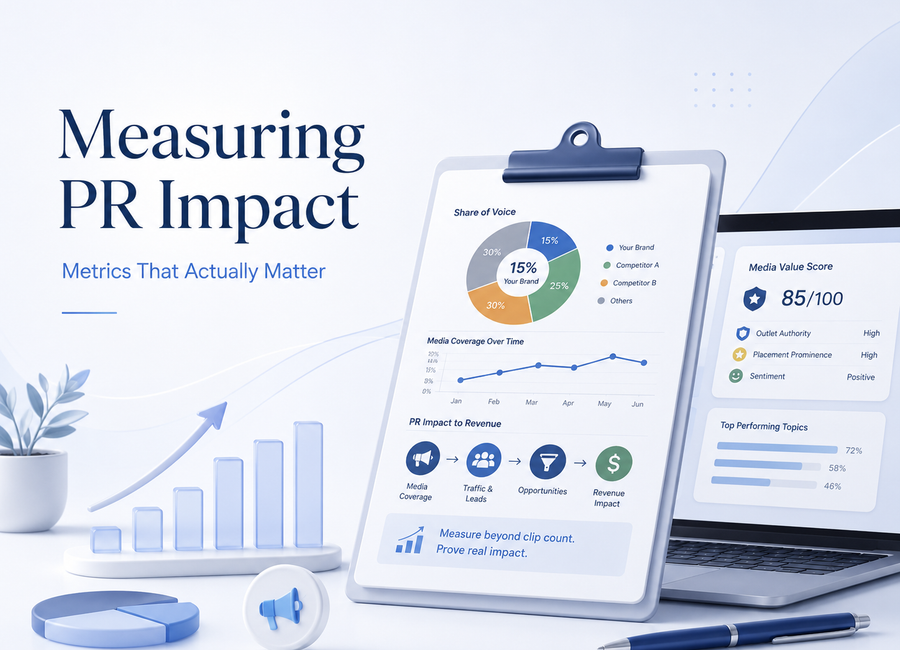
Measure Share of Relevant Voice
Share of voice can show how often the brand appears within a defined media conversation compared with selected competitors.
The comparison should use relevant subjects and credible outlets.
A raw mention count may be misleading.
The team should examine the quality and message of coverage.
A competitor may have more mentions but weaker positioning.
Share of relevant voice is more useful than total visibility.
Measure Referral and Search Behaviour
Online coverage may generate referral traffic and branded search.
The brand can monitor which media relationships produce engaged visitors, product exploration or enquiries.
Traditional coverage may also influence later search behaviour.
The team should compare results with a baseline and consider other campaigns.
Traffic does not define the entire relationship value, but it provides useful evidence of audience action.
Measure Qualified Enquiries
High-value businesses should record whether media exposure contributes to suitable opportunities.
Sales and customer-service teams can ask how the prospect discovered the brand.
The original source should remain connected with the lead where possible.
The report should separate general enquiries from qualified opportunities.
One significant partnership or customer may justify a long-term media programme more than large volumes of low-value traffic.
Measure Reputation and Trust
Long-term media relationships should support awareness, trust and authority.
Customer research, stakeholder interviews and brand studies can examine whether audiences view the organisation as credible and expert.
Media relationships contribute to this perception but do not operate alone.
Product quality, service and leadership behaviour remain essential.
The report should avoid claiming that all reputation change came from media activity.
Avoid Advertising Value Equivalency
Advertising value equivalency attempts to calculate what editorial space would have cost as an advertisement.
It does not measure trust, relationship strength, audience understanding or commercial action.
A more credible report examines media quality, message pull-through, source requests, search behaviour, stakeholder outcomes and business value.
Earned coverage and paid media serve different roles and should not be treated as financial equivalents.
Conduct Regular Relationship Reviews
The PR team should review its media relationships periodically.
It can identify where contact has become inactive, which journalists have changed roles and which new voices are becoming influential.
The team should also examine whether the brand is providing enough value.
A relationship may weaken when outreach becomes repetitive or inaccurate.
Regular review supports strategic improvement.
Common Media Relationship Mistakes
One common mistake is contacting journalists only when the brand wants coverage.
Another is treating a large email database as a relationship network.
Brands may send irrelevant pitches, use incorrect names or contact several people at the same publication simultaneously.
Some PR teams overclaim, miss deadlines or provide unavailable spokespeople.
Others pressure journalists for approval, publication dates or positive wording.
Expensive gifts and hospitality may be used as substitutes for editorial relevance.
The company may also react badly when an article is critical or when a pitch is declined.
These behaviours weaken trust.
A Practical Long-Term Media Relationship Process
The process begins by defining the brand’s strategic communication themes and target audiences.
The PR team maps relevant national, premium, trade, regional, broadcast, podcast and digital media.
Current journalists, editors, producers and contributors are researched according to their beats and formats.
A structured relationship database records professional history, interests and interactions.
The team identifies credible internal experts and prepares a source directory.
Background information, biographies, images, data and media assets are maintained through one source of truth.
The brand develops relevant stories, research and commentary rather than relying only on launches.
Initial outreach is concise, personalised and focused on audience value.
Journalist deadlines and editorial independence are respected.
When interest develops, the organisation provides reliable access, accurate information and prepared spokespeople.
Between campaigns, the PR team shares selective useful updates and responds to relevant source requests.
Exclusive information, embargoes, samples, press trips and customer access are managed transparently.
Published coverage is shared responsibly through owned and social channels.
Critical or declined coverage is handled professionally.
The team measures relationship outcomes, media quality, message pull-through, strategic visibility and commercial influence.
Regular reviews improve the contact map, source system and future outreach.
Building Relationships for Luxury Brands
Luxury brands should focus particularly on selectivity, editorial quality and experience.
Journalists may need access to craftsmanship, design, properties, chefs, stylists or private service systems.
The brand should provide these experiences professionally without expecting guaranteed praise.
Media communication should remain aligned with the luxury position.
Frequent generic pitches and excessive gifting can reduce credibility.
The relationship should demonstrate restraint, reliability and attention to detail.
Building Relationships for Event Brands
Event companies can become valuable sources on guest experience, production, security, logistics, hospitality and cultural trends.
The PR team should identify spokespersons with operational knowledge.
Media relationships can develop before, during and after major events.
Journalists need accurate access, schedules, interview coordination and visual assets.
The event itself becomes evidence of the company’s professionalism.
Poor media management at the venue can damage relationships even when the broader event succeeds.
Building Relationships for B2B Brands
B2B media relationships depend strongly on expertise and data.
Journalists may need technical context, customer examples and senior leadership commentary.
The company should avoid vague promotional language.
It should provide evidence and explain complex issues clearly.
Trade media, newsletters, podcasts and business journalists may all influence decision-makers.
Long-term relationships can position the organisation as a trusted category source.
Building Relationships for Regional Growth
Regional media relationships should begin before a market launch.
The brand can learn about local interests, language preferences and cultural context.
It should prepare local spokespeople, examples and data.
Journalists should not receive generic national pitches with one city reference.
Consistent local engagement can support trust among customers, institutions, partners and employees.
Building Relationships During a Crisis
Established relationships become especially valuable during a crisis.
Journalists know where to seek verified information.
The brand can respond through familiar professional channels.
However, the relationship should not be used to request favourable treatment.
The company must provide facts, acknowledge uncertainty and support affected stakeholders.
Trust developed over time may increase confidence that the organisation’s statement is worth considering.
That trust can disappear quickly if the brand uses the relationship to mislead.
For brands operating in high-value or reputation-sensitive markets, a structured crisis PR strategy can help protect communication accuracy when pressure increases.
Frequently Asked Questions
1. What is a long-term media relationship?
A long-term media relationship is a sustained professional connection between journalists and PR representatives built through repeated interactions, reliable information sharing, and consistent editorial support.
2. Do media relationships guarantee coverage?
No. Media relationships never guarantee publication or positive coverage. They only improve trust, communication efficiency, and the likelihood of future editorial consideration.
3. Why are media relationships important for brands?
They help brands become trusted sources for journalists, increasing the chances of being included in industry stories, expert commentary, features, and trend analysis.
4. How do journalists decide whether to trust a PR source?
Trust is built through accuracy, responsiveness, consistency, respect for deadlines, and the ability to provide useful, verified information without exaggeration.
5. What mistakes damage media relationships the most?
Common mistakes include sending irrelevant pitches, overclaiming, missing deadlines, pressuring journalists, and treating media outreach as purely promotional communication.
6. How often should brands contact journalists?
Only when the communication is relevant. Quality and usefulness matter more than frequency. Excessive or unnecessary outreach can damage credibility.
7. What role does editorial independence play?
Editorial independence is essential. Journalists decide the final angle, headline, and inclusion of information. PR teams cannot control or influence these decisions.
8. How can brands become valuable media sources?
By offering expert insights, timely commentary, original data, real access to people or experiences, and clear, accurate information.
Conclusion
Long-term media relationships are built on trust, not transactions. They develop gradually through consistent accuracy, professional communication, and respect for editorial independence.
For luxury and premium brands, these relationships become especially valuable because they influence how credibility, authority, and relevance are perceived in the market. However, their strength depends on discipline—providing real value without expecting guaranteed coverage in return.
When brands treat journalists as partners in information rather than channels for promotion, media relations evolves into a strategic asset. It creates sustained visibility, stronger storytelling opportunities, and more meaningful inclusion in industry conversations.
Ultimately, successful media relationships are not defined by how many articles a brand secures, but by how often it is trusted as a reliable, relevant, and professional source.
Turn Media Relationships Into a Strategic Authority System
Strong media relationships don’t happen through outreach alone—they are built through strategy, consistency, and credibility.
At Double Trouble Studio, we help brands develop structured PR ecosystems that go beyond pitching. From journalist mapping and expert positioning to long-term media strategy and digital amplification, we build systems that turn communication into authority.
If your brand is ready to move from one-time coverage to long-term media trust, let’s build your media relationship strategy.
📩 info@dtsworld.in 📞 +91 80000 06021 📍 Andheri (West), Mumbai
Need this for your brand?
Let DTS build your next campaign.
From PR, celebrity management and events to websites, social media, SEO and AI video production — Double Trouble Studio helps brands grow with strategy and execution.
Discuss Your Requirement →