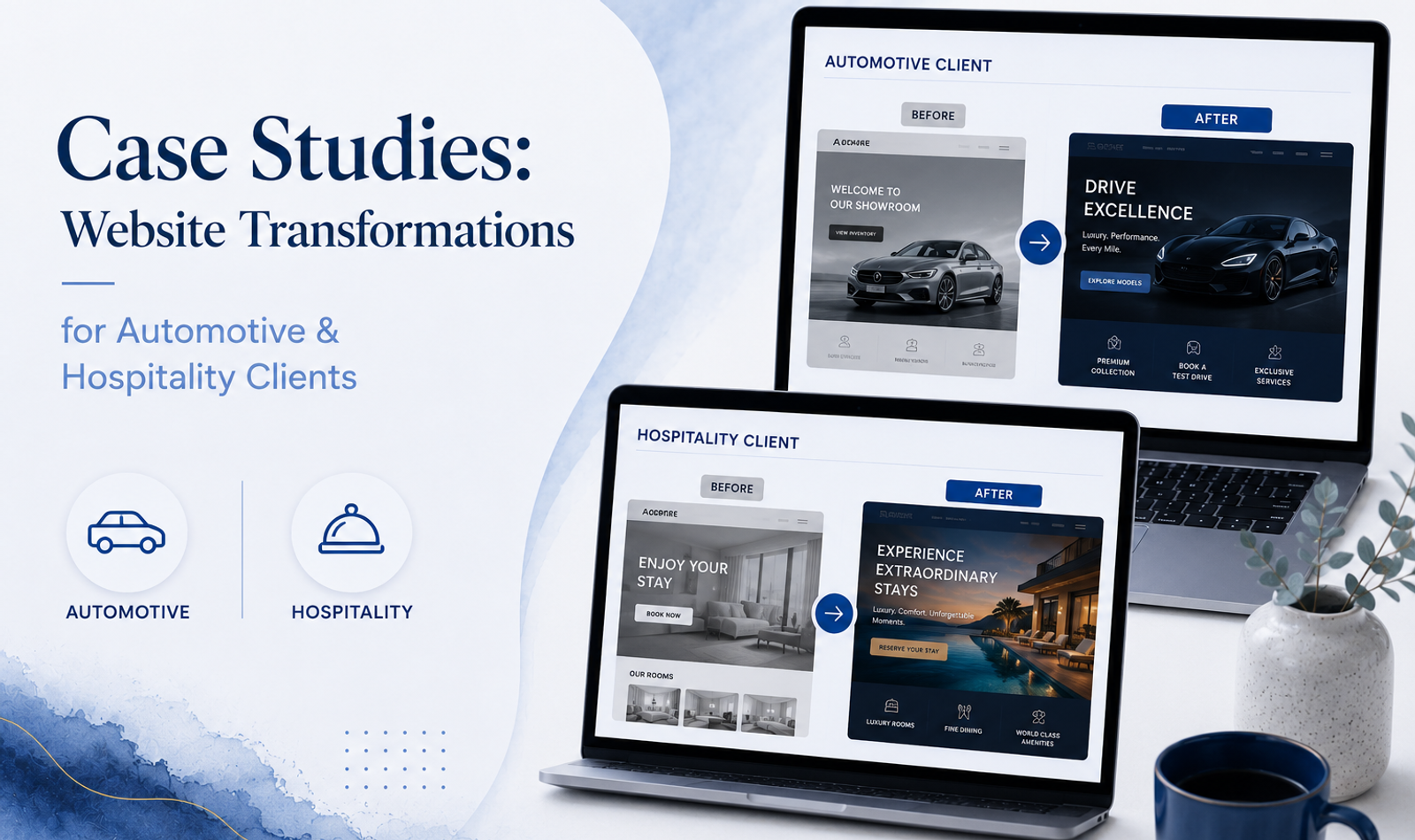
Case Studies: Website Transformations for Automotive & Hospitality Clients
A website transformation is not simply a visual redesign.
For automotive and hospitality brands, a website often sits at the centre of the customer journey. It influences how customers discover the business, evaluate trust, compare options, explore services, make enquiries and decide whether the brand feels credible enough to choose.
A premium automotive brand may have an excellent fleet, experienced chauffeurs and reliable operations, but if its website feels outdated, difficult to navigate or unclear on mobile, potential customers may never understand that value.
A hospitality brand may have beautiful rooms, strong service and memorable guest experiences, but if its website functions only as a gallery rather than a booking and discovery platform, the business may remain overly dependent on third-party platforms.
This is why website transformation should be approached strategically.
The strongest transformations connect brand positioning, UI/UX, content, technical SEO, mobile performance, speed, conversion architecture, analytics and customer experience.
At Double Trouble Studio, website development is approached as part of a wider brand and digital-growth system rather than an isolated design project.
This guide explores practical automotive and hospitality website-transformation scenarios, the problems brands commonly face, the strategies used to solve them and the metrics businesses should evaluate after launch.
The case studies are structured as strategic examples. Specific commercial performance figures should only be used when supported by verified client analytics.
What Is a Website Transformation?
A website transformation is the strategic improvement of an existing website across design, technology, content, search visibility and conversion experience.
It may include:
- Brand and messaging refinement
- Information architecture
- UI/UX redesign
- Mobile optimisation
- Website speed
- Core Web Vitals
- SEO architecture
- Content restructuring
- Service or product pages
- Galleries
- Booking or enquiry journeys
- Conversion-focused CTAs
- Analytics
- Security
- Integrations
- Lead tracking
A transformation may involve rebuilding the entire website or improving specific parts of the existing platform.
The objective is not simply to make the website look newer.
The objective is to make the website more useful for both the customer and the business.
Brands exploring a larger transformation can also review professional website development and digital marketing services to understand how development, search visibility and customer acquisition can work together.
Why Automotive and Hospitality Websites Require Special Attention
Automotive and hospitality customers often make high-consideration decisions.
They want information before contacting the business.
They compare alternatives.
They check reviews.
They inspect photographs.
They search by location.
They want clear pricing or at least clear service expectations.
They often visit several websites before enquiring.
This means the website must answer questions quickly while building confidence.
An automotive customer may want to understand:
- Vehicle categories
- Fleet quality
- Chauffeur standards
- Airport transfer availability
- Corporate mobility solutions
- Event transportation
- City coverage
- Safety processes
- Enquiry options
A hospitality customer may want to understand:
- Room categories
- Property atmosphere
- Location
- Dining
- Amenities
- Experiences
- Event possibilities
- Availability
- Booking process
The website must therefore combine information and emotion.
It must explain the offering while helping the customer imagine the experience.
The Transformation Framework
A practical website transformation can be understood through six stages:
Audit → Positioning → UX Architecture → Content → Technology → Conversion
The audit identifies what is wrong.
Positioning determines what the brand should communicate.
UX architecture organises the customer journey.
Content explains value.
Technology ensures speed, mobile usability, security and technical reliability.
Conversion design guides the visitor towards enquiry, booking or another meaningful action.
A strong website transformation should address all six.
Case Study One: Premium Automotive Mobility Brand
The Starting Situation
Consider an established chauffeur-driven automotive business.
The company may have decades of operational experience, a premium fleet, corporate customers and multi-city service capability.
However, its existing website may still behave like a digital brochure.
The homepage may include a company introduction, some vehicle photographs and a contact number.
Important services may not have dedicated pages.
The customer may not easily understand whether the company provides:
- Corporate rentals
- Airport transfers
- Chauffeur-driven luxury cars
- Event transport
- Executive mobility
- Long-term vehicle requirements
- Multi-city travel
The brand may therefore have strong offline capability but weak digital communication.
This creates a gap between actual quality and perceived quality.
Automotive Website Problem One: Weak Positioning
The first issue is often positioning.
Many automotive businesses use broad phrases such as:
“Best Car Rental Service”
“Premium Cars at Best Prices”
“Luxury Cars Available”
These phrases do not explain why the company is different.
A premium mobility company may be stronger when positioned around reliability, professional chauffeurs, corporate support, service consistency and travel coordination.
The website must communicate the brand as a professional mobility partner rather than only another rental provider.
This is especially important when the business wants to attract companies, executives, luxury travellers, event organisers and hospitality partners.
Transformation Step One: Rebuild the Homepage Around Customer Needs
The transformed homepage should explain the business immediately.
Instead of beginning with vague lifestyle messaging, the hero section should answer:
What does the company provide?
Who is it for?
Where does it operate?
Why should customers trust it?
A premium automotive homepage may introduce:
Chauffeur-Driven Mobility for Corporate, Airport, Event and Premium Travel Requirements
Supporting content can then communicate experience, city coverage, fleet categories, service reliability and booking assistance.
The customer should understand the company within seconds.
Transformation Step Two: Build Dedicated Service Pages
A serious automotive website should not place every service on one generic page.
Dedicated service pages improve both user experience and search visibility.
Useful service categories may include:
- Corporate mobility
- Airport transfers
- Executive travel
- Chauffeur-driven luxury cars
- Event transportation
- Wedding transportation
- Long-term rentals
- Outstation travel
Each page should explain:
- What the service includes
- Who it is suitable for
- Key benefits
- Operating process
- Vehicle availability
- Geographic coverage
- Trust signals
- Next step
This creates stronger relevance for both customers and search engines.
Transformation Step Three: Build Location Architecture
Automotive services are highly location-sensitive.
Customers often search using combinations such as:
“chauffeur-driven car rental Mumbai”
“corporate car rental Delhi”
“airport transfer Pune”
“luxury car rental Bangalore”
A location-based website structure can therefore support search discovery.
DTS also uses structured location architecture across service verticals through its locations section, demonstrating how service and geography can be connected within site architecture.
For automotive brands, location pages should be useful rather than duplicated.
Each page should explain local service relevance, airport connectivity, business districts, travel use cases and enquiry options.
Transformation Step Four: Improve Fleet Discovery
Vehicle selection is a major part of the automotive journey.
Customers should be able to explore fleet categories easily.
A useful fleet experience may divide vehicles into:
- Executive sedans
- Luxury sedans
- SUVs
- Premium SUVs
- MPVs
- Coaches
- Event fleets
Each category can include photographs, seating guidance, luggage information, typical use cases and enquiry CTA.
The goal is not necessarily to create a complicated ecommerce catalogue.
The goal is to help customers understand which vehicle fits their requirement.
Transformation Step Five: Build Trust Into Every Page
Automotive mobility depends heavily on confidence.
Trust signals may include:
- Years of experience
- Corporate servicing capability
- Trained chauffeurs
- Vehicle maintenance standards
- Operational support
- Multi-city coordination
- Customer testimonials
- Secure booking process
- Professional response systems
These signals should not appear only on the About page.
They should be integrated throughout the website.
Potential customers who want to understand the company behind the service can also visit the Double Trouble Studio About page as an example of how agency credibility and business context can support trust.
Transformation Step Six: Build Stronger Enquiry Paths
Many automotive sites lose customers because contact information is difficult to find.
The transformed website should create multiple logical enquiry paths.
These may include:
- Request a quote
- WhatsApp enquiry
- Call now
- Corporate enquiry
- Event transport enquiry
- Airport transfer request
Forms should request enough information to support a useful response.
For example:
- City
- Pickup date
- Pickup location
- Vehicle preference
- Number of passengers
- Service type
- Contact details
However, forms should not become unnecessarily long.
Automotive Transformation: Before vs After
Area
Before
After
Positioning
Generic car rental
Premium mobility partner
Services
One broad page
Dedicated service pages
Fleet
Limited gallery
Structured fleet discovery
Locations
Weak local relevance
Search-oriented location architecture
Mobile
Basic responsive layout
Mobile-first enquiry experience
Trust
Few proof points
Experience, process and testimonials
CTA
Contact page only
Contextual enquiries throughout
SEO
Limited service targeting
Service + location structure
Analytics
Basic traffic data
Conversion and lead-source tracking
The biggest change is that the website begins working as a sales and trust platform rather than a static brochure.
Case Study Two: Boutique Hospitality Website
The Starting Situation
Consider a premium boutique hotel or resort.
The property may have beautiful architecture, strong interiors, curated food and personalised service.
However, its website may rely too heavily on photographs.
The customer may see a gallery but still struggle to understand:
- Room differences
- Experiences
- Dining
- Event options
- Destination advantages
- Travel information
- Check-in details
- Booking process
The property may therefore look beautiful but remain difficult to evaluate.
This creates dependence on OTAs and third-party travel platforms.
Hospitality Website Problem One: Visuals Without Narrative
Hospitality is emotional.
Guests are not simply buying a bed.
They are buying a stay experience.
A strong website should communicate atmosphere, comfort, service, location and emotion.
The customer should be able to imagine:
Arrival.
Morning.
Dining.
The room.
The view.
Activities.
The surrounding destination.
The transformed website should therefore move beyond a basic photo gallery.
Transformation Step One: Build the Property Story
The homepage should communicate the property’s identity.
A boutique resort may be positioned around privacy, local culture and slow travel.
An urban hotel may focus on design, connectivity and business comfort.
A wedding property may focus on celebration, accommodation and hospitality.
A wellness retreat may focus on calm, restoration and natural surroundings.
The website should make that positioning visible from the first section.
Transformation Step Two: Improve Room and Stay Pages
Each room category should receive clear content.
Important information may include:
- Room size
- Occupancy
- Bed type
- Key amenities
- View
- Bathroom
- Additional bed policy
- Photographs
- Booking CTA
Customers should not have to switch repeatedly between unrelated pages to understand their options.
Visual hierarchy matters.
The most important information should appear first.
Transformation Step Three: Build Experience-Led Content
Hospitality websites become stronger when they explain what guests can do, not only where they can sleep.
Useful experience pages may include:
- Dining
- Spa
- Pool
- Wellness
- Local excursions
- Private dining
- Celebrations
- Weddings
- Corporate retreats
- Weekend itineraries
Experience content can increase both customer interest and organic-search opportunities.
For hospitality brands connected with celebrations, a broader events and weddings service strategy can also help connect venue experience with event planning, guest management and production.
Transformation Step Four: Improve Booking Architecture
A booking CTA should be visible throughout the customer journey.
The visitor may be ready to act after viewing:
A room.
A package.
A wedding venue.
A restaurant.
An experience.
The website should therefore provide contextual booking or enquiry options.
The customer should not always be forced back to the homepage.
A strong hospitality funnel may be:
Discovery → Experience → Proof → Availability → Booking
Every page should support the next step.
Transformation Step Five: Build Destination Content
Destination content can become a major SEO and conversion asset.
A hotel should not assume guests already understand the location.
Useful topics may include:
- How to reach the property
- Nearby attractions
- Best time to visit
- Weekend itinerary
- Airport or railway connectivity
- Local food
- Cultural experiences
- Wedding-season guidance
- Family activities
This type of content serves both search visibility and customer planning.
Transformation Step Six: Strengthen Guest Trust
Hospitality customers evaluate reviews and reassurance before booking.
Trust signals may include:
- Guest testimonials
- Ratings
- Awards
- Media features
- Property credentials
- Secure booking
- Clear cancellation information
- High-quality original photography
- Contact support
Hospitality brands seeking stronger authority can connect website content with PR, media and marketing so that credible third-party visibility supports website conversion.
Hospitality Transformation: Before vs After
Area
Before
After
Homepage
Property gallery
Experience-led storytelling
Rooms
Basic listings
Detailed room discovery
Experiences
Limited
Dedicated experience pages
Destination
Minimal
Search-friendly destination content
Booking
One booking button
Contextual booking funnel
Mobile
Photo-heavy
Faster mobile-first navigation
SEO
Brand terms only
Destination + experience + booking intent
Trust
General claims
Reviews, proof and clear policies
Content
Static
Ongoing blogs and guides
Case Study Three: Automotive Website Designed for Corporate Leads
Automotive transformations become more complex when the primary audience is B2B.
Corporate travel managers, executive assistants, procurement teams, event managers and hospitality partners evaluate different information from individual leisure customers.
They may want:
- Monthly billing
- Multi-city coverage
- Dedicated support
- Fleet availability
- Executive vehicles
- Airport movement
- Event logistics
- Employee travel
- Reporting
- Contract terms
The website must therefore reflect professional decision-making.
Corporate Landing Pages
A dedicated corporate mobility page should explain the operating model clearly.
The page may include:
Corporate Fleet Solutions
Executive Travel
Employee Transport
Airport Transfers
Event Mobility
Multi-City Coordination
The CTA can be stronger than a generic “Contact Us.”
Examples include:
Request a Corporate Mobility Proposal
Discuss Your Travel Requirement
Speak With Our Corporate Team
This immediately improves qualification.
Use Case-Based Content
Corporate decision-makers respond well to scenarios.
For example:
“A company needs executive airport transfers for visiting leadership.”
“A luxury hotel needs reliable vehicle support for VIP guests.”
“An event organiser needs 70 vehicles coordinated across multiple hotels.”
“A company needs monthly chauffeur-driven vehicles for senior management.”
These scenarios help customers recognise themselves.
Build B2B Authority
The website can also connect with thought leadership.
Topics may include:
- Corporate mobility planning
- Executive transportation standards
- Multi-city travel coordination
- Airport transfer management
- Event transportation
- Chauffeur training
- Corporate travel efficiency
Professional content can also support social and LinkedIn campaigns.
Case Study Four: Hospitality Website Built for Weddings and Events
Hotels and resorts often have significant revenue opportunities beyond room bookings.
Weddings, corporate events, private celebrations and destination programmes can become important business verticals.
However, many hospitality websites provide only one “Events” page with a few banquet photographs.
This is not enough for high-value enquiries.
Transform Event Discovery
A stronger hospitality site can create separate sections for:
- Weddings
- Corporate events
- Private celebrations
- Meetings
- Destination events
- Banquets
- Outdoor venues
Each section should include:
- Capacity
- Venue type
- Accommodation
- Catering
- Setup possibilities
- Support services
- Gallery
- Enquiry CTA
Customers planning large celebrations often need deeper guidance around hospitality and guest movement. DTS also provides dedicated guest management services, which shows how guest experience can be treated as a specialised part of event planning rather than an afterthought.
Connect Event Design With Hospitality
The website should not only show empty venue photographs.
It should help customers imagine the transformation.
This may include galleries showing:
Ceremonies.
Receptions.
Corporate dinners.
Outdoor events.
Stage setups.
Dining.
Guest arrival.
Room hospitality.
For premium weddings and high-profile events, celebrity management can also become part of the broader event ecosystem when talent participation is relevant.
Why Mobile Experience Matters
Automotive and hospitality searches often begin on smartphones.
A customer may be:
At the airport.
Travelling.
Comparing hotels.
Looking for a car.
Planning an event.
Searching during a meeting.
The mobile experience must therefore be treated as primary.
Mobile Automotive UX
Important mobile actions include:
- Call
- Request quote
- Explore fleet
- Check location
- Submit itinerary
The navigation should remain simple.
Buttons should be easy to use with one hand.
Vehicle photographs should not make pages unnecessarily heavy.
Forms should be short.
Mobile Hospitality UX
Important mobile actions include:
- View rooms
- Check availability
- Explore experiences
- Call property
- Open map
- Book
- Enquire about weddings
Photo galleries should load efficiently.
Sticky CTAs can improve action without blocking content.
The menu should remain easy to use.
Website Speed as Part of Brand Experience
Slow websites damage both usability and perception.
For premium brands, this becomes especially important.
Customers expect quality.
A visually impressive website that takes several seconds to become usable feels less premium.
Large images, autoplay videos, excessive animations and poorly optimised scripts are common causes of slow performance.
Website transformation should therefore include:
- Image optimisation
- Modern image formats
- Lazy loading
- Code reduction
- Script management
- Video optimisation
- Caching
- Hosting review
- Font optimisation
Speed should be tested on real mobile connections, not only high-speed office internet.
Technical SEO During a Website Transformation
Redesigning a website without SEO planning can damage existing visibility.
URLs may change.
Internal links may disappear.
Pages may be removed.
Metadata may be lost.
Redirects may fail.
Search engines may temporarily encounter duplicate or missing content.
A website transformation should therefore include an SEO migration plan.
Important tasks include:
- URL mapping
- 301 redirects
- Canonical tags
- XML sitemap updates
- Robots.txt review
- Metadata migration
- Internal linking
- Schema markup
- Broken-link checks
- Indexation monitoring
Businesses wanting comprehensive digital growth should treat technical SEO as part of their overall web development and marketing strategy, not as work added only after the website launches.
Content Strategy Before and After Transformation
Content architecture is often one of the biggest changes during website redesign.
Before Transformation
Websites commonly contain:
- Thin pages
- Repetitive copy
- Generic service descriptions
- Poor internal linking
- No FAQs
- Weak local pages
- Little educational content
After Transformation
A stronger structure may include:
- Dedicated services
- Locations
- FAQs
- Case studies
- Blogs
- Galleries
- Process pages
- Customer guidance
- Conversion CTAs
Content improves both discoverability and trust.
Automotive Content Examples
Automotive brands can publish content around:
- Corporate mobility
- Chauffeur-driven travel
- Airport transfers
- Event transportation
- Executive vehicles
- Long-distance travel
- Corporate fleet planning
- City travel guides
Hospitality Content Examples
Hospitality brands can publish:
- Destination guides
- Weekend itineraries
- Wedding planning guides
- Food experiences
- Seasonal travel
- Local attractions
- Property experiences
- Celebration planning
A structured blog resource centre can become an important search and education asset rather than being treated as a simple news section.
Galleries as Conversion Tools
Images play an important role in both industries.
However, galleries should help customers make decisions.
A gallery should be structured around useful categories.
Automotive Gallery Categories
- Executive sedans
- Luxury vehicles
- SUVs
- Chauffeurs
- Corporate movement
- Airport arrivals
- Wedding convoys
- Events
Hospitality Gallery Categories
- Rooms
- Dining
- Pool
- Spa
- Weddings
- Events
- Architecture
- Experiences
Alt text and image optimisation should also support accessibility and search.
Lead Magnets for High-Consideration Customers
Not every website visitor is ready to book immediately.
Lead magnets can help capture earlier interest.
Automotive brands may offer:
- Corporate mobility guide
- Event transportation checklist
- Airport transfer planning guide
- Executive travel proposal
Hospitality brands may offer:
- Destination wedding guide
- Weekend itinerary
- Corporate retreat guide
- Event planning brochure
- Celebration package guide
Lead magnets should provide actual value.
They should not exist only to collect email addresses.
Conversion Architecture
A conversion-focused website should guide customers intentionally.
The page should not depend on one generic Contact button.
Different visitors may require different next steps.
Automotive CTAs
- Request a quote
- Plan airport transfer
- Speak with corporate mobility team
- Book chauffeur-driven car
- Discuss event fleet requirements
Hospitality CTAs
- Check availability
- Reserve your stay
- Plan your wedding
- Explore dining
- Request event proposal
- Speak with reservations
A strong conversion system connects the CTA to the content immediately above it.
Website Security for Booking and Lead Websites
Hospitality and automotive websites often collect personal information.
This may include:
- Names
- Phone numbers
- Email addresses
- Travel information
- Booking dates
- Event details
Security should therefore be part of the website transformation.
Important foundations include:
- HTTPS
- Secure forms
- Strong admin authentication
- Access control
- Software updates
- Backups
- Plugin monitoring where applicable
- Spam protection
- Secure integrations
For booking sites, payment and booking-engine security require additional care.
Security should not become a once-a-year task.
It should form part of ongoing website maintenance.
Analytics and Conversion Tracking
A transformed website should be measurable.
Without analytics, the business cannot understand whether the redesign is creating better outcomes.
Important website events may include:
- Contact forms
- WhatsApp clicks
- Phone calls
- Booking clicks
- Quote requests
- Brochure downloads
- Fleet views
- Room views
- Wedding enquiries
- Corporate enquiries
The team should distinguish between basic engagement and valuable conversion.
A gallery view is not equal to a booking.
A blog visit is not equal to a qualified corporate enquiry.
Different actions should be measured according to commercial importance.
What Metrics Should Be Compared Before and After Redesign?
A website transformation should establish a baseline before launch.
Useful metrics include:
Metric
Why It Matters
Organic traffic
Search visibility
Branded search
Brand awareness
Mobile engagement
Mobile UX quality
Bounce/engagement rate
Content relevance
Service-page traffic
Commercial discovery
Form submissions
Lead generation
Booking clicks
Hospitality intent
WhatsApp clicks
High-intent action
Qualified leads
Business value
Conversion rate
Website efficiency
Core Web Vitals
Technical performance
Indexed pages
Search health
The objective is not necessarily to increase every metric.
For premium businesses, fewer but better-qualified enquiries may be more valuable than large volumes of low-quality submissions.
Common Automotive Website Mistakes
One common mistake is showing cars without explaining services.
Another is failing to communicate city coverage.
Some businesses create massive fleet galleries but provide little guidance about which vehicle suits which requirement.
Corporate capability is often buried inside generic copy.
Another major problem is weak mobile enquiry design.
Customers may need to call or message quickly, but CTAs are difficult to find.
Many automotive sites also compete only on price.
This weakens premium positioning.
The website should communicate professionalism, safety, convenience, reliability and service depth.
Common Hospitality Website Mistakes
Hospitality websites often prioritise appearance over usability.
Heavy videos and large image files can make the site slow.
Room details may be difficult to compare.
Booking CTAs may disappear during the customer journey.
Hotels may also rely entirely on third-party booking engines without building enough direct customer trust.
Another mistake is ignoring destination content.
Customers are often searching for both the property and the location.
A strong website should serve both needs.
Website Transformation for Premium Brands
Premium websites should feel refined but still remain practical.
Luxury does not mean making navigation difficult.
It does not mean hiding information.
It does not mean excessive animations.
It does not mean five-minute cinematic intros.
Luxury digital experience often comes from restraint.
Clear typography.
Strong photography.
Fast pages.
Thoughtful spacing.
Simple navigation.
Confident messaging.
Smooth enquiries.
High-quality proof.
The brand should feel easy to understand.
For service-led companies, the same principle applies across their wider digital ecosystem. Visitors should be able to move naturally from information to proof to project work and finally to enquiry.
When Should an Automotive or Hospitality Brand Redesign Its Website?
A website transformation should be considered when the current website:
- Looks significantly weaker than the actual brand
- Performs poorly on mobile
- Loads slowly
- Has unclear navigation
- Generates low-quality enquiries
- Has outdated services
- Has weak search visibility
- Cannot be updated easily
- Has broken pages or forms
- Does not represent new positioning
- Is difficult to scale into locations
- Depends heavily on one homepage
- Provides little proof
- Does not track customer behaviour
A redesign should solve a business problem.
It should not happen simply because the internal team is bored with the current design.
How Double Trouble Studio Approaches Website Transformation
Double Trouble Studio approaches website transformation by first understanding the brand, customer and commercial objective.
The process may include reviewing:
- Current website
- Competitors
- Audience
- Search demand
- Positioning
- Customer journey
- Service structure
- Content gaps
- Mobile usability
- Website speed
- Technical SEO
- Lead flow
- Analytics
The next stage is architecture.
Pages are organised according to customer needs and search behaviour.
Design then supports that structure.
Content explains value.
Development turns the experience into a reliable digital product.
SEO foundations support visibility.
Conversion tracking makes the final website measurable.
The objective is not simply to launch a more attractive website.
The objective is to create a website that better represents the brand and contributes to growth.
Brands planning a website transformation can contact Double Trouble Studio to discuss website strategy, development, SEO, content and digital growth requirements.
Frequently Asked Questions
What is a website transformation case study?
A website transformation case study explains the original website problems, the strategy used to address them, the changes implemented and the business or customer-experience outcomes that can be measured afterwards.
Why do automotive brands need specialised websites?
Automotive customers need information about services, fleet categories, city coverage, safety, chauffeurs, corporate capability and booking options. A specialised website structures this information around the customer journey.
What should a hospitality website include?
A hospitality website should include property positioning, room information, experiences, dining, destination guidance, galleries, reviews, FAQs, availability and a clear booking or enquiry journey.
How can a website redesign increase enquiries?
A redesign can improve enquiries through clearer positioning, stronger service pages, better CTAs, mobile usability, improved trust signals, faster performance and more relevant landing pages.
Why is mobile experience important?
A large number of customers research hospitality and mobility services while travelling or using smartphones. A slow or difficult mobile experience can lead directly to lost enquiries.
How does SEO fit into website transformation?
SEO should influence site architecture, URLs, content, metadata, internal links, speed, structured data and migration planning. It should be integrated before launch rather than added afterwards.
Should every automotive service have a separate page?
Important services generally benefit from dedicated pages when they address different customer intentions. Corporate mobility, airport transfers and event transport should not necessarily share one generic page.
Should hotels create destination content?
Yes. Destination content can help customers plan their trip while also supporting organic visibility for location-based searches.
How should website transformation success be measured?
Success can be measured through organic visibility, user engagement, speed, booking activity, enquiry conversion, qualified leads, direct traffic, service-page performance and customer feedback.
Does a premium website need large animations?
Not necessarily. Premium UX should prioritise clarity, performance and refinement. Animation should support the experience rather than slow it down or distract the customer.
How often should a website be updated?
Content, software, security, SEO and technical performance should be reviewed continuously. A complete redesign is only necessary when the website no longer supports the brand or business properly.
Can website redesign affect existing Google rankings?
Yes. Rankings can be damaged if URLs, metadata, internal links or content are changed incorrectly. A proper migration and redirect plan should therefore be part of the redesign.
Conclusion
Automotive and hospitality website transformations demonstrate why modern websites should be treated as business systems rather than online brochures.
For automotive brands, the website must build trust around reliability, fleet quality, chauffeurs, corporate capability, city coverage and travel coordination.
For hospitality brands, the website must translate physical experience into digital desire while making room discovery, destination planning and booking easier.
Both industries require strong mobile experiences.
Both require technical performance.
Both require search visibility.
Both require customer proof.
Both require clear conversion journeys.
The strongest transformations begin with strategy rather than design.
The business first identifies what is not working.
It then clarifies positioning, restructures customer journeys, improves content, modernises technology and builds measurable conversion paths.
A successful transformation does not only create a more attractive website.
It creates a website that explains value more clearly, builds greater trust, attracts better customers and contributes more directly to commercial growth.
Double Trouble Studio works with premium, luxury, hospitality, automotive, event and service-led brands across website strategy, UI/UX, web development, SEO, content, PR and digital marketing.
The objective is simple: turn the website from a static digital presence into a stronger brand, discovery and conversion platform.
📩 info@dtsworld.in 📞 +91 80000 06021 📍 Andheri (West), Mumbai
Need this for your brand?
Let DTS build your next campaign.
From PR, celebrity management and events to websites, social media, SEO and AI video production — Double Trouble Studio helps brands grow with strategy and execution.
Discuss Your Requirement →