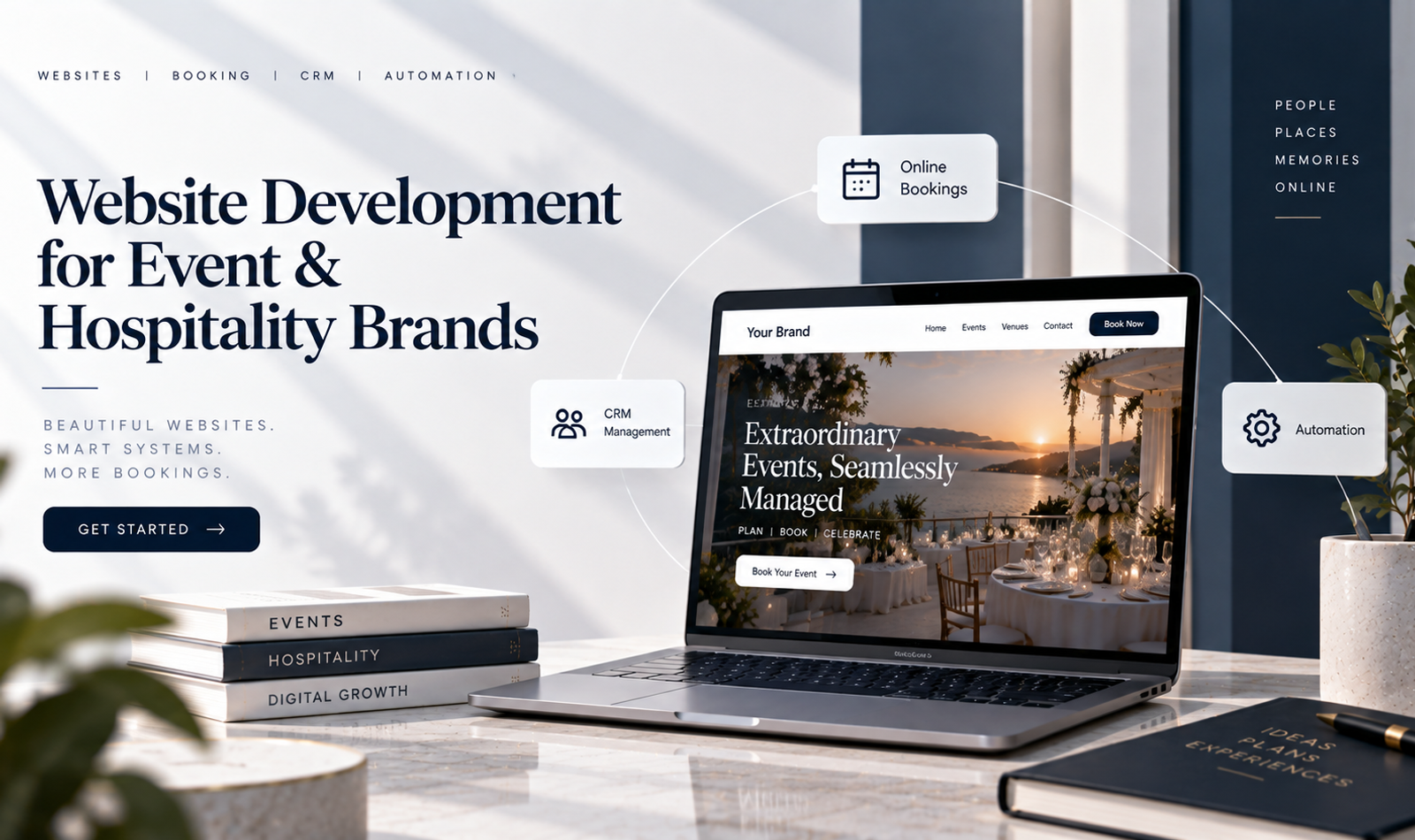
Website Development for Event & Hospitality Brands: Booking, CRM & Automation
For event and hospitality brands, a website is no longer simply a digital brochure.
Hotels, resorts, wedding venues, event companies, banquet spaces, luxury hospitality brands and experience-led businesses increasingly depend on their websites to manage the complete journey from discovery to enquiry, booking and post-booking communication.
A potential customer may discover a venue through Google, view photographs on Instagram, visit the website, check availability, submit an enquiry, speak with the sales team, receive a quotation, confirm a booking and continue communicating with the business through email or WhatsApp.
If these stages operate through disconnected systems, the customer experience becomes fragmented and the internal team spends unnecessary time performing repetitive administrative work.
Modern website development for event and hospitality brands should therefore connect three important layers:
Customer Experience → Business Operations → Marketing & Sales
This is where booking systems, CRM integration and automation become important.
A well-developed hospitality or event website can help a business capture enquiries, organise leads, manage booking requests, automate communication, collect payments, coordinate guest information and measure which marketing channels actually generate revenue.
However, adding more software does not automatically create a better system.
The website, booking process, CRM and automation tools need to work together around a carefully designed customer journey.
This guide explains how event and hospitality brands can approach website development strategically, including booking systems, CRM integration, lead management, WhatsApp and email automation, payment integration, guest experience, website UX, SEO, security, analytics and long-term scalability.
What Is an Event or Hospitality Website?
An event or hospitality website is a digital platform designed to help customers discover, evaluate, enquire about or book an experience, property, venue or service.
Depending on the business, the website may represent:
a hotel,
resort,
wedding venue,
banquet hall,
event management company,
destination wedding company,
luxury travel brand,
restaurant,
corporate event venue,
conference facility,
guest management company,
or experience-based hospitality business.
The exact functionality varies according to the business model.
A hotel may need real-time room availability and direct reservations.
A wedding venue may require enquiry-based booking because pricing depends on date, guest count, event format and customised requirements.
An event management company may need detailed lead forms and CRM integration rather than instant online booking.
The correct website architecture should therefore reflect how the business actually sells.
Why Event and Hospitality Websites Need More Than Good Design
Visual presentation is extremely important in hospitality.
Customers often make emotional decisions based on:
photography,
video,
atmosphere,
design,
location,
service,
and perceived experience.
However, attractive visuals alone do not create an effective hospitality website.
A visitor may love the property but still leave if they cannot understand:
availability,
pricing approach,
capacity,
services,
location,
booking process,
or how to contact the team.
The website needs to balance emotion and functionality.
Strong imagery creates desire.
Clear information reduces uncertainty.
Good UX helps customers explore.
Trust signals create confidence.
Booking functionality creates action.
CRM and automation help the business continue the conversation.
For premium brands, luxury website UX principles can help create this balance between visual impact, speed and usability.
The Modern Event & Hospitality Digital Journey
A hospitality customer rarely follows a perfectly linear path.
Someone planning a destination wedding may first discover a property on Instagram.
They may later search for the venue on Google.
They may view photographs and videos.
Then they may compare the property with alternatives.
A family member may visit the website.
The customer may submit an enquiry.
The sales team may contact them through WhatsApp.
A quotation may be shared.
A site visit may be scheduled.
The booking may eventually be confirmed several weeks later.
This journey contains multiple touchpoints.
The website should therefore be viewed as part of a larger digital system.
A strong architecture can connect:
Discovery → Website Visit → Enquiry → CRM → Follow-Up → Quotation → Booking → Payment → Guest Communication → Experience → Feedback
The more effectively these stages communicate with each other, the easier it becomes to deliver a consistent customer experience.
Website Development for Event & Hospitality Brands: The Core Components
A professional event or hospitality website may require several interconnected systems.
The most important usually include:
Website + Booking/Enquiry System + CRM + Automation + Payments + Analytics
Each component has a different role.
The website attracts and educates visitors.
The booking or enquiry system captures intent.
The CRM organises customer information.
Automation helps teams manage repetitive communication.
Payment systems support transactions.
Analytics measures the complete journey.
The objective is not to use as many tools as possible.
The objective is to build a connected digital infrastructure that makes the customer journey easier and the business more efficient.
1. Start With the Customer Journey Before Designing the Website
Website development should begin by understanding how customers make decisions.
Consider a wedding venue.
A potential customer may need to know:
where the venue is located,
how many guests it accommodates,
what different spaces are available,
whether accommodation exists,
what events can be hosted,
what services are included,
and how availability can be checked.
A hotel customer has different priorities.
They may want:
room types,
dates,
availability,
pricing,
amenities,
location,
policies,
and direct booking.
An event management client may need:
service capabilities,
previous work,
event categories,
process,
credentials,
and consultation options.
These differences should determine the website architecture.
The website should be built around customer intent, not simply around the company's internal departments.
2. Create a Clear Information Architecture
Event and hospitality websites can contain significant amounts of information.
Hotels may have:
rooms,
restaurants,
spa,
events,
weddings,
offers,
galleries,
and experiences.
Event companies may offer:
corporate events,
weddings,
celebrity management,
guest management,
production,
entertainment,
and private celebrations.
Without a clear hierarchy, the website can quickly become difficult to navigate.
Information architecture determines how these pages relate to each other.
A logical structure helps customers understand where they are and where they should go next.
It also supports internal linking and search-engine understanding.
For example, an event company may use a structure such as:
Home → Events & Weddings → Corporate Events → Service Details → Enquiry
while a venue may use:
Home → Weddings → Venue Spaces → Gallery → Availability Enquiry
The structure should reflect the buying journey.
3. Design for Visual Experience Without Sacrificing Usability
Hospitality is highly visual.
A customer evaluating a hotel, venue or event company wants to imagine the experience.
High-quality:
photography,
video,
virtual tours,
galleries,
and event imagery
can therefore be extremely valuable.
However, visual storytelling should not make the website difficult to use.
Large uncompressed videos, oversized images and excessive animations can create slow loading and poor mobile performance.
A luxury website should feel visually rich without becoming technically heavy.
The principles discussed in designing high-end luxury websites are particularly relevant for premium hospitality and event brands because design, performance and brand perception need to work together.
4. Make Mobile Experience a Priority
Many customers discover event and hospitality businesses through mobile devices.
They may arrive from:
Instagram,
Google,
WhatsApp,
digital advertisements,
or shared links.
The mobile website should therefore make important actions easy.
Visitors should be able to:
view rooms or venues,
browse galleries,
check essential information,
call,
open WhatsApp,
submit an enquiry,
or begin a booking
without struggling with the interface.
Forms should fit comfortably on smaller screens.
Buttons should be easy to tap.
Images should load efficiently.
Menus should remain simple.
A mobile website should not feel like a desktop website squeezed onto a smaller display.
5. Decide Between Instant Booking and Enquiry-Based Booking
One of the most important website-development decisions is determining whether customers should book immediately or submit an enquiry.
Different hospitality businesses require different models.
Hotels commonly benefit from direct booking engines because room inventory and pricing can often be structured.
A highly customised wedding or event may not be suitable for immediate booking.
The business may first need to understand:
date,
guest count,
venue,
location,
budget,
event type,
production requirements,
and accommodation needs.
In this situation, an enquiry workflow may be more appropriate.
Some businesses may use a hybrid model.
For example, customers may book rooms directly but submit an enquiry for weddings or corporate events.
The website should support the commercial model rather than forcing every service into the same booking process.
6. What Is a Website Booking System?
A website booking system allows customers to request or confirm a reservation digitally.
Depending on the business, it may manage:
dates,
availability,
inventory,
pricing,
packages,
guest numbers,
time slots,
payments,
and confirmation.
The booking system may be developed directly into the website or integrated with an existing third-party platform.
The correct approach depends on:
business complexity,
existing technology,
budget,
scalability,
and operational requirements.
The most important objective is ensuring that the booking experience feels connected to the brand.
Customers should not move from a premium website into a confusing or visually inconsistent booking process without a good reason.
7. Real-Time Availability Can Reduce Booking Friction
Where operationally possible, real-time availability can significantly improve the customer experience.
A hotel visitor may want to know whether a room is available for specific dates before entering personal information.
A venue customer may want to understand which dates are potentially open.
A restaurant customer may want to reserve a specific time.
Displaying availability reduces uncertainty.
However, availability information must be reliable.
A booking system that shows inaccurate inventory creates a worse experience than a simple enquiry form.
Integration with the operational system therefore becomes critical.
8. Build the Booking Experience Around Simplicity
Booking systems can become unnecessarily complicated.
A customer should not need to understand the internal structure of the business to complete a reservation.
The process should ask for information in a logical order.
For example:
Dates → Room or Venue → Guests → Add-ons → Contact Details → Payment → Confirmation
Complex event enquiries may use a different structure:
Event Type → Preferred Date → Location → Guest Count → Requirements → Contact Information
Each stage should have a clear purpose.
If the booking process becomes long, a multi-step experience may make it easier to complete.
9. Integrate the Website With a CRM
A CRM, or Customer Relationship Management system, helps businesses organise interactions with potential and existing customers.
For event and hospitality businesses, CRM integration can be extremely valuable because customer journeys often involve multiple conversations.
Without CRM integration, enquiries may arrive through:
email,
website forms,
WhatsApp,
phone calls,
Instagram,
and advertising platforms.
Different team members may store information in different places.
This creates a risk that enquiries are forgotten, duplicated or followed up inconsistently.
When the website connects with a CRM, new enquiries can automatically create structured lead records.
The team can then track each opportunity through the sales journey.
10. What Information Should the CRM Capture?
The CRM should capture information that genuinely helps the business manage the customer relationship.
For an event company, useful information may include:
customer name,
contact information,
event type,
event date,
location,
estimated guest count,
source,
assigned sales representative,
and lead status.
For a hotel or venue, the CRM may include:
stay dates,
event dates,
room requirements,
venue preference,
package interest,
and communication history.
The CRM should not collect unnecessary information simply because the software allows it.
Every field should support sales, operations, marketing or customer service.
11. Create a Clear Lead Pipeline
A CRM becomes more useful when leads move through clearly defined stages.
For example:
New Enquiry → Contacted → Qualified → Proposal Shared → Follow-Up → Negotiation → Confirmed → Lost
This allows management to understand the sales pipeline.
Instead of asking:
“How many enquiries did we receive?”
the business can ask:
“How many qualified enquiries became confirmed bookings?”
That is a much more valuable question.
A structured pipeline can also identify operational problems.
If many qualified leads receive proposals but very few convert, the business may need to review:
pricing,
proposal quality,
follow-up,
or offer positioning.
12. Automatically Assign Leads to the Right Team
Automation can help route enquiries according to predefined rules.
For example:
wedding enquiries may go to the wedding sales team,
corporate enquiries may go to the corporate events team,
room bookings may go to reservations,
and media enquiries may go to marketing.
Businesses operating across multiple locations may route leads geographically.
This reduces manual forwarding and can improve response time.
However, automation should always have a clear fallback so valuable enquiries are not lost because of an incorrect rule.
13. Use Automation to Improve Response Time
Event and hospitality customers frequently contact multiple businesses while comparing options.
Slow responses can reduce the chance of conversion.
Automation can provide an immediate acknowledgement after an enquiry.
For example:
“Thank you for your enquiry. Our team has received your event requirements and will contact you shortly.”
This confirms that the form worked.
The system can simultaneously:
create the CRM lead,
assign it,
notify the relevant team,
and record the source.
Automation does not replace the sales conversation.
It helps the conversation begin efficiently.
14. Email Automation for Hospitality & Event Brands
Email automation can support multiple stages of the customer journey.
After an enquiry, a customer may receive:
confirmation,
brochure,
venue information,
or consultation details.
After booking, automation may support:
payment reminders,
check-in information,
event schedules,
travel instructions,
or pre-arrival communication.
After the experience, customers may receive:
feedback requests,
thank-you messages,
or relevant future offers.
The important principle is relevance.
Automated communication should feel useful rather than repetitive.
15. WhatsApp Automation for Event & Hospitality Businesses
WhatsApp plays an important role in customer communication for many businesses in India.
A website can provide direct WhatsApp actions or connect enquiries with structured WhatsApp workflows.
Useful applications may include:
enquiry acknowledgement,
booking confirmation,
appointment reminders,
venue visit reminders,
payment updates,
and important guest information.
However, businesses should avoid excessive automated messaging.
WhatsApp is a personal communication environment.
Automation should support the customer rather than create spam.
Consent and appropriate messaging practices should be considered when designing these workflows.
16. Booking Confirmation Automation
Once a booking is confirmed, customers should receive clear information.
A confirmation workflow may provide:
booking reference,
date,
venue or room details,
payment status,
contact information,
and next steps.
This reduces uncertainty and can also reduce repetitive questions for the customer-support team.
For complex events, the confirmation may trigger an internal workflow so operations teams know that planning needs to begin.
17. Payment Gateway Integration
Online payment functionality can make booking significantly easier.
Depending on the business model, the website may support:
full payment,
deposit,
advance payment,
or milestone payments.
Payment should be integrated securely.
The customer should clearly understand:
what is being charged,
whether it is refundable,
what the payment confirms,
and what happens next.
Payment confirmation should also update the relevant booking or CRM record where technically possible.
This reduces manual reconciliation.
18. CRM and Payment Data Should Work Together
A disconnected payment process creates administrative work.
For example, a customer may pay an advance online while the sales team continues to see the CRM opportunity as unpaid.
A better system can update the relevant record after payment confirmation.
This allows sales, finance and operations teams to work from more consistent information.
The exact integration depends on the platforms being used, but the principle remains the same:
customer actions should update business systems wherever appropriate.
19. Guest Management Integration
Events involve more than the person who made the booking.
A wedding may involve hundreds of guests.
A corporate event may involve:
delegates,
speakers,
VIPs,
media,
employees,
and partners.
Guest-management workflows may therefore require:
RSVPs,
guest categories,
arrival information,
transport details,
room allocation,
check-in,
and seating information.
DTS's Guest Management services illustrate how guest coordination forms an important part of premium event execution.
For destination celebrations, the guest management for destination weddings in India guide also explains the complexity of coordinating guests across travel, accommodation and event schedules.
20. Event Registration Systems
Corporate conferences, exhibitions and brand events may require structured registration.
The website may allow participants to:
register,
choose sessions,
provide company information,
receive confirmation,
and obtain event instructions.
The system can also support different attendee categories.
For example:
delegate,
speaker,
VIP,
media,
partner,
or staff.
Registration information can then support operational planning and post-event communication.
21. Contactless Check-In
For suitable events, digital registration can extend into on-site check-in.
Guests may receive:
QR codes,
digital passes,
or unique registration identifiers.
This can make arrival faster and provide more accurate attendance information.
The DTS guide to contactless check-in systems for high-end events explores how digital check-in can support premium guest experiences.
Technology should still be supported by trained staff and contingency processes, particularly for VIP or high-volume events.
22. Personalise the Guest Journey
CRM and guest data can help businesses provide more relevant experiences.
Personalisation might include:
preferred room type,
dietary requirements,
event category,
communication preference,
or previous customer history.
However, personalisation should not become intrusive.
Businesses should collect only information they genuinely need and handle personal data responsibly.
For luxury experiences, thoughtful personalisation can strengthen service when it is based on useful customer preferences rather than unnecessary data collection.
23. Protect Guest and Customer Data
Event and hospitality websites may collect significant personal information.
Depending on the service, this can include:
names,
phone numbers,
email addresses,
travel details,
booking information,
payment-related information,
and guest preferences.
Security should therefore be considered from the beginning of development.
Businesses should think about:
secure connections,
access control,
software updates,
backups,
data handling,
third-party integrations,
and appropriate permissions.
The DTS guide to building secure websites for premium clients provides additional context on security, data protection and digital trust.
24. Website Security and Maintenance Cannot Be an Afterthought
Booking and hospitality websites are operational systems.
If the website fails during a major campaign or peak booking period, the business may lose enquiries and revenue.
Maintenance should therefore include:
software updates,
security monitoring,
backups,
form testing,
booking testing,
performance monitoring,
and integration checks.
Third-party APIs and plugins can change.
Payment gateways can require updates.
CRM connections can fail.
Regular monitoring reduces the chance that these issues remain unnoticed.
Businesses operating booking platforms should review website security and maintenance for e-commerce and booking sites.
25. Build Trust Throughout the Website
Hospitality and event purchases often involve significant emotional and financial commitment.
Customers need confidence.
Trust can be supported through:
real photography,
detailed venue information,
authentic testimonials,
case studies,
recognisable clients,
transparent policies,
clear contact information,
and professional presentation.
A customer booking an important wedding venue or corporate event needs more than an attractive hero image.
They need evidence that the business can deliver.
26. Use Galleries as Decision-Making Tools
Galleries should do more than decorate the website.
A wedding venue gallery can show:
ceremony spaces,
reception layouts,
room categories,
day and evening views,
and different event capacities.
An event company can show:
stage design,
guest experience,
production,
branding,
entertainment,
and venue transformations.
The gallery should help customers understand the possibilities.
For content-heavy brands, a strong website content strategy using blogs, galleries and other assets can help turn visual material into a broader marketing resource.
27. Build Strong Venue and Service Pages
Every major venue or service should have enough information to support customer evaluation.
A venue page may include:
description,
capacity,
location,
facilities,
gallery,
event suitability,
accommodation,
and enquiry CTA.
A service page may include:
scope,
process,
experience,
work examples,
FAQs,
and consultation options.
Thin pages containing only a few photographs and a contact button may not provide enough information for customers or search engines.
28. SEO for Event and Hospitality Websites
Search can be a powerful discovery channel for event and hospitality brands.
Potential customers may search for terms such as:
luxury wedding venue in Mumbai,
corporate event management company,
destination wedding planner,
hotel near a specific location,
banquet venue for 500 guests,
or guest management company.
Website architecture should support these search journeys naturally.
SEO may involve:
service pages,
venue pages,
location pages,
blogs,
FAQs,
technical optimisation,
internal linking,
and local search strategy.
The website should not create hundreds of low-quality pages simply to target keyword variations.
Each important page should provide genuine customer value.
29. Local SEO for Hospitality Brands
Location is particularly important in hospitality and events.
Customers frequently search using city, neighbourhood or destination terms.
The website should clearly communicate relevant location information.
For businesses serving Mumbai, DTS's guide to local SEO for Mumbai businesses provides a useful foundation for improving location-based search visibility.
Event and hospitality brands operating in multiple cities may require a carefully planned location-page strategy rather than duplicating identical content across every market.
30. Technical SEO Matters for Booking Websites
A visually impressive website may still struggle in search if technical foundations are weak.
Important areas include:
mobile usability,
page speed,
crawlability,
indexation,
canonical tags,
structured data,
internal linking,
and sitemap configuration.
Booking systems can introduce additional complexity if important content is generated dynamically.
The development team should therefore consider SEO architecture before launch rather than trying to correct everything later.
DTS's guide to technical SEO foundations, speed, mobile and Core Web Vitals explains these foundations in greater detail.
31. Connect Marketing Campaigns With CRM Attribution
A hospitality business may generate enquiries from:
Google Ads,
Meta Ads,
organic search,
Instagram,
email,
PR,
and referral campaigns.
If all enquiries simply enter one inbox without source information, the business cannot accurately understand which channels generate valuable customers.
Website forms and CRM systems can capture attribution data where appropriate.
This can help management understand:
which campaigns generate leads,
which generate qualified opportunities,
and which eventually generate bookings.
Marketing decisions can then be based on business outcomes rather than clicks alone.
32. Track More Than Website Traffic
Website analytics should answer commercial questions.
Important metrics may include:
booking-start rate,
booking completion,
form submissions,
qualified enquiries,
phone clicks,
WhatsApp clicks,
conversion rate,
lead source,
booking value,
and abandonment.
For example, if thousands of visitors view a venue page but very few begin an enquiry, the page may have a messaging or UX problem.
If many visitors start the booking process but abandon during payment, the booking journey may require investigation.
Analytics should help identify where customer friction exists.
33. Use Automation for Internal Operations Carefully
Automation is not only customer-facing.
It can also support internal teams.
For example, a confirmed event could trigger:
a CRM stage update,
an operations notification,
a task for the finance team,
a reminder for the sales manager,
or a project handover workflow.
This reduces repetitive coordination.
However, automation should not create unnecessary complexity.
Every automated workflow should answer:
What manual problem does this solve?
If there is no clear answer, the automation may not be necessary.
34. Avoid Over-Automating Hospitality
Hospitality depends heavily on human service.
Automation should therefore support people rather than replace every interaction.
Customers may appreciate automatic booking confirmation.
They may not appreciate receiving ten generic messages after making an enquiry.
VIP guests may require personalised communication.
Complex event requirements may require experienced human consultation.
The strongest systems combine:
Automation for Repetition + Humans for Judgment and Hospitality
This balance allows businesses to improve efficiency without making the experience feel impersonal.
35. Build for Scalability
The website should support future business requirements.
A small hospitality brand may initially operate one property but later add multiple locations.
An event company may expand into new cities.
A venue may introduce new spaces.
A hotel may introduce experiences, restaurants or membership programmes.
The architecture should make expansion possible without rebuilding the entire website.
Scalability should be considered across:
CMS,
database,
booking architecture,
CRM,
integrations,
content structure,
and hosting.
Event & Hospitality Website Development Checklist
Before developing or redesigning an event or hospitality website, define the primary customer journeys.
Determine whether each service requires instant booking, enquiry-based booking or a hybrid approach.
Create a clear website sitemap.
Plan service, venue, room and location pages.
Define the CRM lead pipeline.
Decide what information forms need to capture.
Map where enquiries should be assigned.
Identify which customer communications can be automated.
Define payment requirements.
Plan booking confirmations.
Review guest-management requirements.
Design mobile journeys carefully.
Plan photography and video optimisation.
Implement analytics and conversion tracking.
Review SEO architecture.
Plan security, backups and ongoing maintenance.
Finally, test the complete journey from the first website visit to the confirmed booking rather than evaluating individual website screens in isolation.
Frequently Asked Questions About Event & Hospitality Website Development
What is hospitality website development?
Hospitality website development involves designing and building digital platforms for hotels, resorts, venues, restaurants and related hospitality businesses, often including booking, enquiry, CRM, payment and customer-management functionality.
What should an event website include?
An event-business website may include service information, previous work, galleries, event categories, enquiry forms, testimonials, FAQs, contact information and integrations with CRM or registration systems.
Does a hotel website need a booking system?
Hotels that want customers to reserve directly generally benefit from a booking engine connected appropriately with room availability and operational systems.
What is CRM integration?
CRM integration connects website enquiries and customer activity with a customer relationship management system so the business can organise, assign, track and follow up leads.
Why is CRM important for event companies?
Event sales often involve multiple follow-ups, proposals and discussions. A CRM helps teams maintain structured records and track opportunities through different sales stages.
Can website enquiries automatically enter a CRM?
Yes, when the website and CRM support appropriate integration. Form submissions can create or update CRM records and trigger workflows.
Can WhatsApp be integrated with a hospitality website?
Websites can provide WhatsApp actions and, depending on the approved technology and setup, connect certain customer communications with structured WhatsApp workflows.
Can booking confirmations be automated?
Yes. A booking system can trigger confirmation communication containing relevant reservation details and next steps.
Can payments be accepted directly through an event website?
Yes, depending on the business model and payment infrastructure. Businesses can accept deposits, advances or full payments through suitable secure payment integrations.
What is an event registration system?
An event registration system allows attendees to provide information, register for an event and receive relevant confirmation or attendance information.
Can a website manage wedding RSVPs?
Yes. A customised website or guest-management system can collect RSVP information and support guest coordination depending on project requirements.
How can automation help hospitality businesses?
Automation can support enquiry acknowledgement, lead assignment, reminders, booking confirmations, payment communication and internal operational workflows.
Should every customer interaction be automated?
No. Hospitality depends on personal service. Automation is most effective for predictable repetitive processes while human teams handle conversations requiring judgment and personal attention.
Is SEO important for hospitality websites?
Yes. Search visibility can help hotels, venues and event businesses reach customers actively searching for relevant services or destinations.
Is mobile website design important for event businesses?
Yes. Many customers discover venues and event brands through Google, Instagram, WhatsApp and other mobile channels.
What should be tracked on a hospitality website?
Useful metrics can include enquiries, bookings, booking completion, lead source, phone clicks, WhatsApp clicks, conversion rate and qualified opportunities.
How can a website reduce booking abandonment?
Clear pricing where appropriate, simple forms, strong mobile UX, fast loading, trust signals and a straightforward booking process can reduce unnecessary friction.
How secure should an event booking website be?
Security should be treated seriously, particularly where the website handles personal information, account data or payment-related processes. Access control, software maintenance, backups and secure integrations should be part of development.
Should event companies have separate pages for different services?
Usually, major services benefit from dedicated pages when customers have different needs and search intent. Each page should provide genuinely useful information rather than duplicating generic content.
Can an event and hospitality website connect with marketing campaigns?
Yes. Landing pages, forms, analytics and CRM attribution can help businesses connect marketing sources with leads and eventual bookings.
Final Thoughts
Website development for event and hospitality brands should no longer be approached as simply creating an attractive collection of pages.
The website can become part of the operational infrastructure of the business.
A well-planned system connects:
Discovery → Website Experience → Enquiry or Booking → CRM → Follow-Up → Payment → Guest Communication → Experience → Feedback → Retention
Each stage should make the journey easier for both the customer and the internal team.
Booking technology can reduce unnecessary friction.
CRM integration can help organise and qualify enquiries.
Automation can reduce repetitive administrative work.
Payment integration can simplify confirmation.
Guest-management systems can improve coordination.
Analytics can show which marketing channels generate meaningful business.
However, technology should remain aligned with hospitality.
The objective is not to automate every human interaction.
It is to use technology where it creates greater speed, accuracy and convenience while preserving personal service where it matters.
For premium event and hospitality brands, this balance is particularly important.
Customers expect beautiful presentation, but they also expect websites to work.
They expect fast loading.
They expect simple mobile navigation.
They expect enquiries to receive responses.
They expect bookings to be clear.
They expect payments to be secure.
And once they become guests, they expect communication to feel coordinated.
The strongest digital strategy therefore combines:
Brand Experience + Website UX + Booking Technology + CRM + Automation + SEO + Analytics + Human Hospitality
When these elements work together, the website becomes more than a marketing asset.
It becomes a connected platform for customer acquisition, sales, booking and guest experience.
Build an Event & Hospitality Website With Double Trouble Studio
Double Trouble Studio combines digital strategy, website development, UI/UX, event expertise and marketing to create digital experiences aligned with both customer expectations and business operations.
For event and hospitality brands, that can include website architecture, enquiry journeys, booking experiences, CRM-ready lead capture, guest-management workflows, SEO foundations, content strategy and conversion-focused development.
Explore DTS's Web Development & Marketing services, learn about our Events & Weddings services, explore Guest Management, review our selected work, or contact Double Trouble Studio to discuss your website requirements.
📩 info@dtsworld.in 📞 +91 80000 06021 📍 Andheri (West), Mumbai.
Need this for your brand?
Let DTS build your next campaign.
From PR, celebrity management and events to websites, social media, SEO and AI video production — Double Trouble Studio helps brands grow with strategy and execution.
Discuss Your Requirement →