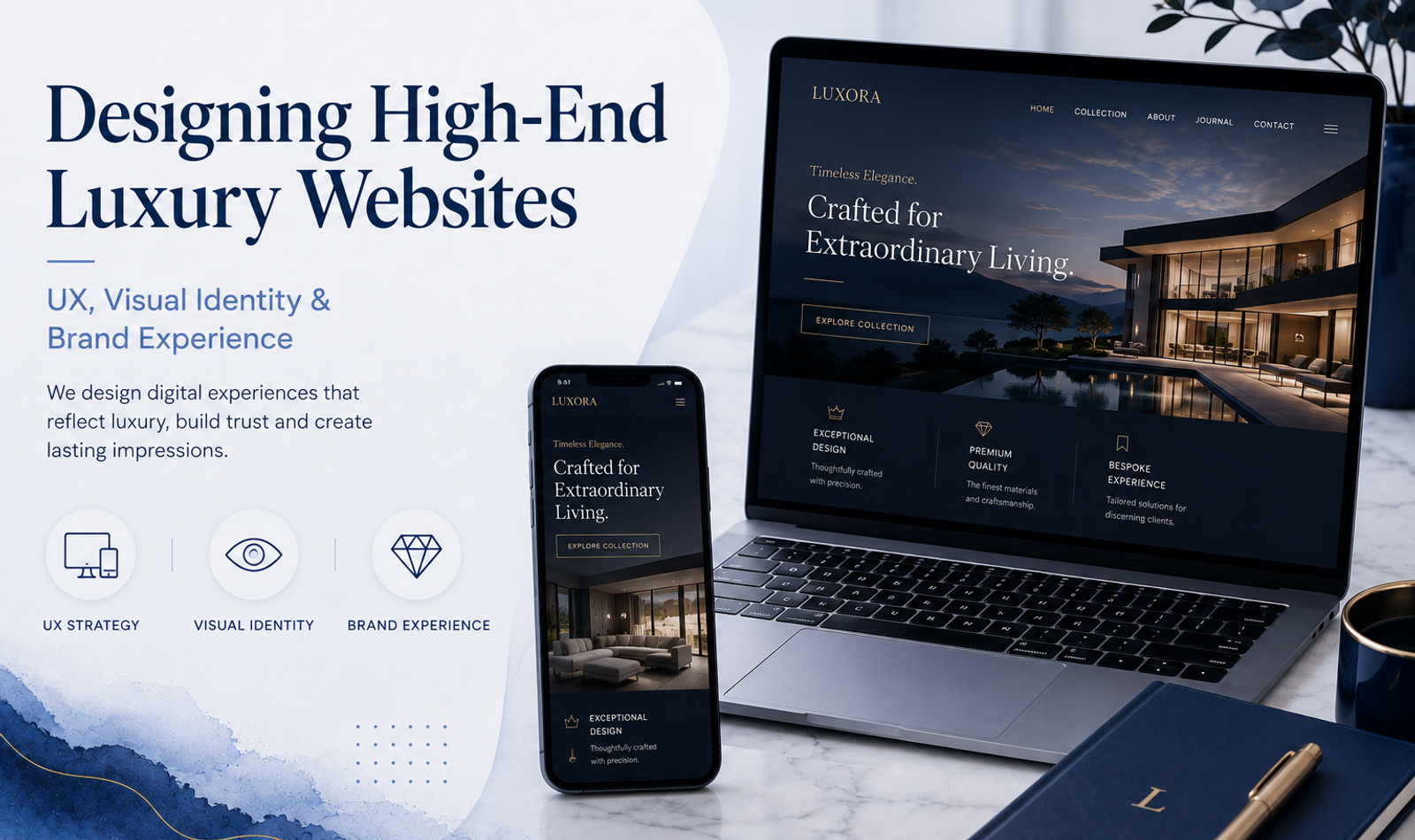
Designing High-End Luxury Websites (UX, Visual Identity & Brand Experience)
Luxury website design in 2026 is no longer about using black backgrounds, gold typography, large photographs and expensive-looking animations.
A truly high-end website must feel premium at every stage of the digital experience.
From the first second a visitor lands on the homepage to the moment they explore a service, view a portfolio, read a case study, submit an enquiry or book a consultation, every interaction contributes to how they perceive the brand.
For luxury, hospitality, lifestyle, real estate, fashion, automotive, events and premium service businesses, a website is more than a digital brochure. It is often the first serious interaction a potential customer has with the brand.
A customer may discover a business through Instagram, a Google search, a media feature, an influencer, an event or a recommendation. But before making a high-value decision, they often visit the website to understand whether the business feels credible, established and aligned with their expectations.
This is why high-end website design must bring together UX, visual identity, storytelling, performance, content, SEO and conversion strategy.
At Double Trouble Studio, we approach websites as complete brand experiences rather than isolated design projects. The objective is not simply to make a website look beautiful. It is to create a digital environment that communicates value, builds trust and helps the right customer move towards action.
This guide explains how brands can design high-end luxury websites that combine premium aesthetics with strategic user experience and measurable digital performance.
What Makes a Website Feel Truly Luxurious?
Luxury is often misunderstood as decoration.
Brands may assume that a dark colour palette, serif typography, cinematic photography and slow animations automatically create a premium website.
They can contribute to the experience, but they are not enough.
A high-end website feels luxurious because everything appears intentional.
The spacing feels considered. The typography has hierarchy. Images are selected carefully. Navigation feels effortless. Copy is concise but meaningful. Motion supports the story instead of distracting from it. Pages load smoothly. Mobile interactions feel refined. Calls to action are present without becoming aggressive.
Most importantly, the website understands its audience.
A customer exploring a luxury wedding company has different expectations from someone researching a premium automotive service, boutique hotel, interior design studio or high-end real estate development.
Luxury website design begins with understanding those expectations and creating an experience around them.
Brands planning their wider digital ecosystem should therefore treat website development and digital marketing as connected disciplines rather than separating design, technology and customer acquisition.
Why Luxury Website Design Is Different
Mass-market websites often focus heavily on speed of purchase, promotional messaging, offers and immediate conversion.
Luxury websites require a more balanced approach.
The customer may need time to explore.
They may want to understand the brand story, craftsmanship, process, portfolio, expertise, reputation and customer experience before making contact.
The website therefore needs to create desire while reducing uncertainty.
For a premium service brand, this may mean explaining the process clearly without making the experience feel transactional.
For a luxury event company, it may mean combining cinematic imagery with proof of execution, hospitality expertise and previous work.
For a premium hospitality brand, it may mean creating a sense of place before asking the customer to make a reservation.
For a luxury real estate business, the website may need to balance architecture, lifestyle, location, credibility and enquiry generation.
The best luxury websites do not force conversion.
They create enough confidence and desire that conversion becomes the natural next step.
Start With Luxury Brand Positioning
Website design should begin before the first wireframe is created.
The team needs to understand the brand's positioning.
What does the brand want to be known for?
Who is the priority customer?
Why should that customer choose this brand?
What emotional value does the brand create?
What makes the experience different from competitors?
What evidence supports its premium positioning?
Without clear answers, website design quickly becomes subjective.
One stakeholder wants minimalism. Another wants more colours. Someone wants animations. Someone wants every service on the homepage.
Strong positioning gives these decisions strategic context.
A brand built around quiet sophistication may require restrained typography, generous whitespace and editorial photography.
A luxury entertainment or event brand may need a more immersive and dynamic digital experience.
A premium technology business may combine sophistication with precision and innovation.
Positioning should determine the website's visual and verbal language rather than allowing current design trends to define the brand.
Businesses should also understand their wider identity, history and capabilities before translating them online. A strong About page can support this by giving potential customers context behind the business rather than presenting only services.
Understanding the High-End Customer
Luxury UX begins with customer understanding.
High-value customers are not simply looking for more expensive products or services. Their motivations can include convenience, privacy, expertise, personalisation, craftsmanship, exclusivity, status, confidence and reduced risk.
A customer organising a destination wedding may value flawless coordination and guest experience more than the lowest quotation.
A luxury homeowner may value design expertise and execution confidence.
A corporate client may prioritise professionalism, reliability and accountability.
A premium traveller may value seamless service and personal attention.
The website should answer the questions that matter to these customers.
Can I trust this company?
Do they understand customers like me?
Have they handled work at this level before?
What makes them different?
What will the experience be like?
How do I take the next step?
Good UX answers these questions naturally throughout the customer journey.
UX Strategy for Luxury Websites
User experience, or UX, determines how easily visitors can understand and navigate the website.
Luxury UX should feel effortless.
Visitors should not need to work hard to find basic information.
Navigation should be clear. Page hierarchy should make sense. Important information should appear at the right moment. Buttons should behave predictably. Forms should be simple. Mobile interactions should work naturally.
Luxury does not justify confusing design.
In fact, complexity often weakens the premium experience.
A high-end website may use unusual layouts or artistic interactions, but creativity should never prevent usability.
The best luxury UX often feels almost invisible.
The visitor simply moves through the website without thinking about how it works.
Creating a Premium Visual Identity Online
A brand's visual identity must translate effectively from offline assets into a digital environment.
A logo alone does not create identity.
The website needs a complete visual system involving typography, colours, imagery, spacing, grids, icons, motion, buttons, cards and other interface elements.
These elements should feel related.
Consistency creates recognition.
For luxury brands, restraint is particularly important.
Too many fonts, colours, animations, gradients, icons and design treatments can quickly make the website feel less premium.
Instead, the design should establish a clear visual hierarchy.
Hero sections can create emotional impact. Supporting sections can become quieter and more informative. Portfolio areas can allow imagery to dominate. Conversion sections can become clearer and more functional.
Luxury design works when every element has a purpose.
The Role of Typography in Luxury Web Design
Typography strongly influences perception.
Serif typefaces can create an editorial, heritage or sophisticated feeling.
Clean sans-serif fonts can communicate modernity, confidence and precision.
The strongest luxury websites often use typography as part of the visual experience rather than treating text as something placed on top of the design.
Large headlines can create drama.
Smaller supporting copy can introduce detail.
Carefully controlled line lengths improve readability.
Spacing between headings, paragraphs and sections creates visual rhythm.
However, typography must remain functional.
A beautiful typeface that becomes difficult to read on mobile is not good luxury design.
Premium design combines personality with usability.
Using Photography and Video to Build Desire
Luxury brands are highly visual.
Photography and video can communicate atmosphere, material, scale, emotion and craftsmanship much faster than copy alone.
But image quality matters.
Poorly lit photographs, inconsistent colour grading, generic stock imagery and low-resolution assets can weaken an otherwise sophisticated website.
Brands should develop a consistent image direction.
For hospitality, this may include architecture, details, people, food and atmosphere.
For events, it may include design, guest experience, scale, entertainment and emotional moments.
For automotive brands, it may include exterior details, interiors, service moments and lifestyle contexts.
Video can take this experience further.
Cinematic hero films, campaign videos, product sequences and subtle motion can make the website more immersive. Brands that want to develop these assets can integrate AI video and VFX production into the wider digital content strategy.
The key is optimisation.
Beautiful visual content should not make the website unnecessarily slow.
Designing a Luxury Homepage
The homepage should communicate the brand quickly without trying to explain everything at once.
A strong luxury homepage usually begins with a clear hero section.
The hero should establish identity and positioning.
Instead of generic lines such as "Welcome to our website" or "We provide the best services," the headline should communicate a meaningful point of view.
The sections that follow can introduce key capabilities, selected work, brand philosophy, proof, customer experience and relevant content.
The homepage should also create pathways into deeper pages.
Someone interested in the company should be able to explore its story.
Someone looking for a specific service should reach that service easily.
Someone evaluating previous work should reach the portfolio.
Someone ready to enquire should be able to reach the contact page without unnecessary steps.
The homepage is not supposed to contain the entire website.
Its job is to create understanding and guide exploration.
Creating High-End Service and Product Pages
Luxury service pages need more than a service name and a short paragraph.
They should explain the value behind the service.
What does the customer receive?
What problem does it solve?
How does the process work?
Why is the company qualified to deliver it?
What makes the experience different?
What proof is available?
For example, an agency offering events and wedding management should not rely only on glamorous event photographs. The website can explain planning, hospitality, production, vendor coordination, entertainment, guest experience and execution.
Similarly, brands providing specialised guest management services should communicate how arrival, hospitality, coordination and guest journeys contribute to the overall experience.
Service pages should reduce uncertainty while preserving premium positioning.
Storytelling for Luxury Brand Websites
Luxury customers often buy meaning alongside functionality.
Storytelling helps communicate that meaning.
A brand story may explain its origin, philosophy, founder vision, design process, heritage, craftsmanship, customer approach or reason for existing.
However, storytelling should remain relevant to the customer.
Long brand histories are not automatically engaging.
The story should help the visitor understand why the brand behaves differently today.
Luxury storytelling can also extend beyond the About page.
Service pages can explain process.
Case studies can explain transformation.
Blogs can demonstrate expertise.
Photography can communicate atmosphere.
Founder insights can build authority.
PR can strengthen credibility.
Brands can support this wider reputation-building system through a strategic PR and media marketing approach that connects earned visibility with the website experience.
Building a Seamless Customer Journey
The website should be designed around the complete journey rather than individual pages.
A typical visitor may move from:
Discovery → Homepage → Service → Portfolio → About → FAQ → Contact → Enquiry
Another visitor may arrive directly through Google on a blog or service page.
Someone coming from Instagram may land on the homepage.
Someone who discovered the brand through PR may search its name and immediately check previous work.
Each journey should make sense.
Internal links are particularly important because they allow visitors to explore relevant information naturally.
For brands operating across multiple markets, dedicated location pages can also help customers understand geographic relevance while supporting organic search discovery.
Mobile UX for Luxury Websites
Mobile is not a smaller version of desktop.
It requires its own design thinking.
A cinematic desktop website may look impressive on a large monitor but become difficult to use when every animation, oversized headline and video is compressed into a phone screen.
Mobile users need clear navigation, readable typography, fast-loading imagery, properly sized buttons and simplified interactions.
Forms should be easy to complete.
Phone and WhatsApp actions should work immediately.
Images should crop correctly.
Menus should not hide important information.
Videos should be optimised for smaller screens and network conditions.
For many customers, mobile is the first and possibly only version of the website they see.
A luxury website therefore needs to feel premium in someone's hand, not only on a designer's desktop monitor.
Speed and Core Web Vitals Without Compromising Design
Luxury websites often contain high-resolution photography, video, custom typography and motion.
These assets can create performance problems if they are implemented carelessly.
A slow website immediately damages the experience.
Visitors should not have to wait for a 20 MB hero video to load simply because the brand wants cinematic impact.
Developers should optimise image formats, responsive image sizes, video loading, scripts, fonts and third-party integrations.
Core Web Vitals should also be monitored to understand loading performance, responsiveness and visual stability.
The objective is not to remove premium content.
It is to deliver it efficiently.
Performance itself is part of luxury UX.
Navigation and Information Architecture
A premium website should make complexity feel simple.
If a company provides multiple services, locations or categories, information architecture becomes critical.
Visitors should understand the structure without opening five menus.
Navigation labels should be clear rather than unnecessarily clever.
Important pages should remain accessible.
Breadcrumbs, internal links, related services and contextual CTAs can help visitors move naturally between information.
For agencies or service businesses with multiple disciplines, a central services structure can help customers understand how different capabilities connect instead of presenting them as unrelated offerings.
Using White Space and Minimalism Correctly
White space is one of the most recognisable characteristics of high-end digital design.
But white space does not literally need to be white.
It refers to breathing room around elements.
Luxury websites often use space to create focus.
Instead of placing six messages, four buttons and multiple graphics inside one screen, the design allows one important idea to dominate.
This creates confidence.
However, minimalism should not become emptiness.
A website can look visually sophisticated but still fail if customers cannot understand the offer.
The strongest luxury design balances simplicity with useful information.
Micro-Interactions and Motion Design
Motion can add sophistication when used carefully.
A subtle image reveal, elegant menu transition, controlled hover interaction or gentle text animation can make a website feel crafted.
But animation should support hierarchy and storytelling.
It should not exist simply because it is technically possible.
Excessive scroll effects, long loading animations and complicated cursor interactions can frustrate visitors.
Luxury motion should feel controlled.
The customer should remember the brand, not the animation library.
Luxury E-commerce and Booking Experiences
For luxury e-commerce and booking brands, the transaction itself must feel premium.
Product discovery should be intuitive.
Photography should provide enough detail.
Variants should be clear.
Pricing should be transparent where appropriate.
Booking calendars should work properly.
Checkout should require as few unnecessary steps as possible.
Confirmation messages should feel consistent with the brand.
For high-value services, immediate checkout may not always be appropriate.
A consultation, private appointment, reservation request or customised proposal may better support the buying journey.
The conversion mechanism should match how customers actually purchase.
Building Trust Through Proof and Credibility
Luxury customers want reassurance before making expensive decisions.
Proof can include client stories, previous work, testimonials, awards, press coverage, certifications, partnerships, founder expertise and detailed case studies.
A strong selected work portfolio allows customers to judge execution rather than relying entirely on marketing claims.
Celebrity association can also strengthen visibility for certain categories when used strategically. Brands working with public figures should ensure that celebrity management supports the wider positioning rather than becoming disconnected publicity.
Proof should be integrated naturally.
Luxury websites should demonstrate credibility rather than repeatedly announcing that the company is "premium" or "best."
Conversion Strategy Without Making Luxury Feel Sales-Heavy
Luxury websites still need to convert.
The difference is how conversion is presented.
Aggressive pop-ups, constant discount banners, countdown timers and repeated "BUY NOW" buttons may work for some mass-market categories but can damage a high-end experience.
Premium calls to action can feel more consultative.
Examples include:
Request a Private Consultation
Discuss Your Project
Explore the Collection
Plan Your Experience
Request a Proposal
Book an Appointment
Speak With Our Team
CTA language should match the buying process.
Placement also matters.
Visitors should encounter the next logical action after receiving enough information to consider it.
SEO for High-End Luxury Websites
Beautiful websites still need to be discoverable.
SEO should be incorporated into the website architecture from the beginning.
This includes logical page structures, descriptive URLs, title tags, meta descriptions, headings, internal links, image alt text, schema where appropriate, mobile performance and useful content.
Service pages should target relevant commercial search intent.
Location pages can support geographic discovery.
Blog content can answer informational searches and demonstrate expertise.
Technical SEO should ensure that search engines can crawl and understand the website properly.
A high-end website does not need to choose between design and SEO.
Both should be planned together.
The Double Trouble Studio blog can also function as an ongoing authority layer, allowing useful guides and industry insights to support service pages through contextual internal linking.
GEO and AI-Search Optimisation
Search behaviour is expanding beyond traditional search engine results.
Customers increasingly use AI-assisted tools to research companies, compare options and ask detailed questions.
This makes clarity even more important.
Websites should provide direct, factual information about who the company is, what it does, where it operates, how its services work and what differentiates it.
FAQs, case studies, structured service information, expert articles and original insights can help establish clearer brand context.
GEO and AI-search optimisation should not mean producing robotic content specifically for machines.
Useful content should remain written for people.
The objective is to make expertise easy to understand, verify and reference.
Accessibility and Usability in Premium Design
Accessibility should not be considered separate from high-quality design.
Small grey text on a slightly lighter grey background may look sophisticated in a mock-up but become difficult to read.
Tiny navigation, poor contrast and unclear buttons create unnecessary friction.
Premium experiences should be usable.
Typography should remain readable.
Interactive elements should be understandable.
Images should have meaningful alt text where appropriate.
Keyboard navigation and semantic structure should be considered during development.
Good accessibility often leads to better UX for everyone.
Common Luxury Website Design Mistakes
One major mistake is confusing luxury with visual excess.
Too many animations, fonts, videos and effects can reduce sophistication.
Another is prioritising aesthetics over speed.
A beautiful website that takes too long to load is still a poor experience.
Some brands make the opposite mistake and create extremely minimal websites that provide almost no useful information.
Customers need enough detail to make decisions.
Generic stock imagery is another problem.
It may make the website look polished initially, but it rarely creates a distinctive identity.
Weak mobile experiences, confusing navigation, poor copy, outdated portfolio work and aggressive CTAs can also damage premium positioning.
Finally, brands often launch a beautiful website and then stop maintaining it.
A high-end digital experience needs continuous improvement.
How to Measure Luxury Website Performance
Luxury website performance should be evaluated using both brand and business signals.
Traffic alone is not enough.
Brands should understand where visitors come from, which pages they explore, how long they engage, what content supports decisions and where they leave.
Important measures may include organic visibility, branded searches, engagement, enquiry submissions, WhatsApp actions, consultation bookings, conversion rate and lead quality.
For high-value services, lead quality can be more important than lead volume.
Ten enquiries from highly relevant customers may be more valuable than hundreds of poorly matched leads.
Website analytics should therefore connect with actual sales feedback.
The objective is to understand whether the digital experience attracts and converts the type of customer the brand wants.
Luxury Website Design Trends for 2026
Luxury web design in 2026 is increasingly moving towards controlled digital experiences rather than excessive decoration.
Editorial layouts continue to influence premium websites.
Large-format typography is being combined with carefully selected imagery.
Motion is becoming more purposeful.
Cinematic video remains valuable when performance is managed correctly.
Brands are also investing more in original content rather than relying on generic stock visuals.
AI can support visual production, personalisation and content workflows, but premium brands need human judgement to maintain consistency and quality.
The strongest trend is not a particular font, layout or animation.
It is intentionality.
Luxury brands are becoming more selective about what appears on screen and why.
How Double Trouble Studio Approaches Luxury Website Design
Double Trouble Studio approaches luxury website design as a combination of brand strategy, creative direction, UX, development, content and digital growth.
We begin by understanding the business, audience and desired positioning.
The website architecture is then planned around customer journeys rather than simply arranging pages.
Visual identity is translated into a digital system involving typography, imagery, spacing, motion and interface behaviour.
Content is structured to explain services, demonstrate expertise and create search visibility.
Development focuses on responsive performance, mobile usability and technical foundations.
Where required, the wider ecosystem can connect website development with PR and media marketing, AI video and VFX, content, SEO and other digital growth activities.
The objective is to create a website that looks premium because the entire experience is premium.
Frequently Asked Questions
What makes a website look luxurious?
A luxury website combines refined visual identity, premium imagery, intentional typography, controlled spacing, intuitive UX, strong storytelling and seamless performance. Luxury comes from consistency and attention to detail rather than decoration alone.
Why is UX important for luxury websites?
High-value customers expect effortless experiences. Clear navigation, responsive design, useful information and intuitive customer journeys help reinforce the quality promised by the brand.
Should luxury websites use minimal design?
Minimal design can work extremely well for luxury brands when it supports the positioning. The objective should be clarity and focus rather than removing useful information simply to create empty space.
How important is website speed for luxury brands?
Website speed is extremely important. Premium photography, video and animation should be optimised carefully so that visual quality does not create a slow or frustrating user experience.
Can a luxury website also be SEO-friendly?
Yes. Luxury design and SEO can work together through strong technical foundations, structured pages, helpful content, internal linking, optimised media and clear information architecture.
How can luxury websites generate leads without looking too promotional?
Luxury brands can use refined calls to action such as private consultations, project enquiries, appointment bookings and proposal requests instead of relying on aggressive promotional techniques.
What pages should a luxury brand website include?
The exact structure depends on the business, but common pages include Home, About, Services or Collections, Work or Portfolio, Case Studies, Blog or Journal, Locations, FAQs and Contact.
How does visual identity affect luxury website design?
Visual identity determines how colours, typography, photography, layouts, graphics and motion work together to communicate the brand's personality and positioning.
Why is mobile design important for luxury websites?
Many potential customers first discover premium brands through social media, search, PR and advertising on their phones. The mobile experience therefore needs to communicate the same level of quality as desktop.
How often should a luxury website be updated?
Content, security and technical performance should be monitored continuously. SEO, UX, case studies, imagery and conversion performance should also be reviewed regularly as the brand and customer behaviour evolve.
Conclusion
A high-end luxury website is not defined by how expensive it looks.
It is defined by how intentionally it communicates, how effortlessly it works and how accurately it reflects the brand behind it.
Visual identity creates the first impression.
UX determines how customers move through the experience.
Photography, video and storytelling create emotion.
Content explains value.
Technical performance protects usability.
SEO improves discoverability.
Proof creates confidence.
Conversion strategy turns interest into meaningful action.
When these elements work together, the website becomes much more than a digital presentation.
It becomes part of the brand experience itself.
For luxury, hospitality, lifestyle, event, automotive, real estate, fashion and premium service businesses, this digital experience can directly influence perception, trust and buying decisions.
Double Trouble Studio helps premium and luxury brands create high-end digital experiences through brand strategy, website development, UX, content, SEO, PR, digital marketing and AI-led visual production.
If your current website no longer reflects the quality, positioning or ambition of your business, connect with Double Trouble Studio to discuss a more strategic digital experience.
📩 info@dtsworld.in 📞 +91 80000 06021 📍 Andheri (West), Mumbai
Need this for your brand?
Let DTS build your next campaign.
From PR, celebrity management and events to websites, social media, SEO and AI video production — Double Trouble Studio helps brands grow with strategy and execution.
Discuss Your Requirement →