
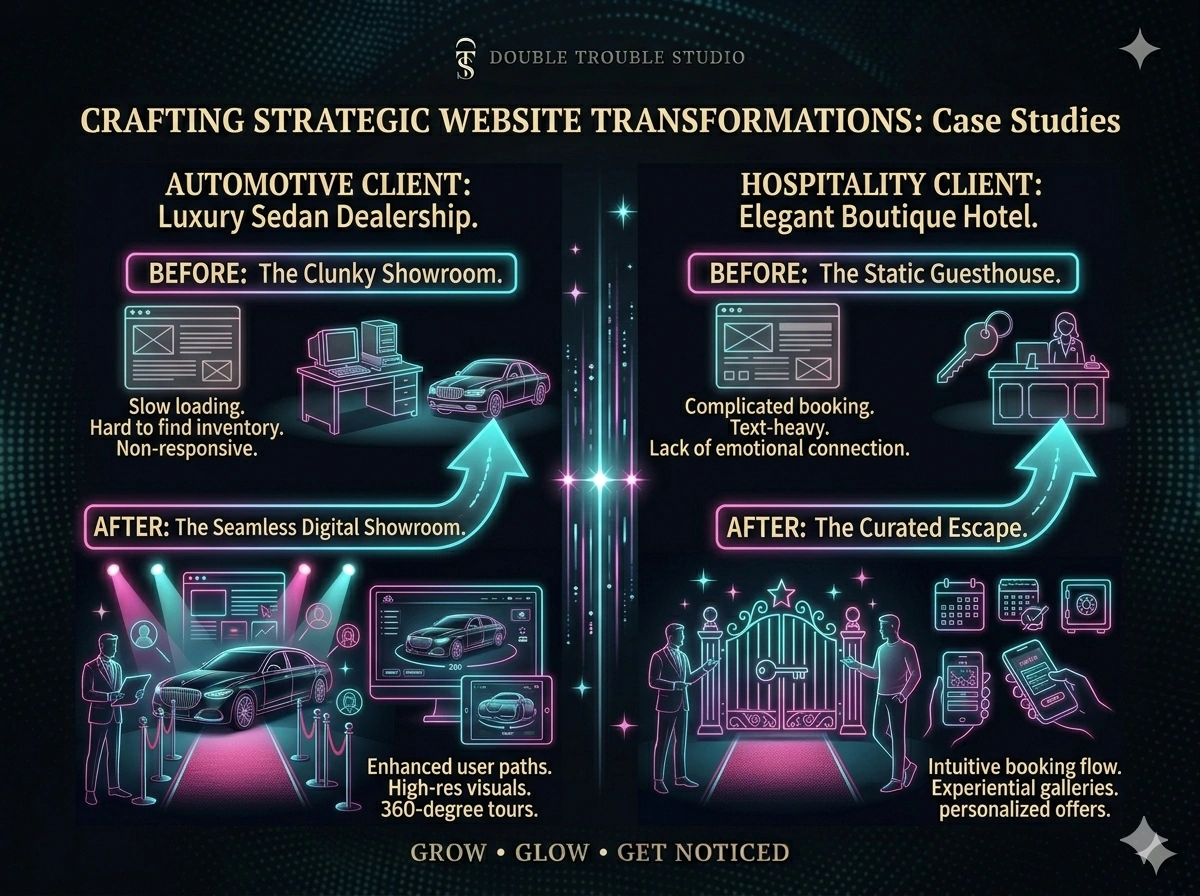
Case Studies: Website Transformations for Automotive & Hospitality Clients
In high-value industries such as automotive and hospitality, a website is more than a digital asset. It is a decision-making environment where perception, trust, and intent converge. Unlike low-consideration products, these sectors involve longer decision cycles, higher investment, and more scrutiny from users.
In 2026, website transformations are no longer limited to visual redesigns. They involve restructuring entire digital ecosystems — aligning UI/UX, performance, content, and conversion strategy to create measurable impact.
The following case studies illustrate how strategic website transformations can elevate brand positioning and drive tangible business outcomes.
Because in premium markets, transformation is not about change.
It is about alignment.
Case Study 1: Automotive Brand — From Static Presence to Lead Engine
A premium automotive dealership operating in a competitive urban market faced a common challenge. Despite offering high-end vehicles and strong offline reputation, their website functioned primarily as a static brochure.
Users could browse vehicle listings, but there was no structured journey guiding them toward inquiry or engagement. Navigation was fragmented, mobile experience was inconsistent, and performance issues reduced user retention.
The transformation began with redefining the website’s purpose. Instead of acting as a catalogue, it was repositioned as a lead-generation platform.
UI/UX was redesigned to create a clear flow. Users were guided from discovery to detailed exploration, with well-placed inquiry prompts integrated naturally into the experience. Mobile responsiveness was prioritized, ensuring consistency across devices.
Content strategy was also restructured. Instead of generic descriptions, vehicle pages included curated storytelling, highlighting features, lifestyle alignment, and ownership experience.
Performance optimization improved loading speed significantly, reducing drop-offs. SEO enhancements increased organic visibility, attracting more relevant traffic.
The result was not just increased traffic, but higher-quality leads. Users spent more time on the website, engaged with multiple pages, and converted at a significantly improved rate.
The transformation shifted the website from passive presence to active growth driver.
Case Study 2: Hospitality Brand — Elevating Digital Experience for Bookings
A luxury hospitality brand with a strong offline presence faced a different challenge. While their property delivered exceptional on-ground experiences, their website did not reflect the same level of sophistication.
The booking process was fragmented, visuals were inconsistent, and the overall experience lacked cohesion. Users often dropped off before completing reservations.
The transformation focused on aligning digital experience with brand identity.
Visual design was refined to reflect the property’s aesthetic. High-quality imagery, consistent styling, and immersive layouts created a stronger emotional connection.
The booking journey was simplified. Navigation was restructured, reducing friction and making the process intuitive. Clear pathways guided users from exploration to reservation without confusion.
Content was enhanced to provide depth. Room descriptions, amenities, and experiences were presented in a way that allowed users to visualize their stay.
Technical improvements ensured faster loading times and stable performance, particularly on mobile devices. This was critical, as a significant portion of users accessed the website through smartphones.
Post-transformation, the brand saw improved engagement metrics, higher booking completion rates, and stronger direct traffic. The website began to function as a true extension of the brand experience.
Digital perception aligned with physical reality.
Case Study 3: Multi-Location Hospitality Chain — Scaling Consistency
A growing hospitality chain operating across multiple locations faced challenges in maintaining consistency. Each property had its own presentation style, leading to fragmented brand identity across digital platforms.
Users navigating between locations experienced inconsistency in design, content, and booking flow. This reduced trust and created confusion.
The transformation focused on creating a unified system.
A centralized design framework was developed, ensuring that all properties followed the same visual language and structure. This created a cohesive brand identity across locations.
Content strategy was standardized while allowing for localized customization. Each property maintained its uniqueness while aligning with the overall narrative.
The booking system was integrated, allowing users to navigate seamlessly between locations and complete reservations without disruption.
Performance optimization ensured that all pages maintained consistent speed and responsiveness, regardless of location.
The result was a stronger brand presence and improved user confidence. Guests could explore multiple properties within a unified experience, increasing cross-location engagement.
Consistency created scalability.
Case Study 4: Automotive Experience Brand — Enhancing Engagement
An automotive experience brand specializing in luxury test drives and curated experiences faced a different challenge. Their website attracted traffic but struggled to convert users into bookings.
The issue was not visibility, but engagement. Users lacked clarity on offerings, and the journey from interest to action was unclear.
The transformation focused on experience mapping.
Content was restructured to highlight unique offerings, emphasizing experiential value rather than technical details. Visual storytelling played a key role, allowing users to imagine the experience.
Interactive elements were introduced to enhance engagement, guiding users through available options and helping them make decisions.
Conversion points were redesigned to feel natural and integrated, encouraging users to take action without pressure.
Performance improvements ensured smooth interaction, reducing friction during navigation.
The result was increased engagement, longer session durations, and improved booking rates.
The website evolved from informational to experiential.
Key Insights Across Transformations
Across these case studies, certain patterns emerge. Successful website transformations are not driven by isolated changes. They are the result of integrated strategies that align design, content, performance, and conversion.
User experience plays a central role. Websites must be intuitive, responsive, and aligned with user expectations. Content must provide clarity while reinforcing brand identity. Performance must support seamless interaction.
Most importantly, the website must have a defined purpose. Whether it is lead generation, booking, or engagement, every element must contribute to that objective.
In premium markets, clarity creates efficiency.
Conclusion: Transformation as Strategic Alignment
Website transformation is not about redesigning pages. It is about redefining how a brand is experienced digitally.
For automotive and hospitality brands in India, where competition is intense and customer expectations are high, this transformation becomes essential. It ensures that digital presence supports business goals while reinforcing brand positioning.
When executed correctly, a website becomes more than a platform.
It becomes a strategic asset.
Because in high-value industries, users do not just browse.
They evaluate.
Frequently Asked Questions (FAQs)
What is a website transformation?
It involves redesigning and restructuring a website to improve user experience, performance, and conversion.
Why are case studies important?
They provide real-world insights into how strategies are applied and what results can be achieved.
How long does a website transformation take?
It varies depending on complexity, but typically ranges from a few weeks to several months.
What is the biggest benefit of transformation?
Improved user engagement, higher conversion rates, and stronger brand positioning.
Do all industries require the same approach?
No. Each industry requires tailored strategies based on audience behavior and business goals.
Design Your Website Transformation Strategy
If you are looking to transform your website for your automotive brand, hospitality business, or premium service, success requires more than design — it requires strategic alignment.
From UI/UX redesign and content structuring to performance optimization and conversion strategy, our team ensures that your website delivers measurable impact while reflecting your brand’s premium positioning.
📩 hello@dtsworld.in 📞 +91 80000 06021 📍 Andheri East, Mumbai
👉 Design Your Website Strategy