
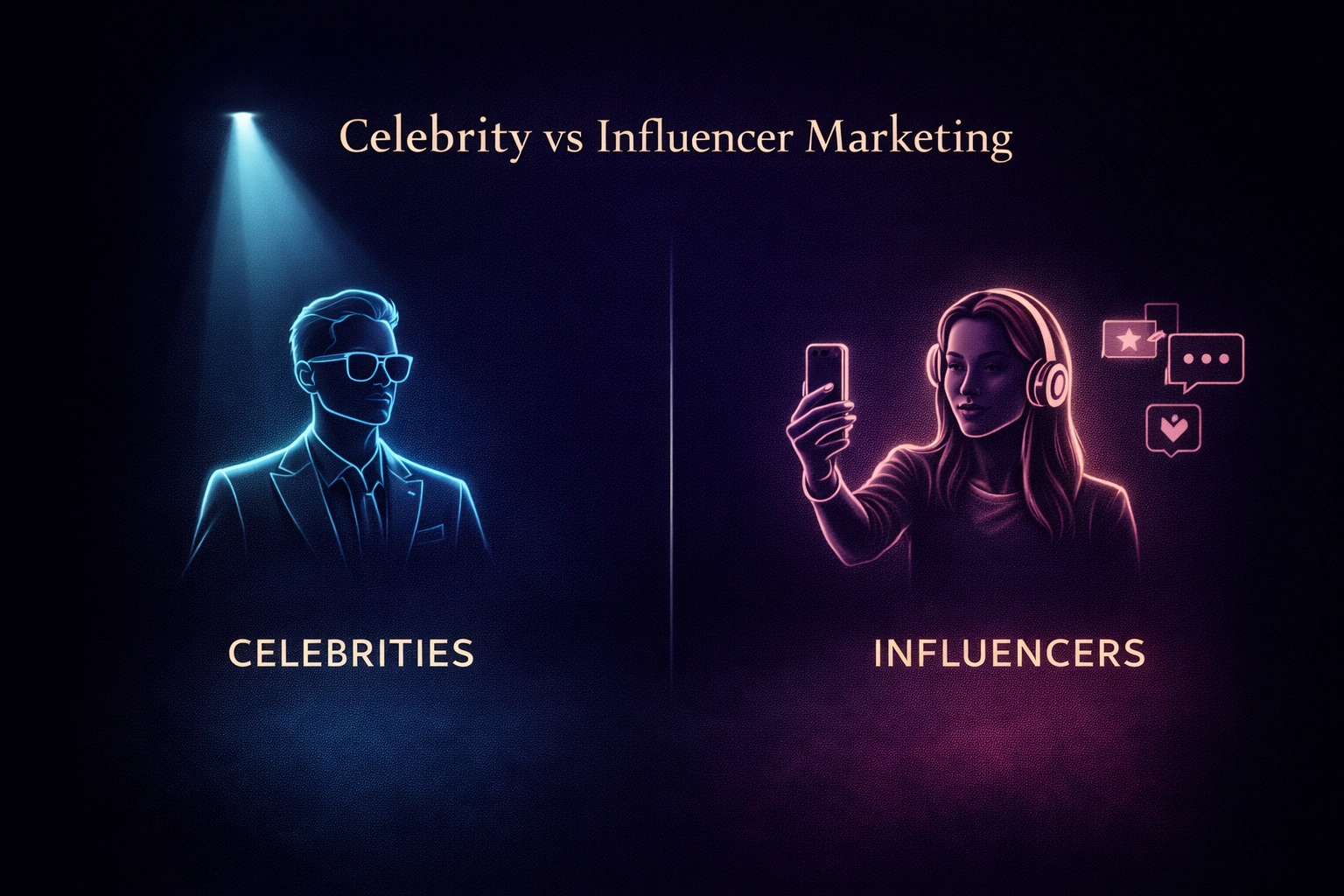
Celebrity vs Influencer Marketing (Reach, Credibility & ROI Breakdown)
In today’s evolving marketing landscape, brands are no longer limited to traditional advertising channels. The rise of digital platforms and social media has transformed how influence is created and consumed. For luxury brands, this shift has introduced a critical strategic question—should they invest in celebrity marketing or influencer marketing?
At first glance, both approaches may seem similar. Both involve leveraging individuals with public visibility to promote a brand. However, the underlying dynamics, impact, and long-term value of these strategies are significantly different. Choosing the wrong approach can dilute brand positioning, while the right one can elevate it.
In India’s rapidly growing luxury and premium market, where consumer expectations are shaped by both global exposure and digital behavior, this decision has become increasingly important. It is no longer about choosing visibility.
It is about choosing the right kind of influence.
Understanding the Difference Between Celebrities and Influencers
Celebrities and influencers operate in different spheres of visibility and authority. Celebrities typically gain recognition through traditional media such as films, television, sports, or public achievements. Their influence is built over time and is often associated with mass appeal and widespread recognition.
Influencers, on the other hand, derive their authority from digital platforms. Their influence is often niche-focused, built around specific interests such as fashion, travel, fitness, or lifestyle. They connect with audiences through consistent content and direct engagement.
This fundamental difference shapes how each category impacts brand perception. Celebrities bring scale and prestige, while influencers bring relatability and targeted engagement. Understanding this distinction is essential for making strategic decisions.
Strategic Context: Where This Fits in Modern Brand Building
Marketing today is deeply integrated with digital ecosystems, brand positioning, and audience behavior. Choosing between celebrities and influencers is not an isolated decision. It must align with broader brand strategy and digital presence.
To understand how marketing channels, digital strategy, and brand positioning work together, you can explore this comprehensive guide: 👉 https://www.dtsworld.in/blog/ultimate-guide-web-development-digital-marketing
This pillar resource provides a complete overview of digital brand building, while this blog focuses specifically on influence-based marketing strategies.
Reach: Mass Visibility vs Targeted Exposure
Reach is often the first metric brands consider when evaluating marketing strategies. Celebrities offer unmatched scale, allowing brands to access large and diverse audiences across multiple platforms. Their presence in mainstream media ensures visibility beyond digital channels.
However, this broad reach comes with limitations. While celebrities can create widespread awareness, their audience is often less defined. This makes it difficult to target specific consumer segments with precision.
Influencers, by contrast, offer more targeted reach. Their audiences are typically built around specific interests, making it easier to connect with niche segments. While their overall reach may be smaller, it is often more relevant.
In luxury branding, relevance often matters more than scale. The ability to reach the right audience can be more valuable than reaching a larger one.
Credibility: Authority vs Relatability
Credibility plays a crucial role in how audiences perceive marketing messages. Celebrities carry authority derived from their achievements and public image. Their association with a brand can enhance prestige and aspirational appeal.
However, this authority can sometimes feel distant. Audiences may perceive celebrity endorsements as transactional, especially when the association lacks authenticity. This can reduce the effectiveness of the message.
Influencers, on the other hand, build credibility through relatability. Their content often feels personal and authentic, creating a stronger connection with their audience. This makes their recommendations more persuasive.
In luxury branding, credibility must be carefully balanced. While aspirational value is important, authenticity cannot be ignored. The challenge lies in choosing the right type of credibility for the brand.
ROI: Investment vs Measurable Impact
Return on investment is one of the most critical factors in marketing strategy. Celebrity endorsements typically require significant financial investment. The returns are often measured in terms of visibility and brand perception rather than direct conversions.
This makes ROI difficult to quantify. While celebrities can create strong brand recall, translating that into measurable results can be challenging. The impact is often long-term and intangible.
Influencer marketing, in contrast, offers more measurable outcomes. Digital platforms provide data on engagement, conversions, and audience behavior. This allows brands to track performance more accurately.
However, lower cost does not always mean higher value. The effectiveness of influencer marketing depends on alignment and execution. In luxury branding, ROI must be evaluated beyond immediate metrics.
Brand Positioning: Prestige vs Accessibility
Brand positioning is a key factor in deciding between celebrities and influencers. Celebrities are often associated with prestige, making them suitable for brands that want to emphasize exclusivity and aspiration.
Their presence can elevate brand perception and create a sense of luxury. However, overuse or misalignment can make the brand appear overly commercial.
Influencers, on the other hand, bring a sense of accessibility. They make brands feel more approachable and relatable. This can be beneficial for brands looking to engage with younger or digitally active audiences.
In luxury branding, maintaining exclusivity is essential. The choice between prestige and accessibility must align with the brand’s identity and long-term strategy.
Engagement: Passive Visibility vs Active Interaction
Engagement is where influencer marketing often outperforms celebrity marketing. Influencers interact directly with their audience through comments, messages, and content. This creates a sense of community and involvement.
Celebrities, while highly visible, often have limited direct interaction with their audience. Their communication is typically one-directional, focusing on broadcasting rather than engagement.
For brands, this difference has significant implications. High engagement can lead to stronger connections and higher conversion rates. However, it must be aligned with brand positioning.
In luxury events and branding, engagement should enhance experience without compromising exclusivity. The approach must be carefully balanced.
Longevity: Short-Term Campaigns vs Long-Term Influence
Celebrity marketing is often associated with large-scale campaigns that generate immediate visibility. While these campaigns can be impactful, their effect may be short-lived if not supported by long-term strategy.
Influencer marketing, particularly with long-term collaborations, can create sustained engagement and consistent messaging. This allows brands to build relationships with audiences over time.
Luxury brands typically benefit from long-term strategies. Consistency and continuity are key to maintaining strong brand identity. The choice between short-term impact and long-term influence must align with overall objectives.
Risk Factors: Reputation and Brand Impact
Both celebrity and influencer marketing come with risks. Public perception of individuals can change rapidly, and any negative association can impact the brand.
Celebrities, due to their high visibility, carry significant reputational risk. A single controversy can have widespread impact. Influencers, while less visible, can also affect brand perception if not carefully selected.
Risk management requires thorough evaluation and ongoing monitoring. Brands must ensure that their chosen partners align with their values and maintain a consistent public image.
Hybrid Strategy: Combining Celebrities and Influencers
In many cases, the most effective approach is not choosing between celebrities and influencers but combining both. A hybrid strategy allows brands to leverage the strengths of each.
Celebrities can create awareness and prestige, while influencers can drive engagement and conversion. This combination provides both scale and relevance.
However, integration must be strategic. Both elements must align with the brand’s identity and messaging. Without alignment, a hybrid approach can create inconsistency.
Which Strategy is Right for Luxury Brands?
The decision between celebrity and influencer marketing depends on multiple factors, including brand positioning, target audience, and campaign objectives. There is no one-size-fits-all answer.
Luxury brands focused on exclusivity and global positioning may benefit more from celebrity associations. Brands targeting digital-native audiences may find influencer marketing more effective.
Ultimately, the choice must align with the brand’s identity and long-term vision. Strategy should guide the decision, not trends.
Conclusion: Influence Must Align with Identity
Celebrity and influencer marketing are both powerful tools, but their effectiveness depends on alignment. Reach, credibility, and ROI must be evaluated within the context of brand positioning and objectives.
In luxury branding, where perception is everything, the choice of influence must be intentional. It must enhance identity, not dilute it.
Because in the end, success is not about choosing the most popular option.
It is about choosing the most aligned one.
Frequently Asked Questions (FAQs)
Q. What is the main difference between celebrity and influencer marketing?
Celebrity marketing focuses on mass reach and prestige, while influencer marketing emphasizes targeted engagement and relatability. Both have different strategic advantages.
Q. Which is better for luxury brands, celebrities or influencers?
It depends on the brand’s positioning and objectives. Celebrities are better for prestige and visibility, while influencers are effective for engagement and niche targeting.
Q. Is influencer marketing more cost-effective than celebrity marketing?
Generally, yes. Influencer marketing often requires lower investment and provides measurable results. However, effectiveness depends on alignment and execution.
Q. Can luxury brands use both celebrities and influencers?
Yes, a hybrid strategy can combine the strengths of both approaches. However, it must be executed carefully to maintain brand consistency.
Q. How is ROI measured in celebrity marketing?
ROI is often measured through brand awareness, recall, and perception rather than direct conversions. It focuses on long-term value.
Q. What are the risks of influencer marketing?
Risks include misalignment, lack of authenticity, and reputational issues. Proper selection and monitoring are essential.
Q. How does audience alignment impact marketing success?
Audience alignment ensures that the message reaches the right people, increasing effectiveness and relevance.
Contact Us
If you are building a luxury brand, choosing between celebrity and influencer marketing requires more than comparison. It requires strategy, positioning, and long-term vision.
From brand alignment and audience analysis to campaign execution and performance tracking, every decision must be carefully structured.
📩 hello@dtsworld.in 📞 +91 80000 06021 📍 Andheri East, Mumbai
👉 Build High-Impact Marketing Strategies with DTS