
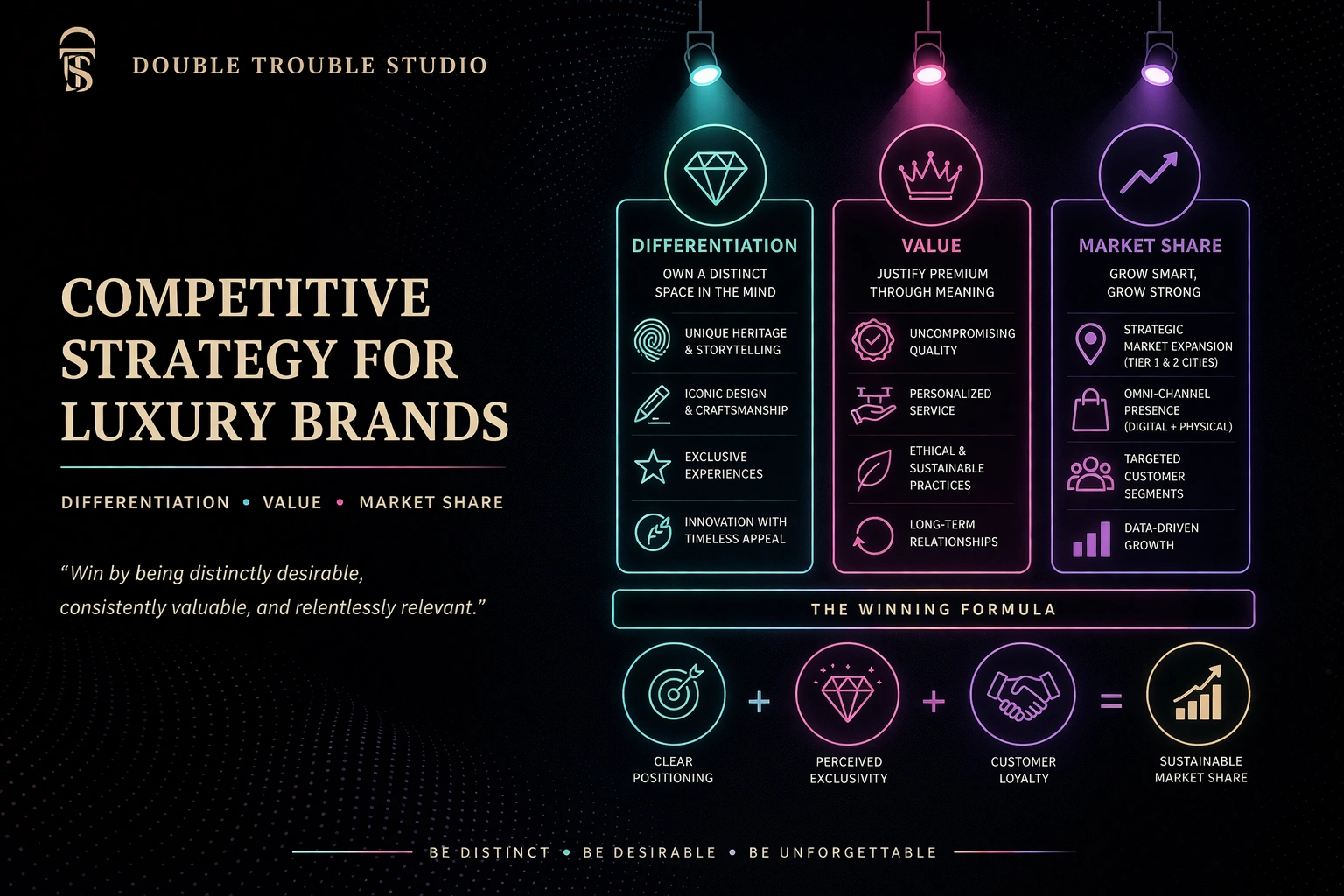
Competitive Strategy for Luxury Brands (Differentiation, Value & Market Share)
In 2026, competition in luxury markets does not operate in the same way as mass-market industries.
Luxury brands are not competing solely for customers.
They are competing for perception.
This distinction changes everything.
In traditional markets, competition is often defined by pricing, features, and accessibility. Brands attempt to outperform each other by offering more value at lower cost or reaching larger audiences faster.
In luxury branding, this logic fails.
Reducing price weakens exclusivity. Increasing accessibility dilutes desirability. Expanding too quickly reduces control over perception.
As a result, competitive strategy in premium markets is not about outperforming competitors directly.
It is about redefining the frame of comparison.
Luxury brands that succeed are not those that win against competitors in the same category.
They are those that make comparison irrelevant.
This is achieved through differentiation, value construction, and controlled market presence.
Because in premium markets, the strongest brands are not the most visible.
They are the most distinct.
Rethinking Competition: From Market Share to Mind Share
The concept of competition in luxury branding begins with a shift in perspective.
Instead of focusing on market share alone, brands must focus on mind share — the space they occupy in the audience’s perception.
Market share measures transactions.
Mind share measures meaning.
A brand with strong mind share can command higher prices, maintain loyalty, and sustain relevance even with a smaller customer base. Conversely, a brand with weak positioning may achieve temporary growth but struggle to maintain value.
This is why luxury brands often appear to operate differently from mass-market companies. They prioritize perception over scale, consistency over frequency, and selectivity over reach.
For example, a luxury brand may choose to limit distribution, appearing only in curated environments. This reduces volume but increases perceived value.
Similarly, communication may be restrained rather than constant, ensuring that every interaction feels intentional.
These decisions are not limitations.
They are strategic.
They protect mind share.
Differentiation as Identity, Not Feature Advantage
Differentiation is often misunderstood as a product-level advantage.
Brands attempt to highlight unique features, superior quality, or innovative elements to distinguish themselves. While these factors contribute to perception, they are rarely sufficient in luxury markets.
Most premium offerings already meet high standards.
True differentiation lies in identity.
It is defined by how the brand positions itself, the narrative it creates, and the emotional space it occupies.
For example, two luxury brands may offer similar services, but one positions itself around heritage and craftsmanship, while the other emphasizes innovation and modern design.
This distinction shapes perception.
It influences audience alignment.
It determines value.
Differentiation must therefore be intentional.
It must be embedded into every aspect of the brand — from communication and design to experience and pricing.
It is not a feature.
It is a framework.
Creating Value Beyond Functionality
Value in luxury branding extends beyond functionality.
While quality is essential, it is often assumed in premium markets. Customers do not choose luxury brands solely for what they do, but for what they represent.
This representation includes status, identity, and emotional connection.
For example, a luxury hospitality experience is not defined only by comfort or service. It is defined by how it makes the guest feel — exclusive, valued, and aligned with a certain lifestyle.
Similarly, a premium product is not evaluated only for its performance, but for its narrative, craftsmanship, and positioning.
This layered value allows luxury brands to command higher prices and maintain loyalty.
However, it must be constructed deliberately.
Every interaction must reinforce the same perception.
Value is not communicated through statements.
It is experienced through consistency.
Pricing as a Competitive Strategy Tool
In luxury markets, pricing is not a response to competition.
It is a strategic signal.
A high price does not merely reflect cost or margin. It communicates exclusivity, confidence, and positioning.
However, pricing must align with perception.
If the brand’s identity, experience, and communication do not support the price, it creates skepticism. If pricing is too low, it reduces perceived value.
This alignment is critical.
Pricing also influences competitive positioning. A brand that maintains premium pricing differentiates itself from mid-market competitors. It sets expectations and defines its audience.
In this sense, pricing becomes a tool for segmentation.
It determines who engages with the brand.
And who does not.
This selectivity strengthens positioning.
Controlling Visibility to Protect Exclusivity
Visibility is often treated as a primary objective in branding. However, in luxury markets, visibility must be controlled.
Excessive exposure can reduce exclusivity. When a brand appears everywhere, it loses its sense of rarity.
This does not mean avoiding visibility.
It means managing it strategically.
Luxury brands often choose curated platforms, selective collaborations, and controlled digital presence. They focus on quality of exposure rather than quantity.
For example, appearing in a high-end publication or hosting a curated event can create stronger impact than broad digital campaigns.
This approach ensures that visibility reinforces positioning.
Rather than diluting it.
Expanding Market Share Without Diluting Identity
Growth remains important, even in luxury branding. However, expanding market share requires a different approach.
Instead of increasing volume indiscriminately, luxury brands focus on expanding within aligned segments.
This may involve entering new geographic markets, introducing complementary offerings, or deepening relationships with existing customers.
Each expansion must align with positioning.
For example, entering a new city requires understanding its cultural context and audience expectations. The brand must adapt its approach while maintaining its identity.
Similarly, introducing new offerings must reinforce the existing narrative.
Expansion should feel like a natural extension.
Not a deviation.
Competitive Positioning Through Narrative Control
Narrative plays a critical role in competitive strategy.
It defines how the brand is perceived and how it differentiates itself from others.
In luxury branding, narrative must be consistent across all touchpoints. It must align with identity, pricing, and experience.
This consistency creates clarity.
It ensures that the brand is understood in a specific way.
For example, a brand positioned around quiet luxury will maintain a restrained narrative, focusing on subtle cues and refined communication. A brand positioned around bold expression will adopt a more visible and dynamic approach.
Both strategies can be effective.
But only when executed consistently.
Narrative control is not about messaging alone.
It is about perception management.
Long-Term Competitive Advantage Through Consistency
Sustainable competitive advantage in luxury branding is not achieved through short-term tactics.
It is built over time.
Consistency is the key factor.
Brands that maintain a clear identity, align their actions with their positioning, and reinforce their narrative across all touchpoints create strong perception.
This perception becomes difficult to replicate.
It creates loyalty.
It strengthens value.
Competitors may attempt to imitate elements of the brand, but without the same level of consistency, they struggle to achieve the same impact.
Consistency builds recognition.
Recognition builds trust.
Trust creates advantage.
Common Competitive Mistakes in Luxury Branding
Several patterns undermine competitive positioning in luxury markets.
One of the most common is attempting to compete on price. Reducing pricing to attract a broader audience weakens exclusivity.
Another is overexposure. Excessive visibility reduces rarity and diminishes perceived value.
Inconsistency is also a major issue. Mixed messaging, varied visual identity, or inconsistent experiences create confusion.
Imitation is another risk. Replicating successful brands may create familiarity, but it does not create distinction.
Avoiding these mistakes requires discipline.
Competitive strategy must be aligned with positioning.
Frequently Asked Questions (FAQs)
What defines competition in luxury markets?
Ans: Competition is based on perception and positioning rather than price or features.
How do luxury brands differentiate themselves?
Ans: Through identity, narrative, and emotional connection rather than functional advantages.
Why is pricing important in competitive strategy?
Ans: Pricing signals positioning and helps define the brand’s audience.
Can luxury brands increase market share without losing exclusivity?
Ans: Yes, through controlled expansion and alignment with positioning.
What is the biggest mistake in luxury competition?
Ans: Competing on price or visibility instead of maintaining distinct identity.
Conclusion: Competing Through Clarity, Not Comparison
Competitive strategy in luxury branding is not about outperforming others in the same space.
It is about defining your own space.
Differentiation, value, and market share must be aligned with positioning. Every decision must reinforce the same identity.
In 2026, where premium markets are becoming increasingly competitive, clarity becomes the strongest advantage.
Brands that define themselves precisely can operate with confidence. They can command value, maintain exclusivity, and sustain growth.
Because in luxury markets, success is not achieved by competing harder.
It is achieved by competing differently.
Design Your Competitive Strategy
If you are building or scaling a luxury brand, a structured competitive strategy ensures clarity, differentiation, and long-term advantage.
From positioning and pricing alignment to narrative development and market expansion, our team helps you create a strategy that strengthens perception and sustains growth.
📩 hello@dtsworld.in 📞 +91 80000 06021 📍 Andheri East, Mumbai
👉 Design Your Luxury Brand Strategy