
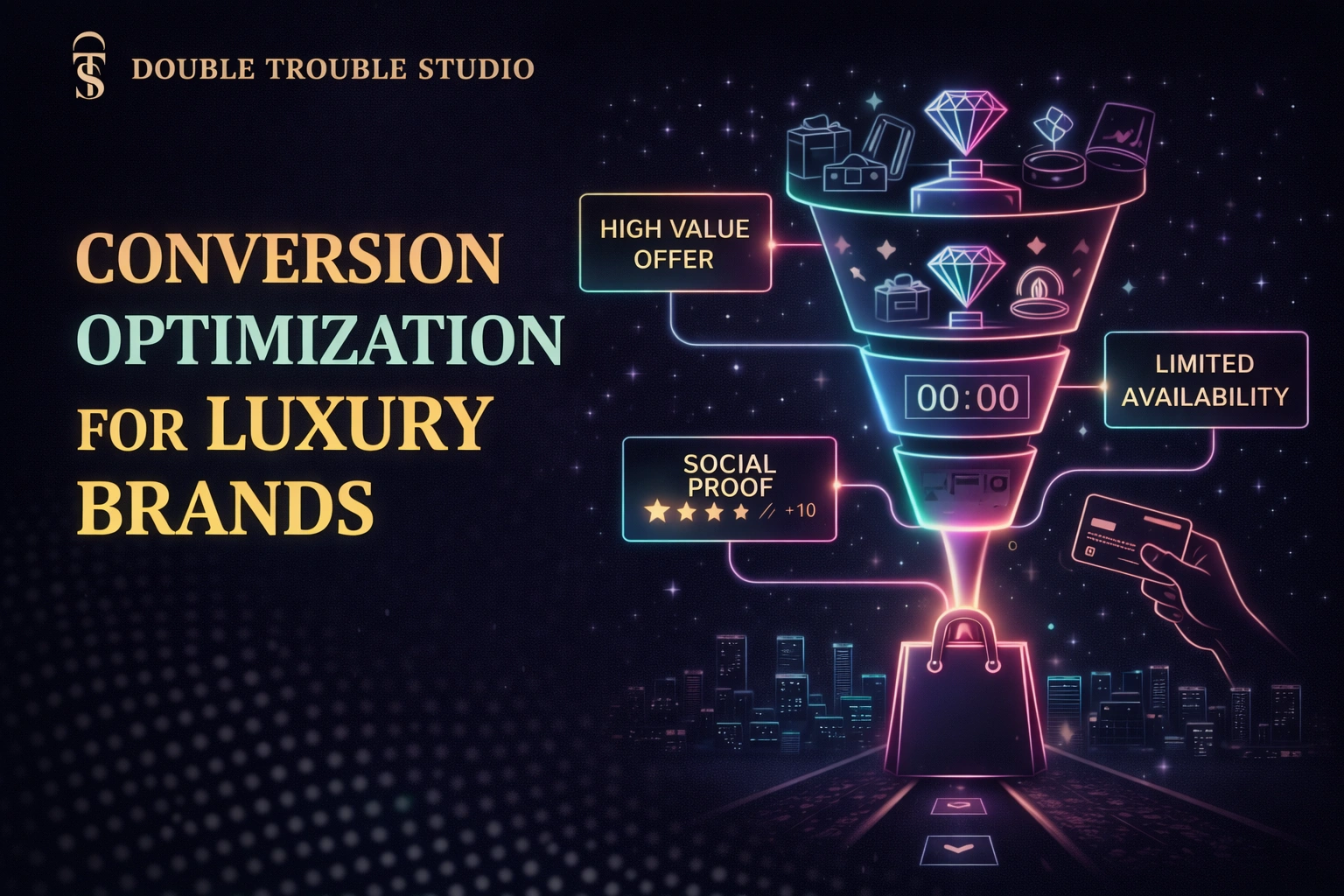
Conversion Optimization for Luxury Brands (High-Ticket Funnel Strategy)
In 2026, conversion optimization for luxury brands cannot be approached using the same frameworks applied to mass-market businesses. Traditional conversion strategies often prioritize speed, urgency, and volume. They are designed to reduce friction, push quick decisions, and maximize transactional efficiency. While this approach works effectively for low to mid-ticket products, it fails to align with the psychology of high-value purchases.
Luxury conversions operate on a completely different foundation.
They are not driven by urgency.
They are driven by trust, perception, and emotional alignment.
When a client considers a high-ticket service, whether it is a premium wedding, luxury event, or high-end brand collaboration, the decision is not immediate. It involves evaluation, validation, and reassurance. The client is not just purchasing a service. They are investing in an experience, a reputation, and a reflection of their own identity.
This changes how conversion must be designed.
Instead of pushing users towards quick actions, luxury funnels must guide them through a structured journey. This journey builds confidence, reinforces positioning, and gradually moves the user from interest to commitment.
Conversion, in this context, is not a single step.
It is a process of alignment.
Understanding High-Ticket Buyer Psychology
The foundation of any effective luxury funnel lies in understanding the psychology of high-ticket buyers. Unlike impulse-driven purchases, high-value decisions involve multiple layers of consideration. Clients evaluate not only the offering but also the credibility of the brand, the consistency of its communication, and the perceived risk associated with the decision.
One of the defining characteristics of luxury buyers is their sensitivity to perception. They are not looking for the lowest price or the fastest solution. They are looking for assurance. They want to feel confident that the brand they choose reflects their standards and aligns with their expectations.
This means that conversion optimization must focus on reducing perceived risk rather than increasing urgency. Trust signals become more important than discounts. Clarity becomes more important than persuasion.
Another important factor is emotional alignment. High-ticket buyers often make decisions based on how a brand makes them feel. Logic supports the decision, but emotion drives it. A website, landing page, or funnel that fails to create emotional resonance will struggle to convert, regardless of how well it is structured.
Time is also a critical element. Luxury buyers do not rush decisions. They may interact with a brand multiple times before taking action. This requires a funnel that supports repeated engagement rather than one-time conversion attempts.
Understanding these psychological factors allows brands to design funnels that feel natural rather than forced.
Rethinking the Funnel: From Linear Conversion to Layered Experience
Traditional funnels are often linear. They guide users from awareness to consideration to conversion in a direct path. While this structure can be effective in certain contexts, it is not sufficient for luxury branding.
Luxury funnels must be layered.
Instead of pushing users through predefined steps, they must provide multiple entry points and allow users to engage at their own pace. Some users may begin with content exploration, while others may arrive with high intent and seek immediate contact.
This requires flexibility in design.
The funnel must accommodate different levels of readiness while maintaining consistency in messaging. Each interaction should reinforce the same positioning, ensuring that the user’s perception remains aligned regardless of where they enter the journey.
Another important aspect of layered funnels is depth. Instead of presenting all information upfront, content should be structured progressively. Initial interactions may focus on brand positioning and storytelling, while deeper layers provide detailed information, case studies, and validation.
This progression mirrors the decision-making process of high-ticket buyers. It allows them to explore the brand gradually, building confidence at each stage.
Conversion is not forced.
It is earned.
Building Trust Through Content and Experience
Trust is the most critical factor in high-ticket conversion.
Without trust, no amount of design optimization or technical refinement can drive meaningful results. Luxury brands must therefore prioritize trust-building at every stage of the funnel.
Content plays a central role in this process. Instead of focusing solely on features or services, content must communicate credibility, expertise, and consistency. Case studies, behind-the-scenes insights, and detailed explanations of processes can help establish authority.
Visual content is equally important. High-quality imagery and video not only enhance aesthetics but also reinforce perception. The style, tone, and consistency of visuals must align with the brand’s positioning.
User experience also contributes to trust. A website that feels smooth, intuitive, and refined creates confidence. Conversely, technical issues, inconsistent design, or unclear navigation can raise doubts.
Another key element is social proof. Testimonials, media coverage, and client experiences provide validation. However, these elements must be presented in a way that feels authentic rather than promotional.
Trust is built through consistency.
Every interaction must reinforce the same message.
Designing High-Ticket Landing Experiences
Landing pages for luxury brands require a different approach compared to standard conversion pages. Instead of aggressive calls-to-action and high-pressure tactics, the focus must be on creating an environment that encourages exploration and engagement.
The first impression is critical. The opening section of the page must communicate positioning immediately. This is achieved through a combination of visuals, typography, and messaging. The user should understand the brand’s value within seconds, without feeling overwhelmed.
As the user scrolls, the content should unfold in a structured manner. Each section should build on the previous one, gradually providing more depth. This creates a narrative flow that keeps the user engaged.
Calls-to-action must be integrated seamlessly. Instead of interrupting the experience, they should feel like a natural next step. For example, an invitation to connect or inquire can be positioned within the flow of content rather than as a separate element.
The design must also account for different user behaviors. Some users may want to explore extensively, while others may be ready to take action quickly. The page should accommodate both without compromising experience.
A high-ticket landing experience is not about pushing conversion.
It is about facilitating it.
Lead Nurturing: Extending the Funnel Beyond the Website
In luxury conversion, the funnel does not end with a website visit. It extends into follow-up interactions, communication, and relationship building.
Lead nurturing plays a critical role in this process. Once a user expresses interest, the brand must continue to engage them in a way that reinforces trust and maintains interest.
This can be achieved through personalized communication, curated content, and thoughtful follow-ups. The tone of communication must remain consistent with the brand’s identity. It should feel professional, refined, and attentive.
Timing is also important. Follow-ups should be timely but not intrusive. The objective is to remain present without creating pressure.
Luxury clients value attention to detail. Personalized interactions, such as addressing specific preferences or referencing previous conversations, can significantly enhance the experience.
Lead nurturing transforms interest into commitment.
It ensures that the relationship continues beyond the initial interaction.
Balancing Exclusivity and Accessibility
One of the most complex aspects of luxury conversion is balancing exclusivity with accessibility. On one hand, the brand must appear selective and premium. On the other hand, it must remain approachable enough for potential clients to engage.
This balance must be reflected in the funnel design.
Content should communicate exclusivity through tone, visuals, and positioning. At the same time, pathways to engagement should be clear and accessible.
For example, inquiry forms, consultation bookings, or contact options should be easy to find but not overly prominent. They should feel like an invitation rather than a demand.
Exclusivity enhances desirability.
Accessibility enables conversion.
The challenge is maintaining both.
Measuring Success Beyond Conversion Rates
In traditional marketing, conversion rates are often the primary metric of success. However, in luxury branding, this metric alone is insufficient.
High-ticket conversions are influenced by multiple factors, including brand perception, trust, and long-term relationships. Metrics such as engagement quality, inquiry value, and client retention provide a more comprehensive understanding of performance.
For example, a lower conversion rate with high-value clients may be more beneficial than a higher conversion rate with lower-value transactions.
This requires a shift in measurement.
Success must be evaluated in context.
Challenges in Luxury Conversion Optimization
Luxury conversion optimization presents unique challenges. One of the most common is over-optimization. Applying aggressive tactics can disrupt the experience and weaken perception.
Another challenge is inconsistency. Misalignment between different touchpoints can create confusion and reduce trust.
There is also the challenge of patience. High-ticket conversions take time, and brands must be willing to invest in long-term strategies.
Addressing these challenges requires a disciplined approach.
Frequently Asked Questions (FAQs)
What is a high-ticket funnel?
Ans: It is a structured conversion process designed for premium services, focusing on trust, experience, and long-term engagement.
How is luxury conversion different from regular conversion?
Ans: Luxury conversion prioritizes perception, trust, and emotional alignment rather than speed and urgency.
What drives high-ticket conversions?
Ans: Trust, brand positioning, and consistent experience are key drivers.
Are traditional funnel tactics effective for luxury brands?
Ans: Not always, as aggressive tactics can weaken premium perception.
How can brands improve luxury conversion rates?
Ans: By focusing on trust-building, refined user experience, and structured lead nurturing.
Conclusion: Conversion as a Process of Alignment
Conversion optimization for luxury brands is not about increasing numbers.
It is about creating alignment.
Every element of the funnel, from initial interaction to final decision, must reinforce the brand’s positioning. Trust must be built gradually, and engagement must feel natural.
In high-ticket environments, conversion is not achieved through pressure.
It is achieved through confidence.
Design Your High-Ticket Funnel Strategy
If you are building a luxury brand or premium service, your conversion strategy must reflect your positioning.
From funnel design and user experience to lead nurturing and performance optimization, our team helps you create systems that convert without compromising perception.
📩 hello@dtsworld.in 📞 +91 80000 06021 📍 Andheri East, Mumbai
👉 Design Your High-Ticket Funnel Strategy