
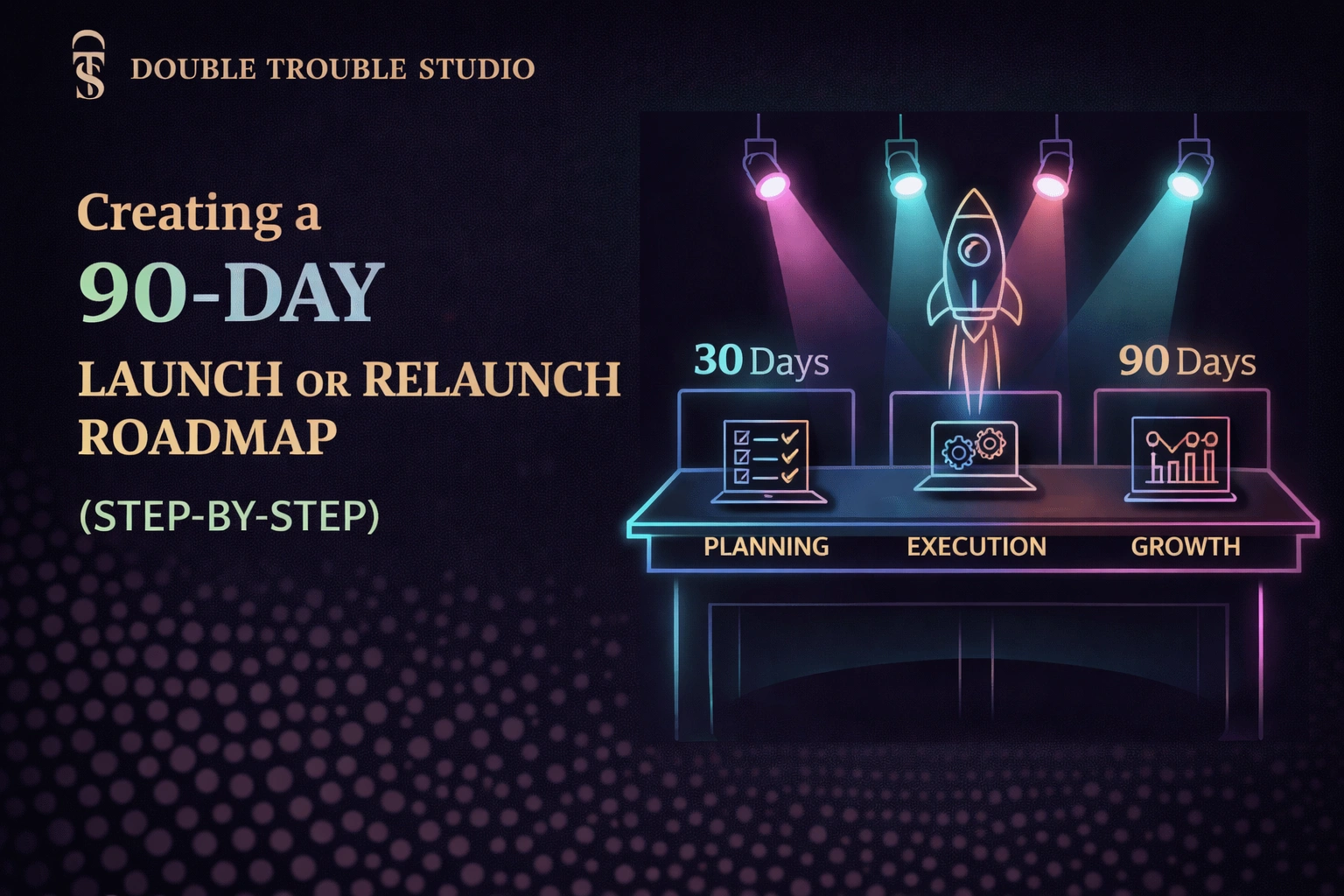
Creating a 90-Day Launch or Relaunch Roadmap (Step-by-Step)
In premium markets, launches are not moments.
They are orchestrated timelines.
Whether it is the introduction of a new brand, the relaunch of an existing identity, or the unveiling of a new product or experience, success is rarely determined by what happens on the launch day alone. It is defined by how strategically the entire journey is structured — before, during, and after the moment of visibility.
In 2026, where attention is fragmented and competition is intense, a launch without a roadmap is not just inefficient.
It is invisible.
A 90-day launch or relaunch roadmap provides the structure required to build anticipation, establish positioning, and sustain momentum. It transforms a single announcement into a layered narrative that unfolds over time, allowing the audience to engage progressively.
For luxury brands, this structure becomes even more critical. Visibility must be controlled. Messaging must be precise. Every interaction must reinforce the brand’s identity.
Because in premium environments, impact is not created through volume.
It is created through timing, sequencing, and consistency.
Understanding the 90-Day Framework as a Strategic Timeline
A 90-day roadmap is not simply a scheduling tool. It is a strategic framework that divides the launch process into distinct phases, each with a specific objective.
The first phase focuses on foundation and anticipation. The second phase centers on visibility and activation. The third phase ensures continuity and reinforcement.
This segmentation allows brands to manage attention effectively. Instead of concentrating all efforts on a single moment, it distributes impact across a defined period.
The structure also provides clarity for internal teams. It aligns creative, marketing, PR, and operational functions around a shared timeline, ensuring that every activity contributes to the overall objective.
In luxury branding, where perception is built gradually, this approach is essential.
A launch is not an announcement.
It is a progression.
Phase One: Strategic Foundation and Pre-Launch Engineering (Days 1–30)
The first 30 days define the foundation of the launch. This phase is often underestimated, as it operates largely behind the scenes. However, it is the most critical stage in determining the success of everything that follows.
At this stage, the focus is not on visibility. It is on clarity.
The brand’s positioning must be fully defined. Messaging frameworks must be established. Visual identity must be aligned. Every element that will be communicated later must first be structured internally.
This includes refining the core narrative. What is being launched? Why does it matter? How should it be perceived?
For relaunches, this phase also involves identifying gaps in the existing brand perception. What needs to change? What must remain consistent? How should the transition be communicated?
Parallel to strategic alignment, content development begins. This includes creating visual assets, video content, campaign materials, and digital platforms. AI-assisted tools may accelerate production, but human oversight ensures that quality and consistency are maintained.
Equally important is internal alignment. Teams must understand the roadmap, their roles, and the sequencing of activities. Without this alignment, execution becomes fragmented.
In premium launches, preparation is not a preliminary step.
It is the defining stage.
Building Anticipation Without Exposure
A key objective of the pre-launch phase is to build anticipation without revealing too much. This requires a controlled approach to visibility.
Teasers, subtle hints, and selective previews can be used to create curiosity. However, these elements must align with the brand’s tone. For luxury brands, subtlety is often more effective than overt promotion.
The goal is not to inform the audience fully, but to create intrigue.
This may involve controlled releases through social platforms, curated interactions with select audiences, or early engagement with influencers and media partners.
Timing is critical. Each interaction should feel intentional, contributing to a growing sense of anticipation.
Anticipation is not built through noise.
It is built through restraint.
Phase Two: Launch Execution and Visibility Amplification (Days 31–60)
The second phase marks the transition from preparation to activation. This is where the brand becomes visible, and the narrative reaches its peak.
However, in a structured roadmap, the launch is not a single event. It is a sequence of coordinated actions that unfold over time.
The initial moment of launch may involve a key announcement, event, or campaign release. This is supported by synchronized activities across digital platforms, PR channels, and experiential touchpoints.
AI-driven content adaptation allows for multiple variations of the core narrative, ensuring that it reaches different audience segments effectively. At the same time, consistency is maintained through centralized creative direction.
PR plays a significant role in this phase. Media coverage, influencer collaborations, and strategic placements extend the reach of the launch. The narrative must remain consistent across all channels, reinforcing the brand’s positioning.
Engagement becomes a focus. Audiences are not just observing the launch. They are interacting with it.
Every interaction must be designed to reinforce perception.
Because in premium launches, visibility alone is not enough.
It must translate into understanding.
Managing Momentum During the Launch Window
One of the most common mistakes in launch strategies is treating the launch moment as the peak, followed by a decline in activity. In a 90-day roadmap, momentum is sustained throughout the second phase.
Content is released in stages, ensuring that the narrative continues to evolve. Different aspects of the brand or offering are highlighted progressively, maintaining audience interest.
For example, an initial announcement may focus on the overarching concept, followed by deeper explorations of features, experiences, or stories.
This layered approach prevents saturation. It keeps the audience engaged without overwhelming them.
Momentum is not maintained through repetition.
It is maintained through progression.
Phase Three: Post-Launch Consolidation and Long-Term Positioning (Days 61–90)
The final phase of the roadmap focuses on consolidation. While the initial excitement of the launch may have subsided, this stage is critical in ensuring that the brand’s positioning is reinforced.
Content during this phase shifts from introduction to validation. Testimonials, case studies, and behind-the-scenes narratives provide depth. They transform initial impressions into sustained perception.
Engagement continues through curated interactions. Events, collaborations, and community-building activities extend the brand’s presence beyond the launch window.
For relaunches, this phase is particularly important. It ensures that the new positioning is understood and accepted by the audience.
Consistency becomes the priority. Every interaction must reinforce the same identity.
Because perception is not established in a moment.
It is reinforced over time.
Integrating Digital, PR, and Experiential Channels
A successful 90-day roadmap integrates multiple channels into a cohesive system. Digital platforms, PR activities, and experiential elements must work together.
Digital platforms provide continuous visibility. PR extends credibility. Experiences create emotional connection.
AI tools enable efficient content distribution and adaptation, ensuring that each channel receives content tailored to its context. However, the underlying narrative must remain consistent.
Integration ensures that the audience experiences the brand as a unified entity, regardless of where they encounter it.
Fragmentation weakens impact.
Integration strengthens it.
Adapting the Roadmap for Launch vs Relaunch
While the structure of a 90-day roadmap remains consistent, its application differs between launches and relaunches.
A new launch focuses on introduction. It builds awareness from the ground up, establishing identity and presence.
A relaunch focuses on transformation. It must communicate change while retaining existing recognition.
This requires careful balance. Too much change can create confusion. Too little change may fail to achieve the desired impact.
The roadmap must account for this difference, adjusting messaging, content, and sequencing accordingly.
Strategy is not fixed.
It is contextual.
Challenges in Execution and How to Manage Them
Even with a structured roadmap, execution presents challenges. Timing misalignment, content delays, and inconsistent messaging can disrupt the flow.
Managing these challenges requires flexibility. The roadmap must be treated as a guide, not a rigid structure. Adjustments may be necessary based on audience response and external factors.
However, flexibility must not compromise consistency. Core messaging and positioning must remain intact.
Execution is not just about following a plan.
It is about maintaining alignment.
Frequently Asked Questions (FAQs)
What is a 90-day launch roadmap?
Ans: It is a structured plan that divides a launch or relaunch into phases, ensuring strategic preparation, execution, and post-launch reinforcement.
Why is a 90-day timeline effective?
Ans: It allows brands to build anticipation, manage visibility, and sustain momentum over a defined period.
What is the most important phase in the roadmap?
Ans: The pre-launch phase is critical, as it defines the foundation and alignment for the entire launch.
Can this roadmap be used for relaunches?
Ans: Yes, but it must be adapted to communicate transformation while maintaining brand recognition.
How do luxury brands approach launches differently?
Ans: They focus on controlled visibility, precise messaging, and consistent perception rather than high-volume promotion.
Conclusion: Launching as a Controlled Narrative
A successful launch or relaunch is not defined by a single moment of attention. It is defined by how effectively a narrative is introduced, expanded, and reinforced over time.
The 90-day roadmap provides the structure to achieve this. It transforms a launch from a reactive activity into a strategic process.
For luxury brands, this structure ensures that every interaction contributes to a cohesive perception. It allows visibility to be managed, messaging to be controlled, and identity to be reinforced.
Because in premium markets, success is not about being seen once.
It is about being understood consistently.
Design Your Launch Roadmap
If you are planning a brand launch, relaunch, or high-impact campaign, a structured roadmap ensures clarity, alignment, and sustained visibility.
From pre-launch strategy and content development to launch execution and post-launch consolidation, our team ensures that your brand is introduced with precision and reinforced with consistency.
📩 hello@dtsworld.in 📞 +91 80000 06021 📍 Andheri East, Mumbai
👉 Design Your 90-Day Launch Strategy