
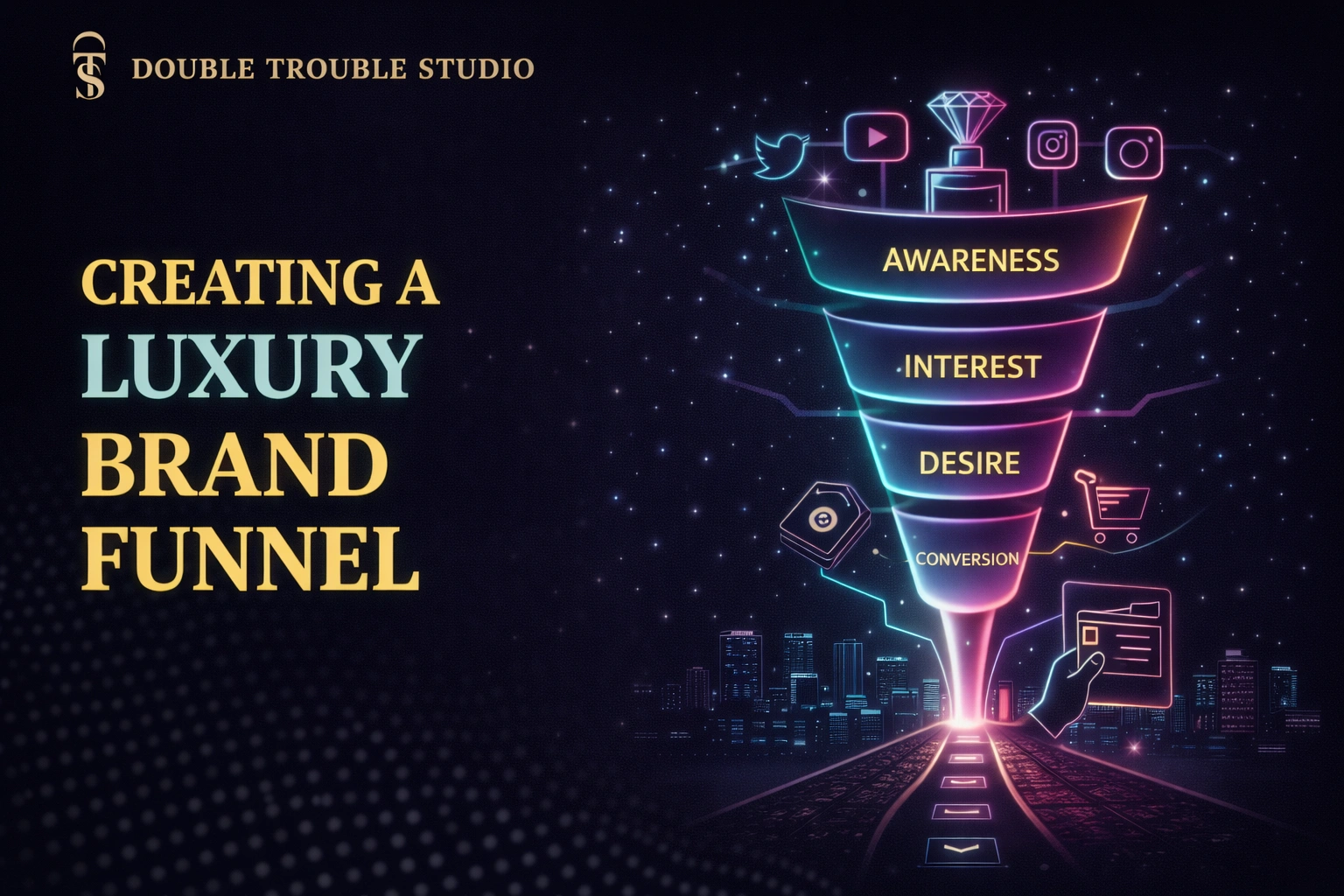
Creating a Luxury Brand Funnel (Awareness to Conversion Strategy)
In 2026, the concept of a marketing funnel has evolved significantly, particularly for luxury brands where traditional models of awareness, interest, and conversion do not operate in a linear or transactional manner. While conventional funnels are designed to move users quickly toward a purchase decision, luxury brand funnels function as layered ecosystems that guide perception, build trust, and create emotional alignment over time. The objective is not immediate conversion but controlled progression, where each stage reinforces the brand’s positioning and gradually reduces hesitation.
A luxury funnel must therefore be understood not as a sequence of steps, but as a carefully structured journey. This journey begins with awareness, where the brand establishes its presence and identity, and continues through consideration, where trust and credibility are developed, ultimately leading to conversion, where the client commits with confidence. Each stage must be designed with precision, ensuring that the experience feels cohesive, refined, and aligned with premium expectations.
Because in luxury branding, conversion is not driven by urgency.
It is driven by assurance.
Awareness: Establishing Presence Without Diluting Exclusivity
The awareness stage is the first point of interaction between the brand and its potential audience, and it plays a critical role in shaping perception. Unlike mass-market brands that rely on broad visibility and frequent exposure, luxury brands must approach awareness with restraint. The goal is not to be seen everywhere but to be seen in the right context.
This requires a strategic approach to visibility. Channels such as curated social media platforms, high-end publications, and selective collaborations allow the brand to maintain its exclusivity while reaching relevant audiences. The content used in this stage must focus on storytelling rather than promotion. It should communicate the brand’s identity, values, and aesthetic in a way that feels aspirational and authentic.
Visual consistency is particularly important during awareness. High-quality imagery, refined design, and cohesive styling contribute to a strong first impression. The audience should immediately recognize the brand’s positioning without requiring explicit explanation.
Another key element of awareness is narrative clarity. The brand must communicate what it represents and who it is for. This does not mean listing services or features. It means creating a perception that aligns with the expectations of a premium audience. The messaging should be subtle yet distinct, allowing the audience to form an understanding without feeling directed.
Awareness in luxury branding is not about capturing attention quickly.
It is about creating interest that feels intentional.
Consideration: Building Trust Through Depth and Consistency
Once awareness is established, the funnel moves into the consideration stage, where potential clients begin to evaluate the brand more closely. This stage is critical because it determines whether initial interest will develop into meaningful engagement.
In luxury branding, consideration is driven by trust. Clients need to feel confident that the brand can deliver on its promises and that it aligns with their expectations. This requires a combination of content, experience, and validation.
Content during this stage must provide depth. Detailed case studies, behind-the-scenes insights, and comprehensive explanations of processes help establish credibility. Instead of generic descriptions, the brand should demonstrate expertise and attention to detail.
User experience also plays a significant role. The website, landing pages, and digital interactions must feel seamless and refined. Navigation should be intuitive, content should be structured logically, and the overall experience should reflect the brand’s identity.
Social proof is another important factor. Testimonials, client experiences, and media features provide validation. However, these elements must be presented carefully. In luxury branding, quality matters more than quantity. A few well-curated examples can be more effective than an extensive list.
Consistency across touchpoints is essential. The brand’s tone, visuals, and messaging must remain aligned across all platforms. Any inconsistency can create doubt and weaken trust.
Consideration is not about persuasion.
It is about reassurance.
Engagement: Creating Interaction Without Pressure
Between consideration and conversion lies a critical stage that is often overlooked in traditional funnels: engagement. This stage involves creating meaningful interactions that deepen the relationship between the brand and the potential client.
Engagement in luxury funnels must be designed carefully. Unlike aggressive marketing tactics that push users toward immediate action, luxury engagement should feel natural and unobtrusive. The objective is to provide opportunities for interaction without creating pressure.
This can be achieved through personalized communication, curated content, and interactive experiences. For example, inquiry forms, consultation options, and direct communication channels should be accessible but not intrusive. They should feel like invitations rather than demands.
Email communication and follow-ups also play a role in engagement. These interactions must be tailored to the individual, reflecting their interests and preferences. Generic messaging can reduce the sense of personalization and weaken the connection.
Events and exclusive experiences can further enhance engagement. Whether digital or physical, these interactions allow the brand to demonstrate its value in a more immersive way.
Engagement is where interest becomes connection.
It transforms passive awareness into active consideration.
Conversion: Facilitating Decisions Through Confidence
The conversion stage in a luxury funnel is fundamentally different from that of a mass-market funnel. It is not about creating urgency or pushing users toward a quick decision. Instead, it is about facilitating a decision that feels confident and informed.
High-ticket conversions require a sense of assurance. Clients need to feel that they are making the right choice, and this confidence must be supported by the entire funnel. Every interaction leading up to this stage contributes to the final decision.
The conversion process itself must be seamless. Whether it involves booking a consultation, submitting an inquiry, or completing a transaction, the experience should be smooth and intuitive. Any friction can create hesitation.
Communication during this stage is critical. Clear information, responsive support, and professional interaction reinforce trust. The tone should remain consistent with the brand’s identity, ensuring that the experience feels premium.
It is also important to avoid aggressive tactics. Discounts, countdowns, and high-pressure messaging can undermine the brand’s positioning. Luxury clients value discretion and control, and the conversion process should reflect these values.
Conversion is not the result of a single interaction.
It is the culmination of the entire journey.
Post-Conversion: Extending the Funnel Beyond the Transaction
In luxury branding, the funnel does not end with conversion. Post-conversion interactions play a crucial role in building long-term relationships and reinforcing brand loyalty.
After a client commits, the brand must continue to deliver a consistent experience. Communication should remain professional and attentive, ensuring that the client feels valued. Updates, follow-ups, and personalized interactions contribute to this experience.
Post-conversion engagement also creates opportunities for advocacy. Satisfied clients are more likely to recommend the brand and share their experiences. This organic promotion is particularly valuable in luxury markets, where word-of-mouth carries significant influence.
Feedback is another important aspect. Understanding client experiences allows the brand to refine its processes and improve future interactions.
The funnel, therefore, becomes cyclical.
Each stage influences the next.
Integrating the Funnel into a Cohesive System
A luxury brand funnel is not a collection of isolated stages. It is a cohesive system where each component supports the others. Awareness, consideration, engagement, and conversion must be aligned to create a seamless experience.
This requires a unified strategy. Brand positioning, messaging, and visual identity must remain consistent across all stages. AI and data tools can support this integration by providing insights and maintaining consistency, but human oversight is essential to ensure alignment.
Integration also involves collaboration across teams. Marketing, design, sales, and customer experience must work together to deliver a unified journey.
A well-integrated funnel creates clarity.
It ensures that every interaction contributes to the same perception.
Challenges in Building Luxury Funnels
Designing a luxury funnel involves several challenges. One of the most common is applying mass-market tactics to premium contexts. Aggressive strategies can disrupt the experience and weaken positioning.
Another challenge is inconsistency. Misalignment between different stages can create confusion and reduce trust.
There is also the challenge of patience. Luxury funnels require time to develop and refine. Immediate results are less important than long-term effectiveness.
Addressing these challenges requires discipline and strategic clarity.
Frequently Asked Questions (FAQs)
What is a luxury brand funnel?
Ans: It is a structured journey that guides potential clients from awareness to conversion while maintaining premium positioning.
How is it different from a regular funnel?
Ans: It focuses on trust, experience, and long-term engagement rather than quick conversions.
What drives conversion in luxury funnels?
Ans: Confidence, credibility, and emotional alignment are key drivers.
Is awareness important for luxury brands?
Ans: Yes, but it must be controlled to maintain exclusivity.
Can luxury funnels use digital tools?
Ans: Yes, but they must be integrated carefully to preserve brand identity.
Conclusion: Conversion Through Experience
Creating a luxury brand funnel is not about optimizing steps.
It is about designing experiences.
Each stage of the funnel must contribute to a cohesive journey that builds trust, reinforces positioning, and guides the client toward a confident decision. Awareness creates interest, consideration builds trust, engagement deepens connection, and conversion finalizes the relationship.
In premium markets, success is not defined by how quickly users convert.
It is defined by how confidently they choose.
Design Your Luxury Brand Funnel
If you are building a premium brand or service, your funnel must reflect your positioning.
From awareness strategy and content design to engagement systems and conversion optimization, our team helps you create structured funnels that deliver results without compromising exclusivity.
📩 hello@dtsworld.in 📞 +91 80000 06021 📍 Andheri East, Mumbai
👉 Design Your Luxury Funnel Strategy