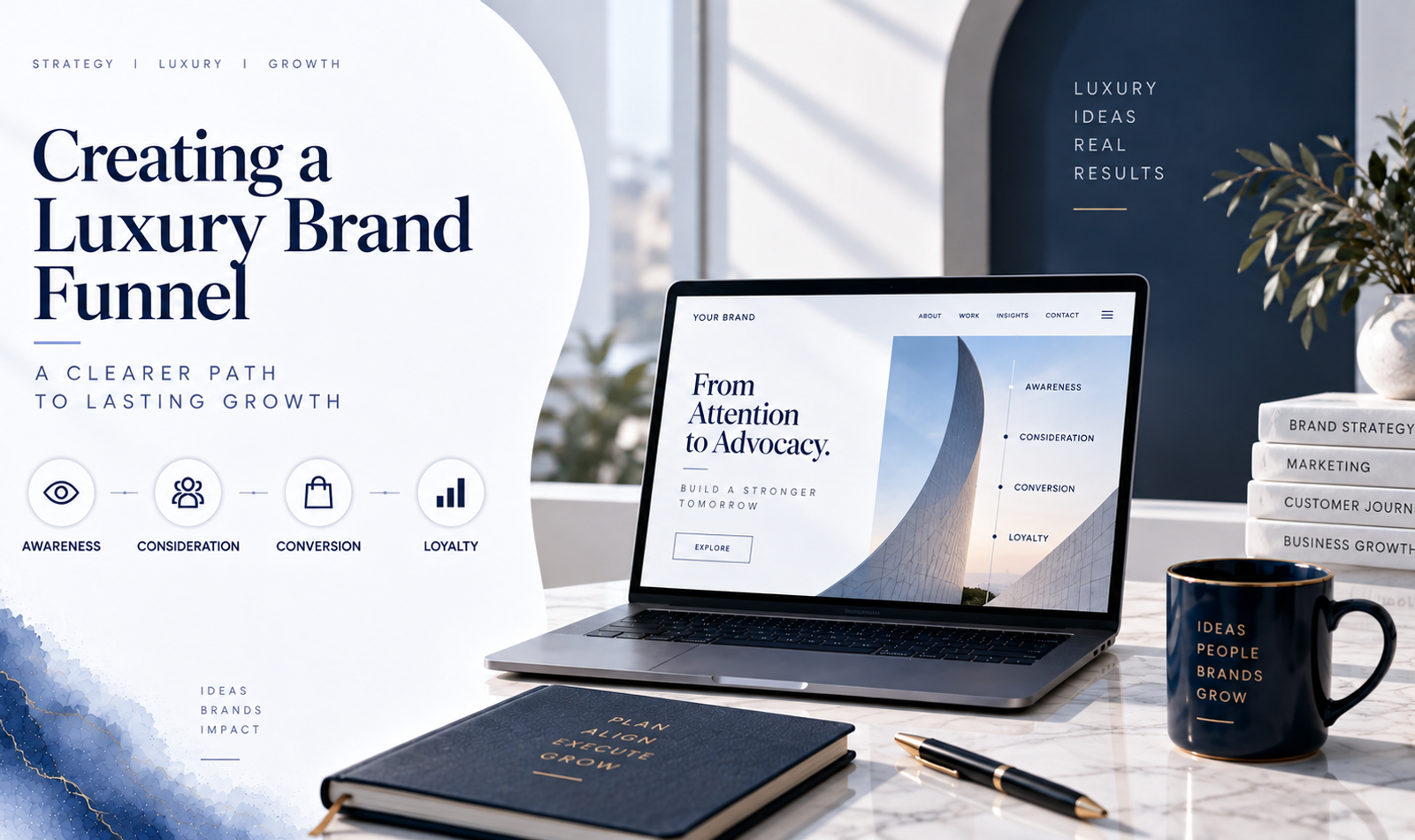
Creating a Luxury Brand Funnel: Awareness to Conversion Strategy
Luxury customers rarely discover a premium brand and purchase immediately.
A customer considering a luxury hotel, premium automobile, designer label, high-end real estate project, destination wedding service or exclusive lifestyle experience usually moves through several stages before making a decision.
They may first discover the brand through Instagram.
Later, they may see a media feature.
They may search for the brand on Google, visit its website, explore its work, watch videos, read reviews, compare alternatives, speak with a representative and finally decide whether the experience justifies the price.
Every interaction influences perception.
This journey is the luxury brand funnel.
A traditional marketing funnel often focuses on moving as many people as possible from awareness to purchase.
Luxury marketing requires a different approach.
The objective is not simply:
More Reach → More Leads → More Sales
A luxury funnel needs to create:
Awareness → Desire → Credibility → Consideration → Trust → Personalised Experience → Conversion → Loyalty → Advocacy
The customer must feel that the brand is desirable before being asked to buy.
This guide explains how to create a luxury brand funnel that connects positioning, PR, social media, content, influencers, events, websites, paid media, customer experience and conversion strategy.
What Is a Luxury Brand Funnel?
A luxury brand funnel is the structured customer journey that moves a potential buyer from discovering a premium brand to trusting, purchasing and eventually advocating for it.
The stages typically include:
Awareness
The customer discovers the brand.
↓
Interest
Something about the brand creates curiosity.
↓
Desire
The customer begins to value what the brand represents.
↓
Consideration
The customer explores the offering more seriously.
↓
Trust
The customer looks for evidence that the brand can deliver its promise.
↓
Conversion
The customer takes a meaningful commercial action.
↓
Experience
The actual product or service must validate the brand promise.
↓
Loyalty
A positive experience creates repeat preference.
↓
Advocacy
Satisfied customers recommend or publicly associate themselves with the brand.
The exact journey varies by category.
A ₹15,000 premium product may have a relatively short funnel.
A luxury property, premium automobile, destination wedding or high-value professional service may require weeks or months of consideration.
The higher the price, complexity and perceived risk, the more important the middle of the funnel becomes.
Why Luxury Marketing Funnels Are Different
Luxury customers are not purchasing functionality alone.
They may also be purchasing:
status,
identity,
design,
craftsmanship,
access,
convenience,
personalisation,
heritage,
service,
experience,
or emotional meaning.
This changes how the funnel should work.
A mass-market funnel may emphasise:
Price → Offer → Urgency → Purchase
A luxury funnel is more likely to emphasise:
Perception → Desire → Credibility → Experience → Trust → Purchase
Discount-driven conversion tactics can sometimes damage premium positioning.
For luxury brands, the customer should understand why the brand deserves its premium before being pushed toward a transaction.
This is why luxury brand positioning strategy should be established before aggressively scaling marketing.
The Luxury Brand Funnel at a Glance
A practical luxury funnel can be divided into seven stages:
Stage 1 — Awareness
Objective: Become known by the right audience.
Stage 2 — Interest
Objective: Give people a reason to explore the brand.
Stage 3 — Desire
Objective: Build emotional and aspirational value.
Stage 4 — Consideration
Objective: Help potential customers understand the offering and differentiation.
Stage 5 — Trust
Objective: Reduce uncertainty through authority, proof and experience.
Stage 6 — Conversion
Objective: Make the next step effortless, premium and personal.
Stage 7 — Loyalty & Advocacy
Objective: Turn customers into repeat buyers and brand advocates.
Every marketing channel should have a defined role within these stages.
Stage 1: Building Luxury Brand Awareness
The first challenge is simple:
The right people need to know that your brand exists.
But luxury awareness should not be confused with maximum exposure.
A premium brand does not necessarily need everyone to know it.
It needs visibility among:
potential customers,
relevant communities,
media,
industry leaders,
influencers,
partners,
and cultural tastemakers.
The objective is qualified awareness.
PR for Luxury Brand Awareness
PR can be particularly powerful at the top of a luxury funnel because premium purchases are influenced by credibility.
A customer may interpret:
“the brand says it is premium”
very differently from:
“a respected publication considers this brand worth covering.”
PR can help establish:
authority,
relevance,
founder credibility,
brand story,
and cultural visibility.
Potential PR angles include:
brand launches,
founder stories,
design philosophy,
industry insights,
innovation,
collaborations,
new collections,
milestones,
and experiential campaigns.
Businesses building this layer can explore DTS's PR and media marketing services.
Social Media for Luxury Brand Discovery
Instagram, LinkedIn, YouTube and other platforms can introduce customers to the brand repeatedly.
But luxury social media should not become an endless catalogue.
Content should create a world around the brand.
That world may communicate:
craftsmanship,
design,
lifestyle,
people,
process,
culture,
expertise,
exclusivity,
and experience.
A customer should begin recognising the brand before being asked to purchase.
This creates mental availability.
When the customer eventually needs the category, the brand already exists in their consideration set.
Influencer and Creator Discovery
Creators can introduce luxury brands to established communities.
However, follower count alone should not determine creator selection.
Luxury brands should evaluate:
audience relevance,
creator credibility,
visual compatibility,
content quality,
engagement quality,
reputation,
and brand alignment.
The objective is not simply:
“How many people will see this?”
It is:
“What will people think about our brand because this person is associated with us?”
DTS's guide to influencer marketing for luxury brands explains creator selection, campaigns and ROI in greater detail.
Paid Media for Luxury Awareness
Paid advertising can extend brand visibility beyond organic audiences.
But premium advertising should protect perception.
Poorly designed ads can weaken the brand even if they generate cheap clicks.
Luxury advertising should maintain:
strong art direction,
high-quality imagery,
consistent typography,
controlled messaging,
premium landing experiences,
and relevant targeting.
Paid media should amplify the brand identity rather than create a completely different commercial identity.
Stage 2: Turning Awareness Into Interest
Awareness alone has limited value.
A person can recognise a brand without caring about it.
The next stage therefore asks:
Why should the customer explore further?
Interest is created when the brand communicates something relevant, distinctive or desirable.
This could be:
an unusual design philosophy,
exceptional craftsmanship,
exclusive access,
a strong founder story,
superior service,
personalisation,
innovation,
or a compelling experience.
Use Storytelling Instead of Constant Selling
Luxury brands need stories.
A customer may want to know:
Who created this?
Why does it exist?
What inspired the design?
How is it made?
Who is it for?
Why is it different?
What does ownership or participation feel like?
This is where content becomes important.
Strong brand storytelling gives the product meaning beyond its specifications.
A ₹500 object and a ₹50,000 object may perform the same basic function.
The premium often comes from everything surrounding the object:
design,
materials,
story,
service,
scarcity,
reputation,
and cultural meaning.
Build a Recognisable Brand Narrative
The strongest brands repeatedly communicate a small number of meaningful ideas.
They do not reinvent their identity every week.
The brand narrative should connect:
website,
PR,
social media,
advertising,
events,
sales communication,
and customer experience.
This consistency helps customers understand what the brand stands for.
DTS's guide to building a brand narrative through story-led PR explains how a consistent narrative can strengthen communication across channels.
Stage 3: Creating Desire
Interest is rational curiosity.
Desire is emotional.
Luxury brands need both.
A customer should not only understand the offering.
They should begin imagining themselves experiencing it.
That may mean:
driving the automobile,
wearing the collection,
staying at the resort,
living in the property,
attending the event,
or receiving the service.
This is why luxury marketing relies heavily on visual storytelling and experience.
Visual Identity Creates Perceived Value
Every visual element contributes to perceived quality.
These include:
photography,
video,
typography,
colour,
layout,
packaging,
website design,
social media,
advertising,
and physical environments.
If the product is premium but the communication looks ordinary, the customer receives conflicting signals.
Luxury marketing requires visual consistency across the funnel.
Use Video to Create Experience Before Purchase
Video is especially effective for products and services where atmosphere matters.
A premium hospitality brand can show:
arrival,
interiors,
service,
food,
landscape,
and guest experience.
A luxury automobile company can show:
design,
interior detail,
movement,
comfort,
and chauffeur service.
A wedding company can show:
venue transformation,
guest arrival,
entertainment,
design,
and emotional moments.
AI is also expanding what brands can produce visually. Businesses exploring new production models can review DTS's AI video production for luxury brands.
For campaign execution, DTS also offers dedicated AI Video & VFX services.
Use Events to Create Physical Desire
Luxury is often easier to understand through experience than explanation.
Events can allow customers to:
touch,
taste,
wear,
drive,
experience,
or interact with the brand.
Examples include:
private previews,
product launches,
fashion presentations,
tasting experiences,
VIP dinners,
test-drive events,
destination experiences,
and invitation-only gatherings.
A well-designed event can move customers from awareness to desire very quickly because they experience the brand physically.
DTS's guide to luxury product launch events explains how brands can create launches designed around experience rather than simple product display.
Stage 4: Moving Customers Into Consideration
At this point, the customer knows the brand and finds it attractive.
Now they begin asking practical questions.
Why should I choose this brand?
What exactly am I getting?
Is it worth the premium?
Can I trust them?
What do previous customers say?
How does it compare with alternatives?
This is the consideration stage.
The marketing strategy now needs to provide information without destroying the emotional appeal created earlier.
Your Website Becomes Critical
Social media may create discovery.
PR may create authority.
Advertising may create traffic.
But the website often becomes the place where customers evaluate the brand more seriously.
A luxury website should communicate:
positioning,
offering,
proof,
visual quality,
expertise,
experience,
and next steps.
It should also be:
fast,
mobile-friendly,
easy to navigate,
visually consistent,
and technically reliable.
Poor website design creates doubt.
If the brand promises premium service but the website feels outdated, slow or confusing, the digital experience contradicts the positioning.
DTS's web development and marketing services focus on building websites that support both brand experience and business conversion.
Luxury Website UX Should Reduce Friction
Luxury does not mean complicated.
In many cases, the opposite is true.
Premium digital experiences should feel effortless.
A visitor should quickly understand:
who the brand is,
what it offers,
why it is different,
and what to do next.
DTS's guide to luxury website UX principles explains how minimalism, speed and emotional design can strengthen premium digital experiences.
Use Content to Answer High-Intent Questions
During consideration, customers often search for more detailed information.
This creates opportunities for:
blogs,
guides,
comparisons,
FAQs,
case studies,
videos,
and service pages.
For example, someone considering a luxury event partner may search:
How much does a luxury event cost?
How should VIP guests be managed?
How do celebrity appearances work?
What should a destination wedding timeline include?
Useful content answers these questions before the sales conversation.
It also allows the brand to demonstrate expertise.
Stage 5: Building Trust
Luxury customers may be willing to pay more.
But they usually expect greater certainty in return.
Trust therefore becomes one of the most important stages in the funnel.
Trust can come from multiple sources.
Media Authority
Features in respected publications.
Social Proof
Testimonials, reviews and customer experiences.
Case Studies
Evidence that the brand has delivered similar work.
Founder Authority
A credible person associated with the business.
Partnerships
Associations with respected brands or individuals.
Website Quality
A professional digital experience.
Consistency
The same quality and positioning across every touchpoint.
Responsiveness
Professional communication when the customer makes contact.
No single trust signal creates the entire effect.
Trust accumulates.
Use Case Studies to Reduce Purchase Risk
A case study answers:
“Can this company actually deliver what it promises?”
Strong case studies can show:
the challenge,
approach,
execution,
and result.
They are particularly important for:
agencies,
event companies,
hospitality,
real estate,
automotive services,
and other high-value categories.
Potential customers can also explore DTS's selected work to see how experience and execution can be presented as part of a brand's trust-building journey.
Founder-Led Authority
For many premium service businesses, customers are also evaluating the people behind the company.
Founder communication can strengthen trust through:
expert commentary,
interviews,
articles,
LinkedIn,
industry events,
and media features.
A credible founder can become a trust bridge between an unfamiliar brand and a cautious customer.
The founder PR and personal branding strategy explains how business leaders can build authority without turning every communication into self-promotion.
Stage 6: Converting Luxury Customers
Conversion is where many brands make a major mistake.
After spending months building a premium identity, they suddenly use aggressive tactics:
BUY NOW!
LIMITED OFFER!
50% OFF!
LAST CHANCE!
These approaches may work in some categories.
But they can also undermine luxury perception.
Luxury conversion should feel like a continuation of the premium experience.
Create a High-Touch Conversion Experience
Depending on the category, the conversion action might be:
Book a private consultation.
Schedule a viewing.
Request an appointment.
Speak with a specialist.
Book a test drive.
Request a proposal.
Reserve an experience.
Join a private preview.
The CTA should match the purchase behaviour.
A customer buying a high-value service may not be ready for:
Buy Now
But they may be comfortable with:
Request a Private Consultation
Reduce Form Friction
Do not ask customers for unnecessary information.
A lead form should collect what is required to begin the conversation.
For example:
Name
Contact information
Service interest
Location
Timeline
Message
Additional information can be collected later.
A complicated form creates friction before the relationship even begins.
Response Time Matters
Imagine a customer has spent several weeks considering a premium service.
They finally submit an enquiry.
Then nothing happens for two days.
The funnel has failed at the most important moment.
High-value leads should be:
captured,
organised,
assigned,
and followed up
efficiently.
The digital journey should connect:
Website → Lead Capture → CRM → Sales → Follow-Up
This is why conversion architecture matters alongside branding.
DTS's guide to building conversion-focused marketing funnels explains how websites can be structured around customer action rather than traffic alone.
Personalisation at the Conversion Stage
Premium customers often expect personal attention.
Personalisation can include:
relevant recommendations,
tailored proposals,
private consultations,
custom packages,
dedicated relationship managers,
and contextual follow-ups.
The customer should feel understood.
However, personalisation should be based on legitimate information provided by the customer or appropriately collected through the relationship.
Luxury personalisation should feel thoughtful rather than intrusive.
High-Ticket Conversion Is Often Assisted Conversion
Many premium purchases do not happen through a completely automated funnel.
Digital marketing may create the opportunity.
A person closes it.
For example:
Instagram → Website → Enquiry → Consultation → Proposal → Follow-Up → Purchase
or:
PR Article → Google Search → Website → Case Study → Meeting → Conversion
This is why attribution can become complicated.
The final conversion may have multiple influences.
Luxury brands should therefore analyse the complete customer journey, not only the final click.
Retargeting in a Luxury Brand Funnel
Not every interested customer converts immediately.
Retargeting can help maintain visibility among people who have already interacted with the brand.
Potential audiences include:
website visitors,
video viewers,
social engagers,
product viewers,
and previous leads.
Retargeting creative should not simply repeat:
BUY NOW
Instead, it can introduce additional trust.
For example:
case study,
customer story,
media feature,
product detail,
behind-the-scenes content,
or founder expertise.
This moves the customer forward rather than simply repeating the same message.
Luxury Funnel Content by Stage
Different stages require different content.
Awareness Content
Purpose: Get noticed
Examples:
PR,
Reels,
creator collaborations,
brand films,
paid awareness campaigns,
event visibility.
Interest Content
Purpose: Create curiosity
Examples:
brand stories,
founder content,
behind-the-scenes,
design philosophy,
educational content.
Desire Content
Purpose: Create aspiration
Examples:
cinematic films,
editorial photography,
experiential content,
customer lifestyle storytelling,
events.
Consideration Content
Purpose: Explain value
Examples:
service pages,
product pages,
blogs,
guides,
FAQs,
comparisons.
Trust Content
Purpose: Reduce risk
Examples:
case studies,
testimonials,
reviews,
media features,
credentials,
partnerships.
Conversion Content
Purpose: Enable action
Examples:
consultation pages,
enquiry forms,
booking systems,
proposals,
sales communication.
Loyalty Content
Purpose: Strengthen relationship
Examples:
private updates,
exclusive invitations,
personalised communication,
VIP experiences.
Integrating PR, Social Media, Website and Events
A strong luxury funnel does not operate through isolated channels.
Consider this customer journey:
Step 1
The customer discovers the brand through an influencer.
Step 2
They follow the Instagram page.
Step 3
A week later, they see a media article.
Step 4
They search for the brand on Google.
Step 5
They visit the website.
Step 6
They read a case study.
Step 7
They see an event invitation.
Step 8
They attend the event.
Step 9
They speak with a representative.
Step 10
They make an enquiry.
Which channel generated the customer?
The answer is:
the ecosystem.
This is why luxury marketing works best when PR, social, digital and experiential marketing reinforce one another.
Integrating Events Into the Luxury Funnel
Events can influence several funnel stages simultaneously.
Before the event:
Awareness
Invitations, PR and social promotion generate attention.
During the event:
Desire + Trust
Guests physically experience the brand.
After the event:
Consideration + Conversion
Content, follow-ups and media coverage extend the experience.
A single premium event can therefore generate:
customer relationships,
social content,
media coverage,
influencer content,
brand films,
sales opportunities,
and long-term digital assets.
This makes events particularly valuable within luxury marketing.
Integrating PR Into the Funnel
PR can influence more than awareness.
At the top of the funnel, PR creates discovery.
In the middle, it creates credibility.
Near conversion, media coverage can become a trust signal.
A brand featured in respected media can reuse that visibility through:
website sections,
social media,
sales decks,
email,
and investor communication.
This multiplies the value of each media feature.
Luxury brands can explore DTS's guide to digital PR vs traditional PR for luxury brands to understand how modern PR can support both authority and online visibility.
Integrating SEO Into the Luxury Funnel
Search behaviour often appears during the middle and bottom of the funnel.
A customer may discover a brand socially but later search:
the brand name,
reviews,
service details,
pricing information,
comparisons,
or category questions.
SEO helps the brand appear during these moments.
Luxury SEO should therefore include:
brand search visibility,
service pages,
category content,
educational articles,
location pages,
technical SEO,
and authority-building content.
DTS's guide to SEO for luxury brands explains how search visibility can support premium positioning without turning luxury communication into keyword-heavy content.
Luxury Funnel Strategy for High-Ticket Services
High-ticket services require deeper consideration.
Examples include:
luxury weddings,
premium events,
high-end website projects,
brand consulting,
real estate,
private travel,
and celebrity management.
A useful funnel may look like:
Educational Content
↓
Brand Discovery
↓
Website
↓
Case Study
↓
Consultation
↓
Custom Proposal
↓
Relationship Building
↓
Conversion
The purpose of marketing is not necessarily to complete the sale automatically.
It is to create a qualified sales conversation.
Luxury Funnel Strategy for Products
Luxury product funnels may look slightly different.
For example:
Creator Discovery
↓
Brand Social
↓
Product Story
↓
Website
↓
Product Exploration
↓
Reviews / Press / Social Proof
↓
Purchase
↓
Packaging & Delivery Experience
↓
Repeat Purchase
↓
Advocacy
The physical experience after conversion becomes extremely important because it determines whether the premium promise was real.
Luxury Funnel Strategy for Hospitality
Hospitality is highly experiential.
The funnel might include:
Instagram / Travel Content
↓
PR / Creator Recommendation
↓
Website
↓
Rooms / Experience Exploration
↓
Reviews
↓
Booking
↓
Pre-Arrival Communication
↓
On-Property Experience
↓
Post-Stay Follow-Up
↓
Repeat Visit / Recommendation
Here, the funnel continues far beyond booking.
The actual guest experience determines future marketing performance.
Luxury Funnel Strategy for Events and Weddings
A premium event or wedding funnel may include:
Social Discovery
↓
Search
↓
Portfolio
↓
Case Studies
↓
Consultation
↓
Concept Discussion
↓
Proposal
↓
Follow-Up
↓
Booking
↓
Planning Experience
↓
Event Delivery
↓
Referral
In high-trust categories, the experience between enquiry and purchase can be as important as the advertising itself.
Luxury Funnel Strategy for Automotive Brands
Automotive funnels can combine digital and physical touchpoints.
For example:
Brand Film
↓
Social / Advertising
↓
Website
↓
Model Exploration
↓
Reviews
↓
Configurator
↓
Test Drive
↓
Sales Consultation
↓
Purchase
↓
Ownership Experience
The test drive becomes a critical transition between digital desire and physical conviction.
Common Luxury Brand Funnel Mistakes
1. Chasing Reach Instead of Relevance
Millions of irrelevant impressions are not necessarily valuable.
Focus on the right audience.
2. Selling Too Early
Customers need context before conversion.
Build desire first.
3. Overusing Discounts
Constant discounting can weaken premium perception.
4. Poor Website Experience
Premium advertising cannot compensate for an ordinary digital experience.
5. Inconsistent Branding
Different identities across social, website and advertising create confusion.
6. No Proof
Customers need evidence.
Use case studies, reviews, PR and credible social proof.
7. Slow Follow-Up
Marketing value disappears when qualified enquiries are ignored.
8. Generic Sales Communication
Premium customers expect relevance.
9. Treating Every Customer the Same
Different customers enter at different stages.
10. Ending the Funnel at Purchase
Luxury growth often depends heavily on:
retention,
repeat business,
referrals,
and advocacy.
Measuring a Luxury Brand Funnel
Luxury brands should measure the entire journey rather than one vanity metric.
Awareness Metrics
Reach
Impressions
Video views
Branded search
Media coverage
Share of voice
Interest Metrics
Profile visits
Website visits
Content engagement
Video completion
Saves
Return visitors
Consideration Metrics
Service-page visits
Product-page engagement
Case-study views
FAQ engagement
Email sign-ups
Consultation-page visits
Conversion Metrics
Qualified enquiries
Appointments
Bookings
Proposals
Conversion rate
Customer acquisition cost
Revenue
Loyalty Metrics
Repeat purchase rate
Customer lifetime value
Referrals
Reviews
Recommendations
VIP engagement
The correct KPI depends on the stage.
Do Not Measure Luxury Marketing Only by Last-Click Conversion
Suppose a customer:
discovers the brand through Instagram,
reads a media article,
visits the website three times,
attends an event,
and eventually searches the brand on Google before converting.
Google may receive the final attribution.
But Google did not create the entire customer relationship.
Luxury brands should evaluate:
assisted conversions,
branded search growth,
direct traffic,
lead quality,
media exposure,
social engagement,
and customer feedback
alongside final conversion.
Optimising the Luxury Funnel
A funnel is not something a business creates once and forgets.
It should continuously improve.
A useful optimisation cycle is:
ATTRACT
Are we reaching the correct audience?
↓
ENGAGE
Is the content creating interest?
↓
DESIRE
Does the brand feel premium and distinctive?
↓
EDUCATE
Can customers understand the value?
↓
PROVE
Are we providing sufficient credibility?
↓
CONVERT
Is taking the next step easy?
↓
DELIVER
Does the experience fulfil the promise?
↓
RETAIN
Are we maintaining the relationship?
↓
MEASURE
Where are customers dropping out?
↓
OPTIMISE
What should improve next?
A Practical Luxury Brand Funnel Framework
Businesses can use this framework:
POSITIONING
Define what makes the brand premium and distinctive.
↓
AWARENESS
Use PR, social media, creators, paid media and events.
↓
INTEREST
Communicate stories, expertise, design and values.
↓
DESIRE
Create aspirational visual and experiential communication.
↓
CONSIDERATION
Provide useful information through the website and content.
↓
TRUST
Use media authority, reviews, case studies and social proof.
↓
CONVERSION
Create a simple, premium next step.
↓
EXPERIENCE
Deliver the promise.
↓
LOYALTY
Maintain the relationship.
↓
ADVOCACY
Encourage satisfied customers to recommend the brand.
The key principle is simple:
Every stage should make the next stage easier.
Frequently Asked Questions About Luxury Brand Funnels
What is a luxury brand funnel?
A luxury brand funnel is the customer journey that moves potential buyers from initial brand awareness through interest, desire, consideration and trust to conversion, loyalty and advocacy.
How is a luxury marketing funnel different from a normal sales funnel?
Luxury funnels generally place greater emphasis on brand perception, aspiration, storytelling, credibility, personalisation and experience rather than relying primarily on price, promotions and immediate conversion.
What are the stages of a luxury brand funnel?
A practical luxury funnel includes awareness, interest, desire, consideration, trust, conversion, experience, loyalty and advocacy.
How do you create awareness for a luxury brand?
Luxury brands can build awareness through PR, premium social content, influencer collaborations, advertising, events, partnerships and search visibility.
Why is brand positioning important in a luxury funnel?
Positioning determines how customers understand the brand, why it is different and why its premium may be justified. Weak positioning makes every later funnel stage harder.
What role does PR play in luxury marketing?
PR can create awareness, authority and third-party credibility. Media coverage can also become a trust signal later in the customer journey.
How does social media support a luxury funnel?
Social media supports discovery, storytelling, aspiration, community building, retargeting and ongoing customer relationships.
Why is a website important for luxury brands?
The website often becomes a major consideration and conversion touchpoint. It needs to communicate the brand's positioning, offering, proof and next steps through a premium digital experience.
How can luxury brands improve conversions?
Luxury brands can improve conversion by reducing friction, strengthening trust signals, providing relevant information, offering high-touch consultations and responding quickly to qualified enquiries.
Should luxury brands use discounts to increase conversions?
Discounting may be appropriate in certain categories or circumstances, but excessive discounting can weaken exclusivity and premium perception. Conversion strategies should align with the brand's positioning.
What is a high-ticket marketing funnel?
A high-ticket marketing funnel is a customer journey designed for expensive or complex purchases that usually require more education, trust, personal interaction and consideration before conversion.
What content works best in the consideration stage?
Useful content includes case studies, guides, FAQs, comparisons, service pages, product information, testimonials and expert content.
How can influencers help a luxury brand funnel?
Relevant influencers can introduce the brand to trusted communities, create aspirational context and provide social proof. Creator-brand alignment is more important than follower count alone.
How do events support luxury marketing?
Events create direct experiences with the brand and can generate awareness, desire, trust, customer relationships, content and PR opportunities simultaneously.
How should luxury brands measure funnel performance?
Measure awareness, engagement, website behaviour, qualified enquiries, conversions, acquisition cost, customer lifetime value, repeat business, referrals and brand-level indicators.
Does the luxury funnel end after conversion?
No. Customer experience, retention, repeat purchases, referrals and advocacy are important parts of long-term luxury brand growth.
How long does a luxury customer funnel take?
It varies significantly by product, price and complexity. Some premium purchases may convert quickly, while high-value services, property, automobiles or major events can require weeks or months of consideration.
Can SEO help luxury brands generate customers?
Yes. SEO can help luxury brands appear during research and consideration when potential customers search for services, products, comparisons, expertise and brand information.
What is the most important part of a luxury marketing funnel?
There is no single stage that works independently. Strong positioning, awareness, desire, trust, conversion experience and delivery need to work together.
Final Thoughts
A luxury brand funnel should not feel like a funnel to the customer.
It should feel like a carefully designed brand experience.
The customer discovers something interesting.
They become curious.
Curiosity becomes desire.
Desire leads to exploration.
Exploration builds confidence.
Confidence creates a conversation.
The conversation becomes a purchase.
The purchase becomes an experience.
And the experience can become loyalty and advocacy.
That is the real luxury customer journey.
The strongest funnel therefore connects:
PR + Social Media + Content + Influencers + Events + Website + SEO + Paid Media + Sales + Customer Experience
Each channel has a different role.
PR creates credibility.
Social creates discovery and connection.
Content creates understanding.
Video creates desire.
Events create experience.
The website creates consideration.
Case studies and reviews create trust.
Sales creates confidence.
Customer experience validates the promise.
The objective is not simply to generate more leads.
It is to create the right perception, attract the right audience, build sufficient trust and make the final conversion feel like the natural next step.
For premium brands, that distinction matters.
Luxury marketing is not about pushing customers through a funnel.
It is about designing a journey that makes the brand increasingly desirable and credible at every stage.
Build a Luxury Brand Funnel With Double Trouble Studio
Double Trouble Studio helps premium and luxury brands connect positioning, PR, social media, digital marketing, websites, events, influencer collaborations and creative production into one integrated customer journey.
Explore DTS's PR & Media Marketing services, strengthen your digital customer journey through Web Development & Marketing, explore Events & Weddings, review our selected work, or contact Double Trouble Studio to discuss your luxury brand growth strategy.
📩 info@dtsworld.in 📞 +91 80000 06021 📍 Andheri (West), Mumbai.
Need this for your brand?
Let DTS build your next campaign.
From PR, celebrity management and events to websites, social media, SEO and AI video production — Double Trouble Studio helps brands grow with strategy and execution.
Discuss Your Requirement →