
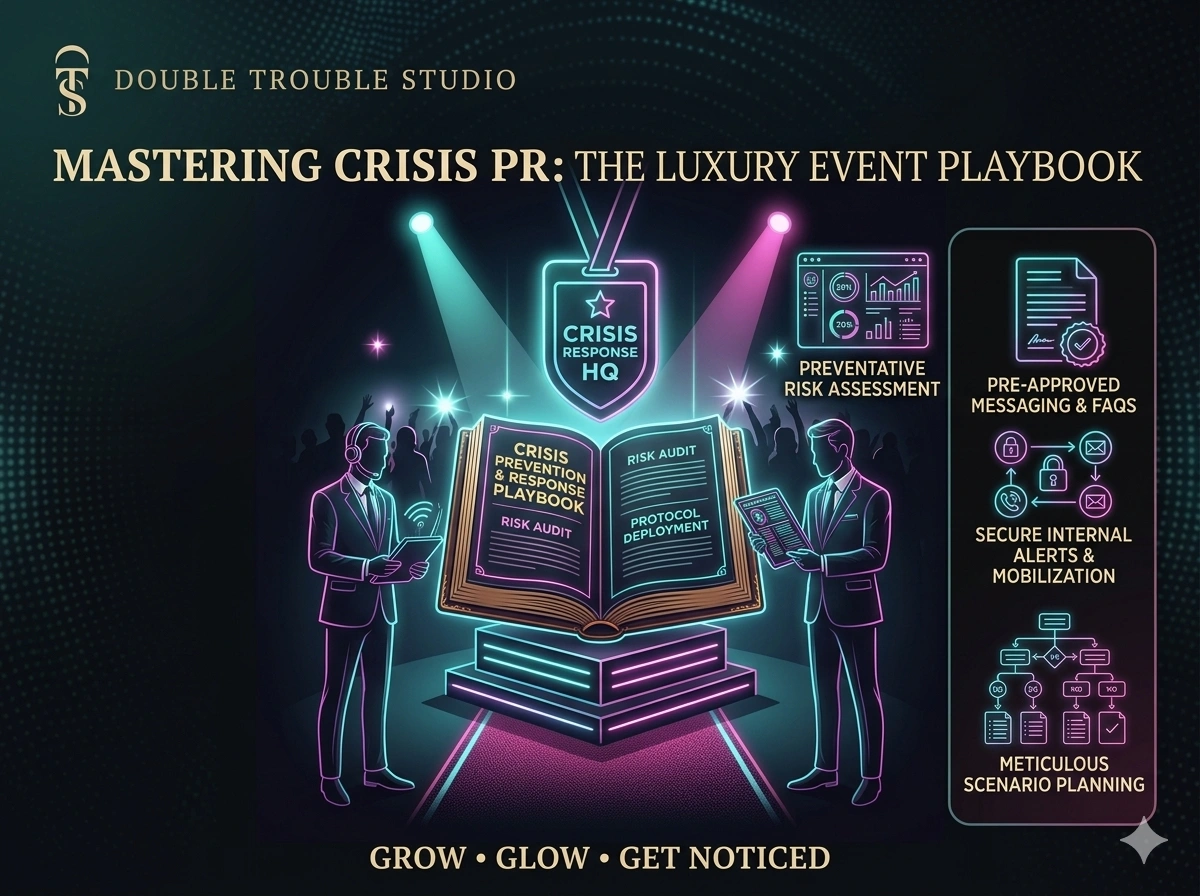
Crisis PR in Luxury & Events: Prevention & Response Playbook
In luxury events and premium brand environments, perfection is not an aspiration — it is an expectation. Every detail is curated, every experience is controlled, and every interaction is designed to reinforce perception. Yet, despite the highest levels of planning, crises can emerge.
A delayed celebrity arrival, a guest management failure, a public complaint, a vendor breakdown, or a misinterpreted social media moment — any of these can escalate quickly in high-visibility environments. What makes luxury ecosystems particularly sensitive is not just the occurrence of issues, but how they are perceived and discussed within influential networks.
In 2026, crisis PR is no longer reactive. It is strategic. The brands that protect their reputation most effectively are not the ones that avoid crises entirely — but the ones that anticipate, structure, and respond with precision.
Because in premium markets, reputation is not just built over time.
It can shift in moments.
Understanding the Nature of Crises in Luxury Environments
Not all crises are dramatic. In luxury events, many challenges begin as subtle disruptions. A slight delay, an uncoordinated interaction, or a minor service inconsistency may appear insignificant operationally. However, within high-end audiences, perception is shaped quickly.
Luxury audiences are highly perceptive and often influential. Their experiences are shared within selective circles, where word-of-mouth carries significant weight. A small issue, if not managed correctly, can become part of a larger narrative.
This makes crisis management less about scale and more about sensitivity. The ability to identify early signals and respond before escalation is what differentiates effective PR teams.
In luxury environments, crises are rarely defined by what happens.
They are defined by how it is perceived.
Prevention as the First Line of Defense
The most effective crisis strategy begins before any issue arises. Prevention is not about eliminating risk entirely, but about reducing exposure and preparing for potential scenarios.
Structured planning plays a key role. Guest management systems, vendor coordination frameworks, and clear communication protocols minimize the likelihood of operational breakdowns. However, prevention extends beyond logistics.
Reputation mapping is equally important. Understanding potential vulnerabilities — whether related to brand positioning, celebrity associations, or audience expectations — allows teams to anticipate risks.
Preparedness also includes defining response frameworks in advance. When teams know how to respond, decisions are faster and more consistent.
In high-profile environments, preparation creates control.
Early Detection: Identifying Signals Before Escalation
Crises rarely emerge without warning. Early signals often appear through guest feedback, internal observations, or digital conversations. The ability to detect these signals early can prevent escalation.
On-ground teams play a critical role in this process. Their awareness and responsiveness determine how quickly issues are identified. Digital monitoring also provides insight into how conversations are evolving online.
Early detection allows for subtle intervention. Issues can be addressed quietly, without drawing attention or creating disruption.
In luxury environments, discretion is as important as action.
Structuring the Response Framework
When a crisis does occur, response must be structured, not improvised. A clear framework ensures that communication remains consistent and aligned with the brand’s positioning.
The first step is internal alignment. All stakeholders — from management to on-ground teams — must operate with the same understanding of the situation. Conflicting messages can amplify confusion and weaken credibility.
The response itself must be measured. Overreaction can create unnecessary attention, while underreaction can signal indifference. The tone must reflect responsibility, clarity, and control.
In premium markets, how a brand responds often matters more than the issue itself.
Communication: Balancing Transparency and Control
Crisis communication in luxury environments requires a delicate balance. Transparency builds trust, but excessive disclosure can amplify the situation. Control ensures stability, but silence can create speculation.
The approach must be calibrated. Communication should address the issue clearly while maintaining composure. The goal is to reassure stakeholders without escalating visibility.
Audience segmentation also plays a role. Internal stakeholders, guests, media, and digital audiences may require different levels of communication. A one-size-fits-all approach often leads to misalignment.
In crisis PR, communication is not just about what is said.
It is about how, when, and to whom it is said.
Managing Media and Digital Amplification
In today’s connected environment, crises can extend beyond the event space into digital platforms. Social media, online discussions, and media coverage can amplify issues rapidly.
Managing this requires both speed and strategy. Monitoring conversations allows teams to understand how the narrative is evolving. Timely responses help shape perception before it solidifies.
Media engagement must also be handled carefully. Not every situation requires public statements, but when it does, messaging must be clear and consistent.
The objective is not to control every conversation.
It is to guide the narrative.
The Role of Leadership and Decision-Making
Crisis situations require strong leadership. Decisions must often be made quickly, with limited information. Experience and judgment play a critical role in determining the right course of action.
Leadership ensures that responses remain aligned with brand values. It also provides confidence to teams, allowing them to act decisively.
In luxury environments, hesitation can create uncertainty. Clear direction maintains stability.
Post-Crisis Recovery and Narrative Rebuilding
Once the immediate situation is managed, the focus shifts to recovery. This involves not only resolving the issue but also restoring confidence and reinforcing the brand narrative.
Follow-up communication, improved processes, and continued engagement help rebuild trust. In some cases, the way a brand handles a crisis can strengthen its reputation.
Recovery is not about returning to normal.
It is about moving forward with greater clarity.
Learning and Future Preparedness
Every crisis provides insight. Post-event analysis helps identify gaps in planning, communication, and execution. These learnings can be integrated into future strategies, reducing the likelihood of recurrence.
Preparedness evolves with experience. Over time, brands develop stronger frameworks, allowing them to handle challenges with greater confidence.
In premium environments, learning is part of growth.
Conclusion: Control Defines Credibility
Crisis PR in luxury events is not about avoiding every issue. It is about managing perception with precision, responding with clarity, and maintaining control under pressure.
In India’s premium market, where reputation is built through consistency and trust, the ability to handle crises effectively becomes a defining factor. Brands that approach crisis management strategically do not just protect their image.
They strengthen it.
Because in high-profile environments, challenges are inevitable.
But how they are handled defines everything that follows.
Frequently Asked Questions (FAQs)
What is crisis PR in luxury events?
It involves managing communication and perception during unexpected situations that may impact brand reputation.
Can crises be completely avoided?
No, but they can be anticipated and managed effectively through preparation.
What is the first step in crisis response?
Internal alignment and understanding of the situation before external communication.
How should brands communicate during a crisis?
With clarity, composure, and controlled transparency.
Can a crisis damage a luxury brand permanently?
If mismanaged, yes. However, effective handling can also strengthen reputation.
Design Your Crisis PR Strategy
If you are planning a luxury event, brand launch, or high-visibility experience in India, crisis management should not be reactive — it should be built into your strategy from the beginning.
From risk assessment and prevention frameworks to real-time response and narrative recovery, our team ensures that your brand remains protected, composed, and in control at every stage.
📩 hello@dtsworld.in 📞 +91 80000 06021 📍 Andheri East, Mumbai
👉 Design Your Crisis PR Strategy