
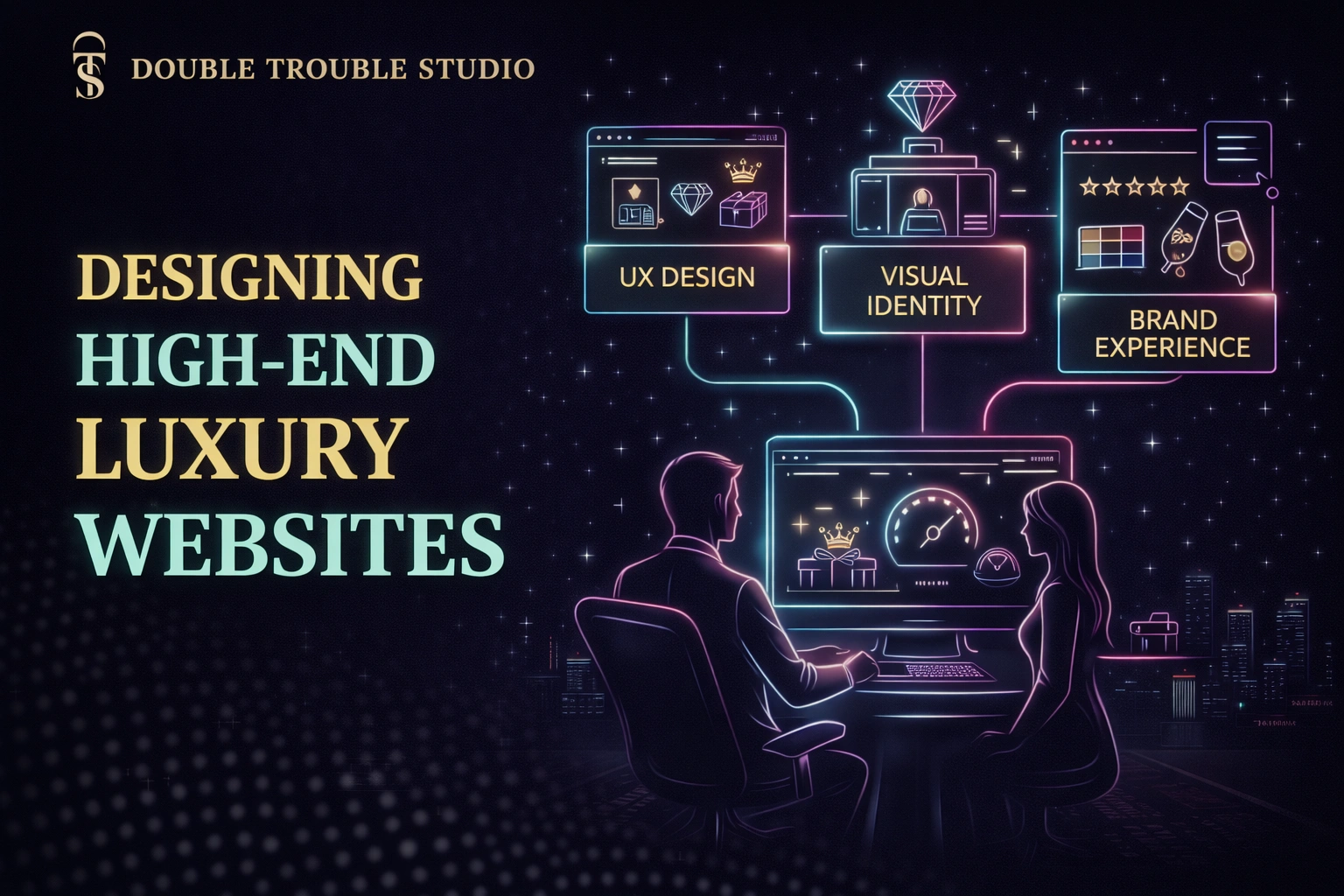
Designing High-End Luxury Websites (UX, Visual Identity & Brand Experience)
In 2026, a website is no longer a digital brochure.
For luxury brands, it is the primary environment where perception is formed, directly influencing brand positioning.
Before a client attends an event, visits a property, or interacts with a brand physically, they experience it digitally. The website becomes the first point of contact, and in many cases, the most influential one. It shapes expectations, communicates positioning, and defines how the brand is understood, often supported by content strategy.
Unlike mass-market websites, which prioritize speed, volume, and conversion efficiency, luxury websites operate on a different logic. They are not designed to capture attention quickly and convert immediately. They are designed to create immersion, evoke emotion, and establish authority, aligned with brand storytelling.
This distinction changes how design decisions are made.
User experience, visual identity, and brand storytelling must work together to create a cohesive digital environment. Every detail — from typography and spacing to transitions and content flow — contributes to perception, often aligned with UX design principles.
Designing a luxury website is therefore not a technical task.
It is a strategic one.
Because in premium markets, the website does not just present the brand.
It represents it.
Understanding Luxury UX: Experience Over Efficiency
User experience in luxury websites operates on a fundamentally different principle compared to conventional web design. In most digital environments, UX is optimized for speed, clarity, and immediate action. Users are guided quickly towards conversions, with minimal friction and maximum efficiency.
In luxury branding, this approach is not always appropriate, especially when compared with conversion funnel strategies.
Luxury UX is not about reducing time.
It is about enhancing experience.
The objective is not to move the user quickly through the website, but to allow them to engage with the brand at a deliberate pace. This requires a shift in design philosophy. Instead of focusing solely on functionality, the website must create a sense of presence.
This is achieved through controlled navigation, thoughtful content sequencing, and immersive interactions. For example, instead of presenting all information at once, content can be revealed progressively, aligned with content structuring.
Transitions play a significant role in this experience. Smooth animations, subtle movements, and responsive interactions create a sense of fluidity. These elements must be carefully balanced. Overuse can feel distracting, while underuse can make the experience feel static.
Another important aspect of luxury UX is clarity without clutter. While the experience may be immersive, it must not be confusing. Navigation should remain intuitive, even if it is not immediately obvious.
Mobile experience is also critical. Luxury audiences often interact with brands across multiple devices, making mobile performance essential.
Luxury UX is not about adding complexity.
It is about creating depth.
Visual Identity: Translating Brand Positioning into Design
Visual identity is one of the most visible aspects of a luxury website, but it is also one of the most misunderstood. Many brands equate luxury design with minimalism, assuming that clean layouts and neutral colors are sufficient to create a premium feel.
While minimalism can be effective, it is not a universal solution.
Luxury visual identity must be aligned with brand positioning, similar to positioning strategy.
A brand positioned around heritage may use rich textures, detailed typography, and classical layouts. A brand focused on modern luxury may adopt bold visuals, dynamic compositions, and contemporary design elements.
The key is consistency.
Every visual element must contribute to the same narrative.
Typography plays a central role in this process. The choice of fonts, spacing, and hierarchy influences how the content is perceived.
Color is another critical factor. Luxury brands often use restrained color palettes, but restraint does not mean limitation.
Imagery and video content are equally important. High-quality visuals must align with the brand’s narrative, often supported by design strategy.
Whitespace is often overlooked but plays a crucial role in luxury design.
Visual identity is not about decoration.
It is about communication.
Crafting a Premium Brand Experience Through Digital Interaction
A luxury website must go beyond aesthetics and functionality. It must create an experience that reflects the brand’s identity.
This experience is shaped through interaction.
Every interaction, whether it is scrolling, clicking, or hovering, contributes to how the brand is perceived. These interactions must feel intentional and refined, aligned with interaction design.
For example, hover effects can reveal additional information in a subtle way. Scroll-based animations can guide the user through a narrative. Micro-interactions can provide feedback without being intrusive.
Performance is another critical factor. Luxury websites must load quickly and operate smoothly, supported by technical SEO.
The objective is to create an environment where the user feels engaged.
Not distracted.
Content Strategy: Storytelling Within the Interface
Content in luxury websites is not just informational.
It is narrative.
The way content is structured and presented influences how the brand is understood. Instead of listing features or services, luxury websites focus on storytelling, aligned with story-led strategy.
This storytelling can be achieved through a combination of text, visuals, and interactions.
The tone of content must align with the brand’s identity. Language should be precise, refined, and consistent.
Content hierarchy is also important. Key messages should be highlighted, while supporting information should remain accessible, supported by content frameworks.
Content is not separate from design.
It is part of it.
Conversion Without Compromising Experience
Conversion is an important objective for any website, but in luxury branding, it must be approached differently.
Aggressive calls-to-action, pop-ups, and promotional banners can disrupt the experience. Instead, conversion elements must be integrated seamlessly, aligned with conversion strategy.
For example, contact forms, booking options, or inquiry buttons can be placed within the natural flow of the website.
Trust signals are also important. Testimonials, case studies, and media features reinforce credibility, often supported by case studies.
The goal is to create an environment where the user feels comfortable taking action.
Not pressured.
Maintaining Consistency Across the Digital Ecosystem
A luxury website does not exist in isolation.
It is part of a broader digital ecosystem that includes social media, PR, and offline experiences. Consistency across these touchpoints is essential, aligned with integrated strategies.
The visual identity, tone of voice, and narrative must remain aligned.
Regular updates and maintenance are also important, supported by website maintenance.
Consistency is not a one-time achievement.
It is an ongoing process.
Challenges in Designing Luxury Websites
Designing a luxury website involves several challenges.
One of the most common is overdesign. Attempting to create a visually impressive website can lead to excessive elements that distract from the core experience.
Another challenge is underdesign. Minimalism, when applied without depth, can result in a website that feels generic.
Balancing aesthetics, functionality, and performance requires careful planning, often aligned with performance optimization.
There is also the challenge of scalability. As the brand grows, the website must adapt without losing its identity.
Addressing these challenges requires a structured approach.
Conclusion: Designing for Perception, Not Just Function
Luxury website design is not about creating a functional platform.
It is about creating a digital experience.
User experience, visual identity, and content must work together to communicate the brand’s positioning. Every detail contributes to perception, and every interaction reinforces identity, forming a key part of brand strategy.
In 2026, where digital presence often defines first impressions, the importance of a well-designed luxury website cannot be overstated.
Because in premium markets, the website is not just a tool.
It is the brand.
Design Your Luxury Website
If you are building or redesigning your website, creating a premium digital experience requires both technical expertise and strategic clarity.
From UX design and visual identity to content strategy and performance optimization, our team ensures that your website reflects precision, consistency, and luxury positioning.
📩 hello@dtsworld.in 📞 +91 80000 06021 📍 Andheri East, Mumbai
👉 Design Your Luxury Website Strategy