
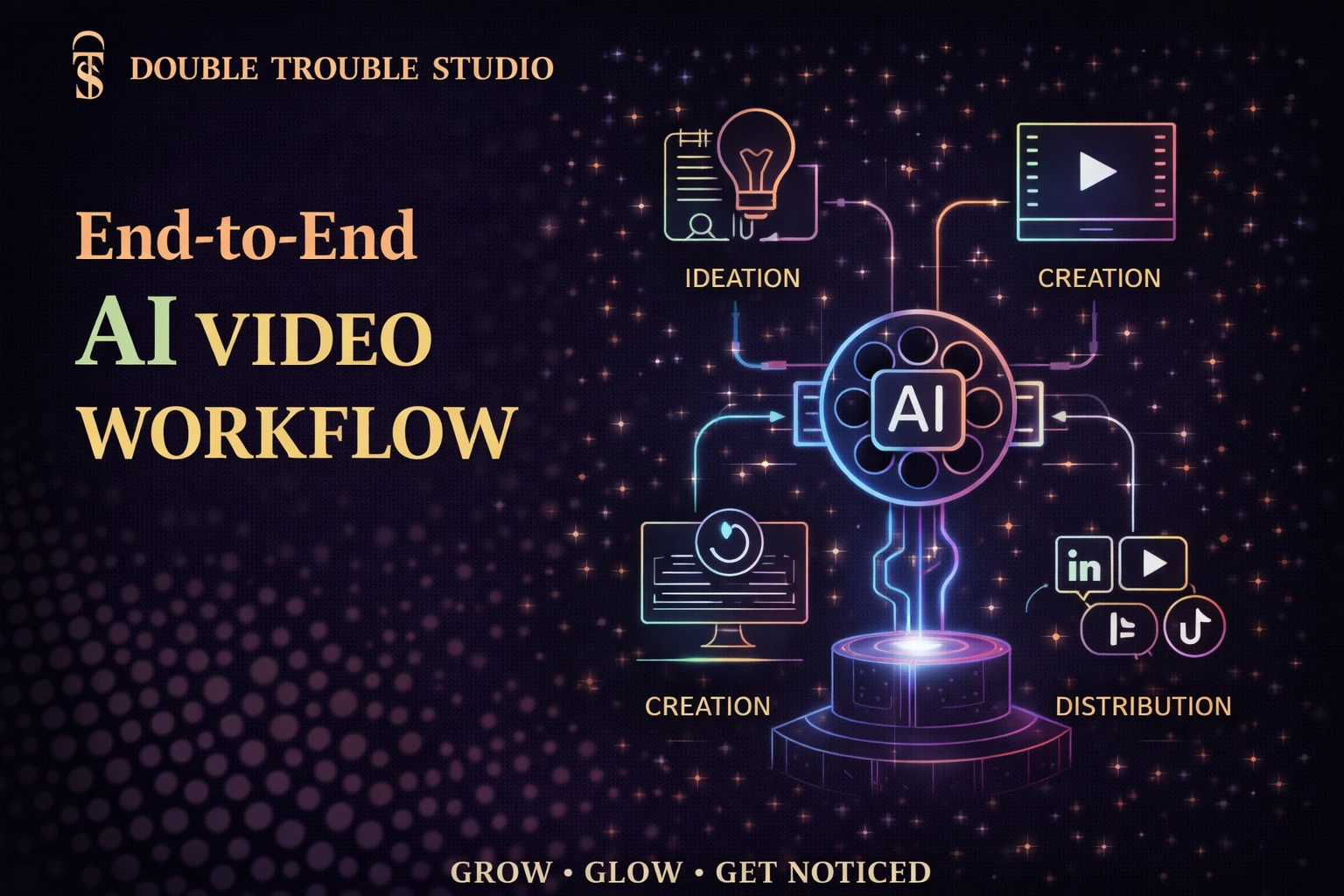
End-to-End AI Video Workflow (Ideation, Creation & Distribution Explained)
In 2026, video production has evolved from a linear, resource-heavy process into a dynamic and adaptive system driven by artificial intelligence. The traditional workflow of ideation, pre-production, shooting, editing, and distribution still exists, but AI has transformed how each stage operates. It has introduced speed, flexibility, and scalability, allowing brands to produce high-quality video content more efficiently than ever before.
However, the integration of AI into video workflows is not simply a matter of replacing manual processes with automation. It requires a structured approach that ensures technology supports creative intent rather than disrupting it. For premium and luxury brands, this distinction is particularly important. Video content is not just a communication tool; it is an extension of brand identity. Every frame must align with positioning, every narrative must reinforce perception, and every distribution decision must maintain exclusivity.
An end-to-end AI video workflow therefore requires careful design. It must integrate ideation, creation, and distribution into a cohesive system where each stage informs the next. This ensures that the final output is not only efficient to produce but also consistent in quality and aligned with strategic objectives.
Because in modern video production, efficiency alone does not define success.
Alignment does.
Ideation: Structuring Creative Direction with AI Support
The ideation stage is where the foundation of any video project is established. It defines the concept, the narrative direction, and the emotional tone that will guide the entire production process. Traditionally, this stage relied heavily on brainstorming sessions, reference gathering, and iterative discussions. While these methods are still relevant, AI has significantly expanded the possibilities within this phase.
AI tools enable rapid exploration of ideas. Creative teams can generate multiple concept variations, visual styles, and narrative directions within minutes. This allows for a broader range of possibilities to be considered before narrowing down to a final direction. For example, a brand can explore different visual interpretations of the same concept, testing variations in tone, pacing, and composition to determine which approach aligns best with its identity.
However, the abundance of options introduces a new challenge. Without a clear framework, ideation can become unfocused. The presence of multiple directions may lead to indecision or a fragmented concept that lacks coherence. This is why strategic clarity is essential before AI is applied. The brand must define its objective, target audience, and desired emotional response. These elements act as filters, ensuring that AI-generated ideas remain aligned with the overall vision.
Narrative development is another critical component of ideation. AI can assist in structuring storylines, suggesting sequences, and visualizing scenes. This accelerates the process of transforming abstract ideas into concrete concepts. However, narrative depth cannot be automated. The ability to create a story that resonates emotionally and aligns with brand positioning requires human judgment.
Ideation also involves considering practical constraints such as budget, timeline, and platform requirements. AI can provide insights into these factors, helping teams evaluate feasibility and optimize planning. This ensures that the concept is not only creative but also executable.
Ultimately, ideation in an AI-driven workflow is a balance between exploration and control. AI expands creative possibilities, but direction ensures that these possibilities translate into meaningful outcomes.
Creation: From Pre-Production to Final Output
The creation stage is where ideas are transformed into tangible content. This stage includes pre-production planning, actual production, and post-production refinement. AI influences each of these components, creating a more integrated and efficient process.
Pre-production has been significantly enhanced by AI. Storyboarding, which traditionally required manual illustration or basic visual references, can now be generated dynamically. Scenes can be visualized with realistic detail, allowing teams to understand how the final output will look before production begins. This reduces uncertainty and enables more precise planning.
AI also supports resource optimization during pre-production. Scheduling, location selection, and technical requirements can be analyzed and adjusted to improve efficiency. Virtual simulations allow teams to test different setups, such as lighting and camera angles, without physical constraints.
During production, AI introduces real-time capabilities. Virtual production techniques allow environments to be generated and displayed during filming, reducing the need for physical sets. Camera tracking, exposure adjustments, and other technical elements can be enhanced through AI systems, improving accuracy and consistency.
However, the role of human expertise remains critical. Cinematography, direction, and performance cannot be fully automated. These elements contribute to the emotional depth and authenticity of the content. AI supports execution, but it does not replace creative judgment.
Post-production is where AI’s impact becomes most visible. Editing, color grading, and visual effects can be accelerated significantly. AI tools can analyze footage, suggest cuts, and apply adjustments automatically. This reduces the time required for repetitive tasks and allows editors to focus on refinement.
Despite this efficiency, post-production still requires careful oversight. Editing is not just a technical process; it is a narrative one. The pacing of scenes, the timing of transitions, and the integration of sound all influence how the story is experienced. These decisions must be guided by creative intent.
The creation stage, therefore, becomes a hybrid process. AI enhances efficiency and precision, while human input ensures quality and alignment.
Distribution: Delivering Content with Precision and Control
The final stage of the workflow is distribution, where the completed video content is delivered to the audience. AI has transformed this stage by enabling more targeted and efficient distribution strategies.
Traditional distribution relied on broad approaches, such as television broadcasting or general online publishing. AI-driven distribution, on the other hand, allows for precise targeting. Content can be delivered to specific audience segments based on behavior, preferences, and context. This increases relevance and engagement.
AI also enables content adaptation. A single video can be modified into multiple formats, optimized for different platforms such as social media, websites, or streaming services. This ensures that the content maintains its impact across various channels.
However, distribution in luxury branding requires careful control. While AI makes it possible to reach larger audiences, excessive visibility can reduce exclusivity. The brand must balance reach with selectivity, ensuring that distribution aligns with positioning.
Timing is another critical factor. AI can analyze audience behavior to determine optimal release schedules, maximizing visibility and engagement. However, timing must also consider narrative flow. Content should be released in a way that maintains continuity and reinforces the overall story.
Performance analysis is an integral part of distribution. AI tools provide real-time insights into how content is received, including engagement metrics and audience feedback. This allows brands to adjust their strategies dynamically.
However, metrics must be interpreted within context. High engagement does not always equate to positive perception. Luxury brands must evaluate not just how content performs, but how it aligns with their identity.
Distribution is not the end of the workflow.
It is part of a continuous cycle.
Insights gained from distribution inform future ideation, creating a feedback loop that improves overall effectiveness.
Integration Across the Workflow
The true strength of an end-to-end AI video workflow lies in integration. Each stage must connect seamlessly with the others, ensuring that decisions made during ideation are reflected in creation and reinforced in distribution.
This integration requires a unified framework. Creative direction, brand guidelines, and strategic objectives must be consistent across all stages. AI tools can facilitate this by maintaining parameters and applying them throughout the workflow.
Collaboration is also essential. Teams must work together, sharing insights and aligning their efforts. AI can support collaboration by providing centralized data and real-time updates.
Integration transforms the workflow from a series of isolated steps into a cohesive system.
Challenges in AI Video Workflows
While AI offers significant advantages, it also introduces challenges. One of the primary risks is over-reliance on automation. Excessive dependence on AI can reduce creativity and lead to generic output.
Another challenge is maintaining consistency. As content is produced at scale, ensuring alignment with brand identity becomes more complex.
There is also the risk of overproduction. The ease of content creation can lead to excessive output, reducing impact.
Addressing these challenges requires discipline and strategic oversight.
Frequently Asked Questions (FAQs)
What is an AI video workflow?
Ans: It is a structured process that integrates AI tools into ideation, creation, and distribution stages of video production.
How does AI improve video production?
Ans: AI enhances efficiency, enables rapid iteration, and provides advanced tools for visualization and editing.
Can AI replace traditional production workflows?
Ans: No, AI complements traditional methods but does not replace human creativity and expertise.
What are the risks of AI workflows?
Ans: Risks include over-automation, loss of creativity, and inconsistency.
How can brands maintain quality in AI workflows?
Ans: By combining AI capabilities with strong creative direction and disciplined execution.
Conclusion: A System Defined by Alignment
The end-to-end AI video workflow represents a significant evolution in content production. It offers speed, flexibility, and scalability, but these advantages must be balanced with control and intention.
For premium brands, the objective is not simply to produce content efficiently. It is to ensure that every stage of the workflow contributes to a cohesive and consistent narrative.
AI enhances the process.
But alignment defines the outcome.
Design Your AI Video Workflow
If you are building a video production system, integrating AI requires both technical expertise and strategic clarity.
From ideation and production to distribution and optimization, our team helps you create workflows that combine efficiency with precision.
📩 hello@dtsworld.in 📞 +91 80000 06021 📍 Andheri East, Mumbai
👉 Design Your AI Video Workflow