
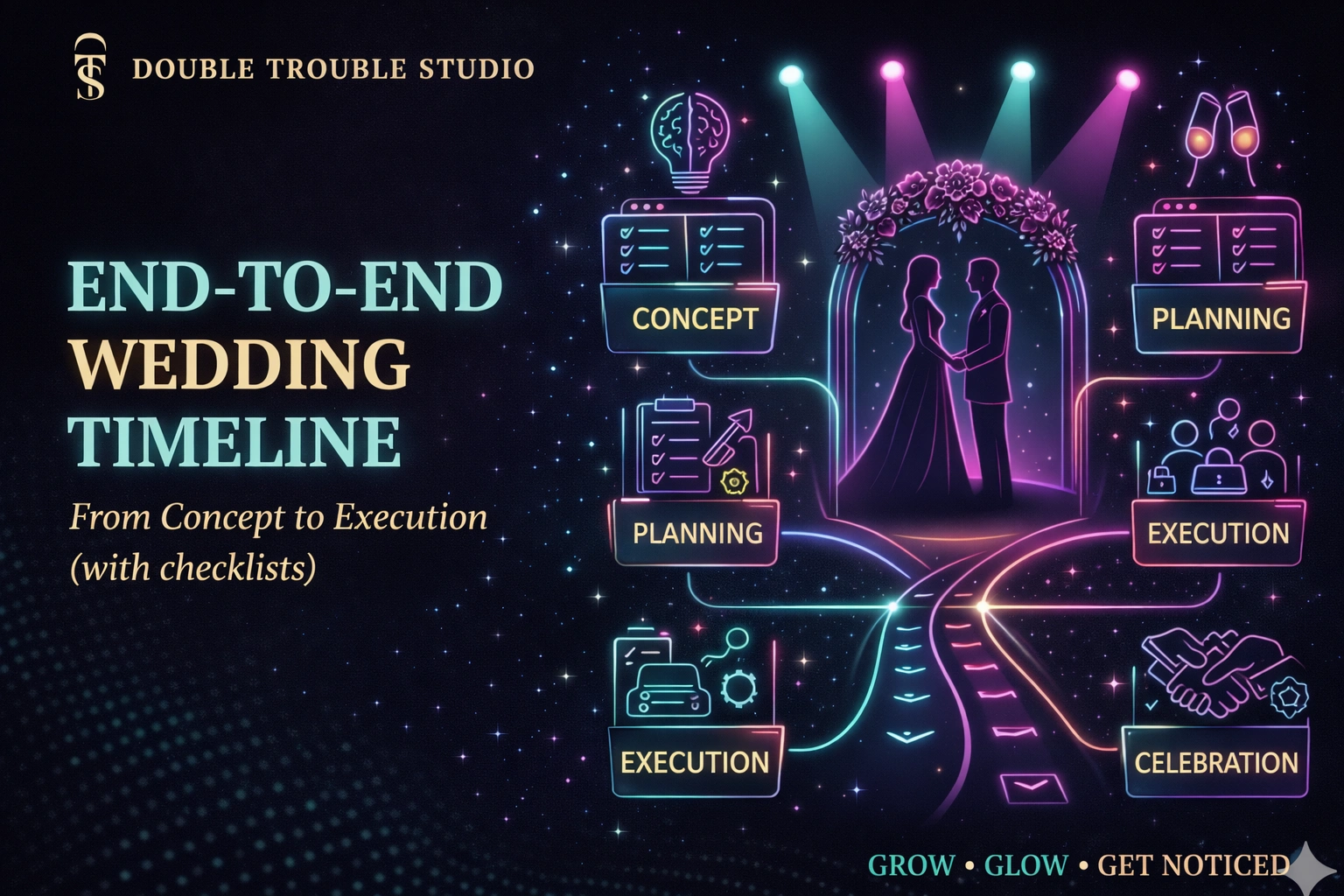
End-to-End Wedding Timeline: From Concept to Execution (with checklists)
In luxury weddings, what guests experience as effortless celebration is, in reality, the result of months of structured planning, layered coordination, and precise execution. Every detail — from venue selection to guest flow, from décor to entertainment — must align seamlessly across timelines that are often underestimated.
In 2026, wedding planning in India has evolved into a highly strategic process. Families are no longer just organizing events; they are curating multi-day experiences that reflect identity, status, and storytelling. This shift has made timeline management one of the most critical aspects of execution.
Because in premium weddings, delays are not just operational issues.
They are perceptual disruptions.
This guide outlines a complete end-to-end wedding timeline — from initial concept to final execution — ensuring that every phase is approached with clarity and control.
Phase 1: Concept Development & Vision Alignment (6–12 Months Before)
Every luxury wedding begins with a concept, not a checklist. Before vendors are contacted or venues are shortlisted, the vision must be defined. This includes understanding the scale of the celebration, the tone of the events, and the overall aesthetic direction.
At this stage, decisions are less about logistics and more about identity. Whether the wedding leans toward a traditional, contemporary, or fusion experience will influence every subsequent choice. Guest size, destination preferences, and budget alignment also begin to take shape here.
A clear concept acts as a foundation. Without it, planning becomes fragmented, and execution loses coherence.
Phase 2: Venue Finalization & Date Blocking (5–10 Months Before)
Once the vision is defined, venue selection becomes the next critical step. In India’s premium wedding market, high-demand venues are often booked months in advance, making early finalization essential.
The venue is not just a location. It defines logistics, guest experience, and design possibilities. Factors such as accessibility, accommodation capacity, and event flow must be evaluated alongside aesthetics.
At this stage, dates are locked, and primary event structures begin to form. The timeline transitions from abstract planning to tangible execution.
Phase 3: Vendor Curation & Strategic Booking (4–8 Months Before)
With the venue confirmed, vendor selection begins. This includes planners, decorators, caterers, entertainment teams, photographers, and technical production partners.
In luxury weddings, vendor selection is not about availability alone. It is about alignment with the concept and the ability to deliver at scale. Each vendor becomes part of a larger ecosystem, and their coordination determines the smoothness of execution.
Early booking ensures access to top-tier talent while allowing sufficient time for customization and collaboration.
Phase 4: Guest List Structuring & Invitations (3–6 Months Before)
Guest management begins long before invitations are sent. The guest list must be structured thoughtfully, considering family dynamics, social circles, and event-specific attendance.
Segmentation plays a key role here. Different events may require different guest groups, and managing this flow ensures both exclusivity and comfort.
Invitation design and distribution follow, reflecting the tone of the wedding. Digital confirmations, RSVP tracking, and guest communication systems must be established to avoid last-minute uncertainty.
A well-managed guest list creates clarity across all other planning stages.
Phase 5: Design Development & Experience Mapping (2–4 Months Before)
As the wedding approaches, focus shifts toward design and experience. Décor concepts are refined, event layouts are mapped, and thematic elements are finalized.
This phase also includes flow planning. Entry sequences, stage positioning, guest movement, and hospitality zones must be visualized in advance. Every transition between events should feel seamless.
Luxury weddings are defined by cohesion. Design is not limited to visuals; it extends to how guests move, interact, and experience each moment.
Phase 6: Logistics Planning & Coordination (1–2 Months Before)
Logistics form the backbone of execution. Travel arrangements, accommodation allocations, transportation schedules, and vendor timelines must all be aligned.
At this stage, detailed schedules are created. Each event is broken down into timelines that account for setup, execution, and transitions. Buffer time is built into every movement to absorb unexpected delays.
Coordination between teams becomes critical. Misalignment at this stage can create cascading disruptions during the wedding.
Preparation reduces uncertainty.
Phase 7: Final Confirmations & Rehearsals (2–3 Weeks Before)
As the wedding date approaches, all elements are reconfirmed. Vendor contracts, guest attendance, and logistical arrangements are reviewed in detail.
Rehearsals and walkthroughs are conducted to identify potential gaps. Entry sequences, stage cues, and event transitions are tested to ensure readiness.
This phase is about refinement. Small adjustments made here can prevent major issues later.
Precision is achieved before the first guest arrives.
Phase 8: On-Ground Execution & Real-Time Management
Execution is where planning meets reality. Every team must operate in sync, responding to real-time developments without disrupting the experience.
Guest arrivals, event transitions, entertainment schedules, and hospitality services are all managed simultaneously. Coordination teams ensure that timing remains intact and that any deviations are handled discreetly.
In luxury weddings, the goal is not perfection.
It is seamlessness.
Guests should experience continuity, even when adjustments are being made behind the scenes.
Phase 9: Post-Wedding Closure & Continuity
The wedding does not end with the final event. Post-wedding engagement plays a significant role in extending the experience.
Thank-you communication, content sharing, and feedback collection help maintain connection with guests. Vendor settlements and internal reviews also ensure that learnings are documented for future events.
In premium environments, closure is as important as execution.
It completes the narrative.
The Role of Structured Checklists
While luxury weddings are driven by creativity, execution depends on structure. Checklists ensure that no detail is overlooked and that every phase progresses systematically.
From initial concept discussions to final guest departures, structured tracking allows teams to maintain control over complex timelines. It transforms planning from reactive to proactive.
Checklists do not limit creativity.
They protect it.
Conclusion: Time Is the Invisible Framework
An end-to-end wedding timeline is not just a planning tool. It is the invisible framework that supports the entire experience. In India’s luxury wedding ecosystem, where expectations are elevated and details are amplified, time management becomes a defining factor.
When timelines are structured, execution feels effortless. When they are not, even the most beautiful concepts can fall short.
Because in premium weddings, guests may not see the timeline.
But they always feel its impact.
Frequently Asked Questions (FAQs)
When should wedding planning ideally begin?
For luxury weddings, planning should begin at least 6–12 months in advance to ensure access to premium venues and vendors.
Why is timeline planning important?
It ensures that every phase of the wedding is executed smoothly without last-minute disruptions.
How are guest lists managed effectively?
Through segmentation, RSVP tracking, and structured communication systems.
What is the biggest challenge in wedding execution?
Coordinating multiple vendors and timelines simultaneously while maintaining a seamless guest experience.
Are checklists necessary for luxury weddings?
Yes. They provide structure and ensure that no detail is overlooked during planning and execution.
Design Your Wedding Planning Strategy
If you are planning a luxury wedding, destination celebration, or multi-day event in India, timeline management is not just about scheduling — it is about orchestrating an experience with precision.
From concept development and vendor coordination to guest management and on-ground execution, our team ensures that every phase is aligned, structured, and seamlessly delivered.
📩 hello@dtsworld.in 📞 +91 80000 06021 📍 Andheri East, Mumbai
👉 Design Your Wedding Planning Strategy