
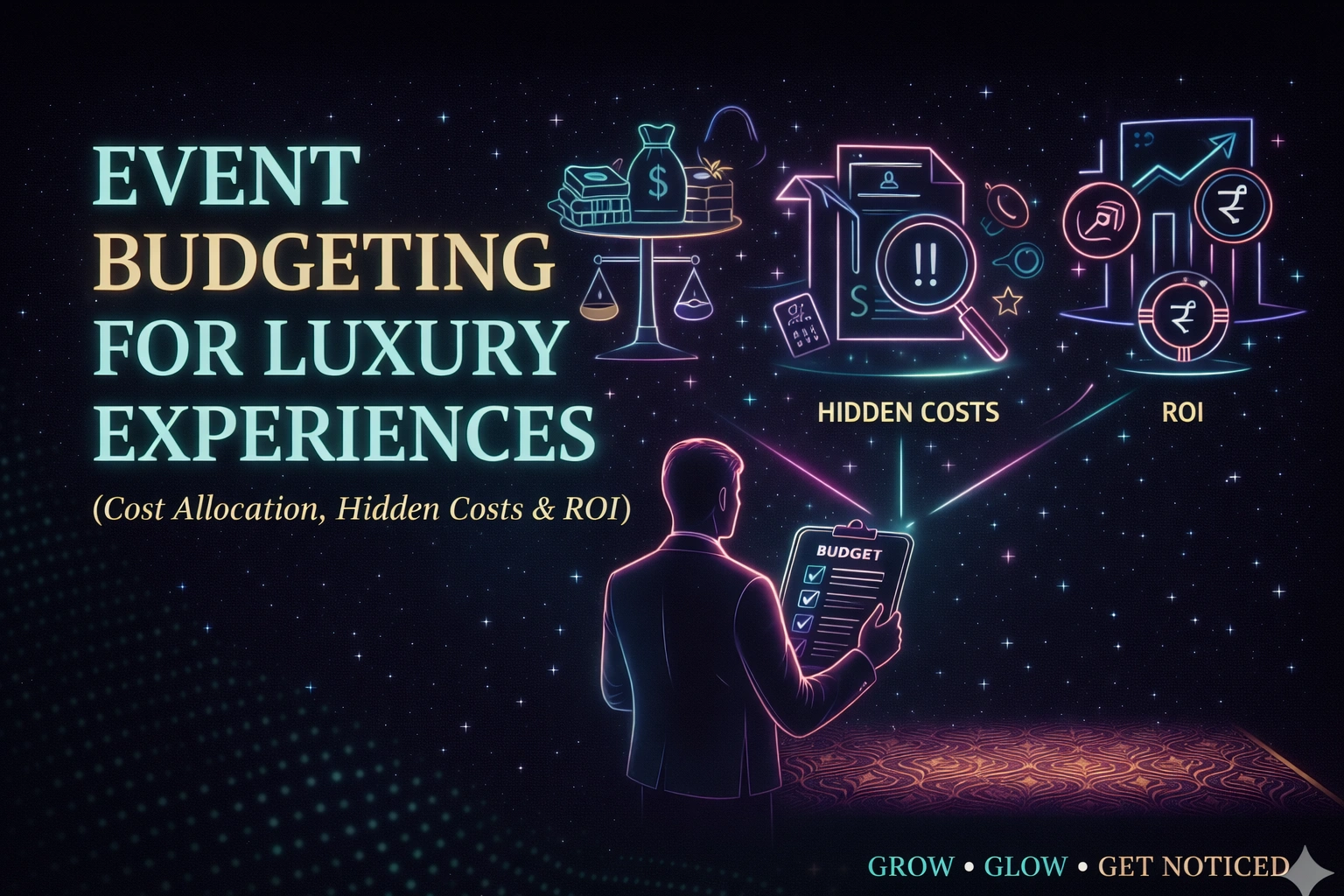
Event Budgeting for Luxury Experiences (Cost Allocation, Hidden Costs & ROI)
In the world of luxury events, budgeting is not simply a financial exercise — it is a strategic framework that defines the quality, perception, and overall success of the experience. Whether it is a high-profile brand launch, an ultra-premium wedding, or an exclusive hospitality event, every decision is influenced by how intelligently the budget is structured.
Luxury experiences operate in a space where expectations are high, details are scrutinized, and execution must feel effortless. However, behind that seamless experience lies a carefully engineered budgeting strategy that balances creativity with control. The difference between a well-executed luxury event and a chaotic one often comes down to how the budget is planned, allocated, and managed throughout the process.
In today’s environment, where costs fluctuate and audience expectations continue to evolve, event budgeting has become more complex than ever. It is no longer about estimating expenses. It is about building a system that ensures consistency, protects brand perception, and delivers measurable outcomes.
Understanding Budgeting in the Context of Luxury Events
Luxury event budgeting is fundamentally different from standard event planning. It is not about minimizing cost — it is about maximizing value while maintaining precision. Every element, from venue selection to guest experience, contributes to perception. Even minor compromises can impact how the event is remembered.
At a premium level, budgeting must account for both visible and invisible elements. The visible components include venue, décor, production, and hospitality. The invisible components, however, are what define execution. These include logistics coordination, time management, vendor reliability, contingency planning, and experience design.
A luxury event does not succeed because of how much is spent. It succeeds because of how intelligently resources are allocated.
The Role of Cost Allocation in Premium Event Planning
Cost allocation is where strategy begins. Instead of distributing budget evenly, high-end events require prioritization based on impact. Certain elements carry more weight in shaping perception, and these must receive greater investment.
For example, guest arrival experience, lighting design, and overall ambiance often define the first impression. If these elements are executed flawlessly, they elevate the entire event. On the other hand, overspending on less impactful areas can dilute the overall experience without adding real value.
Strategic allocation ensures that every rupee contributes to perception. It also creates clarity during decision-making. When priorities are defined early, teams can move faster without constantly revisiting budget constraints.
In luxury event planning, clarity of allocation leads to confidence in execution.
The Hidden Costs That Most Brands Overlook
One of the biggest challenges in event budgeting is managing hidden costs. These are expenses that are not immediately visible during initial planning but emerge during execution. If not anticipated, they can disrupt the budget and compromise quality.
Hidden costs often appear in logistics, where transportation, last-minute changes, and coordination gaps increase expenses. They also arise in production, where technical adjustments, overtime charges, and equipment upgrades become necessary. Vendor-related costs, such as additional manpower or extended service hours, can also impact the budget unexpectedly.
Another critical area is time. Delays in decision-making or execution often lead to increased costs. Rush charges, expedited services, and emergency fixes can significantly inflate the budget.
In luxury events, hidden costs are not exceptions — they are part of the process. The key is to anticipate them and build flexibility into the budget.
Balancing Aesthetics and Financial Discipline
Luxury events are driven by aesthetics, but they must be supported by financial discipline. This balance is what separates structured planning from impulsive spending.
Creative ideas often evolve during the planning phase. Concepts expand, designs become more ambitious, and expectations rise. While this evolution is natural, it must be controlled within a defined financial framework. Without discipline, budgets can quickly spiral without delivering proportional value.
The goal is not to restrict creativity but to guide it. By aligning creative decisions with budget priorities, brands can achieve high-impact experiences without unnecessary overspending.
True luxury is not about excess. It is about precision.
The Importance of Vendor Strategy in Budget Control
Vendors play a critical role in shaping both cost and quality. Choosing the right partners is not just about pricing — it is about reliability, consistency, and understanding of luxury standards.
Experienced vendors bring efficiency. They anticipate challenges, reduce errors, and ensure smoother execution. This often results in better cost control over time. On the other hand, choosing vendors based solely on lower pricing can lead to inconsistencies, delays, and additional costs during execution.
Negotiation is another important aspect. In luxury events, negotiation is not about reducing cost aggressively. It is about structuring value. This includes defining deliverables clearly, aligning expectations, and ensuring there are no ambiguities that could lead to additional charges later.
A strong vendor strategy creates stability within the budget.
ROI in Luxury Events: Measuring What Truly Matters
Return on investment in luxury events is often misunderstood. Unlike performance marketing, where results are measured in immediate conversions, luxury events deliver value in more nuanced ways.
Brand perception is one of the most important outcomes. A well-executed event enhances how the brand is seen, remembered, and talked about. This perception influences long-term customer behavior, partnerships, and market positioning.
Media coverage is another key factor. High-end events often generate significant PR value through press mentions, social media amplification, and influencer engagement. This visibility extends the impact of the event beyond its physical duration.
Client relationships also play a crucial role. Luxury events often serve as platforms for building and strengthening relationships with high-value clients, investors, and partners. The long-term business impact of these relationships often outweighs the immediate cost of the event.
ROI in luxury experiences is not always immediate, but it is deeply influential.
Building a Budget That Adapts to Change
Flexibility is essential in luxury event budgeting. No matter how detailed the plan, changes are inevitable. Guest lists evolve, concepts refine, and external factors influence execution.
A rigid budget structure can create stress and limit adaptability. Instead, budgets should include contingency planning that allows for adjustments without compromising core elements.
This flexibility ensures that when unexpected situations arise, the event can adapt without losing quality. It also provides teams with the confidence to make decisions quickly, knowing that there is room to accommodate change.
In luxury event planning, adaptability is as important as planning.
The Role of Experience Design in Budget Optimization
Experience design is often the most overlooked aspect of budgeting, yet it has the greatest impact on perception. When an event is designed thoughtfully, even moderate budgets can deliver premium experiences.
This involves understanding guest flow, emotional touchpoints, and sensory elements. Lighting, music, space design, and timing all contribute to how the event is experienced. When these elements are aligned, the event feels cohesive and elevated.
Investing in experience design allows brands to optimize budgets without compromising on quality. It shifts focus from individual elements to the overall journey, creating a more impactful outcome.
Luxury is not defined by individual components. It is defined by how everything comes together.
Why Structure Defines Success in Luxury Event Budgeting
Event budgeting at a premium level is not about restriction. It is about control, clarity, and strategic decision-making. When budgets are structured properly, they enable creativity rather than limit it.
Brands that approach budgeting casually often face challenges during execution. Costs escalate, priorities shift, and the final outcome lacks cohesion. On the other hand, brands that invest in structured budgeting create experiences that feel seamless, intentional, and impactful.
At Double Trouble Studio, event budgeting is integrated into a larger framework that includes creative direction, vendor management, production planning, and performance evaluation. This ensures that every event is not only visually impressive but also strategically aligned with business goals.
Because in luxury experiences, success is not measured by how much is spent.
It is measured by how effectively every decision contributes to the final perception.
Book Luxury Event Planning & Budget Strategy
If you are planning a high-end event, brand launch, corporate experience, or luxury wedding, structured budgeting is essential to achieving the level of precision and impact expected in premium environments.
At Double Trouble Studio, we design and execute luxury events with a focus on cost intelligence, creative excellence, and measurable outcomes. From initial planning to final execution, every element is aligned with your brand vision.
📩 hello@dtsworld.in 📞 +91 80000 06021 📍 Andheri East, Mumbai
👉 Start planning your luxury experience
Because in premium events, budgeting is not about numbers.
It is about control, clarity, and creating experiences that last far beyond the moment.