
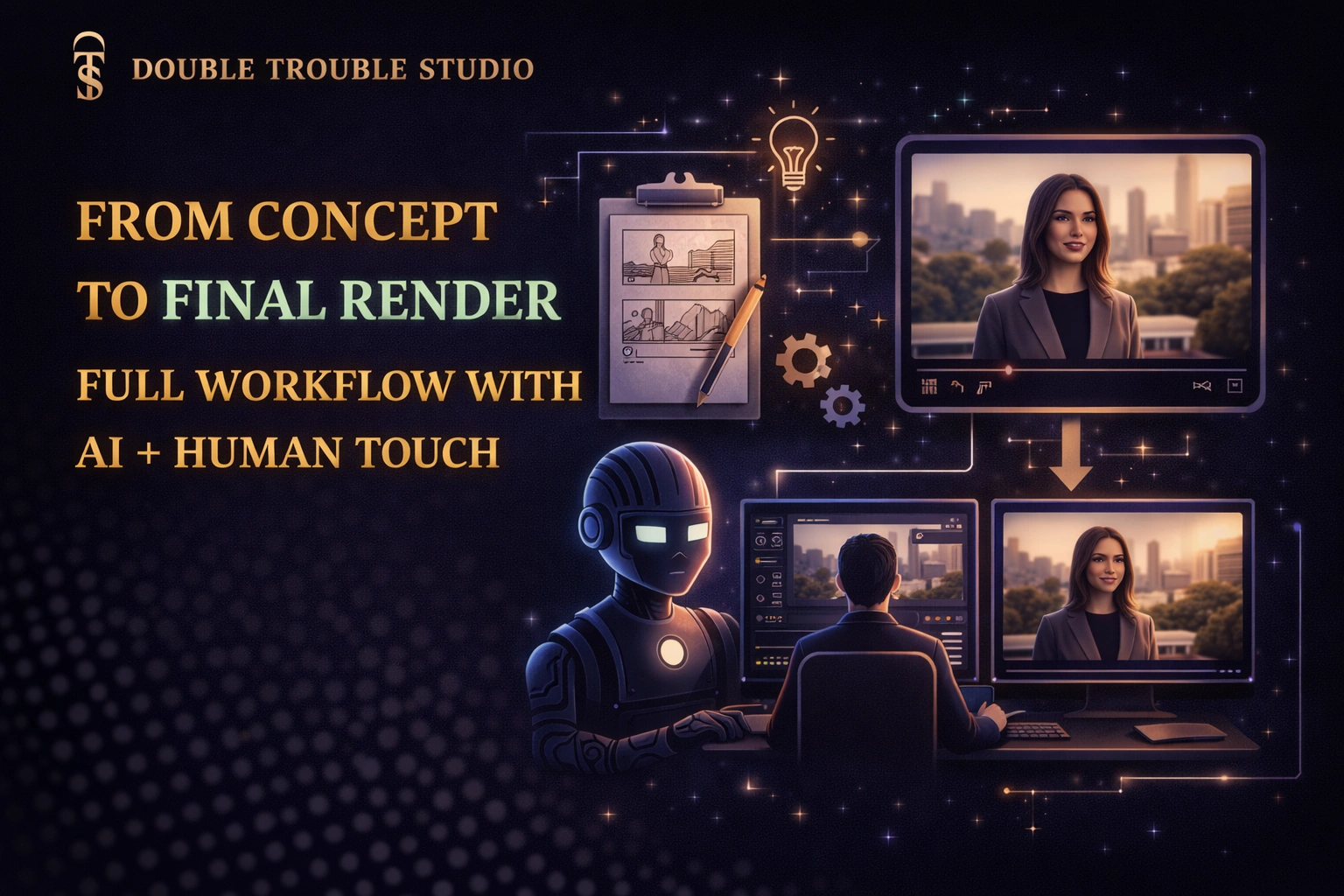
From Concept to Final Render: Full Workflow with AI + Human Touch
In 2026, video production is no longer a linear pipeline defined by isolated stages. It has evolved into an integrated system where artificial intelligence and human expertise operate simultaneously across the entire workflow. From the earliest conceptual spark to the final rendered output, every stage is influenced by a combination of automation, data-driven assistance, and creative judgment.
For high-end productions — whether luxury brand films, event recaps, automotive visuals, or hospitality campaigns — this hybrid workflow is not simply an efficiency upgrade. It is a structural transformation. It allows teams to reduce iteration cycles, improve precision, and maintain consistency across increasingly complex productions.
However, despite these advancements, one principle remains unchanged. Technology can accelerate processes, but it cannot define meaning. Narrative intent, visual identity, and emotional impact still depend on human direction.
The modern production workflow is therefore not about replacing traditional methods.
It is about augmenting them.
Because the difference between content and cinematic experience lies not in tools, but in how those tools are orchestrated.
Concept Development: From Abstract Ideas to Structured Direction
Every production begins with an idea, but in professional workflows, an idea alone is insufficient. It must be translated into a structured concept that aligns with brand positioning, audience expectations, and platform requirements.
In traditional environments, this stage relied on brainstorming sessions, references, mood boards, and iterative discussions. While effective, it often required significant time to move from abstraction to clarity. AI has fundamentally compressed this timeline.
Through prompt-based ideation systems and visual generation tools, creative teams can now explore multiple conceptual directions simultaneously. A single input can generate variations in tone, visual style, narrative approach, and thematic execution. This allows teams to evaluate ideas not just conceptually, but visually and structurally.
For example, a luxury automotive campaign concept can be explored across multiple environments — urban nightscapes, minimal studio settings, or cinematic landscapes — within minutes. Each variation provides insight into how the final output may feel, enabling faster decision-making.
However, concept development is not about generating options.
It is about selecting the right direction.
AI expands the range of possibilities, but human judgment defines which path aligns with the brand. This decision requires understanding of positioning, audience psychology, and long-term narrative consistency.
In high-end production, concept development is not a creative exercise alone.
It is a strategic decision-making process.
Scriptwriting and Narrative Architecture
Once a concept is established, it must be translated into a narrative framework. Scriptwriting defines the structure, pacing, and progression of the story. It determines how information is revealed, how emotions are built, and how the audience is guided through the experience.
AI-assisted scriptwriting tools have significantly accelerated this stage. By analyzing inputs such as tone, audience profile, and content objectives, these systems can generate structured drafts that include scene breakdowns, transitions, and dialogue frameworks.
From a technical perspective, this reduces the time required for initial drafts and ensures logical consistency. It eliminates common issues such as uneven pacing or fragmented storytelling. Writers can begin with a structured base rather than an empty page.
However, narrative architecture in premium content requires more than structure. It requires nuance. The rhythm of a scene, the timing of a reveal, and the subtlety of language cannot be fully automated.
For example, in a luxury hospitality film, the transition between arrival and experience must feel seamless and emotionally engaging. AI can suggest structure, but human writers refine the pacing to ensure that the narrative feels natural and immersive.
This distinction is critical.
AI organizes narrative.
Humans interpret it.
Storyboarding and Pre-Visualization Systems
Storyboarding serves as the bridge between written narrative and visual execution. It translates abstract ideas into concrete visual plans, defining composition, camera movement, and scene transitions.
In traditional workflows, this process required manual sketching or detailed digital design. It depended heavily on the ability of artists to interpret scripts visually. AI has transformed this into a more immediate and data-driven process.
Scripts can now be converted into visual sequences using AI-assisted pre-visualization tools. These systems generate scene layouts, camera angles, and environmental references based on narrative input. While not final outputs, they provide a functional representation of how the content will unfold.
This capability is particularly valuable in complex productions involving multiple locations, dynamic camera movements, or heavy VFX integration. Teams can simulate sequences before production begins, identifying potential issues and refining execution plans.
From a technical standpoint, this reduces uncertainty. Camera setups, lighting requirements, and spatial relationships can be planned with greater accuracy.
However, pre-visualization must be treated as a guide, not a final blueprint. Human directors and cinematographers refine these visuals, ensuring that they align with creative intent.
Visualization provides clarity.
Direction provides meaning.
Pre-Production Engineering and Workflow Alignment
Pre-production is where conceptual and visual planning are translated into executable frameworks. It involves scheduling, resource allocation, technical setup, and logistical coordination.
AI plays a significant role in optimizing this stage. Scheduling systems can analyze availability, location constraints, and production requirements to create efficient timelines. Resource management tools can predict potential conflicts and suggest adjustments.
For high-end productions, where multiple teams operate simultaneously, this level of optimization is critical. It ensures that production flows smoothly and that resources are utilized effectively.
Technical planning is also enhanced through AI-assisted simulations. Lighting setups, camera placements, and environmental conditions can be tested virtually before physical execution. This reduces trial-and-error during production.
However, alignment remains a human responsibility. Teams must ensure that every element — from creative direction to technical execution — is synchronized.
Pre-production is not just planning.
It is system design.
Production: Controlled Execution in a Hybrid Environment
Production is the stage where all planning converges into execution. Cameras capture footage, lighting defines visual tone, and performances bring narratives to life.
Despite advancements in AI, this stage remains fundamentally human-driven. Directors guide performances, cinematographers control framing, and crews execute complex setups.
However, AI enhances production through real-time support systems. Camera tracking, exposure adjustments, and environmental monitoring can be assisted by AI tools, improving efficiency and accuracy.
Virtual production technologies further integrate AI into this stage. Real-time rendering engines allow environments to be generated and displayed during filming. This enables immediate feedback and reduces reliance on post-production.
For example, in a luxury brand film, a background environment can be visualized on set, allowing directors to adjust composition and lighting in real time.
This integration reduces uncertainty and improves control.
Production becomes more predictable.
More precise.
Post-Production: Precision Editing and Enhancement
Post-production transforms raw footage into a cohesive final product. Editing defines pacing, color grading establishes visual tone, and sound design enhances immersion.
AI significantly accelerates technical processes in this stage. Automated editing tools can identify key moments, suggest cuts, and organize footage. Object removal, noise reduction, and visual enhancement can be performed with minimal manual intervention.
However, editing is not purely technical. It is narrative-driven. Editors shape the flow of the story, deciding when to cut, how long to hold a frame, and how to build emotional progression.
In luxury content, this precision is critical. Every transition must feel intentional. Every frame must contribute to the overall experience.
AI supports efficiency.
But editors define storytelling.
VFX Integration and Rendering Systems
Visual effects and rendering represent the final stage of the workflow. This is where digital elements are integrated, and the final output is produced.
AI-assisted VFX tools simplify tasks such as rotoscoping, compositing, and environment generation. They reduce the complexity of integrating digital and real-world elements.
Rendering systems have also evolved. AI optimizes processing, reducing render times while maintaining quality. Techniques such as real-time ray tracing and physically based rendering ensure photorealistic outputs.
However, achieving high-end results requires expertise. Lighting, textures, and motion must be aligned precisely. Even minor inconsistencies can affect realism.
Rendering is not just a technical endpoint.
It is the culmination of the entire workflow.
Human Oversight and Creative Control
Across all stages, one element remains constant — human oversight. AI provides tools, but it does not define outcomes.
Creative direction ensures that content aligns with brand identity. It guides decisions related to narrative, visuals, and execution.
In premium production, this oversight is critical. It ensures that efficiency does not compromise quality.
AI operates within defined parameters.
Humans define those parameters.
Balancing Efficiency with Cinematic Craft
The integration of AI into video production creates a balance between efficiency and craftsmanship. Efficiency reduces time and cost. Craftsmanship ensures quality and emotional impact.
For luxury brands, this balance defines success. Content must be produced efficiently, but it must also reflect the highest standards.
This requires a disciplined approach. Automation must be used strategically, and human expertise must guide refinement.
Efficiency enables scale.
Craftsmanship defines perception.
Frequently Asked Questions (FAQs)
What is a hybrid video production workflow?
Ans: It is a system that combines AI tools with human expertise to create efficient and high-quality video content from concept to final output.
How does AI improve production workflows?
Ans: AI accelerates tasks such as ideation, scriptwriting, editing, and visual effects, reducing time while improving consistency.
Can AI replace human creators in production?
Ans: No, AI supports workflows, but human creativity, direction, and decision-making remain essential.
What is the most critical stage in production?
Ans: Concept development and pre-production are the most critical, as they define the structure and direction of the entire project.
Is AI suitable for high-end luxury content?
Ans: Yes, when used strategically, it enhances efficiency while maintaining precision and quality.
Conclusion: The Future is Integrated, Not Automated
The journey from concept to final render has evolved into a hybrid workflow where AI and human creativity operate together. Each stage benefits from this integration, creating a process that is both efficient and precise.
For high-end productions, this evolution offers significant advantages. It reduces uncertainty, improves alignment, and enhances quality. However, the core of production remains unchanged.
Storytelling, emotion, and creative intent still define the final outcome.
Technology supports these elements.
It does not replace them.
Because in modern video production, success is not defined by automation alone.
It is defined by how effectively technology and creativity are integrated.
Design Your Production Workflow
If you are planning high-end video content, integrating AI into your workflow requires both technical understanding and creative direction.
From concept development and pre-visualization to production and final rendering, our team ensures that every stage is aligned with your brand’s vision and execution standards.
📩 hello@dtsworld.in 📞 +91 80000 06021 📍 Andheri East, Mumbai
👉 Design Your Video Production Strategy