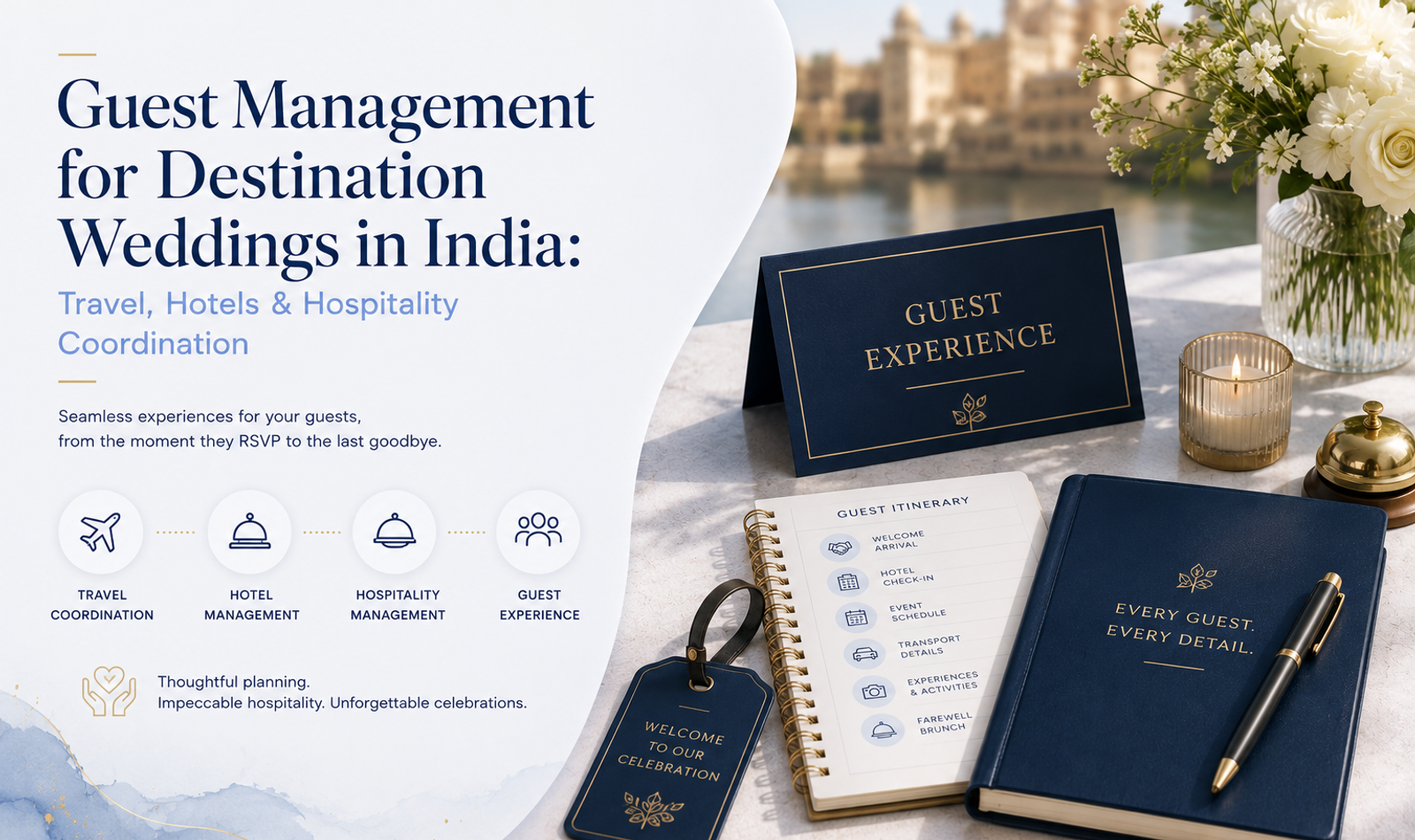
Guest Management for Destination Weddings in India: Travel, Hotels & Hospitality Coordination
A destination wedding is not only about the couple, the venue, the décor or the celebrations. For every guest attending the wedding, the experience begins much earlier.
It may begin with an invitation and RSVP request.
Then come questions about flights, trains, airport pickups, hotel rooms, check-in timings, luggage, wedding itineraries, local transportation, meal preferences and departure arrangements.
For a wedding with 200, 300 or 500 guests travelling from different cities and countries, these individual requirements quickly become a complex hospitality operation.
This is why professional guest management is an important part of destination wedding planning.
A strong guest management system connects RSVPs, travel information, hotel coordination, airport transfers, wedding transportation, welcome desks, concierge support, VIP handling and departures into one organised guest journey.
For the couple, the wedding may begin with the first function.
For the guest management team, it begins weeks or even months before the first guest arrives.
The objective is simple: guests should feel welcomed, informed and looked after without seeing the operational complexity happening behind the scenes.
This guide explains how destination wedding guest management in India works and how families, planners and brands can coordinate travel, hotels and hospitality for a seamless wedding experience.
What Is Guest Management for a Destination Wedding?
Destination wedding guest management is the complete coordination of guests before, during and after a wedding taking place away from their home city.
It may include:
- RSVP management
- Guest database creation
- Travel information collection
- Flight and train coordination
- Airport and railway station pickups
- Hotel room allocation
- Check-in and check-out assistance
- Welcome desks
- Wedding itineraries
- Welcome hampers and room drops
- Local transportation
- Function-wise guest movement
- VIP and celebrity coordination
- Senior citizen assistance
- International guest support
- Concierge services
- Luggage coordination
- Emergency assistance
- Departure transfers
For large celebrations, wedding and event management and guest hospitality need to work together closely.
The wedding planner may be managing décor, production, entertainment and ceremonies while the guest management team concentrates on the people attending them.
Both operations must remain connected.
Why Destination Weddings Need Dedicated Guest Management
A wedding in the family's home city already requires significant coordination.
A destination wedding adds another layer because guests must travel to participate.
A guest flying from Mumbai may arrive at 10 AM. Another family may reach at 2 PM. International guests may arrive the previous evening. Senior relatives may require wheelchair assistance. A celebrity guest may require a private vehicle and discreet hotel entry.
Meanwhile, the hotel may have fixed check-in timings, airport transfers may involve multiple terminals and wedding functions may be taking place at different venues.
Without central coordination, small problems begin accumulating.
Drivers may wait at the wrong terminal.
Guests may not know where their vehicle is.
Room allocation may be incorrect.
Hotels may not receive updated rooming lists.
Guests may miss transportation to a function.
Families may repeatedly call the bride, groom or wedding planners for basic information.
Professional guest management is designed to prevent this.
The goal is not simply to solve problems when they happen.
The goal is to build a system that reduces the number of problems guests experience in the first place.
Start With a Centralised Guest Database
The guest database is the operational foundation of destination wedding hospitality.
Every confirmed guest should be recorded in one central system.
Depending on the wedding, information may include the guest's name, family group, phone number, city, RSVP status, arrival date, departure date, flight or train details, hotel, room category, transfer requirement, dietary preference and special assistance requirement.
Guests can also be categorised.
For example:
Family
Friends
Bride's side
Groom's side
VIP guests
Celebrity guests
International guests
Senior citizens
Children
Vendors
Performers
The objective is to create one reliable source of information.
If travel details are stored in WhatsApp messages, room allocations are in one spreadsheet and RSVPs are maintained by another person, mistakes become much more likely.
A centralised database allows the hospitality, hotel, transport and planning teams to work from the same information.
RSVP Management
Guest management begins before travel coordination.
The first requirement is knowing who is actually attending.
RSVP management should collect more than a simple yes or no.
Depending on the wedding, guests may need to confirm which family members are attending, arrival and departure plans, accommodation requirements, dietary preferences, children's requirements and special assistance.
The RSVP process should also be easy.
Guests should not have to answer the same questions repeatedly to different teams.
For premium celebrations, communication should feel personal rather than administrative.
The tone, design and response experience should reflect the wedding itself.
Collecting Travel Information
Once attendance is confirmed, the team needs accurate travel details.
This may include:
- Airline or train
- Flight or train number
- PNR where appropriate
- Arrival date
- Arrival time
- Airport or railway station
- Terminal
- Departure date and time
- Number of travellers
- Number of bags
- Special assistance requirements
Travel information should be collected early but continuously updated.
Guests change flights.
Flights get rescheduled.
Someone who initially planned to drive may later decide to fly.
An international guest may change a connecting flight.
The system therefore needs both planning data and real-time updates.
Airport and Railway Station Transfers
The arrival experience is one of the most important moments in destination wedding hospitality.
A guest who lands after several hours of travel should not have to search through WhatsApp chats to find a driver's number.
Airport transfer planning should map guests against vehicles, drivers and arrival windows.
For larger weddings, guests arriving around similar times can be grouped where appropriate.
The operations team should know:
Guest name → Arrival point → Arrival time → Vehicle → Driver → Hotel → Coordinator
Depending on the scale of the celebration, airport representatives may also be positioned at arrival points.
They can identify guests, help with luggage and direct them towards their assigned vehicles.
For luxury weddings, this first interaction matters.
Hospitality begins at arrival—not at the hotel lobby.
Real-Time Travel Monitoring
A printed arrival sheet alone is not enough.
Flights can be delayed, cancelled or diverted.
Guests may miss connections.
Traffic conditions may change transfer times.
The hospitality team therefore needs a live coordination system.
If a flight is delayed by two hours, the vehicle dispatch plan should change accordingly.
Otherwise, a driver may wait unnecessarily while another arrival suddenly has no vehicle available.
A command centre can track changes and communicate with airport teams, drivers, hotel desks and family coordinators.
This becomes particularly important when hundreds of guests are arriving within a short period.
Hotel Selection and Room Block Coordination
Hotel coordination is another major part of destination wedding guest management.
Large weddings may reserve dozens or hundreds of rooms across one or multiple hotels.
The hospitality team must understand the total inventory available, room categories, check-in policies, check-out policies, extra-bed requirements and family preferences.
Room blocks should be planned according to guest groups.
For example, elderly family members may need rooms closer to lifts.
Families with children may prefer adjoining rooms.
VIP guests may require suites or more private sections.
Friends may be grouped together.
The allocation should make operational and social sense.
Creating the Rooming List
The rooming list tells the hotel who is staying where.
It should be treated as a live operational document rather than something sent once and forgotten.
Last-minute cancellations, additions and room swaps are common.
The hotel and guest management team should therefore maintain clear version control.
A typical rooming list may include:
Guest name
Number of occupants
Room type
Check-in date
Check-out date
Special request
VIP status
Extra bed requirement
Child requirement
Arrival information
The final allocation should be communicated carefully.
The objective is to make check-in feel effortless.
Managing Early Arrivals and Late Departures
Destination wedding travel rarely matches hotel timings perfectly.
Some guests may land at 7 AM when hotel check-in begins at 2 PM.
Others may have an 11 PM flight when hotel check-out is at noon.
These situations need advance planning.
Depending on hotel policy and availability, solutions may include early check-in rooms, hospitality lounges, luggage storage, temporary holding rooms, common changing areas or extended check-outs.
Guests should know what to expect before arriving.
Uncertainty creates frustration.
Good hospitality removes that uncertainty.
Pre-Arrival Guest Communication
Guests should receive essential information before travelling.
This may include the destination, hotel address, airport transfer information, weather guidance, function schedule, dress codes, important contact numbers and anything specific to the venue.
The communication should be useful without becoming overwhelming.
Guests do not need ten different messages containing information that could have been presented in one clear itinerary.
For destination weddings, WhatsApp often becomes an important communication channel because updates can be distributed quickly.
However, the communication system should still be controlled.
Too many groups, coordinators and messages can create more confusion rather than less.
Wedding Itineraries
A good wedding itinerary acts as a guest's personal guide to the celebration.
It should clearly communicate:
- Function names
- Dates
- Timings
- Venues
- Dress codes
- Transportation timings
- Important contact information
For multi-day weddings, the itinerary becomes particularly important.
Guests should know when they need to leave the hotel rather than only when a function starts.
If a sangeet begins at 8 PM but the venue is 40 minutes away, the guest communication should clearly state the shuttle or departure time.
Beautiful design matters, but operational clarity matters more.
Welcome Desk and Hotel Hospitality
The welcome desk is often the physical centre of wedding guest management.
It may be located in the hotel lobby or a dedicated hospitality area.
The team can assist with:
Guest verification
Room allocation
Key collection coordination
Welcome hampers
Itinerary distribution
Function information
Transportation questions
Special requests
Local information
The desk should feel warm and organised.
Guests should not see staff searching through multiple sheets to find basic information.
The best hospitality operations make complicated logistics feel simple.
Welcome Hampers and Room Drops
Welcome hampers are common at destination weddings, but they should be planned around the guest experience rather than simply presentation.
Depending on the destination and wedding concept, hampers may include refreshments, local products, practical travel essentials, personalised notes, itineraries or recovery items for the following morning.
Room drops can also be used throughout the celebration.
A note before the next function, personalised gift or small surprise can extend hospitality beyond the welcome desk.
These details are particularly effective in luxury event planning because they make guests feel considered individually.
Local Transportation During the Wedding
Airport transfers are only one part of wedding transportation.
Guests may need transportation between:
Hotel and wedding venue
Hotel and welcome dinner
Hotel and sangeet
Hotel and ceremony venue
Hotel and reception
Multiple hotels
After-party venues
This requires a detailed transportation plan.
Vehicles may include sedans, SUVs, luxury cars, coaches, tempo travellers or golf carts depending on the destination.
The team should plan routes, travel times, pickup points, holding areas, vehicle capacities, driver details and dispatch schedules.
Large weddings often need a dedicated transportation desk.
Function-Wise Guest Movement
Moving 300 guests from a hotel to a wedding venue is very different from booking a few taxis.
Transportation should be planned backwards from the function start time.
If guests need to arrive by 7:30 PM, the team must consider loading time, traffic, distance, vehicle turnaround and late guests.
Communication should also be timed properly.
Guests may receive a reminder before departure.
Hospitality coordinators can be positioned near pickup areas.
Vehicles should be dispatched systematically rather than randomly.
The objective is to prevent both delays and unnecessary waiting.
VIP and Celebrity Guest Management
High-profile guests may require a separate hospitality protocol.
This is where guest management may need to work closely with professional celebrity management.
Celebrity, artist, political, business or other high-profile guests may require:
Private airport transfers
Luxury vehicles
Dedicated coordinators
Private hotel check-in
Security coordination
Separate entrances
Green rooms
Controlled schedules
Personal assistants' coordination
Discreet departures
Privacy is particularly important.
The team should avoid unnecessary sharing of room numbers, travel schedules or personal details.
VIP hospitality should feel seamless without attracting unnecessary attention.
Artist and Performer Hospitality
If the destination wedding includes singers, DJs, celebrity performers or other artists, their logistics should be managed separately from general guest hospitality.
Their requirements may include airport transfers, hotel rooms, technical schedules, sound checks, backstage access, meals, security and departure timing.
This should be coordinated alongside the broader wedding operations so artist movements do not conflict with guest movements.
For large celebrations, professional celebrity and artist coordination can significantly reduce last-minute pressure on the family.
Senior Citizen Guest Management
Senior guests may need additional assistance throughout the celebration.
Requirements can include wheelchair access, rooms close to lifts, shorter walking routes, comfortable vehicles, medical support information and assistance moving between functions.
These requirements should be collected before arrival.
Waiting until a guest reaches the venue to discover that the ceremony location involves a long staircase creates avoidable stress.
Hospitality should anticipate needs.
Children and Family Requirements
Families travelling with children may have different needs.
They may request cots, extra beds, connected rooms, babysitting information, child-friendly meals or different transport timings.
These details can be recorded in the guest database and communicated to the hotel in advance.
For larger destination weddings, dedicated children's activities or supervised spaces may also be considered.
International Guest Coordination
International guests require additional planning.
They may need information about visas, local weather, currency, airport transfers, SIM connectivity, destination travel and local customs.
Their flights may also involve international terminals or connecting domestic flights.
Communication should be particularly clear because international guests may be unfamiliar with the destination.
A dedicated point of contact can make the experience significantly easier.
Food Preferences and Special Requirements
Guest information should include relevant dietary requirements.
These may include vegetarian, Jain, vegan, gluten-free or allergy-related requirements.
The guest management team does not necessarily control catering, but it can ensure relevant information reaches the correct food and beverage team.
Medical or accessibility requirements should also be communicated only to the people who genuinely need the information for guest support.
Guest Concierge
A destination wedding concierge acts as the guest's point of assistance during the celebration.
Guests may ask:
Where is tonight's function?
When does my shuttle leave?
Can I change my airport drop time?
Where can I get my outfit steamed?
Can I arrange a car?
I left something at the venue—who can help?
The concierge system should route these requests efficiently.
The family should not become the help desk for its own wedding.
Luggage Management
Luggage becomes an important operational consideration when many guests arrive or depart together.
The team may need to coordinate unloading, tagging, hotel movement, temporary storage and vehicle loading.
For hotel changes or multi-location celebrations, luggage movement needs even more careful planning.
Clear identification is essential.
A misplaced suitcase on a wedding morning can quickly become a major guest experience problem.
Managing Last-Minute Changes
No destination wedding runs exactly according to the first plan.
Guests cancel.
Flights are delayed.
Rooms change.
Vehicles break down.
Someone misses a shuttle.
A family member decides to stay an extra night.
The objective is therefore not to create a plan that assumes nothing will change.
It is to create an operation capable of responding when something does.
Backup vehicles, escalation contacts, updated databases and clear decision-making authority help teams solve problems quickly.
The Guest Management Command Centre
For large destination weddings, one central command centre can coordinate the entire hospitality operation.
It can connect:
Airport teams
Hotel desks
Transportation teams
Wedding planners
Family representatives
Security
Venue teams
Drivers
VIP coordinators
The command centre maintains the live picture.
If a guest's flight is delayed, airport transport can be updated.
If the guest's hotel changes, the driver can be informed.
If a function timing moves, transportation teams can adjust dispatch schedules.
This is how separate operational departments become one guest management system.
Departure Management
Hospitality does not end after the final function.
Departures need the same level of planning as arrivals.
The team should know each guest's departure time, airport or railway station, terminal, vehicle allocation and hotel check-out status.
Airport drops should account for travel time and recommended reporting time.
Guests should receive their departure details in advance.
Vehicles should be positioned appropriately.
Luggage should be loaded correctly.
For early morning departures after a late reception, coordination becomes particularly important.
The final interaction guests have with the wedding may be their departure transfer.
That experience should be as organised as their arrival.
Destination Wedding Guest Management Across India
Guest logistics vary significantly depending on the wedding destination.
A palace wedding in Rajasthan may involve airport transfers followed by longer road journeys.
A Goa wedding may involve guests arriving through different flight schedules and staying across multiple resorts.
A Mumbai wedding may involve heavy traffic and several venues.
A Delhi NCR celebration may involve guests arriving through airports, railway stations and different parts of the region.
The destination therefore affects transportation planning, hotel selection, guest communication and staffing.
The hospitality plan should be built specifically around the location rather than copied from another wedding.
Guest Management for Udaipur and Jaipur Weddings
Rajasthan remains popular for palace and heritage weddings.
However, guests may be spread across multiple hotels and properties.
Transfers between airports, hotels and venues need careful scheduling.
Heritage properties may also have access restrictions, long walking distances or limited vehicle entry.
Senior citizen movement, luggage and VIP transportation therefore require advance planning.
Guest Management for Goa Weddings
Goa destination weddings often involve resort-based celebrations.
Although functions may be concentrated within one property, guests can still be distributed across different hotels.
Airport transfers are a major consideration, particularly when guests arrive throughout the day.
Beach venues and off-property functions may also require shuttle planning.
Weather should be considered during certain seasons.
Guest Management for Mumbai Weddings
Mumbai weddings require strong transportation planning.
Distances that appear short on a map can take considerably longer during peak traffic.
Airport terminals, hotels and venues must therefore be mapped carefully.
For high-profile celebrations, guest management in Mumbai may also involve VIP movements, celebrities, media considerations and enhanced privacy.
Technology in Destination Wedding Guest Management
Technology can make hospitality operations significantly more efficient.
Digital systems can support RSVPs, guest databases, rooming lists, travel information, transportation assignments and communication.
QR-based information, digital itineraries and WhatsApp updates can reduce confusion.
However, technology should support hospitality rather than replace it.
A senior guest who needs assistance should still be able to speak to a real person.
A VIP should have a coordinator when necessary.
The best guest management combines organised technology with human hospitality.
Common Destination Wedding Guest Management Mistakes
One common mistake is collecting travel information too late.
Another is using multiple disconnected spreadsheets.
Families may also underestimate transportation requirements between functions.
Poor room allocation can create unnecessary guest complaints.
Another mistake is failing to account for early arrivals and late departures.
Some weddings also create too many WhatsApp groups, resulting in communication overload.
VIP requirements may be discovered too late.
Guest transportation may be planned without realistic traffic buffers.
Finally, many teams concentrate heavily on arrival and forget departure logistics.
Most of these issues can be reduced through earlier planning and centralised coordination.
How Early Should Destination Wedding Guest Management Begin?
Guest management should begin as soon as the destination, wedding dates and broad guest list are reasonably clear.
The exact timeline depends on the wedding's scale and complexity.
Initial work may include guest database preparation and RSVP planning.
As confirmations arrive, the team can begin collecting travel and accommodation requirements.
Closer to the wedding, rooming lists, transfer schedules, vehicle allocations, welcome desks and function-wise transportation become more detailed.
The final days should focus on updates and execution rather than building the entire system from scratch.
How to Choose a Destination Wedding Guest Management Company
The right partner should understand both hospitality and operations.
Families should look for experience in managing guest databases, travel coordination, hotels, airport transfers, transportation, VIP guests and on-ground teams.
The company should also have clear systems for handling changes.
Ask how information is collected.
Ask who coordinates with hotels.
Ask how airport pickups are tracked.
Ask how transportation is dispatched.
Ask how VIP requirements are managed.
Ask what happens when a flight is delayed or a guest changes plans.
A good guest management company should be able to explain the operational system behind the hospitality experience.
Frequently Asked Questions
What is destination wedding guest management?
Destination wedding guest management is the coordination of guest RSVPs, travel details, airport transfers, hotels, room allocations, wedding transportation, welcome desks, concierge requirements and departures.
What does a wedding guest management company handle?
A professional team can handle guest databases, RSVP tracking, travel coordination, airport and railway pickups, hotel coordination, check-ins, itineraries, transportation, hospitality desks, VIP requirements and departure transfers.
How are airport transfers managed for destination weddings?
Guest arrival information is mapped against vehicles, drivers and hotels. The operations team tracks arrivals, coordinates drivers and updates allocations when flights are delayed or changed.
How do you manage hundreds of guests at a destination wedding?
Large weddings require a central guest database, clearly divided operational teams, transportation schedules, hotel rooming lists, communication systems and a central command structure.
Who manages celebrities and VIP guests at weddings?
High-profile guests can be handled through dedicated VIP coordinators working with the wedding's hospitality, security and celebrity management teams.
How are hotel rooms allocated for wedding guests?
Rooms are generally allocated based on family groups, check-in dates, room categories, senior citizen requirements, children, VIP status and other practical considerations.
How early should guest management begin?
Planning should begin well before the wedding, ideally once the broad guest list, dates and destination are established. Detailed travel and hotel coordination can then develop as RSVPs are confirmed.
Is guest management different from wedding planning?
Yes. Wedding planning covers the broader celebration, including venues, décor, production, vendors and functions. Guest management concentrates specifically on the guest journey, logistics and hospitality. Both should work together.
How Double Trouble Studio Manages Destination Wedding Guests
At Double Trouble Studio, destination wedding guest management is approached as one connected hospitality journey.
The process begins with guest information and RSVP coordination.
From there, the team can organise travel details, airport and railway transfers, hotel rooming, arrivals, check-ins, welcome hospitality, wedding itineraries, function transportation, concierge requirements and departures.
For celebrations involving high-profile attendees, our celebrity management services can work alongside guest hospitality for more controlled coordination.
For larger celebrations, guest operations are integrated with our broader events and weddings services so hospitality, event timelines, transportation and on-ground execution remain connected.
The objective is not simply to move guests from one place to another.
It is to make the entire journey feel considered.
Conclusion
Destination wedding guest management is ultimately about hospitality supported by strong logistics.
Guests should not have to think about airport pickups, room allocations, shuttle schedules or who to call when plans change.
Those systems should already be working in the background.
A well-managed guest journey begins with accurate information and continues through RSVPs, travel coordination, airport transfers, hotel check-ins, welcome hospitality, wedding functions, transportation, concierge assistance and departures.
For luxury destination weddings, these details become part of the celebration itself.
Beautiful décor may create the first photograph.
Entertainment may create the energy.
But thoughtful hospitality often determines how guests remember the wedding.
Double Trouble Studio provides guest management, events and wedding management, and celebrity management for destination weddings and premium celebrations in India.
For destination wedding guest hospitality, travel coordination and on-ground management, contact Double Trouble Studio to plan a structured guest experience from arrival to departure.
📩 info@dtsworld.in 📞 +91 80000 06021 📍 Andheri West, Mumbai
Need this for your brand?
Let DTS build your next campaign.
From PR, celebrity management and events to websites, social media, SEO and AI video production — Double Trouble Studio helps brands grow with strategy and execution.
Discuss Your Requirement →