Managing Complex Guest Lists for Luxury Events: Segmentation, Prioritization and Control
Luxury events rarely have simple guest lists. A premium wedding, corporate summit, hospitality launch or celebrity-attended experience may include family members, investors, media representatives, public figures, sponsors, performers, government guests and several internal stakeholders.
Each group has different expectations, access requirements and relationship importance. Managing everyone through one general list creates confusion around invitations, RSVPs, seating, security, hospitality and follow-up. Complexity increases further when last-minute additions, plus-ones and changing attendance plans are introduced.
Luxury event guest list management is therefore not an administrative exercise. It is a strategic process that connects event capacity, relationship value, brand positioning, guest experience and operational control.
A well-managed guest list helps the event feel exclusive without becoming rigid. It ensures that the right people are invited, prioritised and supported while protecting the experience from overcrowding, duplication and last-minute chaos.
Quick Answer
Complex guest lists should be managed through one verified database, clearly defined guest segments, invitation priorities and a controlled approval process. Every guest should have a category, relationship owner, RSVP status, access level and relevant hospitality information.
The event team should also set capacity limits, plus-one rules, invitation deadlines and escalation authority before invitations are sent. Luxury event guest list management becomes effective when changes are controlled rather than handled through disconnected messages and informal promises.
What Is Luxury Event Guest List Management?
Luxury event guest list management is the process of planning, organising and controlling the people invited to a premium event. It begins with deciding who should attend and continues through invitation delivery, RSVP confirmation, access, seating and post-event communication.
The process includes more than storing names and contact numbers. A complete guest list should explain who each person is, why they are attending and what type of experience they require.
A celebrity may need a private arrival route and controlled photography. An investor may require access to senior leadership, while an elderly wedding guest may require comfortable seating and transport support.
The guest list becomes the central operational document connecting invitation, arrival, registration, security, hospitality and relationship management. When the information is accurate, every department can prepare more effectively.
Why Complex Guest Lists Require Strategy
Large and high-profile events involve several decision-makers. Family members, founders, sponsors, partners and internal teams may all request invitations for different people.
Without a clear strategy, the list expands faster than the event’s real capacity. Names are added without understanding their relevance, while priority relationships may receive the same process as general attendees.
This creates pressure on seating, catering, registration and hospitality. It can also weaken exclusivity because the event becomes crowded with people who do not contribute to its purpose.
A strategic approach links every invitation to a reason. The organiser should understand whether the guest supports a family relationship, business objective, media opportunity, partnership or cultural responsibility.
The Guest List Defines the Event Experience
The composition of the guest list influences the tone of the entire event. An investor gathering requires different people from a product launch, while a luxury wedding requires a different balance from a public brand experience.
Inviting too broadly can dilute the purpose. Guests may struggle to understand why they are present or who they should meet. The event may look busy while producing very little meaningful interaction.
Inviting too narrowly can also limit value. Important partners, family representatives or media relationships may be overlooked because the list was built without enough context.
The objective is not to create the largest list. It is to create the right combination of people for the event’s purpose, capacity and positioning.
Begin with the Event Objective
The guest-list strategy should begin with a clear understanding of what the event must achieve. Every invitation should connect to the purpose in some way.
A luxury wedding may focus on family relationships, hospitality and emotional celebration. A corporate summit may aim to strengthen client relationships, create partnerships and establish industry authority.
A hospitality launch may require media visibility, influencer participation and high-value customer engagement. A private preview may prioritise select clients and trusted partners rather than maximum attendance.
When the objective is clear, guest selection becomes easier. The organiser can evaluate each proposed name according to relevance instead of responding only to status or pressure.
Define Luxury Capacity Before Adding Names
One of the most important guest list controls is defining the event’s real capacity before invitations begin. The maximum number allowed by the venue is not always the number that can receive a luxury experience.
Guests require space to arrive, register, move, sit, dine and leave comfortably. The organiser must also consider service staff, performers, production teams and security personnel when reviewing operational capacity.
A venue that can technically accommodate 500 people may feel more premium with 350 guests. Reduced density can improve service speed, movement and personal attention.
Capacity should therefore be based on the desired experience, not only the floor plan. Once the limit is set, every invitation request must be reviewed against it.
Create a Capacity Allocation Plan
A complex guest list becomes easier to manage when the total capacity is allocated across different stakeholder groups. This prevents one department or family group from consuming the entire list.
For example, the organiser may reserve a certain number of invitations for hosts, clients, partners, media, sponsors and special guests. The exact allocation depends on the event’s purpose.
A controlled reserve should also be maintained for approved late additions. Filling every place at the beginning leaves no flexibility for genuine last-minute requirements.
Capacity allocation should be reviewed regularly as RSVPs arrive. Unused places can be reassigned through an authorised process rather than distributed informally.
Building One Central Guest Database
The master guest database should be the only approved source of information. Separate spreadsheets, personal notes and messaging threads create conflicting versions.
Each guest record should include identity, category, relationship owner, invitation status and RSVP status. It should also include relevant access, seating and hospitality information.
Important fields may include:
• Guest full name
• Preferred designation
• Guest category
• Invited by
• Relationship owner
• RSVP status
• Plus-one status
• Access level
The database should be simple enough for authorised teams to use correctly. Too many unnecessary columns can make important information difficult to identify.
Establishing Data Ownership
A central database requires clear ownership. One person or team should control the master version and confirm that every approved change is entered accurately.
Different departments may submit updates, but they should not create separate official lists. A name added through a phone call or WhatsApp message should only become confirmed once it appears in the master system.
Editing permissions should be limited. Some team members may only need viewing access, while senior coordinators may approve changes.
Clear ownership prevents accidental deletion, duplicate names and unauthorised invitations. It also allows the organiser to identify who made each decision.
Standardising Guest Information
Complex lists become difficult to manage when names, titles and organisations are entered inconsistently. One person may appear several times because their name has been written differently.
The organiser should establish formatting rules for names, phone numbers, email addresses and organisations. Titles and designations should be verified before invitations are sent.
Duplicate records should be checked using contact information and relationship context. Removing duplicates protects capacity and reduces embarrassing repeated communication.
Standardisation also improves registration. Staff can locate guest records more easily when information follows a consistent structure.
Understanding Guest Segmentation
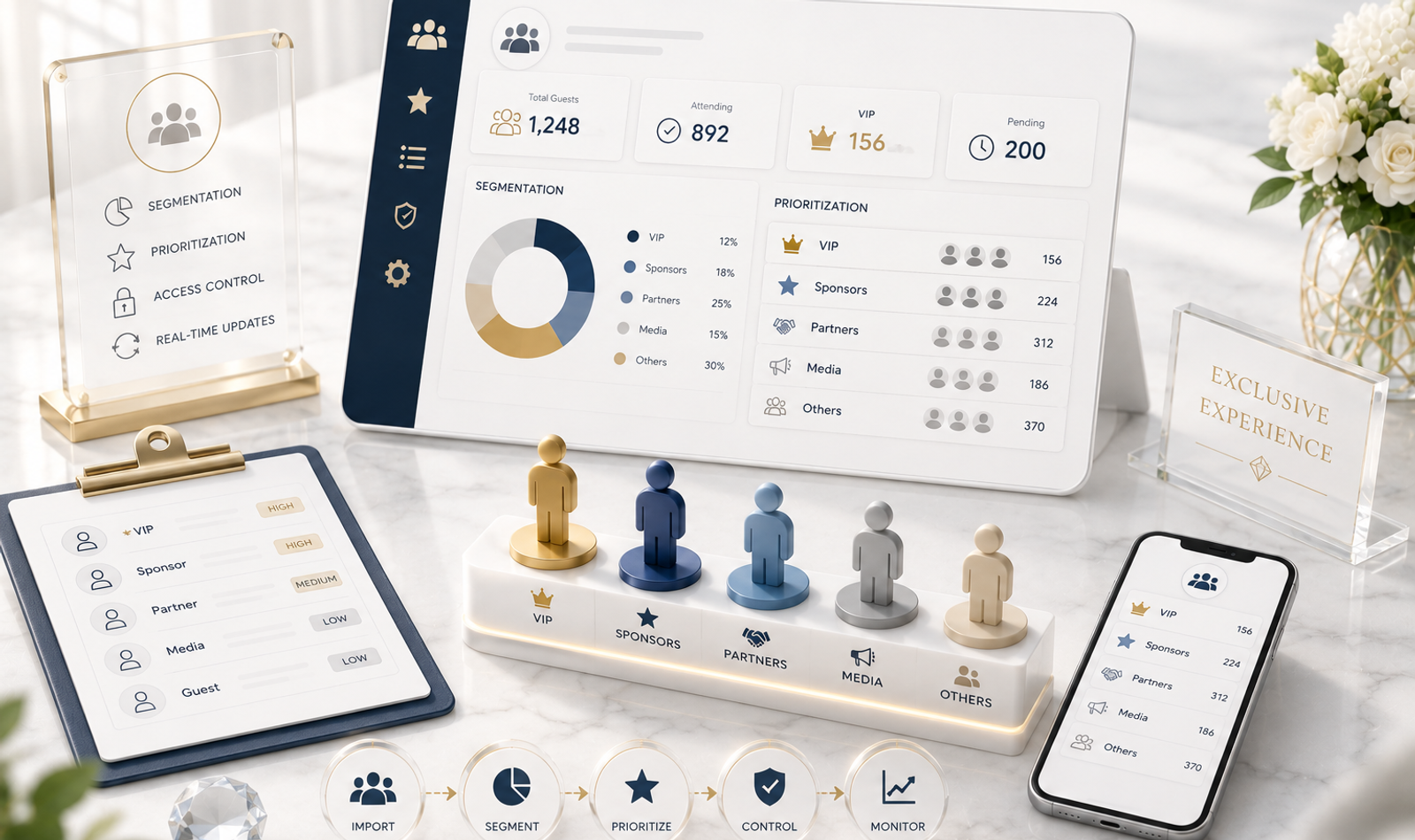
Guest segmentation means organising attendees into meaningful categories according to their relationship, role and operational requirements. It helps teams prepare different journeys without creating visible confusion.
A simple VIP and general guest split is rarely enough for luxury events. Two high-profile guests may require completely different handling because one is a celebrity and the other is an investor.
Useful segments may include:
• Hosts and family
• VIP and celebrity
• Clients and investors
• Media and influencers
• Sponsors and partners
• Speakers and performers
• General attendees
• Vendors and teams
Each segment should have defined communication, access, seating and hospitality requirements. The system should remain practical rather than creating excessive categories that staff cannot understand.
Segmenting by Relationship
Relationship segmentation identifies how the guest is connected to the host, brand or family. This context influences communication and follow-up.
A long-term client may require personal contact from a senior executive, while a new prospect may receive communication through a guest manager. A family elder may require a personal invitation from the host.
The relationship should also influence seating and introductions. Guests with strong strategic or personal connections should not be managed entirely through generic processes.
Relationship context helps the event team understand why the guest matters. It turns the list from a database into a relationship map.
Segmenting by Operational Requirement
Operational segmentation groups guests according to the access, security and hospitality they require. This is different from relationship value.
A media representative may require credentials and access to a press zone. A performer may require backstage access, while a celebrity may need a private arrival and departure route.
Guests with mobility requirements may need shorter walking distances and accessible seating. Destination guests may need airport, hotel and luggage coordination.
Operational segmentation allows teams to prepare the correct support. The categories should describe what must happen rather than making public judgements about status.
Segmenting by Event Participation
Some guests are not attending only as audience members. They may be speakers, sponsors, performers, hosts or content collaborators.
Their guest record should reflect the role they are expected to play. A speaker may need session timing, rehearsal support and stage access.
A sponsor may require hosted introductions and visibility reporting. A wedding family member may have ceremonial responsibilities that affect timing and seating.
Role-based segmentation reduces confusion because the team understands what each person needs to do, not only where they should sit.
Creating Priority Levels
Prioritization helps the organiser decide which guests receive immediate attention when capacity, seating or timing becomes limited. The levels should be defined before pressure begins.
A practical system may use three or four internal priority levels. Each level should have clear criteria rather than being assigned according to personal opinion.
Priority may reflect:
• Host relationship
• Strategic importance
• Protocol requirement
• Event responsibility
• Security sensitivity
• Family relevance
The labels should remain confidential and respectful. They are operational tools, not public rankings of human worth.
Priority One Guests
Priority One guests are typically essential to the event’s purpose or central relationships. Their absence or poor handling could significantly affect the experience or objective.
This category may include hosts, immediate family, key investors, headline speakers, celebrities, senior partners or government guests.
Their invitations, confirmations and requirements should be personally monitored. Arrival, seating, access and follow-up should have clear ownership.
Priority One should remain limited. If too many people receive the highest classification, the system loses meaning and resources become diluted.
Priority Two Guests
Priority Two guests are highly valuable but may not require the same level of protocol or security. They may include important clients, extended family, sponsors, media leaders and strategic partners.
Their communication should remain personalised, but it may be managed through a trained relationship team rather than directly by the host.
The organiser should ensure that their seating, access and hospitality remain appropriate. They should not feel secondary simply because the internal process has different levels.
Priority Two allows the event to maintain strong relationship management without overloading senior hosts.
Priority Three Guests
Priority Three may include general invited attendees, wider professional networks, community members and guests whose participation supports the event atmosphere.
They should still receive a polished and respectful experience. Prioritization should never justify poor service.
The difference may appear in communication method, arrival protocol or relationship ownership rather than basic hospitality quality.
Every guest contributes to the overall event. Priority levels determine operational focus while maintaining a consistent standard of welcome.
Creating an Invitation Approval Process
Luxury guest lists often become difficult because names are added through informal promises. A host, family member or partner may invite someone before checking capacity.
An approval process should define who can propose guests and who can confirm them. Proposed names should not be treated as invited until authorised.
The request should include the guest’s name, relationship, reason for invitation and required category. This information allows the decision-maker to review relevance and capacity.
A clear approval process protects relationships because teams can explain that invitations follow a structured system. It reduces pressure on registration and seating teams later.
Setting Invitation Deadlines
Guest-list deadlines create operational stability. The organiser should establish dates for initial nominations, final invitations, RSVP confirmation and seating freeze.
Late additions may still occur, but they should follow a separate exception process. The deadline helps stakeholders understand that unlimited changes are not possible.
The invitation timeline should allow enough time for guests to respond and for the event team to prepare hospitality. Sending large numbers of invitations too late creates inaccurate planning.
Deadlines should be communicated to internal stakeholders as clearly as event details are communicated to guests. Control begins within the organising team.
Managing Waiting Lists
A waiting list can help organisers manage demand without over-inviting. It allows additional guests to be considered if confirmed attendees decline.
The waiting list should remain confidential. Guests should not feel that they are publicly being treated as a secondary choice.
Invitations released from the waiting list should still feel intentional. The message should not reveal internal capacity management.
The organiser should set a final date after which new invitations will no longer be issued. Very late invitations may create a poor impression unless the relationship allows informal flexibility.
Managing Plus-Ones
Plus-one management is one of the most common sources of guest-list expansion. A single invitation can quickly become two or more attendees when companions are not controlled.
The invitation should clearly state whether a plus-one is included. Where allowed, the companion’s name should be recorded before the event.
The organiser should also clarify how children, assistants, security personnel and drivers are treated. These individuals may require access even when they are not included in seating or hospitality capacity.
Entrance staff should not negotiate plus-one rules publicly. Any exception should be handled by an authorised senior person away from the main queue.
Controlling Family Guest Lists
Luxury weddings may involve several family groups contributing names. Emotional relationships and social expectations can make control more complex.
Each family group may receive a defined allocation and deadline. One representative should be responsible for submitting accurate information.
Duplicate names should be reconciled before invitations are sent. The same guest may appear on lists from both families or several relatives.
Family sensitivities should be handled respectfully, but the event’s capacity and hospitality standards must remain protected. A structured allocation process reduces personal conflict.
Managing Corporate Guest Lists
Corporate events may involve sales teams, founders, marketing departments, sponsors and partners requesting invitations. Each department may view its relationships as essential.
The organiser should connect nominations to the event objective. A guest may be prioritised because they are a current client, strategic prospect, investor or media relationship.
Departments should provide context instead of submitting names alone. The relationship owner should also be identified so follow-up does not become unclear.
Corporate lists should avoid becoming mass databases. The strongest events bring together people who have a genuine reason to attend and interact.
Managing Celebrity Guest Lists
Celebrity and public-figure invitations require controlled communication. The guest may respond through a manager, assistant, publicist or security representative.
The database should distinguish between the celebrity and accompanying team members. Their access, seating and hospitality requirements may differ.
Attendance should remain confidential until authorised. Internal guest lists should not be shared widely simply because the name creates interest.
A dedicated coordinator should manage confirmation, arrival, content permissions and departure. Celebrity attendance requires relationship control as much as list control.
Managing Media and Influencer Guests
Media and influencer lists should support the event’s communication objectives. Invitations should be based on relevance, audience and expected role rather than follower numbers alone.
Journalists may require press notes, interview access and approved photography. Influencers may need content guidelines and clearly defined deliverables when a formal collaboration exists.
The list should distinguish between editorial media, paid collaborators and organic guests. These relationships involve different expectations and follow-up.
Access should also be controlled. A media credential does not automatically provide entry into private or VIP zones.
Managing Sponsors and Partners
Sponsors may receive a guest allocation as part of their agreement. The number, category and access rights should be confirmed in writing.
The organiser should set a deadline for sponsor names. Last-minute submissions can affect credentials, seating and hospitality.
Sponsor guests should be integrated into the central database rather than managed separately. This ensures that registration and access teams work from one source.
Any lead-sharing or guest-data arrangement should be handled transparently and responsibly. Sponsorship does not automatically create unrestricted access to attendee information.
RSVP Management for Complex Lists
RSVP status should be visible for every guest. Common categories may include invited, confirmed, declined, pending and cancelled.
The organiser should also record how and when the response was received. A verbal confirmation should be entered into the master database immediately.
Reminders can be segmented according to guest category and relationship. A VIP may require personal follow-up, while general attendees may receive an automated reminder.
The process should remain respectful. Repeated messages after a clear decline can damage the relationship and create poor brand perception.
Monitoring Confirmation Progress
The event team should review confirmation progress regularly rather than waiting until the final week. Early reporting helps identify slow-response segments and capacity gaps.
The report may show invitations sent, confirmations received, declines and pending responses. It should also identify unresolved plus-ones and incomplete information.
Patterns can guide communication. If many guests have opened the invitation but not responded, the RSVP process may be unclear or inconvenient.
Regular monitoring allows the team to adjust without creating last-minute panic.
Managing Declines and Cancellations
A decline should be recorded promptly and treated respectfully. The guest may still remain an important relationship even when they cannot attend.
Where appropriate, the host can acknowledge the response and express interest in a future opportunity. The tone should match the relationship.
Cancellations may release seating and hospitality capacity. The place can then be reassigned through the waiting-list or approval process.
The database should preserve the correct status. A cancelled guest should not continue receiving arrival instructions or registration credentials.
Handling No-Response Guests
Some guests may not respond despite reminders. The organiser should decide when a pending invitation is considered inactive.
Priority guests may require direct confirmation through a relationship owner. General guests may receive a final deadline after which the place is released.
The process should avoid indefinite uncertainty. Catering, seating and transport cannot remain open until the event begins.
A clear RSVP policy protects planning while still allowing genuine high-priority exceptions to be considered separately.
Connecting the Guest List to Seating
The guest database should connect directly to the seating plan. This prevents names from being placed without updated RSVP information.
Seating should reflect relationships, protocol, accessibility, privacy and movement. Priority does not always mean proximity to the stage.
A guest may be more comfortable near a familiar group or closer to an exit. Media and speakers may need operationally useful positions.
The seating team should work only with confirmed guests unless a controlled reserve is being maintained. Pending names should not displace confirmed attendees indefinitely.
Creating Seating Groups
Seating groups can be organised according to family, organisation, relationship or shared interest. The objective is to create comfortable and meaningful interaction.
At a corporate event, guests from complementary industries may benefit from being placed nearby. At a wedding, family relationships and cultural expectations may influence table planning.
The organiser should avoid assumptions based only on age, job title or social visibility. Relationship owners can provide useful context.
Seating should feel natural even when it has been carefully engineered. Guests should experience relevance, not obvious manipulation.
Maintaining Seating Reserves
A limited seating reserve allows the event to respond to genuine late additions, VIP changes or operational needs.
The reserve should be controlled by one senior decision-maker. If several people use it independently, the flexibility disappears quickly.
Reserved seats should be positioned so that they can be integrated without making the table appear incomplete. The layout team should understand how the reserve will function.
A reserve is not a substitute for list discipline. It protects the event from exceptions while the main guest list remains controlled.
Connecting the Guest List to Access Control
Every guest category should have a defined access level. This may determine entry gate, lounge access, backstage movement or session permissions.
Access information can be connected to QR codes, RFID cards, badges or manual credentials. The technology should retrieve the latest approved status.
The guest list should also identify authorised companions, assistants and security personnel. Their credentials may differ from the main guest.
Access control should remain discreet. The objective is to protect spaces and relationships without making guests feel publicly ranked.
Managing Real-Time Changes
Guest lists continue to change even after the event begins. Flights may be delayed, companions may cancel and senior guests may confirm unexpectedly.
A controlled communication channel should be used for real-time changes. Updates should reach only the departments that need them.
The master database should remain the official source. Screenshots and messages should not become permanent alternative lists.
Every change should include the approving person, time and operational impact. This helps teams understand whether seating, access or hospitality must also be updated.
Creating an Event-Day Control Desk
Complex events benefit from a central guest-control desk. This team manages the master list, exceptions, arrivals and communication between departments.
The control desk should include authorised decision-makers rather than only data-entry staff. It must be able to resolve missing names, plus-one requests and access questions quickly.
Communication with registration, security, seating and hospitality teams should remain structured. Too many informal calls can create conflicting instructions.
The control desk protects the event from visible confusion. Guests receive one coordinated answer instead of being passed between departments.
Preparing for Guest List Exceptions
Not every issue can be prevented. The team should prepare for names missing from the list, duplicate credentials and unapproved companions.
The exception process should be located away from the main queue. This protects privacy and keeps regular entry moving.
Staff should verify the relationship and contact the appropriate owner. They should not publicly accuse or embarrass the guest.
A senior person should make the final decision according to capacity, security and relationship context. The response should remain calm even when access cannot be approved.
Training Guest-Facing Teams
Guest-facing teams should understand the list structure, categories and access rules. They do not need to see every private note.
Training should explain how to search names, verify companions and respond to exceptions. Staff should also know which details must remain confidential.
The tone of communication is as important as the decision. A guest denied access may still remember whether the situation was handled respectfully.
Scenario-based rehearsals help teams practise common problems. Confidence allows them to protect both flow and guest dignity.
Protecting Guest List Privacy
A luxury guest list may contain private contacts, travel details, family relationships and celebrity attendance. Uncontrolled sharing can create serious privacy and security risks.
Access should be limited according to role. Registration teams may require names and credentials, while catering teams may only need hospitality information.
Guest lists should not be forwarded through personal messaging groups or displayed on unprotected screens. Printed copies should be numbered and collected after use.
Privacy is part of luxury service. Guests should feel that their information is handled with the same discretion as their physical experience.
Managing Printed Lists
Printed lists may be necessary as a backup, but they should contain only the information required for that location.
A registration backup may show names and access status without private phone numbers or travel details. A seating list may omit unrelated contact information.
Each copy should be controlled and collected at the end of the event. Lists should not be left at counters, vehicles or staff rooms.
Outdated versions should be destroyed when updated copies are issued. Paper remains useful, but it requires the same discipline as digital information.
Controlling Vendor Access
Hotels, transport providers, security teams, caterers and technology vendors may need parts of the guest list.
Each vendor should receive only what is required for its service. A transport company may need arrival details but not seating or private relationship notes.
The organiser should define how information will be stored, used and deleted. Vendors should not retain the guest database for future marketing.
Controlled sharing reduces risk and keeps responsibility clear. The complete master list should remain restricted to authorised event leadership.
Post-Event Guest List Closure
Guest list management continues after the event. Attendance should be reconciled, and pending hospitality or relationship matters should be assigned.
The organiser should record who attended, who cancelled and which guests require post-event follow-up. This information supports thank-you communication and future planning.
Temporary copies and access accounts should then be removed. Vendors should delete information that is no longer required.
The master record may retain only appropriate relationship and attendance information. Event-specific details should not remain permanently without a clear purpose.
Using Guest List Data for Future Events
Past attendance can help improve future invitation planning. Returning guests may have established preferences or relationship history.
However, attendance at one event should not automatically place a person on every future list. Relevance must be reviewed again.
Preferences may also change. The team should confirm important information rather than assuming that an old requirement remains current.
Historical data should support better relationships, not create uncontrolled permanent profiling. Future invitations should continue to feel intentional.
The CLEAR Guest List Framework
The CLEAR framework can help luxury event teams manage complex guest lists through one disciplined system.
C — Clarify the Objective
Define the event’s purpose, desired audience and real capacity before names are added. Every invitation should have a clear reason.
L — List and Segment
Create one verified database and organise guests according to relationship, role, access and hospitality needs.
E — Establish Priority
Define internal priority levels, approval authority and capacity allocation. Prioritization should remain confidential and practical.
A — Approve and Amend
Use one structured process for nominations, plus-ones, late additions and real-time changes. No informal promise should bypass the master list.
R — Reconcile and Review
Confirm attendance, close pending matters, remove unnecessary data and document improvements after the event.
The CLEAR framework ensures that guest list management remains strategic from planning through post-event closure.
Measuring Guest List Performance
Guest list performance can be measured through accuracy, control and operational outcomes. The organiser should review more than total attendance.
Useful indicators include RSVP completion, duplicate records, late additions and plus-one exceptions. Check-in delays and seating disputes can reveal weaknesses in the list process.
The team should also review whether priority guests received the correct experience and whether follow-up ownership was clear.
Measurement helps identify whether problems were caused by data, communication, approval or execution. These insights improve future events.
Common Guest List Mistakes
One common mistake is beginning with names before defining event capacity and purpose. This allows the list to grow without strategic control.
Another failure is maintaining several competing spreadsheets. Teams may believe they have accurate information while working from outdated versions.
Unclear plus-one rules, unrestricted stakeholder access and weak deadlines also create complexity. These problems often become visible only at registration or seating.
The strongest solution is one database, one approval process and one accountable control team. Complexity becomes manageable when ownership is clear.
Frequently Asked Questions
What Is Luxury Event Guest List Management?
Luxury event guest list management is the strategic planning and control of invitations, RSVPs, guest categories, access, seating and relationship ownership. It ensures that the right guests receive the correct experience.
The process begins before invitations are sent and continues through post-event follow-up. It connects relationship strategy with event operations.
Why Is Guest Segmentation Important?
Guest segmentation helps organisers understand different communication, access and hospitality requirements. Celebrities, media, investors and family members may all require different journeys.
Segmentation reduces confusion and allows teams to prepare before guests arrive. The treatment should remain discreet and respectful.
How Should Guests Be Prioritised?
Guests should be prioritised according to the event objective, relationship importance, protocol, participation and operational requirements. The criteria should be defined before individual names are reviewed.
Priority levels should remain internal. Every guest should still receive a consistent standard of hospitality.
How Can Organisers Prevent Over-Inviting?
The organiser should define real experience capacity before invitations begin. Stakeholder allocations, approval rules and a controlled reserve help protect the limit.
Invitation requests should not become confirmed until they are entered into the approved master list.
How Should Plus-Ones Be Managed?
Invitations should clearly state whether a plus-one is allowed. Approved companions should be named in advance wherever possible.
Unapproved requests should be handled through a senior exception process rather than negotiated publicly at registration.
What Information Should a Guest List Include?
The list should include the guest’s correct name, category, relationship owner, RSVP status, plus-one status and access level. Relevant seating and hospitality requirements may also be included.
Only information required for the event should be collected. Access should be restricted according to role.
How Should VIP Guests Be Managed?
VIP guests should have clear relationship ownership, confirmed access, seating and arrival protocols. Their requirements should be reviewed before the event.
VIP information should remain confidential and available only to relevant teams.
How Should Celebrity Guests Be Listed?
The celebrity, manager, assistant and security personnel should be recorded separately according to their roles. Their access and hospitality needs may differ.
Confirmation and content permissions should be coordinated through authorised representatives.
How Should Corporate Guest Lists Be Managed?
Corporate departments should submit names with relationship context and invitation purpose. One team should control approvals and the master database.
The list should support client, partner, investor and media objectives without becoming a mass contact database.
How Should Wedding Guest Lists Be Controlled?
Family groups can receive defined allocations and deadlines. One representative from each group should submit accurate names.
Duplicates, plus-ones and family relationships should be reviewed before invitations and seating are finalised.
What Is a Guest List Freeze?
A guest list freeze is the deadline after which general changes are no longer accepted. Later additions require senior approval.
The freeze allows registration, seating, security and hospitality teams to prepare with stable information.
How Should Last-Minute Guests Be Handled?
Last-minute requests should be reviewed according to capacity, security and relationship value. One authorised decision-maker should approve or decline the addition.
The change should then be entered into the master database and shared with relevant teams.
How Can Guest List Privacy Be Protected?
Use role-based access, secure systems and limited vendor sharing. Avoid unrestricted spreadsheets, personal messaging groups and unnecessary printed copies.
Sensitive VIP, travel and contact information should receive stronger controls.
How Is Guest List Success Measured?
Success can be measured through RSVP accuracy, duplicate reduction, controlled additions, smooth check-in and limited seating disputes. Priority guest experience and follow-up completion also matter.
The goal is not only attendance. It is accurate and controlled execution.
Does Double Trouble Studio Manage Complex Guest Lists?
Double Trouble Studio supports luxury weddings, corporate events, private previews, hospitality launches and celebrity-attended experiences with guest-list strategy, segmentation, prioritization and RSVP management.
The scope can also include VIP mapping, access planning, seating coordination, event-day control and post-event follow-up.
How Double Trouble Studio Manages Complex Guest Lists
Double Trouble Studio approaches guest-list management as a strategic part of the complete luxury event journey. We connect invitation planning, relationship mapping, RSVP control and on-ground execution through one coordinated process.
Our work can include guest database design, segmentation, invitation prioritization, plus-one management, VIP mapping, seating coordination and access control. We can also support real-time updates, event-day exceptions and post-event reconciliation.
Every guest list is adapted to the event’s objective, venue, capacity and audience. A luxury wedding, corporate summit and celebrity-attended launch require different approval and relationship systems.
The objective is to protect exclusivity while ensuring that every confirmed guest receives a smooth, appropriate and premium experience.
Conclusion
Complex guest lists become difficult when names are collected without structure, ownership or capacity control. The problem is rarely the number of guests alone. It is the absence of a clear system connecting relationships with operations.
Segmentation helps teams understand different requirements, while prioritization protects important relationships and event objectives. Controlled approvals prevent last-minute additions from weakening seating, access and hospitality.
One verified database creates consistency across invitations, registration and on-ground execution. Clear relationship owners ensure that no important guest is overlooked.
When guest list management is strategic, the complexity remains invisible. Guests experience recognition, relevance and ease without seeing the detailed planning behind the event.
Plan Your Luxury Guest List with Double Trouble Studio
A premium event begins with the right people, the right priorities and the right level of control. Double Trouble Studio designs complete guest-list systems for luxury weddings, corporate summits, brand launches, private previews and celebrity-attended experiences.
Our approach can include guest segmentation, invitation prioritization, RSVP management, VIP mapping, seating coordination, access control and event-day guest operations.
Connect with Double Trouble Studio to create a complex guest list that remains accurate, controlled and aligned with your event objectives.
📩 info@dtsworld.in | 📞 +91 80000 06021 | 📍 Andheri West, Mumbai
Need this for your brand?
Let DTS build your next campaign.
From PR, celebrity management and events to websites, social media, SEO and AI video production — Double Trouble Studio helps brands grow with strategy and execution.
Discuss Your Requirement →