What Is a KOL Collaboration? (Quick Answer)
A KOL (Key Opinion Leader) is a person people trust for real knowledge in a field, such as a chef, doctor, stylist, designer or industry expert. A KOL collaboration is a planned partnership where the brand and the KOL agree on what will be shared, when, how it will be labelled and what the KOL will be paid or given.
In simple words: the brand gets borrowed trust and expert credibility, and the KOL gets a clear brief, fair pay and a written agreement. The sections below explain how to plan, choose, contract and measure a KOL or influencer collaboration in India.
They allow companies to enter existing communities through trusted voices rather than depending only on advertisements published through their own channels.
A fashion creator can introduce a collection through personal styling. A travel influencer can demonstrate the experience of a resort. A dermatologist can explain the role of an ingredient within a skincare routine.
A respected founder, architect, chef, financial educator or technology specialist may influence a professional audience through detailed expertise rather than entertainment-led content.
These partnerships can create awareness, social proof, customer education, qualified traffic, enquiries and sales.
However, strong results do not come automatically from choosing a person with a large follower count.
The quality of an influencer or KOL collaboration depends on audience relevance, credibility, content ability, commercial structure, campaign execution and measurement.
A creator may have millions of followers but limited influence within the brand’s target market.
Another creator may have a smaller community but generate stronger conversations, greater trust and more commercially valuable action.
A respected key opinion leader may not publish highly polished lifestyle content, yet their recommendation may strongly influence professional decisions.
Brands must therefore understand what they want the partnership to accomplish before selecting a collaborator.
They must also distinguish between reach and influence.
Reach describes how many people may encounter the content. Influence describes whether the person can affect how the audience thinks, evaluates or acts.
The strongest collaborations combine relevant reach with credible influence.
They also require clear contracts.
The agreement should define deliverables, timelines, approvals, usage rights, advertising permissions, disclosure responsibilities, exclusivity, fees and performance reporting.
Without these details, the brand and creator may have different expectations about what the collaboration includes.
Measurement is equally important.
Likes, views and comments provide useful information, but they do not always demonstrate business value.
A campaign intended to build awareness should be evaluated differently from one designed to generate hotel bookings, product sales, qualified leads or event registrations.
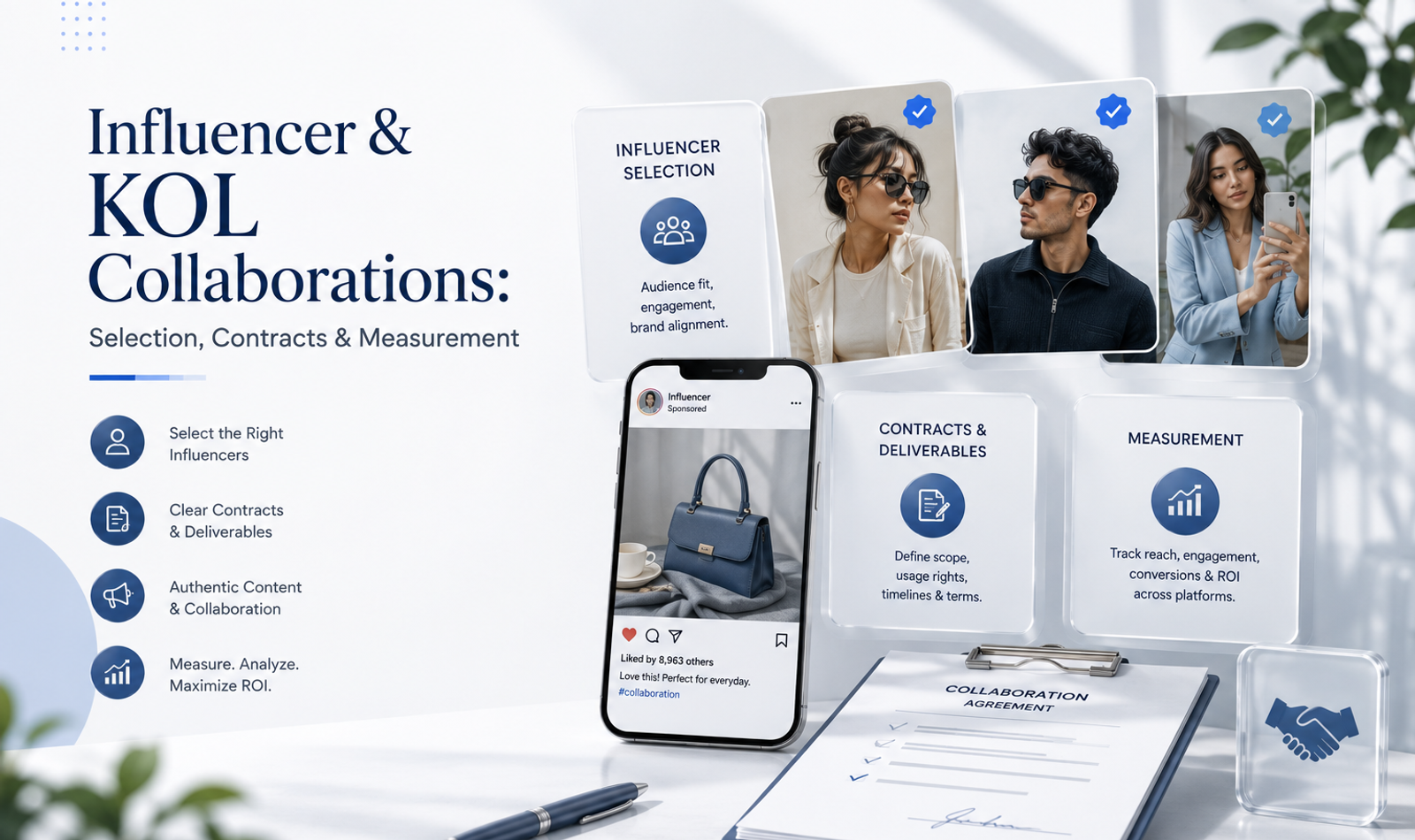
A professional influencer and KOL strategy connects selection, contracts, content and measurement within one campaign system.
KOL vs Influencer: What Is the Difference?
Both can work for your brand, but they do different jobs:
- Why people follow them: a KOL is followed for expertise; an influencer is followed mainly for content, personality and lifestyle.
- What they bring: a KOL brings credibility and deeper trust; an influencer usually brings reach, engagement and a steady flow of content.
- Best use: use KOLs to explain, recommend or validate a product; use influencers to build awareness and show the product in everyday life.
- Audience size: a KOL may have a smaller audience, but it is often more focused on one subject.
- Together: many campaigns use one or two KOLs for authority and a group of influencers for reach.
Understanding Influencers and KOLs
An influencer is a person whose content and audience relationship can affect awareness, preferences or buying behaviour.
Influencers may build their communities through fashion, beauty, travel, food, fitness, business, technology, entertainment, parenting or other specialised subjects.
Their influence often comes from consistent content creation and repeated interaction with followers.
A key opinion leader, commonly known as a KOL, is generally recognised for authority, expertise or professional credibility within a specific field.
A KOL may be a doctor, architect, chef, designer, financial specialist, academic, technology leader, industry analyst or respected entrepreneur.
The distinction is not always absolute.
A dermatologist with a large Instagram following may operate as both an influencer and a KOL.
A technology creator may build influence through entertaining videos while also developing strong subject expertise.
The most useful question is not whether the individual fits perfectly into one category.
The brand should ask why the audience trusts this person and how that trust connects with the campaign objective.
Influencer Reach and KOL Authority
Influencers often provide strong creative distribution.
They understand platform formats, audience attention, visual hooks and social conversation.
They may be especially effective for product discovery, lifestyle positioning and customer relatability.
KOLs often provide depth and authority.
Their audiences may follow them because of professional experience, specialised knowledge or decision-making influence.
A beauty creator may demonstrate how a product feels and appears within a daily routine.
A dermatologist may explain the ingredient from a clinical or educational perspective, provided the claims are accurate and appropriate.
A travel creator may show the atmosphere of a hotel.
A hospitality consultant may discuss the property’s service model, design or business significance.
Both forms of partnership can be valuable.
The correct choice depends on whether the brand needs mass discovery, cultural relevance, customer education, professional trust or a combination of these outcomes.
Plan the Collaboration Before You Pick Anyone
Begin With the Campaign Objective
Influencer selection should begin with the campaign objective rather than a list of popular names.
The brand may want to increase awareness, introduce a new product, build credibility, generate user interest, collect leads or drive purchases.
A launch campaign may require broad visibility and visually strong content.
A premium service campaign may require detailed explanation and a smaller, more qualified audience.
A B2B campaign may need respected industry specialists who can influence decision-makers.
The objective should identify the audience, desired action and measurement period.
A vague objective such as increasing buzz does not provide enough direction.
A stronger objective may be to increase awareness of a new luxury hospitality property among premium travellers in selected Indian cities.
Another may be to generate qualified demonstration requests from senior marketing and ecommerce professionals.
The objective determines the creator profile, content format, platform, offer and measurement framework.
Define the Target Audience
The brand should describe the people it wants the campaign to reach.
This description may include geography, age, language, interests, profession, buying power, category behaviour and stage of the customer journey.
For a luxury destination-wedding property, the audience may include affluent couples, families, wedding planners and premium travel communities.
For a business software company, the audience may include founders, chief technology officers, operations leaders and procurement teams within selected industries.
The creator’s audience should overlap meaningfully with this target.
A large general audience may generate visibility without producing relevant demand.
The team should examine where followers are located, what languages they use and why they follow the creator.
Audience demographics supplied by the creator should be supported by platform analytics where possible.
Define the Desired Audience Action
The campaign should identify what the audience should do after seeing the content.
The action may be to remember the brand, visit a website, follow an account, download a guide, join an event, book a consultation or complete a purchase.
The desired action affects content design.
Awareness content may focus on a strong idea, visual identity and memorable brand association.
Consideration content may provide a demonstration, review, comparison or expert explanation.
Conversion content may include a clear offer, link, code, booking page or lead form.
The action should remain realistic for the audience’s decision stage.
A person encountering a high-value consulting service for the first time may not be ready to sign a contract immediately.
The initial action may be to read a case study or attend a webinar.
How to Choose the Right KOL or Influencer
This is a short version of creator selection. For a detailed selection checklist, scorecard and audience checks, read our guide on influencer marketing for luxury brands.
Understand Influencer Tiers
Influencers are often grouped according to audience size.
Nano influencers typically have smaller communities and may offer strong local or personal relationships.
Micro influencers usually serve more defined niches and can provide strong relevance.
Mid-tier creators may combine meaningful reach with community familiarity.
Macro influencers provide larger distribution and more established production ability.
Celebrity or mega influencers offer broad public recognition but may require higher investment and provide less category-specific engagement.
These categories should not be treated as fixed universal rules because audience size standards differ across platforms and markets.
The brand should focus on the commercial role of each creator.
Several micro creators may help a company enter multiple specialised communities.
One larger creator may provide a significant launch moment.
A KOL may create credibility even when their audience is comparatively small.
Follower Count Is Not Audience Quality
Follower count is one of the most visible creator metrics, but it provides limited information by itself.
A creator may have accumulated followers through unrelated viral content, giveaways or an earlier content category.
The current audience may not match the proposed brand.
Some followers may be inactive, geographically irrelevant or unable to purchase the product.
The selection team should examine audience distribution, content themes, engagement quality, view patterns and follower growth.
Sudden unexplained growth may require closer review.
The objective is not to accuse creators of artificial activity without evidence.
It is to understand whether the visible audience is likely to produce the value the brand expects.
Evaluate Brand and Creator Fit
Brand fit describes how naturally the creator’s identity, content and audience connect with the company.
The collaboration should feel understandable to the audience.
A fitness creator promoting an unrelated financial product may create visibility but weak credibility unless the connection is explained convincingly.
A sustainable fashion brand should examine whether the creator’s broader content supports or contradicts its position.
A luxury brand may need a collaborator whose visual style, language and existing partnerships reflect the desired level of refinement.
Fit does not require the creator to match the brand perfectly.
A surprising collaboration can create attention.
However, the creative idea must explain why the two parties belong together.
Without this connection, the campaign may appear purely transactional.
Evaluate Category Credibility
The selection team should examine whether the creator has previously discussed the category.
Existing category familiarity can make the content more natural and informative.
A skincare creator may already understand product textures, routines and audience questions.
A food creator may know how to describe flavour, preparation and dining experience.
A business KOL may have established opinions about marketing, finance or technology.
However, the brand should also check for excessive category partnerships.
A creator who promotes several competing products within a short period may provide weaker credibility.
The audience may struggle to understand which recommendations are genuine or distinctive.
Category exclusivity and spacing between competing collaborations can help protect the campaign.
Quick Checks Before You Shortlist a Creator
- Is the content quality good enough to sit next to your brand?
- Are comments real conversations, or mostly emojis and generic replies?
- Are average views steady across recent posts, not just one viral post?
- Is the audience in the cities or countries you want to reach?
- Does the audience look real, with no sudden unexplained follower jumps?
- Which brands has the creator worked with before, and did those posts feel honest?
Conduct Reputation Due Diligence
The brand should review credible public information about the creator or KOL.
This may include previous controversies, misleading claims, discriminatory content, regulatory issues or repeated unprofessional conduct.
The depth of review should match the visibility and duration of the partnership.
A long-term ambassador requires deeper assessment than one low-risk product seeding activity.
The team should distinguish verified facts from unsupported allegations.
It should also consider context, timing and whether the person addressed the issue.
Due diligence is not about finding someone who has never received criticism.
It is about identifying material risks that could affect the brand.
Compare Direct Creator and Agency Representation
Some creators manage their own commercial work.
Others are represented by talent managers, agencies or creator networks.
Direct communication may provide speed and personal understanding.
Professional representation may improve contracts, scheduling and campaign coordination.
Neither arrangement is automatically better.
The brand should verify that the representative has authority to negotiate and sign.
Fees, commissions and invoicing structures should be clarified.
A creator should not receive conflicting instructions from the brand, PR agency and talent manager.
Build a Creator Evaluation Scorecard
A scorecard can help compare creators consistently.
The criteria may include audience fit, brand alignment, content quality, category credibility, average performance, geography, professionalism, reputation risk and commercial cost.
Each criterion can be weighted according to the campaign objective.
A conversion campaign may place greater weight on traffic and sales history.
A launch campaign may prioritise reach, creative quality and cultural relevance.
A KOL campaign may prioritise expertise, audience authority and professional reputation.
The scorecard should support judgement rather than replace it.
The final selection should still consider creative chemistry and strategic potential.
Decide Between One-Off and Long-Term Partnerships
A one-off collaboration can support a launch, event or seasonal moment.
It allows the brand to test fit before making a larger commitment.
However, one post may not provide enough repetition to build strong audience association.
Long-term partnerships can create greater familiarity and credibility.
The creator has more opportunities to understand the product and communicate different benefits.
The audience also sees the relationship more than once.
A longer relationship requires stronger due diligence, exclusivity planning and performance review.
The brand should not commit to an annual programme solely because one initial post performed well.
Product Seeding Versus Paid Collaboration
Product seeding involves providing a product or experience without guaranteeing publication unless a separate agreement exists.
The creator may choose whether to post.
A paid collaboration includes defined deliverables and commercial obligations.
Brands should not treat seeding as a way to obtain guaranteed free content.
Creators should understand whether the product is an unconditional gift, a review sample or part of a negotiated campaign.
Where a material connection exists and content is published, appropriate disclosure may be required.
The brand should document the arrangement clearly.
Brief and Co-Create the Content
Build a Clear Campaign Brief
The brief should explain the brand, campaign objective, audience, product, message and required deliverables.
It should identify mandatory information and prohibited claims.
The brief should also describe the desired tone, visual direction, platform format, timeline and call to action.
However, the brief should not attempt to write every word for the creator.
The audience follows the creator because of their voice and style.
Overly scripted content may feel like a traditional advertisement and weaken credibility.
The strongest briefs provide clear boundaries while allowing creative interpretation.
Co-Create the Content Idea
Creators understand their audience behaviour and platform formats.
The brand understands the product, customer and campaign objective.
The best concept often emerges through collaboration.
The creator may recommend a format that has performed well with their community.
The brand may provide customer insights, proof points and access.
A hotel collaboration might include a complete experience narrative rather than a basic room tour.
A beauty campaign may involve a genuine routine demonstration rather than a product held beside the face.
A B2B KOL may prefer a practical framework, case discussion or webinar instead of a promotional post.
Co-creation improves authenticity while protecting strategic relevance.
Separate Mandatory Messages From Flexible Content
The brief should identify which elements are mandatory.
These may include the correct product name, disclosure, key factual information, approved offer and required link.
Flexible elements may include the opening hook, personal story, visual sequence and creator language.
This structure prevents unnecessary revisions.
The brand should avoid making every sentence mandatory.
The creator should also understand that factual accuracy, disclosure and legal requirements cannot be changed for creative reasons.
KOL Agreement vs MOU: Which One Do You Need?
An MOU (memorandum of understanding) is a short document that records the basic understanding between the brand and the KOL. A KOL or influencer agreement is a full contract that sets out exact deliverables, rights, payments and what happens if something goes wrong.
- An MOU can be enough for a simple, low-value or barter collaboration where both sides only need to agree on basic terms.
- A full agreement is safer when there is a paid fee, content reuse, paid ads using the creator’s content, exclusivity or more than one deliverable.
- Either way, write it down. Every promise made on calls, email or chat should go into the signed document before work starts.
For paid deals, and especially large or long-term ones, get the agreement reviewed by a lawyer before signing.
Prepare a Written Contract
Every paid collaboration should be supported by a written agreement.
The contract should identify the parties, campaign, deliverables, platforms, publication dates, fees and payment schedule.
It should also address approvals, content rights, disclosures, exclusivity, cancellation, confidentiality and reporting.
Messaging applications may record discussions but do not replace a complete agreement.
The contract protects both parties by converting assumptions into clear obligations.
Key Clauses in a KOL or Influencer Contract
Use this checklist when you prepare or review a KOL or influencer contract. Each point is explained below.
- Deliverables: the exact number and type of posts, stories, videos or appearances
- Timelines: posting dates, draft dates and how long posts must stay live
- Approvals: who reviews drafts, how many rounds and how fast
- Disclosure: how the post will be labelled as paid or gifted
- Usage rights: where and for how long the brand can reuse the content
- Paid ads rights: whether the brand can run ads using the creator’s content or handle
- Exclusivity: which competitors the creator cannot work with, and for how long
- Fees and payment: the fee, payment dates and what happens if a deliverable is late
- Expenses: travel, stay, styling and who pays for them
- Cancellation and rescheduling: what happens if either side needs to cancel or change dates
- Conduct: what happens if the creator or the brand faces a controversy
- Confidentiality: what the creator must not share before launch
Define Deliverables Precisely
The agreement should specify the number and type of deliverables.
A Reel, Story sequence, feed post, LinkedIn article, YouTube integration and event appearance are different deliverables.
The contract should state length, format and platform where relevant.
For Stories, the number of frames should be defined.
For videos, the brand should clarify whether the product must appear visually, verbally or both.
The agreement should also state whether raw files, thumbnails, captions or alternate edits are included.
Vague language such as social media promotion can create serious disagreement.
Define Publication Timing
The contract should include campaign dates and deadlines.
It should identify when the creator receives the product, when concepts are due, when drafts are submitted and when content goes live.
The schedule should allow realistic production and review time.
The brand should not send products late and expect the creator to protect the original publication date automatically.
The agreement may also state how long the content must remain live.
Temporary formats such as Stories require different documentation and reporting.
Define the Approval Process
The brand should have the right to review factual accuracy, legal compliance and agreed campaign elements.
The creator should retain reasonable control over their voice.
The agreement should define the number of revision rounds and review timelines.
Late brand feedback can delay publication.
Repeated changes beyond the agreed scope may require additional fees.
The brand should avoid approving content through several uncoordinated stakeholders.
One consolidated feedback document is more efficient.
The final live content should also be checked to ensure it matches the approved version and contains the required disclosure.
Address Authenticity and Honest Opinion
Creators and KOLs should not be required to make statements they do not genuinely believe.
A product review should reflect actual experience.
The brand should provide enough time for the creator to use or understand the product where the format requires personal evaluation.
KOL content should remain within the individual’s expertise.
A qualified professional should not be pressured to make unsupported health, financial or performance claims.
Honest content protects the audience, creator and advertiser.
Define Usage Rights
A creator’s posting fee does not automatically provide unlimited rights to reuse the content.
The contract should define where, how and for how long the brand may use the assets.
Usage may include the brand’s organic social channels, website, ecommerce pages, email, in-store screens, presentations or advertising.
Each use has different commercial value.
The agreement should specify territory and duration.
A six-month digital licence in India is different from worldwide permanent usage across all media.
The brand should negotiate only the rights it genuinely expects to use.
Define Paid Advertising Rights
Paid amplification should be addressed separately from organic reposting.
The brand may want to promote creator content through partnership ads, whitelisting or other authorised advertising formats.
The agreement should define the platforms, duration, budget assumptions and permissions.
The creator may charge an additional usage or access fee.
The brand should not download organic content and run it as an advertisement without suitable permission.
Advertising rights may also require content adjustments, including ad-eligible music, claims and calls to action.
Address Raw Content Files
The brand may want raw footage for future edits.
Raw files should not be assumed to be included.
The contract should specify whether they will be delivered, what formats are required and how the brand may edit them.
The creator may want approval over edits that continue to use their identity.
The brand should not alter a creator’s words or appearance in a misleading way.
AI-based modification, dubbing, face replacement or synthetic voice use should require explicit permission.
Define Exclusivity
Exclusivity prevents the creator from working with selected competitors for a defined period.
The agreement should identify the exact category and duration.
A broad restriction covering every related lifestyle product may be unreasonable and expensive.
The creator should know which companies or product categories are included.
The brand should consider the period before and after publication.
Longer or broader exclusivity generally increases the commercial fee because it limits other work.
Address Competitor Content
Even when formal exclusivity is not purchased, the brand may request reasonable spacing between competing partnerships.
The contract can define whether competitor content can be published near the campaign date.
The creator should disclose existing commitments during negotiation.
The brand should not discover a major competitor post immediately after its own content goes live.
Clear planning protects credibility for both partnerships.
Define the Professional Fee
The fee may reflect audience size, content quality, production effort, platform, usage rights, exclusivity and creator demand.
The brand should ask what is included.
The quoted amount may cover only content creation and organic posting.
Additional charges may apply for travel, production teams, raw files, paid usage, category exclusivity and extended licences.
Taxes and agency commissions should be clarified.
Payment milestones should be documented.
A typical arrangement may include an advance and balance linked to draft approval or publication, depending on the parties’ agreement.
Avoid Pricing Only by Followers
Follower-based pricing does not account for audience quality, creative effort, rights or commercial results.
A specialised KOL with a smaller professional audience may command a higher fee because the audience contains valuable decision-makers.
A creator with strong video production may require additional resources.
The brand should assess the total expected value and cost.
The lowest-priced creator may not be the most efficient.
The most expensive creator does not automatically deliver the best result.
Address Expenses
Travel, accommodation, local transport, styling, production equipment and location costs should be allocated clearly.
An influencer attending an event in another city may require a different arrangement from a creator filming at home.
The contract should define which expenses require prior approval.
Receipts and reimbursement timelines may be included.
Unclear expense responsibility can create conflict after the campaign is completed.
Include Cancellation and Rescheduling Terms
Campaigns may be delayed by product availability, events, travel disruption, illness or reputational issues.
The agreement should explain what happens if the brand or creator cancels.
It should address completed production work, non-refundable expenses and rescheduling availability.
The brand should not assume that the creator can move to any new date without additional cost.
The creator should also provide timely notice when they cannot deliver.
Include Morality and Reputation Provisions Carefully
Long-term or highly visible collaborations may include provisions addressing serious conduct that creates material brand risk.
These clauses should not be triggered by every negative comment or public disagreement.
The agreement can define relevant conduct, review procedures, suspension and termination rights.
The creator may request reciprocal protection if the brand becomes involved in serious misconduct or product controversy.
Balanced provisions support a more professional partnership.
Include Confidentiality
The creator may receive unreleased products, campaign plans, pricing, customer information or event details.
The agreement should define what remains confidential and when information may become public.
Embargo dates should be clear.
The brand should also protect the creator’s private data, drafts and payment information.
Confidentiality works in both directions.
Address Intellectual Property
The agreement should identify who owns the original content and what licence the brand receives.
Music, images, locations and third-party assets may involve separate rights.
A song available for organic social use may not be eligible for paid advertising.
The creator should use assets they are authorised to include.
The brand should provide approved logos, product images and campaign material.
Intellectual-property checks should occur before content is published or amplified.
Define Reporting Requirements
The contract should require the creator to provide suitable platform insights.
These may include reach, impressions, views, watch time, engagement, Story completion, link clicks and audience information.
The reporting deadline should be stated.
Temporary content should be captured before it disappears.
The brand should avoid requesting unnecessary personal audience data.
Only information relevant to campaign analysis should be collected.
Disclosure Rules for Paid Collaborations in India
If a brand pays a creator, or gives them anything of value, the audience must be able to see clearly that the post is a brand partnership. Two official sources set this out in India: the ASCI Guidelines for Influencer Advertising in Digital Media and the Department of Consumer Affairs endorsement guidelines for social media influencers (official press release).
Key points from these official sources:
- Disclosure is needed when there is a material connection between the brand and the creator. ASCI explains that this is not only money: it can include free products, discounts, gifts, trips or hotel stays, and family or work relationships.
- The Department of Consumer Affairs lists simple labels such as “advertisement”, “ad”, “sponsored”, “collaboration”, “partnership” or “paid promotion”.
- The label should be clear, prominent and hard to miss. It should not be hidden inside a group of hashtags or links.
- On images, the disclosure should sit on the image. On videos, it should be in both the audio and the video. On live streams, it should stay visible for the whole stream.
- Creators should only endorse products or services they have actually used or checked.
Rules can be updated, so check the latest version of both official sources before each campaign. Then write the exact disclosure format into the creator brief and the agreement, so there is no confusion later.
Define Disclosure Responsibilities
The contract should require appropriate advertising disclosure wherever a material relationship exists.
The disclosure should be clear, prominent and suitable for the platform and content format.
It should not be hidden among many hashtags or placed where audiences are unlikely to notice it.
The brand should provide guidance and verify the published content.
The creator should not remove the disclosure because it affects the appearance of the caption.
Disclosure responsibility should be treated as a central campaign requirement rather than a final administrative detail.
Launch, Manage and Measure the Collaboration
Prepare the Campaign Launch
Products, access, links and briefing material should reach the creator early enough for proper preparation.
Tracking links and promotional codes should be tested.
Landing pages should be live and functional.
Customer-service and sales teams should know that the campaign is launching.
Inventory and booking availability should be confirmed.
A strong creator campaign can generate immediate interest.
The brand should not waste that attention through broken links, unavailable products or slow response.
Coordinate Multiple Creators
A campaign using several creators requires a central schedule and communication system.
The team should track contracts, products, concepts, drafts, publication dates, disclosures and reporting.
Content may be staggered to maintain momentum.
Publishing every collaboration on one day may create a large launch moment but reduce the campaign’s total active period.
The strategy should decide whether synchronisation or sustained distribution is more valuable.
Creators should not receive conflicting feedback from different brand representatives.
Allow Creative Variety
When several creators participate, the content should not look identical.
Repeated scripts can make the campaign appear artificial.
Each creator can focus on a different feature, customer need or experience.
The core brand message should remain consistent, but the expression should reflect the creator’s style.
This variety also helps the brand learn which angles resonate most strongly.
Support Organic Content With Paid Media
Strong creator content can be amplified through paid advertising when the necessary permissions are available.
Paid media can extend the content beyond the creator’s organic audience and support conversion objectives.
The brand can test different creator assets against its standard advertising.
It should evaluate performance according to qualified actions, not only click-through rate.
Content that receives strong organic engagement may not always produce the best paid conversion result.
The advertisement format, audience and call to action also influence performance.
Use Influencer Content Across the Funnel
Creator partnerships can support different customer-journey stages.
Lifestyle videos and relatable stories can introduce the brand.
Demonstrations, reviews and expert explanations can support consideration.
Testimonials, offers and retargeting ads can encourage action.
The brand should not depend on one post to perform every role.
A larger campaign can commission several content formats or repurpose approved assets across the funnel.
Measure According to the Objective
Measurement should begin with the campaign objective.
An awareness campaign may prioritise relevant reach, views, completion and brand recall.
An engagement campaign may examine comments, shares, saves and audience conversation.
A traffic campaign may focus on clicks, landing-page visits and website quality.
A lead-generation campaign may examine enquiries, qualified leads and meetings.
A sales campaign may measure purchases, revenue and acquisition cost.
The same creator may perform differently across these objectives.
One universal influencer score cannot explain every form of value.
What to Track (Short Version)
Measure what matches the goal you set at the start. For a full measurement framework with ROI, ROAS and attribution, see our guide on influencer marketing for luxury brands. In short, track:
- Relevant reach and average video views from the right audience
- Quality of comments, saves and shares, not just likes
- Brand mentions and branded searches during and after the campaign
- Website visits from creator links, and use of creator codes
- Leads, qualified leads, bookings and sales linked to the campaign
- Cost per content piece and the results of any paid ads using creator content
Calculate Campaign ROI
Financial return on investment compares the net financial value generated with the complete campaign cost.
This calculation is most reliable when sales can be connected credibly with the campaign.
Awareness and reputation outcomes should not be converted casually into revenue.
Estimated media value, reach and engagement can be reported separately.
For high-value or long-cycle services, the measurement window may need to continue for several months.
A lead generated during the campaign may convert much later.
Measure KOL Impact
KOL campaigns may require different metrics from entertainment-led influencer campaigns.
A KOL may influence professional understanding, trust and decision-making.
Relevant outcomes may include report downloads, webinar attendance, qualified meetings, event registrations, citations, industry discussion and account-level engagement.
A specialist audience may be small but commercially valuable.
The campaign should not be judged only against consumer-influencer reach benchmarks.
Understand Attribution Limitations
Influencer marketing often contributes near the beginning or middle of the customer journey.
A person may see creator content, search for the brand later and convert through Google or direct traffic.
Last-click reporting may give all credit to the final channel.
The brand should review assisted conversions, customer surveys, branded search and multi-touch journeys where possible.
Attribution remains an estimate of influence rather than a perfect record of human decision-making.
The report should explain its limitations honestly.
Conduct a Post-Campaign Review
After the campaign, the brand should review selection, briefing, contracts, content, coordination and results.
It should identify which creator profiles, formats and messages performed best.
The team should examine whether delays or excessive revisions affected performance.
Creators can also provide useful feedback about audience questions and campaign execution.
The objective is to improve future collaborations rather than simply produce a final report.
Build Long-Term Creator Relationships
Strong creators and KOLs can become valuable long-term partners.
Repeated collaboration allows them to understand the brand more deeply.
The audience also sees a more credible relationship than one isolated paid post.
The brand should treat reliable creators professionally.
Payments should be made on time. Feedback should be clear. Rights should be respected.
A healthy relationship can create better content, faster coordination and more flexible future opportunities.
Long-term partnerships should still be reviewed periodically for performance, fit and audience response.
Common Influencer and KOL Campaign Mistakes
One common mistake is selecting creators according to follower count alone.
Another is using the same brief for every creator regardless of audience or platform.
Brands may over-script content until it loses authenticity.
Some campaigns begin without a written contract or defined usage rights.
Paid advertising permissions may be assumed rather than negotiated.
Disclosure may be hidden or omitted.
Brands may also request unsupported product claims or expect KOLs to comment beyond their expertise.
Another mistake is measuring success only through likes and views.
Campaigns may generate many leads but fail to measure qualification or sales.
Brands sometimes compare specialised KOLs with entertainment creators using the same reach benchmarks.
Poor landing pages, unavailable inventory and slow customer response can waste creator-generated demand.
Finally, brands may treat creators as temporary distribution channels rather than professional partners with their own audiences, rights and reputations.
A Practical Influencer and KOL Collaboration Process
The process begins with a clear business objective, target audience and desired customer action.
The brand decides whether it needs broad influencer reach, specialised KOL authority or a combined portfolio.
Potential partners are researched according to audience fit, category credibility, content quality, geography, average performance, professionalism and reputation.
Platform analytics and previous campaign examples are reviewed.
A weighted scorecard supports the selection process.
The brand prepares a campaign brief identifying the audience, message, mandatory facts, flexible creative areas, deliverables and measurement plan.
The concept is developed collaboratively with the creator where appropriate.
A written contract defines publication dates, fees, approvals, disclosures, exclusivity, content rights, paid advertising rights, reporting and cancellation.
Products, access, links and landing pages are prepared before production begins.
Drafts are reviewed through one consolidated approval process.
The live content is checked for accuracy, disclosure and link functionality.
Campaign performance is monitored across reach, engagement, traffic, qualified leads and sales.
Strong creator content may be amplified through paid advertising when suitable permissions exist.
Sales and customer-service teams record the quality and outcome of campaign-generated enquiries.
The final report separates communication metrics from commercial outcomes.
The team conducts a post-campaign review and identifies creators suitable for long-term relationships.
How Double Trouble Studio Manages KOL Collaborations
At Double Trouble Studio, we handle influencer and KOL campaign management from the first brief to the final report. We shortlist voices that fit your brand and audience, check their past work and reputation, and prepare a clear brief.
We also coordinate the agreement, approvals, disclosure and posting schedule, so the brand and the creator both know what to expect. When a campaign needs a famous face as well, we can help you book celebrities and KOLs for your brand.
Frequently Asked Questions
What is a KOL collaboration?
A KOL collaboration is a paid or unpaid partnership between a brand and a Key Opinion Leader, a person known for real expertise in a field. The KOL shares an honest view of the product with their audience. Brands use KOLs to build trust and authority, not only reach.
What is the difference between a KOL and an influencer?
A KOL is trusted for expertise, such as a chef, doctor or designer. An influencer is followed mainly for content and lifestyle. A KOL usually brings credibility and deeper trust, while an influencer usually brings reach and engagement. Many brands use both in one campaign for different jobs.
What should a KOL agreement include?
A KOL agreement should list the exact deliverables, posting dates, approval steps, disclosure duty, content usage rights, paid ad rights, exclusivity period, fee and payment dates, expenses, cancellation terms, conduct clause and confidentiality. Every promise made on calls or chat should be written into the agreement before work starts.
Is an MOU enough for a KOL collaboration?
An MOU can work for a simple, low-value or barter collaboration where both sides agree on basic terms. For paid work, content reuse, ads or exclusivity, a full written agreement is safer. It protects both sides if dates, content or payments go wrong. Get legal advice for large deals.
Do paid KOL posts need to be labelled in India?
Yes. Paid or gifted posts should be clearly labelled so the audience knows it is a brand partnership. In India, check the latest ASCI influencer guidelines and the Department of Consumer Affairs endorsement guidelines before the campaign, and add the exact disclosure rule to the agreement and the creator brief.
Conclusion
Influencer and KOL collaborations are most effective when they are treated as structured communication systems rather than one-time promotional posts.
The real value of these partnerships comes from alignment between audience, creator credibility, content quality and business objective.
Influencers help brands build visibility and emotional connection, while KOLs strengthen trust through expertise and authority.
However, success does not depend on popularity alone. It depends on relevance, consistency, authenticity and execution.
Brands that define clear goals, select creators strategically, build strong contracts and measure real business outcomes are able to convert influence into meaningful commercial impact.
When managed correctly, influencer and KOL collaborations become a powerful bridge between storytelling, trust and conversion.
Build Influencer & KOL Campaigns That Drive Real Business Results
If you want your brand to move beyond vanity metrics and build influencer campaigns that actually generate qualified leads, trust and sales, the strategy behind creator selection and execution makes all the difference.
At Double Trouble Studio, we design performance-driven influencer and KOL collaboration systems that align audience, content and business goals into measurable growth.
📩 info@dtsworld.in 📞 +91 80000 06021 📍Andheri (West), Mumbai
Related reading: Influencer marketing for luxury brands · Celebrity vs influencer marketing.
Planning a KOL or influencer collaboration? Talk to DTS and we will shortlist the right voices and handle the agreement end to end.
Need this for your brand?
Let DTS build your next campaign.
From PR, celebrity management and events to websites, social media, SEO and AI video production — Double Trouble Studio helps brands grow with strategy and execution.
Discuss Your Requirement →