Integrating Events, PR & Digital into Your Brand Roadmap
A strong brand roadmap cannot depend on only one channel. Events may create powerful real-world experiences, but they need digital visibility to reach a larger audience. Public relations may build credibility, but it becomes stronger when supported by content, social media and search visibility. Digital marketing may generate reach and leads, but it becomes more meaningful when the brand has real stories, people, events and achievements to amplify.
This is why events, PR and digital marketing should not be planned separately.
They should work together as one connected brand growth system.
Many brands treat events as one-time occasions, PR as occasional media coverage and digital marketing as daily posting or advertising. This disconnected approach creates activity, but not always brand value. The brand may host an impressive event, but if there is no press strategy, content plan or post-event digital follow-up, the opportunity is lost. A media feature may bring visibility, but if the website is weak or social media does not reinforce the story, that visibility may not convert. A digital campaign may generate clicks, but if the brand lacks credibility, customers may hesitate.
An integrated brand roadmap solves this problem.
It connects physical experiences, media visibility and digital communication so that every activity supports the same brand objective. For premium, luxury, lifestyle, hospitality, real estate, event, fashion, beauty, wellness and service-led brands, this integration is especially important because customers evaluate trust across multiple touchpoints before making a decision.
This guide explains how to integrate events, PR and digital into your brand roadmap for stronger awareness, credibility, engagement, conversion and long-term brand equity.
What Does Integration Mean in a Brand Roadmap?
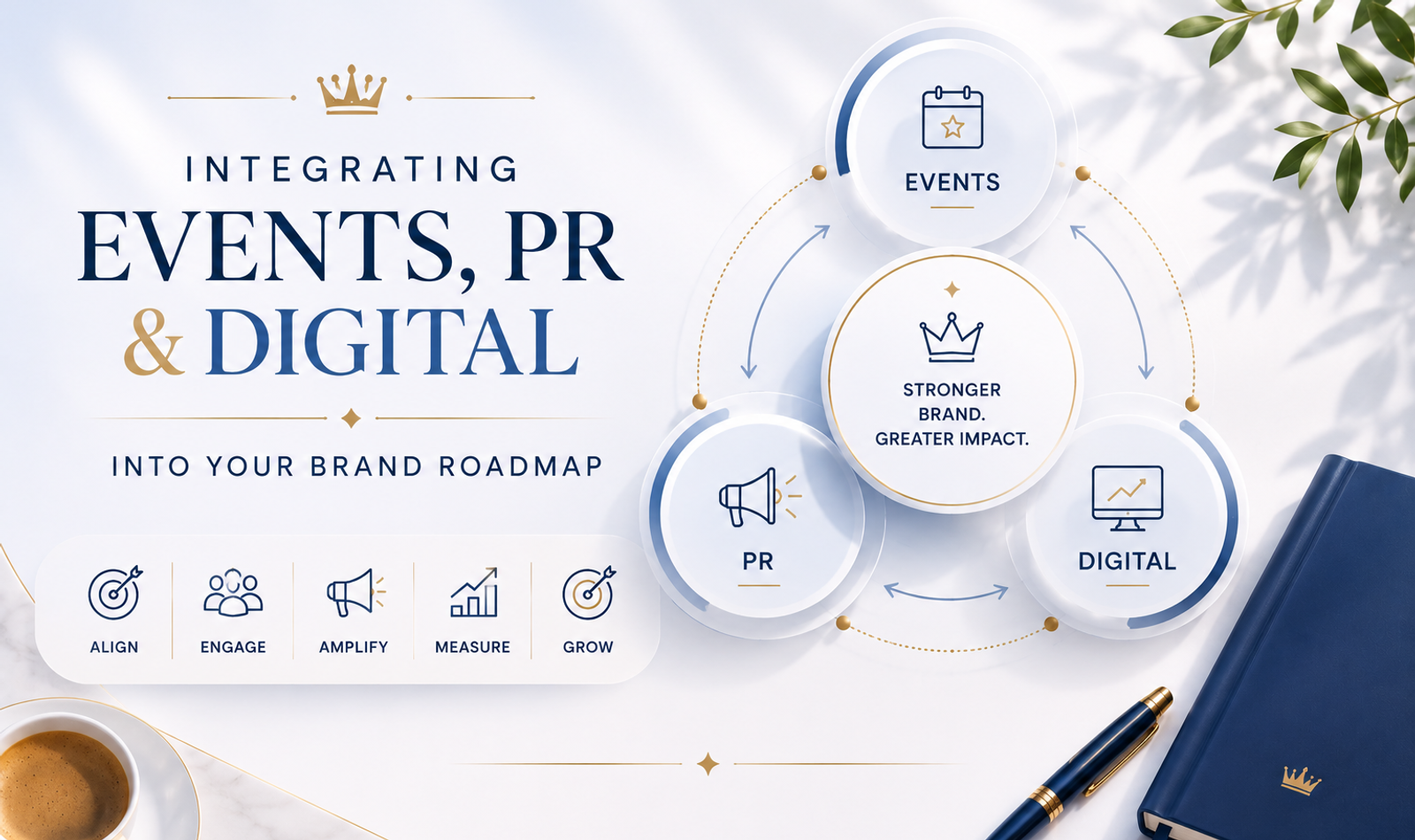
Integration means that events, PR and digital marketing are planned around one central brand strategy rather than operating as separate activities.
The brand roadmap should define what the business wants to become known for, who it wants to reach, what message it wants to communicate and how each channel will contribute to that goal.
Events create experience. PR creates credibility. Digital creates visibility, engagement and conversion.
When these three areas work together, the brand can move customers from awareness to trust and from trust to action.
For example, a premium hospitality brand may host a curated tasting event, invite selected media and creators, capture high-quality content, publish stories on Instagram, secure lifestyle coverage, run retargeting ads and direct interested customers to a booking page. The event becomes more than a physical gathering. It becomes a content engine, PR opportunity, digital campaign and customer acquisition tool.
That is integration.
Why Events, PR and Digital Should Not Work Separately
When events, PR and digital marketing are handled separately, the brand loses momentum.
An event without digital planning may impress the people in the room but fail to reach people outside it. PR without digital amplification may create temporary credibility but disappear quickly. Digital marketing without PR or events may feel repetitive because the brand has fewer real stories to share.
A disconnected roadmap also creates inconsistent messaging.
The PR team may describe the brand one way. The event team may create a different experience. The social media team may use another tone. The website may communicate something else entirely.
Customers notice this lack of consistency.
A premium brand cannot afford confusion. If a brand wants to appear refined, strategic and trustworthy, every channel must reinforce the same positioning.
Integration also improves return on investment.
A single event can generate media stories, creator content, customer testimonials, video assets, social posts, newsletter content, website case studies and future campaign material. A PR feature can be reused across ads, social proof, website sections and sales presentations. A digital campaign can drive attendance, enquiries and post-event conversions.
When planned together, one activity creates value across many channels.
The Role of Events in a Brand Roadmap
Events are powerful because they allow customers, media, partners and communities to experience the brand directly.
A well-designed event can communicate taste, quality, hospitality, confidence, culture and attention to detail better than many digital posts.
Events may include brand launches, product previews, press meets, influencer experiences, customer appreciation evenings, networking sessions, workshops, exhibitions, pop-ups, private dinners, award nights, luxury weddings, corporate gatherings or community activations.
For premium brands, events should not be treated only as decoration or entertainment.
They should be designed around a clear brand objective.
An event can build awareness, strengthen premium perception, introduce a product, create PR value, generate content, build community, support sales or deepen customer relationships.
The event should have a clear message, curated guest list, thoughtful experience flow, strong visual identity, content plan and follow-up system.
For brands that need professional support across planning and execution, an experienced events and weddings team can help connect the physical event experience with the larger brand strategy.
Without these elements, even a beautifully executed event may fail to support the brand roadmap.
The Role of PR in a Brand Roadmap
Public relations helps a brand build credibility through third-party recognition.
While advertising allows a brand to speak about itself, PR allows media platforms, industry voices, creators, communities and public conversations to validate the brand’s story.
PR is especially important for premium brands because customers often look for signals of trust before making high-value decisions.
A brand that appears in relevant media, expert roundups, interviews, event coverage, founder stories and industry features can build authority faster than a brand that only depends on paid promotion.
PR can support many stages of the roadmap.
Before a launch, PR can create anticipation. During an event, PR can bring media presence and coverage. After a campaign, PR can extend the story through interviews, recaps and thought leadership.
However, PR must be based on strong stories.
A brand cannot expect meaningful media coverage only because it exists. It needs a relevant angle.
This may include a founder journey, market insight, product innovation, cultural relevance, luxury experience, community initiative, expansion story, collaboration, design philosophy or expert point of view.
A strategic PR, media and marketing approach can help ensure that these stories support the brand’s positioning rather than creating disconnected publicity.
When PR is integrated with events and digital, every story becomes more visible and more useful.
The Role of Digital in a Brand Roadmap
Digital marketing gives the brand scale, consistency and measurable performance.
It includes the website, SEO, blogs, social media, email marketing, paid advertising, influencer collaborations, video content, performance campaigns, landing pages, analytics and online customer journeys.
Digital is where many customers first discover the brand.
Even after attending an event or reading a media article, customers usually search the brand online before taking action. They may visit the website, check Instagram, read reviews, explore case studies or compare competitors.
This means digital presence must be ready before visibility increases.
A strong digital system should explain the brand clearly, show proof, answer customer questions and guide visitors toward the next step.
Digital also gives longevity to events and PR.
An event may happen on one evening, but digital content can extend its impact for weeks. A PR feature may be published once, but it can be reused on the website, in social media, email campaigns and sales material. A launch campaign may create buzz, but SEO content can continue attracting search traffic long after launch week.
For brands that need their online ecosystem to support these campaigns, web development and digital marketing should be planned alongside PR and event activity rather than after it.
Digital turns brand activity into a measurable growth system.
Start With One Brand Objective
Before integrating events, PR and digital, the brand must define one clear objective.
The objective may be to launch a new brand, reposition as premium, enter a new city, increase qualified leads, improve brand authority, promote a product collection, strengthen founder visibility, attract media attention, build community or increase customer trust.
The objective should be specific.
A vague goal such as “increase visibility” is not enough. A stronger objective would be to build awareness for a premium event planning service among luxury wedding clients in North India, generate qualified enquiries through digital channels and secure credible lifestyle media coverage.
This level of clarity helps the team decide what type of event to create, which media platforms to approach and what digital content to produce.
When the objective is clear, every channel has a defined role.
Define the Core Brand Message
Integration requires one consistent message.
The core brand message should explain what the brand stands for, why it is different and why the audience should care.
This message should appear across event communication, PR material, website copy, social media content, advertisements, email campaigns and sales conversations.
The message does not need to be repeated word-for-word everywhere. It can be adapted to each platform. However, the meaning should remain consistent.
For example, if the brand is positioned around refined luxury hospitality, the event experience should feel refined, the PR story should highlight hospitality expertise and digital content should show the planning, guest experience and service quality behind the brand.
If the core message is unclear, the roadmap will become scattered.
A strong integrated strategy begins with one clear idea.
Build Audience Segments for Each Channel
Different channels may reach different parts of the audience.
Events may reach existing customers, high-value prospects, media, creators, industry leaders and partners. PR may reach a broader credibility-focused audience. Digital may reach potential customers across awareness, consideration and conversion stages.
The brand should define who each channel is meant to influence.
For example, a luxury real estate brand may use events to engage high-net-worth prospects, PR to build market credibility and digital campaigns to attract qualified enquiries from specific locations.
A premium fashion brand may use a launch event for stylists, media and loyal customers, PR for editorial validation and digital content for wider consumer discovery.
A service-led brand may use workshops to educate prospects, PR to build authority and LinkedIn or search content to convert professional audiences.
Audience clarity prevents wasted effort.
It also helps the brand choose the right guest list, media list, creator partners, ad targeting and content formats.
For high-profile launches, celebrity management can also become part of the audience and amplification strategy when the association is relevant to the brand.
Create an Integrated Annual Calendar
Events, PR and digital should be planned through one annual calendar.
This calendar should include major launches, seasonal campaigns, festive periods, industry events, product drops, brand activations, content themes, PR angles and digital campaigns.
Planning everything together allows the brand to build momentum instead of reacting at the last minute.
For example, if a brand plans a luxury product launch in September, the roadmap can include teaser content in August, media outreach before launch, influencer previews, a launch event, live content, post-event PR coverage, retargeting ads and SEO blogs after the campaign.
The same activity then supports multiple channels.
An integrated calendar also prevents internal conflict.
The digital team knows what content is coming. The PR team knows which stories to pitch. The event team understands the brand message. The sales team prepares for enquiries. The website team ensures landing pages are ready.
The brand moves as one system.
Use Events as Content Engines
Every event should be planned as a content opportunity.
This does not mean turning the event into a production set that feels uncomfortable for guests. It means identifying moments that can naturally become useful brand assets.
The brand should plan photography, videography, interviews, guest reactions, behind-the-scenes clips, founder messages, décor details, product interactions, media bytes and customer testimonials.
Before the event, create teaser content.
During the event, capture real-time stories, reels, photographs and short interviews.
After the event, publish recaps, highlight videos, press notes, blog posts, LinkedIn updates, email newsletters and website case studies.
For premium brands, content quality matters.
The visuals should reflect the brand’s identity. The storytelling should explain the purpose of the event, not only show decoration. The content should help audiences understand the brand’s standard, personality and value.
For campaigns requiring more distinctive visual storytelling, AI video and VFX can also extend event concepts into teasers, campaign films and post-event digital assets.
A well-planned event can create weeks of digital content.
Use PR to Extend Event Impact
PR can turn an event from a private experience into a public brand story.
Before the event, PR can support announcements, preview stories, founder interviews, invite-only positioning and media interest.
During the event, PR can manage media attendance, guest interactions, photo opportunities, quote collection and press coordination.
After the event, PR can distribute event highlights, media notes, expert commentary, collaboration stories and outcome-driven coverage.
The key is to create a media-worthy angle.
A launch event is not automatically newsworthy. The brand must explain why it matters.
The angle may focus on a new market trend, cultural relevance, celebrity presence, premium experience, design innovation, community impact, luxury consumer behaviour, founder perspective or industry shift.
PR should not only report that an event happened.
It should explain why the event represents something meaningful.
Use Digital to Amplify PR Credibility
Media coverage becomes more valuable when it is amplified digitally.
A press feature can be shared on Instagram stories, LinkedIn, website press sections, email newsletters, sales decks, WhatsApp broadcasts and retargeting ads.
PR logos and media mentions can also strengthen landing pages and enquiry pages.
This creates social proof.
When potential customers see that the brand has been covered by credible platforms, they may feel more confident.
However, PR amplification should be tasteful.
Premium brands should avoid overusing media coverage in a way that feels desperate. The mention should be presented as part of the brand’s credibility, not as the entire brand identity.
Digital amplification helps PR live longer.
Instead of disappearing after publication, the coverage becomes a continuing trust asset.
Build a Pre-Event Digital Strategy
The digital strategy should begin before the event.
Pre-event content can create anticipation, explain the theme, introduce speakers or collaborators, reveal behind-the-scenes preparation and invite the audience into the brand world.
For a public event, the pre-event strategy may drive registrations, bookings or RSVPs.
For a private event, the strategy may build curiosity without revealing every detail.
The brand can use teaser reels, countdown posts, email invitations, landing pages, WhatsApp communication, influencer hints and founder notes.
The website should have relevant information if the event is connected to a launch or campaign.
Paid ads can also support attendance or awareness if the event has a public-facing objective.
The pre-event phase is where the brand begins shaping perception.
Build a Live Event Communication Plan
Live communication should be planned carefully.
The brand should decide what will be shared in real time and what will be saved for polished post-event content.
Real-time updates may include stories, short clips, guest arrivals, setup details, key moments, speaker highlights and atmosphere shots.
For premium events, avoid chaotic posting.
The content should feel controlled, elegant and aligned with the brand identity.
The team should prepare story templates, hashtags, tagging guidelines, captions, shot lists and approval processes.
If media, creators or partners are attending, make sure they have correct brand names, handles, hashtags, key messages and event information.
Live communication should make the audience feel that something meaningful is happening.
Build a Post-Event Growth System
The post-event phase is where many brands lose value.
After the event, the brand should not simply upload an album and move on.
The team should review the content, publish highlight reels, share media coverage, thank guests, follow up with leads, send newsletters, update the website, create a blog recap and use event proof in future campaigns.
Sales teams should follow up with high-value attendees.
PR teams should pitch event outcomes.
Digital teams should retarget engaged audiences.
Content teams should convert event moments into educational, emotional and proof-based posts.
Professional guest management can also strengthen this process by ensuring that high-value guests receive coordinated communication and a consistent experience before, during and after the event.
The post-event system should continue for several weeks.
This allows the brand to maximise the investment made in the event.
Create a Digital Funnel Around PR and Events
A strong integrated roadmap should include a digital funnel.
At the awareness stage, events and PR introduce the brand to new audiences.
At the consideration stage, digital content explains the brand’s value through service pages, reels, blogs, case studies, testimonials and FAQs.
At the conversion stage, landing pages, enquiry forms, consultations, retargeting ads and email campaigns help interested customers take action.
At the retention stage, newsletters, exclusive events, customer communities and personalised communication keep relationships alive.
This funnel ensures that attention does not disappear.
A person who sees a PR feature should have a clear next step. A person who attends an event should receive follow-up. A person who watches event content should be guided toward more information.
Integration means every touchpoint leads somewhere.
Align Influencer Marketing With Events and PR
Influencer collaborations become stronger when integrated into events and PR.
Instead of asking creators to post generic content, brands can invite them into meaningful experiences.
Creators can attend launches, host previews, participate in workshops, share behind-the-scenes content, interview founders or experience the product in person.
This creates more authentic storytelling.
PR can also support creator collaborations by positioning them as part of a larger brand moment.
For example, a luxury wellness brand may host a private experience with experts, creators and media. Digital content can show the experience, while PR explains the wellness trend and brand perspective.
The collaboration should feel intentional.
Premium brands should choose creators whose audience, tone, values and visual style match the brand identity.
Build SEO Around Events and PR
Events and PR can also support search visibility.
After a major event, the brand can publish a blog recap, photo story, case study or insights article on its website.
If the event introduced a new service, product or campaign, create a dedicated page explaining it.
If PR coverage generated interest, make sure the website answers the questions people may search afterward.
The brand can also create SEO content around event themes, industry trends, customer questions and campaign topics.
For example, a luxury event brand hosting a destination wedding showcase can publish content about luxury wedding planning, destination wedding trends, guest hospitality, venue selection and event budgeting.
This turns short-term visibility into long-term discoverability.
SEO should not be an afterthought.
It should be part of the roadmap from the beginning.
Integrate Email and WhatsApp Communication
Email and WhatsApp are powerful for follow-up and relationship building.
Before an event, they can be used for invitations, reminders, confirmations and personalised updates.
After the event, they can be used for thank-you messages, recap links, exclusive offers, consultation invitations, media coverage and future announcements.
For premium brands, communication should feel personal and polished.
Avoid mass messages that feel careless.
Segment the audience based on relationship type.
Media, customers, prospects, collaborators, creators and internal stakeholders may need different messages.
Strong follow-up can convert event attention into business outcomes.
Create a Measurement System
An integrated roadmap must be measurable.
The brand should track performance across events, PR and digital together.
For events, useful metrics may include attendance quality, guest engagement, enquiries generated, content captured, media attendance, partnership outcomes and follow-up conversion.
For PR, metrics may include media mentions, publication quality, message accuracy, backlinks, referral traffic, founder visibility and credibility impact.
For digital, metrics may include website traffic, engagement, leads, conversion rate, cost per qualified enquiry, email response, social shares, branded search and retargeting performance.
The most important question is not whether one channel performed well alone.
The question is whether the combined system moved the brand closer to its objective.
Review and Optimise After Every Campaign
After each integrated campaign, the brand should review what worked.
Did the event attract the right audience? Did PR coverage communicate the intended message? Did digital content create engagement? Did the website convert traffic? Did enquiries match the desired customer profile? Did the team follow up properly?
This review should lead to improvement.
Maybe the event was strong, but the content was delayed. Maybe PR coverage was good, but the website was not ready. Maybe social reach was high, but leads were weak. Maybe the guest list was impressive, but follow-up was poor.
An integrated roadmap becomes stronger when every campaign teaches the brand what to improve.
Common Mistakes Brands Should Avoid
One common mistake is planning events too late.
A rushed event may look good on the surface but fail to create strategic value because PR, content and digital amplification were not prepared in advance.
Another mistake is treating PR as a post-event activity only.
PR should be considered before, during and after the event.
Brands also make the mistake of capturing content without a plan.
Random photos and videos may not communicate the brand message. A content shot list and story plan should be prepared before the event.
Another mistake is running digital campaigns without a proper landing page.
If people are interested but cannot find clear information, the opportunity is lost.
Some brands also focus too much on vanity metrics.
Large attendance, many views or several media mentions do not always mean success. The brand should measure quality, relevance and conversion.
Finally, many brands fail to follow up.
The real value of events, PR and digital often appears after the first interaction. Without follow-up, interest fades.
How Premium Brands Can Use This Integration
Premium brands should use integration to build both desire and trust.
Events create desire by allowing people to experience the brand world. PR creates trust by placing the brand in credible conversations. Digital converts desire and trust into measurable action.
For a luxury wedding planning brand, integration may include a curated showcase event, media coverage in lifestyle publications, Instagram reels, influencer attendance, a website case study, SEO blogs and retargeting campaigns for engaged couples.
For a premium real estate brand, integration may include a project preview event, architectural PR story, video walkthroughs, paid campaigns, landing pages, lead nurturing and investor-focused content.
For a fashion or jewellery brand, integration may include a collection preview, stylist attendance, editorial features, creator content, campaign photography, website collection pages and email marketing.
For a corporate service brand, integration may include an expert workshop, founder interviews, LinkedIn content, PR commentary, downloadable guides and lead-generation campaigns.
The structure changes by industry, but the principle remains the same.
Every channel should support one brand direction.
Building an Integrated 12-Month Roadmap
A 12-month integrated roadmap should connect major brand moments with channel activity.
The first quarter can focus on strategy, positioning, annual campaign themes, website readiness, PR planning and content pillars.
The second quarter can focus on visibility through events, media outreach, content publishing, creator partnerships and lead-generation campaigns.
The third quarter can focus on expansion through larger campaigns, city-specific activations, strategic collaborations, SEO growth and retargeting.
The fourth quarter can focus on retention, customer events, annual recaps, founder visibility, case studies, performance review and next-year planning.
This structure ensures that the brand is not simply active, but strategically active.
Each quarter should have clear goals, channel roles and measurable outcomes.
Frequently Asked Questions
What does it mean to integrate events, PR and digital?
It means planning events, public relations and digital marketing as one connected brand strategy instead of treating them as separate activities.
Why should events be part of a brand roadmap?
Events create real-world experiences that help customers, media, creators and partners understand the brand’s quality, personality and value.
How does PR support events?
PR helps events gain credibility and visibility through media coverage, founder interviews, press notes, industry stories and post-event features.
How does digital marketing support PR?
Digital marketing amplifies PR coverage through social media, websites, email, paid ads, landing pages and sales material, helping media visibility last longer.
Can small brands integrate events, PR and digital?
Yes. Small brands can start with intimate events, local media, strong content, founder storytelling, social media and simple landing pages.
What should be planned before an event?
The brand should plan the objective, audience, guest list, key message, PR angle, content shot list, digital promotion, website support and follow-up system.
How can events create digital content?
Events can generate photos, reels, interviews, testimonials, behind-the-scenes clips, founder messages, guest reactions, recap videos and website case studies.
How do you measure an integrated campaign?
Measure attendance quality, media coverage, website traffic, social engagement, leads, enquiry quality, conversions, PR value, content performance and follow-up success.
Why do premium brands need integrated strategy?
Premium brands need consistency across every touchpoint because customers judge trust, quality and value through events, media, digital presence and experience.
What is the biggest mistake in event, PR and digital integration?
The biggest mistake is planning each channel separately. Without one strategy, the brand loses consistency, momentum and measurable business value.
Conclusion
Events, PR and digital marketing become far more powerful when they work together.
Events create experience. PR builds credibility. Digital expands reach, engagement and conversion.
When these three areas are integrated into one brand roadmap, every activity supports a larger strategic goal.
A launch event can become a media story, a content campaign, a website case study, a social media series and a lead-generation opportunity. A PR feature can strengthen digital trust. A digital campaign can drive attendance, enquiries and post-event follow-up.
This connected approach helps brands build stronger visibility, clearer positioning, higher credibility and better business outcomes.
For premium and luxury brands, integration is especially important because customers expect consistency. They want the brand to look refined, sound confident, appear credible and deliver a strong experience across every touchpoint.
A brand roadmap should therefore never treat events, PR and digital as separate departments.
They should be planned as one complete growth system.
Double Trouble Studio helps premium, luxury, hospitality, lifestyle, event, real estate, fashion, beauty, wellness and service-led brands integrate events, PR, digital marketing, content, SEO, social media, influencer collaborations and customer experience into one strategic brand roadmap.
Brands can also explore the studio’s work to understand how creative, digital and event-led thinking can come together across different projects.
With the right integration, brands can stop creating disconnected activity and start building meaningful visibility, trust and long-term growth.
Need this for your brand?
Let DTS build your next campaign.
From PR, celebrity management and events to websites, social media, SEO and AI video production — Double Trouble Studio helps brands grow with strategy and execution.
Discuss Your Requirement →