Creating a 90-Day Launch or Relaunch Roadmap: Step-by-Step Brand Strategy Guide
A successful brand launch or relaunch is never just about announcing something new. It is about creating clarity, building anticipation, preparing the right assets, reaching the right audience and making sure every customer touchpoint supports the brand’s promise.
Many brands make the mistake of treating launch day as the main event. They design a logo, post a few creatives, run ads for a week and expect the market to respond immediately. But a strong launch requires much more than visibility. It needs positioning, messaging, content, website readiness, public relations, digital marketing, sales enablement, customer experience and performance tracking.
This is why a 90-day launch or relaunch roadmap is essential.
A 90-day roadmap gives the brand enough time to prepare before going public, create momentum during launch and optimise after the first customer response. It helps founders, marketing teams, agencies, designers, sales teams and operations teams work together instead of handling launch activities in isolation.
Whether you are launching a new brand, introducing a product, opening a new location, relaunching your website, repositioning a premium business or refreshing an existing identity, the first 90 days can shape how the market understands you.
A connected partner such as Double Trouble Studio can bring brand strategy, creative, PR, website development, digital marketing and launch execution under one roadmap rather than treating them as separate activities.
This step-by-step guide explains how to build a practical 90-day launch or relaunch roadmap that supports visibility, credibility, conversion and long-term brand growth.
What Is a 90-Day Launch or Relaunch Roadmap?
A 90-day launch or relaunch roadmap is a structured action plan that defines what a brand must complete before, during and after going live in the market.
It breaks the launch into clear phases so that strategy, creative production, content, marketing, PR, website, customer experience and measurement are handled in the right order.
The roadmap usually covers three broad stages.
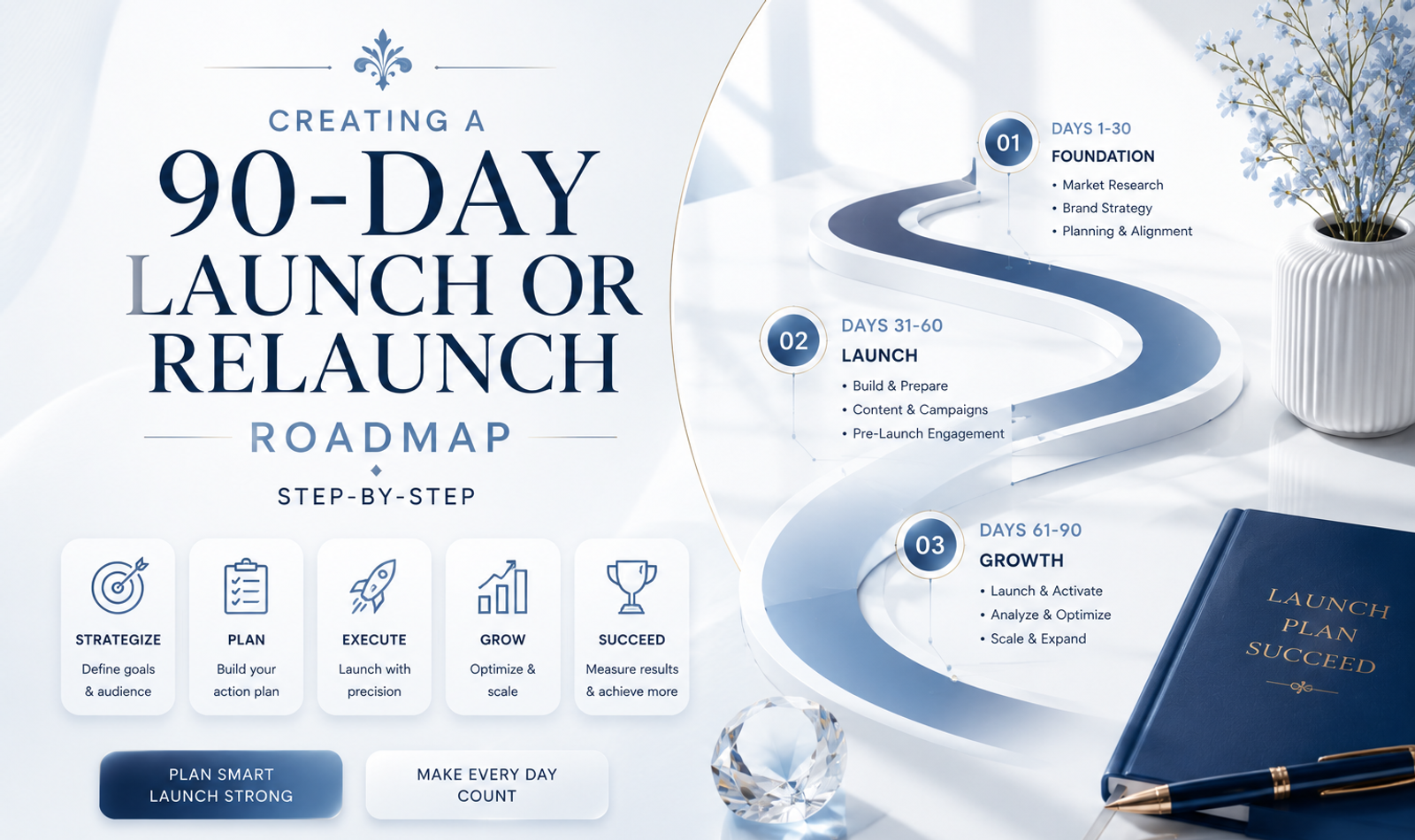
The first 30 days focus on research, positioning, messaging and planning. The next 30 days focus on asset creation, website readiness, content production and campaign preparation. The final 30 days focus on launch activation, promotion, optimisation and performance review.
This structure prevents the brand from rushing into public communication before the foundation is ready.
A good launch roadmap answers important questions.
Who are we launching for? What problem are we solving? Why should customers care? What makes us different? What should we say? Where should we appear? What should happen before launch day? What should happen after launch day? How will success be measured?
When these answers are clear, the launch becomes more focused and effective.
Launch vs Relaunch: What Is the Difference?
A launch is usually the introduction of a new brand, product, service, website, store, event property or business vertical. The audience may not know the brand yet, so the focus is on creating awareness, explaining value and building trust from the beginning.
A relaunch is different. It involves refreshing or repositioning something that already exists. The brand may be changing its identity, improving its website, entering a new market, targeting a premium audience, updating its services or correcting earlier positioning problems.
In a relaunch, the brand must manage both existing perception and future ambition. It must explain what has changed, why it has changed and why customers should pay attention again.
A launch builds first impressions. A relaunch rebuilds perception.
Both require strategy, but a relaunch often needs deeper communication because the audience may already have an opinion about the brand.
Why Brands Need a 90-Day Roadmap
A launch can fail even when the product or service is strong.
The reason is usually not lack of effort. It is lack of alignment.
The website may not be ready when the ads begin. The social media content may not match the brand positioning. The PR story may feel weak. The sales team may not know how to explain the new offer. The customer experience may not support the premium promise. The launch may generate attention, but no clear conversion path.
A 90-day roadmap solves this by connecting every launch activity to one strategic direction.
It also helps the team avoid last-minute panic. Instead of creating creatives, captions, web pages, videos and press material just days before launch, the roadmap creates enough time for planning, production, approvals and optimisation.
For premium brands, this is especially important. Customers notice inconsistency. If the brand looks refined on Instagram but the website feels incomplete, the perception becomes weak. If the campaign promises exclusivity but the communication feels generic, trust reduces.
A roadmap ensures the launch feels intentional, polished and believable.
Step One: Define the Launch Objective
The first step is to define the real objective of the launch or relaunch.
Not every launch has the same goal.
Some brands want awareness. Some want immediate sales. Some want qualified leads. Some want PR visibility. Some want to reposition themselves from mass to premium. Some want to enter a new city. Some want to introduce a new product category. Some want to recover from poor past communication.
The launch objective should be specific.
Instead of saying “we want brand awareness,” define the exact outcome. The brand may want to generate 500 qualified enquiries, increase website traffic by 40 percent, secure media coverage, build a waiting list, improve average order value, attract premium clients or reposition the company for a higher-value audience.
The launch objective will shape the strategy.
A launch focused on immediate sales will require strong offers, landing pages, retargeting and conversion campaigns. A launch focused on authority will require PR, founder storytelling, thought leadership and credibility-building assets. A launch focused on premium repositioning will require stronger identity, refined messaging, improved customer experience and controlled communication.
Without a clear objective, the launch becomes a collection of activities instead of a focused campaign.
Step Two: Understand the Target Audience
The next step is to define the audience.
A launch cannot speak to everyone. The more specific the audience, the stronger the message becomes.
The team should identify who the brand wants to reach, what they need, what they currently believe, what alternatives they consider and what would motivate them to take action.
Basic demographic information is not enough.
The brand must understand the audience’s behaviour, buying triggers, doubts, aspirations and decision-making process.
For example, a premium skincare launch may target customers who are tired of generic beauty claims and want science-backed routines. A luxury event company may target families and brands that want seamless planning, high-touch hospitality and refined guest management. A real estate relaunch may target buyers looking for trust, design quality, location value and lifestyle convenience.
The message should be written around real customer motivations, not only brand features.
When the audience is clearly defined, the brand can choose better content, platforms, offers, visuals and calls to action.
Step Three: Audit the Current Brand Position
For a relaunch, a brand audit is essential. For a new launch, a market and competitor audit is equally important.
The audit should review how the brand currently appears across touchpoints. This includes the website, logo, social media, content, reviews, packaging, store experience, sales material, customer communication and advertising.
The team should identify what is working, what is outdated, what creates confusion and what damages trust.
For an existing brand, customer feedback is especially useful. Review comments, enquiries, complaints, testimonials and sales objections. These insights reveal how the market currently understands the brand.
For a new brand, competitor research helps identify the category codes and gaps. Study what similar brands are saying, how they look, where they are visible and what customers expect from the category.
The purpose of the audit is not to copy competitors. It is to find a meaningful space the brand can own.
Step Four: Define the Brand Positioning
Brand positioning is the foundation of a successful launch or relaunch.
It explains how the brand wants to be perceived in the customer’s mind.
Strong positioning should define the target audience, category, problem, benefit, difference and proof.
A simple structure is:
For a specific audience, our brand is the preferred choice in this category because we deliver a clear benefit through a credible difference.
For example, a premium event agency may position itself as the strategic planning partner for luxury weddings and high-value event experiences, combining creative design, guest management, vendor coordination and flawless execution.
A website development agency may position itself as the digital growth partner for premium brands that need conversion-focused websites, SEO foundations and brand-led user experience.
A restaurant brand may position itself around authentic regional flavours, refined presentation and consistent dine-in and delivery quality.
The positioning must be clear before creative production begins.
If the brand does not know what it wants to stand for, the launch campaign will feel generic.
Step Five: Build the Messaging Framework
After positioning, the brand needs a messaging framework.
This framework converts strategy into practical communication.
It should include the main launch message, supporting messages, customer benefits, proof points, tone of voice, frequently asked questions and call-to-action language.
The main message should explain why the launch matters.
Supporting messages should explain the brand’s value in more detail.
Proof points should show why customers can trust the claim. These may include experience, process, quality standards, testimonials, case studies, certifications, materials, technology, partnerships, founder expertise or measurable results.
The tone of voice should match the brand category.
A premium brand may need a refined, confident and editorial tone. A youth-focused brand may need a more conversational and energetic tone. A corporate service brand may need clarity, authority and trust.
The messaging framework ensures that the website, ads, captions, PR stories, sales scripts and email campaigns all communicate the same idea.
Step Six: Create the Launch Offer or Hook
A launch needs a reason for people to pay attention now.
This does not always mean a discount.
The launch hook could be early access, a limited founding offer, a private preview, an exclusive consultation, a new collection, a launch event, a waitlist, a product bundle, a founder-led session, a free audit, a premium experience or a time-bound service benefit.
The hook should match the brand’s positioning.
A luxury brand should be careful with aggressive discounts because they can weaken perceived value. Instead, it can use exclusivity, access, personalisation or added value.
A relaunch hook should clearly explain what has changed.
For example, a brand may announce a redesigned website, new service structure, upgraded experience, expanded city presence, new product line, improved packaging or sharper premium positioning.
The hook gives the campaign urgency without making it feel desperate.
Step Seven: Prepare the Website and Landing Pages
The website should be ready before launch visibility begins.
Many brands make the mistake of starting ads and social promotion while the website still feels incomplete. This wastes attention and reduces trust.
The website should clearly communicate the launch message, brand positioning, service or product details, proof points and next steps.
For a launch campaign, create a dedicated landing page if needed.
The landing page should include a strong headline, clear value proposition, benefits, visuals, process, testimonials or proof, FAQs and a simple conversion action.
The call to action may be “Book a Consultation,” “Join the Waitlist,” “Shop the Collection,” “Download the Guide,” “Reserve Your Slot,” “Request a Proposal” or “Visit the Store.”
The website should also be mobile-friendly, fast-loading and easy to navigate.
A strategic website development and marketing approach can ensure that design, SEO, user experience and conversion paths are ready before campaign traffic begins.
A strong launch creates interest. A strong website converts that interest into action.
Step Eight: Build the Content System
Content is the engine of a launch.
The brand should plan content before the campaign goes live instead of creating posts randomly each day.
A strong launch content system includes teaser content, educational content, proof-based content, founder story, behind-the-scenes content, product or service explanation, launch announcement, testimonials, FAQs and post-launch reminders.
The content should be created for different stages of awareness.
Some people are discovering the brand for the first time. They need a simple explanation of what the brand does and why it matters.
Some people are already interested. They need proof, details and confidence.
Some people are ready to act. They need a clear offer and next step.
Content should be adapted across Instagram, LinkedIn, YouTube, website blogs, email, WhatsApp, PR and ads.
The best launch content does not only say “we are launching.” It explains why the launch is relevant to the customer.
Step Nine: Build SEO and AI-Search Foundations
A launch or relaunch should also be planned for search visibility.
Customers often search for the brand after seeing an ad, reel, PR article or recommendation. If the website is weak or unclear, the launch loses momentum.
The brand should optimise key pages with clear titles, meta descriptions, service descriptions, product information, location relevance, internal links and FAQs.
For brands expanding geographically, relevant location pages can also help customers and search engines understand where the business operates.
For AI-search and answer-engine visibility, the content should answer customer questions directly.
Useful pages may include service pages, product pages, comparison guides, launch FAQs, process explanations, founder story, case studies and educational blogs.
The goal is not keyword stuffing.
The goal is to make the brand easy to understand for both people and search systems.
A well-structured website supports the launch long after the initial campaign ends.
Step Ten: Prepare Public Relations
Public relations can add credibility to a launch or relaunch.
PR works best when the brand has a clear story.
The story could focus on the founder, category innovation, cultural relevance, customer behaviour, design philosophy, business expansion, new experience, market gap or social impact.
The brand should prepare a press kit before launch.
This may include the brand profile, founder bio, launch note, high-quality images, product or service details, quotes, contact information and key facts.
Media outreach should begin before the public launch date.
For premium and luxury brands, PR should focus on quality rather than quantity. The right publication, podcast, newsletter or industry platform can strengthen credibility more than random visibility.
A structured PR, media and marketing strategy can connect launch coverage with founder positioning, digital amplification and longer-term brand authority.
PR should also be supported by website and social content so that interested readers can explore the brand immediately.
Step Eleven: Prepare Paid Media Campaigns
Paid advertising can help amplify a launch, but it should not begin before the foundation is ready.
Before running ads, the brand should have strong creative assets, clear audience segments, a conversion-ready landing page, tracking setup and follow-up process.
Campaigns should be divided by objective.
Awareness campaigns introduce the launch to new audiences. Consideration campaigns explain value through videos, carousels, testimonials and guides. Conversion campaigns target interested users with clear offers and calls to action. Retargeting campaigns bring back visitors who engaged but did not act.
The brand should test different messages.
One audience may respond to quality. Another may respond to convenience. Another may respond to design, trust, expertise or exclusivity.
Paid media should not be judged only by clicks. Measure lead quality, conversion rate, cost per qualified enquiry, average order value and actual revenue impact.
Step Twelve: Prepare the Sales and Response System
A launch can generate enquiries, but poor follow-up can destroy conversion.
Before launch, the team should prepare response scripts, enquiry forms, WhatsApp replies, email templates, proposal formats and sales talking points.
The response system should match the brand’s positioning.
A premium brand should not respond casually or inconsistently. A luxury brand should not send unclear PDFs or delayed replies. A professional service brand should not make the customer repeat information multiple times.
The first response should be fast, clear and helpful.
The sales team should understand the launch message, pricing logic, customer objections and key benefits.
If the brand is running a waitlist, consultation drive or launch offer, the process should be simple and well-managed.
A strong launch is not complete until the enquiry experience is ready.
Days 1–15: Research and Strategy
The first 15 days should focus on understanding the market, customer and business objective.
During this phase, the team should conduct a brand audit, competitor review, customer research and internal strategy discussion.
The key outcome should be clarity.
By the end of this period, the brand should know what it is launching, who it is targeting, what perception it wants to create and what result it wants to achieve.
This phase should also identify risks.
For example, the website may need major improvement. The product photography may not be premium enough. The message may be too generic. The customer service team may not be ready for increased enquiries.
Finding these problems early prevents launch failure later.
Days 16–30: Positioning and Messaging
The next 15 days should turn research into strategy.
This is when the brand finalises its positioning, launch message, value proposition, customer benefits, proof points and content direction.
The team should also decide the launch hook.
Will the campaign use early access? A new collection? A founder story? A service upgrade? A launch event? A private preview? A free consultation? A limited offer?
The messaging should be approved before design and content production begin.
This prevents unnecessary revisions and keeps the campaign consistent.
By day 30, the brand should have a clear launch narrative.
Days 31–45: Identity, Website and Asset Preparation
During this phase, the brand should prepare the visual and digital assets required for launch.
This may include logo refinements, campaign design system, photography, videos, website pages, landing pages, social media templates, presentation decks, brochures, product mockups, email templates and ad creatives.
For campaigns that require high-impact visual storytelling, AI video and VFX can also become part of the launch asset system across teasers, reels, digital ads and product storytelling.
The website should be tested carefully.
Check mobile responsiveness, loading speed, forms, contact buttons, tracking codes, SEO titles, meta descriptions, page content and internal links.
The brand should also prepare its social media profiles.
Update bios, highlights, pinned posts, profile images, links and contact information.
By day 45, the brand should look ready for public attention.
Days 46–60: Content Production and Pre-Launch Build-Up
This stage should focus on building anticipation.
The brand should create teaser content, behind-the-scenes content, educational posts, founder videos, product previews, service explainers and launch countdown material.
The goal is to warm up the audience before the official announcement.
For a new brand, the content should introduce the problem, category, purpose and upcoming solution.
For a relaunch, the content should signal change.
The brand can use lines such as “Something new is coming,” “We are redefining the experience,” “A new chapter begins,” or “Built again with a sharper vision.”
Pre-launch content should not reveal everything at once.
It should create curiosity while slowly educating the audience.
Days 61–75: PR, Partnerships and Campaign Setup
This phase prepares the launch distribution system.
The brand should begin media outreach, influencer conversations, partnership discussions and paid campaign setup.
If there is a launch event, this is when invitations, venue planning, guest list, media list, production and hospitality details should be finalised.
For premium physical launches, professional event and wedding management can connect venue, production, hospitality, entertainment and guest experience with the larger launch narrative.
If the launch needs a known face or high-profile appearance, a structured celebrity management strategy can help align talent selection with audience, positioning and campaign objectives.
If creators are involved, the brand should provide clear briefs, content guidelines, key messages and posting timelines.
If PR is planned, press notes and media assets should be shared in advance.
Paid campaigns should be built and reviewed before launch day.
By day 75, the brand should have distribution channels ready.
Days 76–90: Launch, Optimise and Follow Up
The final 15 days include the official launch and immediate post-launch response.
Launch day should be coordinated across the website, social media, email, WhatsApp, PR, paid ads, partners and internal teams.
All channels should communicate the same message.
After the launch, the team should monitor website traffic, enquiries, comments, shares, ad performance, customer questions, media response and conversion quality.
The first few days will reveal what customers understand and what they are still confused about.
Use this feedback to improve FAQs, captions, landing pages, sales scripts and retargeting campaigns.
A launch should not stop after the announcement.
The post-launch period is when interest must be converted into trust and action.
What to Do After the First 90 Days
After the first 90 days, the brand should conduct a launch review.
This review should analyse what worked, what failed, what customers responded to and what should be improved.
Look at website performance, lead quality, social engagement, PR coverage, ad results, sales conversion, customer feedback and repeat interest.
The brand should identify which messages generated the strongest response and which channels produced the most valuable customers.
Published work and case studies can also become useful proof assets after launch, helping future customers understand how the brand delivers value in practice.
The next phase should focus on scaling what worked.
This may include improving SEO content, increasing paid media, building more case studies, strengthening email marketing, expanding PR, creating retargeting funnels or refining the customer experience.
A launch is the beginning of market building, not the end.
Key Metrics to Track During a Launch
A launch roadmap should include clear performance indicators.
Awareness metrics include reach, impressions, profile visits, branded searches, press mentions and website traffic.
Engagement metrics include saves, shares, comments, video watch time, email open rates and landing page engagement.
Conversion metrics include enquiries, bookings, purchases, consultation requests, waitlist sign-ups, cost per lead and conversion rate.
Quality metrics include lead relevance, average order value, customer fit, sales feedback and enquiry seriousness.
Brand metrics include customer perception, message recall, media quality, creator response and search interest.
The brand should not judge the launch only by followers or likes.
A successful launch brings the right people closer to action.
Common Launch Mistakes to Avoid
One common mistake is launching without clear positioning.
If customers cannot understand what the brand does and why it is different, attention will not convert into trust.
Another mistake is starting marketing before the website is ready.
A campaign may generate traffic, but a weak website can lose the opportunity.
Brands also make the mistake of creating content only for announcement day.
A strong launch requires pre-launch education and post-launch follow-up.
Another mistake is ignoring the sales process.
If enquiries are not answered quickly and professionally, the brand loses momentum.
Some brands also depend too heavily on discounts.
Discounts may generate short-term sales, but they can weaken premium perception if used carelessly.
Finally, many brands fail to review the launch properly.
Without analysis, the team cannot understand what should be scaled, changed or stopped.
How a 90-Day Relaunch Can Rebuild Brand Perception
A relaunch gives a brand the chance to correct unclear positioning and improve market perception.
It can help the brand attract a better audience, increase pricing power, improve trust and present a more professional identity.
However, a relaunch must be explained clearly.
Customers should understand what is new and why it matters.
The relaunch may include a new website, refined brand identity, upgraded services, better customer experience, stronger content direction or a new market position.
The brand should communicate the relaunch as a meaningful evolution, not just a design update.
A strong relaunch shows that the business has matured.
How SEO, GEO and AI Search Fit Into a Launch Roadmap
Modern customers discover brands across Google Search, social media, AI-assisted search, YouTube, review platforms and digital publications.
This means launch content should be structured for both human readers and search systems.
Use clear headings, direct answers, descriptive page titles, useful FAQs, internal links and original insights.
Create content that answers real customer questions.
For example, a brand can publish guides, process pages, comparison articles, launch FAQs, service explainers and case studies.
This helps the brand appear for informational and commercial searches.
The goal is not to overload pages with keywords.
The goal is to build helpful, clear and credible content around the launch.
A strong search foundation keeps working even after the launch campaign ends.
Frequently Asked Questions
What is a 90-day launch roadmap?
A 90-day launch roadmap is a structured plan that defines the strategy, content, website, PR, marketing, sales and customer experience actions required before, during and after launch.
Why is a 90-day roadmap important for a brand launch?
It helps the brand prepare properly, align teams, avoid last-minute confusion, build anticipation, launch with consistency and measure performance after going live.
What should be included in a launch roadmap?
A launch roadmap should include audience research, brand positioning, messaging, website preparation, content planning, PR, paid ads, sales enablement, launch activation and KPIs.
What is the difference between a launch and a relaunch?
A launch introduces something new to the market. A relaunch refreshes, repositions or improves something that already exists and needs stronger perception or visibility.
How early should launch planning begin?
Launch planning should ideally begin at least 90 days before the public announcement. This gives enough time for strategy, production, testing and campaign preparation.
Should a launch include PR?
Yes, PR can add credibility to a launch when the brand has a strong story, founder angle, product innovation, market insight or meaningful customer benefit.
What content is needed for a launch campaign?
A launch campaign may need teaser posts, announcement creatives, founder videos, product explainers, service pages, FAQs, testimonials, email campaigns, ads and PR assets.
How do you measure launch success?
Launch success can be measured through website traffic, enquiries, bookings, sales, lead quality, press coverage, social engagement, branded search and customer feedback.
Can a small business use a 90-day launch roadmap?
Yes. A small business can use a 90-day roadmap to launch with clarity, manage limited resources better and create a more professional market entry.
What happens after the launch?
After launch, the brand should review performance, improve weak points, follow up with leads, optimise campaigns, create more content and scale the channels that performed best.
Conclusion
A successful launch or relaunch requires more than excitement, visuals and one announcement post.
It requires a clear strategy, strong positioning, a ready website, consistent content, public relations, paid media, sales preparation and a customer experience that matches the brand promise.
The first 30 days should focus on research, positioning and messaging.
The next 30 days should focus on website readiness, content production and campaign assets.
The final 30 days should focus on PR, partnerships, advertising, launch activation and optimisation.
When every stage is planned properly, the launch becomes more than a campaign. It becomes a structured entry point for long-term brand growth.
For premium brands, this roadmap is especially important because first impressions directly affect trust, pricing power and customer perception.
A 90-day launch or relaunch roadmap helps the brand move with clarity instead of urgency. It allows teams to prepare, communicate and execute with confidence.
Double Trouble Studio helps premium, luxury, hospitality, lifestyle, event, real estate, digital and service brands plan successful launches and relaunches through brand strategy, positioning, website development, content systems, PR, social media, digital marketing and customer experience planning.
Brands preparing an upcoming launch, relaunch or market expansion can also contact Double Trouble Studio to build an integrated 90-day roadmap.
A well-built 90-day roadmap can turn a launch from a one-day announcement into a complete brand-building system.
📩 info@dtsworld.in 📞 +91 80000 06021 📍 Andheri (West), Mumbai
Need this for your brand?
Let DTS build your next campaign.
From PR, celebrity management and events to websites, social media, SEO and AI video production — Double Trouble Studio helps brands grow with strategy and execution.
Discuss Your Requirement →