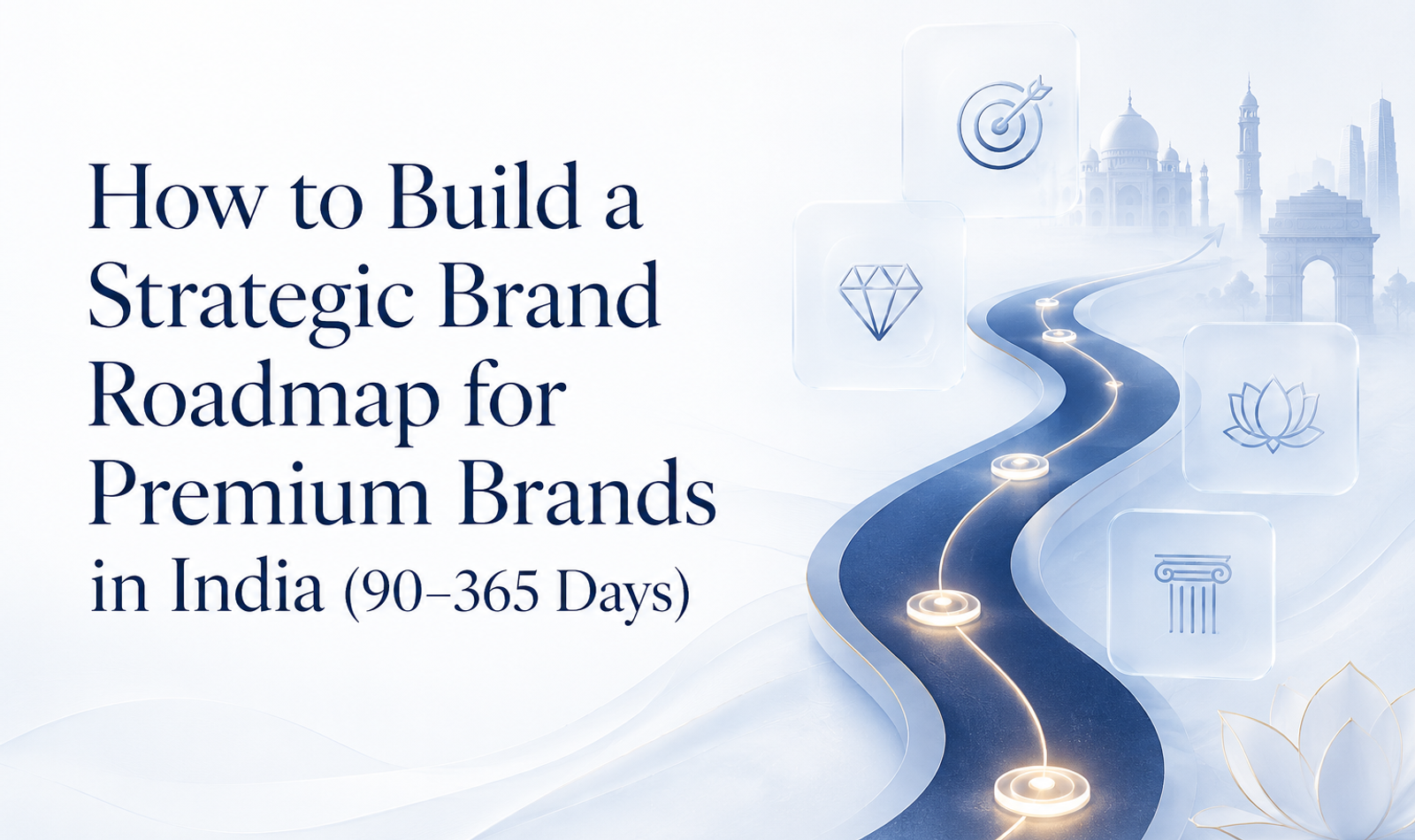
How to Build a Strategic Brand Roadmap for Premium Brands in India: A 90–365 Day Framework
Building a premium brand in India requires more than attractive packaging, luxury visuals, influencer collaborations or expensive advertising. A premium brand becomes valuable when its positioning, product quality, communication, customer experience, digital presence and business strategy work together consistently.
Many brands attempt to enter the premium category by increasing prices and improving design. However, premium positioning cannot be created through appearance alone. Customers must understand why the brand deserves a higher price, what makes it different from available alternatives and how the complete experience delivers superior value.
A strategic brand roadmap gives the business a structured direction for achieving this. It turns broad ambitions into clear priorities across 90, 180, 270 and 365 days. It also helps founders, marketing teams, designers, public relations partners, sales professionals and operational teams work towards the same long-term brand objective.
For premium brands in India, a roadmap is especially important because the market is diverse, competitive and influenced by rapidly changing consumer expectations. Customers now evaluate brands through search engines, social platforms, reviews, websites, creator content, physical experiences and personal recommendations. Every touchpoint contributes to the final perception of quality and credibility.
This guide explains how to create a strategic brand roadmap for premium brands in India and how to use the first year to establish positioning, strengthen visibility, increase demand and build long-term brand equity.
What Is a Strategic Brand Roadmap?
A strategic brand roadmap is a time-based plan that connects a company’s business goals with its brand positioning, identity, messaging, marketing, customer experience and growth priorities.
It identifies where the brand currently stands, what position it wants to achieve and what actions are required to move from one stage to the next.
A complete roadmap should answer several important questions.
What does the brand want to become known for? Who is the priority customer? Why should customers choose the brand instead of its competitors? What should the brand look, sound and feel like? Which channels should be used to build visibility? What must be improved in the customer experience? Which metrics will indicate that the strategy is working?
A roadmap should not be treated as a fixed calendar that cannot be changed. It should act as a strategic decision-making system. Teams can review results, adjust priorities and improve execution while keeping the central brand direction consistent.
Why Premium Brands in India Need a 90–365 Day Roadmap
Premium brand building requires time because customers rarely develop trust after seeing one advertisement or social media post. They may discover the brand through Instagram, search for it on Google, visit its website, compare competitors, check reviews, explore the founder’s credibility and ask for recommendations before making a decision.
Without a roadmap, these activities often happen separately. The design team may create a refined identity, while the sales team continues to communicate through discounts. The content team may promote exclusivity, while advertisements use aggressive urgency. The website may promise a high-quality experience, while enquiry responses remain slow and unprofessional.
These inconsistencies weaken premium perception.
A strategic brand roadmap ensures that brand strategy and digital marketing, customer service and business operations support the same promise. It also helps the organisation prioritise the right work at the right stage.
The first 90 days should create clarity. The next 90 days should build authority. The following stage should focus on scalable growth. The final stage should strengthen retention, advocacy and long-term brand equity.
Premium Branding Is More Than Luxury Visuals
Premium branding and luxury branding are related, but they are not always the same.
A premium brand usually offers higher quality, greater expertise, better design, stronger performance, greater convenience or a more refined customer experience than standard alternatives. Customers pay more because they can understand or experience the additional value.
A luxury brand may go further by building around scarcity, heritage, cultural status, craftsmanship, exclusivity or symbolic value.
Not every premium brand needs to present itself as a luxury brand. A premium hospitality business, skincare company, interior studio, real estate brand, event company, jewellery label or professional service provider may succeed through superior value without creating artificial exclusivity.
The strategic roadmap must therefore define what premium means within the specific category. The brand may compete through craftsmanship, performance, expertise, personalisation, convenience, service, innovation, design, heritage or a combination of these elements.
The Four Stages of a Premium Brand Roadmap
A 90–365 day brand roadmap can be divided into four connected stages.
The first stage focuses on research, positioning, identity and customer experience. The second stage builds market visibility, authority and consistent communication. The third stage scales demand through digital marketing, partnerships and geographic expansion. The final stage strengthens retention, advocacy, governance and long-term brand equity.
Each stage should build on the previous one.
A premium brand should not spend heavily on advertising before its positioning and conversion experience are ready. It should not expand into multiple cities before understanding which audience, offer and message perform best. It should also avoid changing its visual identity repeatedly before customers have had time to recognise it.
Days 1–30: Conduct a Complete Brand Audit
The first month should begin with an honest assessment of the brand’s current position.
A brand audit evaluates how the business presents itself, what customers experience and where gaps exist between the promise and delivery.
The audit should review the website, social media, logo, colour palette, typography, photography, packaging, advertisements, sales presentations, public relations, customer service, reviews and physical environments.
It should also examine business performance.
Identify which products or services generate the highest revenue, profit margins, repeat purchases and referrals. Determine whether customers choose the brand because of genuine preference or because of discounts, founder relationships and aggressive promotions.
Customer research is essential during this stage.
Interview existing customers, lost prospects, sales teams, service teams and business partners. Review website behaviour, support queries, search terms, social comments and customer feedback.
The objective is to understand why customers discover the brand, what makes them trust it, what creates hesitation, which competitors they compare and what makes them willing to pay more.
A premium brand strategy should never be based only on internal assumptions. It must be supported by real customer evidence.
Days 31–60: Define the Brand Positioning
Brand positioning is the most important decision within the roadmap.
It defines the position the brand wants to occupy in the customer’s mind and explains why that position is credible.
A strong positioning strategy should identify the priority customer, market category, customer problem, desired outcome, competitive difference, emotional benefit and proof behind the promise.
Statements such as “high quality,” “premium service” or “customer satisfaction” are not enough. Most competitors can make the same claims.
A stronger position may focus on modern Indian craftsmanship, personalised advisory, exceptional convenience, scientific performance, curated design, responsible production, specialist expertise or highly controlled service.
The positioning must be relevant, distinctive, believable and commercially valuable.
It should address a genuine customer need, separate the brand from alternatives, reflect the company’s actual strengths and support profitable growth.
A useful internal positioning structure is:
For a clearly defined customer, the brand is the premium choice within a specific category because it delivers a distinctive value supported by credible proof.
This positioning statement should guide all future marketing, design and customer experience decisions.
Develop the Brand Purpose and Promise
Once the position is clear, define the brand purpose and promise.
The brand purpose explains why the company exists beyond immediate financial gain. It should feel genuine and connected to the organisation’s actions.
The brand promise defines what customers should consistently expect.
A premium hospitality brand may promise thoughtful, personalised experiences. A premium skincare brand may promise evidence-led care. A premium event company may promise seamless execution and refined guest experiences.
The promise should be specific enough to guide behaviour.
Every department should understand how its work contributes to the promise. The marketing team communicates it, the sales team explains it, the operations team delivers it and customer service protects it.
Build a Messaging Architecture
A messaging architecture creates consistency across the website, advertisements, social media, public relations, packaging, presentations and sales communication.
It should include the primary value proposition, supporting brand pillars, reasons to believe, key customer benefits, brand personality and communication tone.
The value proposition should explain the strongest reason to choose the brand.
The supporting pillars should describe three to five important advantages. These may include expertise, design, personalisation, quality, convenience, technology or service.
Reasons to believe provide evidence. This may include years of experience, specialist processes, certifications, customer results, craftsmanship, proprietary systems, founder expertise or industry recognition.
Premium communication should feel confident, clear and controlled. It should avoid exaggerated language, excessive superlatives and repeated claims of being the best.
The strongest premium brands make their value feel visible through evidence.
Days 61–90: Build the Brand Identity System
After positioning and messaging are established, the brand can develop or refine its visual identity.
The system should include the logo, typography, colour palette, photography direction, graphic language, layout style, video treatment, packaging principles and digital design standards.
The objective is not simply to look expensive. The objective is to create a recognisable and strategically relevant identity.
Premium brands often use clean and restrained design, but restraint should not become generic. A serif font, neutral palette and white background do not automatically create differentiation.
The identity should include distinctive visual elements customers can recognise even when the logo is not present.
The verbal identity should also be defined. Establish preferred vocabulary, sentence style, level of formality, emotional tone and words the brand should avoid.
This ensures that all communication sounds like it comes from one coherent brand.
Map the Premium Customer Journey
The first 90 days should also include a complete customer journey map.
The journey begins before the customer contacts the brand. It includes discovery, research, comparison, enquiry, purchase, delivery, usage, support and repurchase.
Review every important touchpoint.
Consider how the brand appears in search results, how quickly the website loads, how easy it is to understand the offer, how enquiries are handled, how proposals are presented, how payments are processed, how products are delivered and how complaints are resolved.
Premium perception can be damaged by small operational failures.
A beautiful website cannot compensate for delayed responses. Expensive packaging cannot compensate for poor product quality. A luxury showroom cannot compensate for an untrained sales team.
The customer journey must deliver the same standard promised by the brand’s communication.
What Should Be Completed by Day 90?
By the end of the first 90 days, the business should have a documented brand audit, customer insight report, competitor review, positioning statement, audience profiles, messaging architecture, visual identity system, tone-of-voice guide, customer journey map, content pillars and performance dashboard.
These assets create the foundation for consistent brand building during the remaining months.
Days 91–120: Strengthen the Website
The website is one of the most important trust-building assets for a premium brand.
It should clearly explain who the brand serves, what it offers, why it is different and what the visitor should do next.
The homepage should communicate the core positioning without forcing the visitor to search through complex language.
Product and service pages should include detailed information, benefits, processes, proof, frequently asked questions and clear calls to action.
Premium websites should use high-quality photography and refined design, but visuals should not replace useful information.
For high-consideration categories, the website should help visitors explore the brand before making a decision. Consultation forms, appointment booking, project galleries, private previews, lookbooks and downloadable guides can support this journey.
The website must also perform well on mobile devices. Slow loading speed, broken layouts and confusing navigation immediately reduce trust.
For brands rebuilding their digital experience, a professional website development and digital growth strategy can connect premium design with SEO, usability and conversion rather than treating the website as an online brochure.
Days 121–150: Create an SEO and Content Strategy
Premium brands should not depend entirely on paid advertisements and social media for visibility.
A long-term SEO and digital marketing strategy helps the brand appear when potential customers actively search for information, compare services or explore a category.
The content plan should address questions customers ask during awareness, consideration and decision-making stages.
A premium interior brand may publish content about materials, space planning, craftsmanship and project timelines. A luxury hospitality company may create destination guides, travel planning advice and guest experience content. A premium skincare brand may publish detailed explanations about ingredients, routines, compatibility and product selection.
Content should be organised into clear topic clusters.
Each important product or service should have a strong central page supported by blogs, guides, case studies, comparisons and frequently asked questions.
For stronger AI search and answer-engine visibility, content should provide clear definitions, direct answers, descriptive headings, original expertise and useful examples.
Generic content created only to include keywords will not build authority.
The brand should aim to become a trusted source within its category.
Days 151–180: Build Public Relations and Market Authority
Public relations adds third-party credibility to the brand.
While advertisements allow a company to describe itself, media coverage, expert commentary and respected partnerships help external platforms validate the brand.
PR should be based on meaningful stories.
These stories may include the founder’s journey, product innovation, changing consumer behaviour, design philosophy, cultural relevance, craftsmanship, sustainability, industry trends or business expansion.
For founder-led businesses, a structured founder PR and personal branding strategy can strengthen the relationship between the founder's expertise and the company's overall reputation.
Create a media list that includes national publications, lifestyle platforms, business media, regional publications, trade media, podcasts and relevant digital platforms.
Prepare media-ready materials such as founder biographies, professional images, fact sheets, company information, expert quotes and product details.
The goal is not to appear everywhere.
The brand should focus on publications and platforms that strengthen the desired positioning and reach the right customer audience.
Build Strategic Content Pillars
Premium content should do more than maintain posting frequency.
Every piece of content should reinforce the brand’s intended reputation.
A strong content system can be built around expertise, process, brand world, proof and perspective.
Expertise content educates the customer and demonstrates knowledge.
Process content shows how quality is created behind the scenes.
Brand-world content communicates lifestyle, culture, design and emotional appeal.
Proof content includes case studies, testimonials, customer experiences and business outcomes.
Perspective content shares the founder’s opinions, category insights and distinctive point of view.
These pillars can be adapted across blogs, Instagram, LinkedIn, YouTube, email marketing, short-form video and media interviews.
Choose Influencers and Creators Carefully
Influencer selection should not be based only on follower numbers.
Premium brands should evaluate audience quality, category relevance, visual style, credibility, engagement quality and previous partnerships.
A smaller creator with trusted expertise may generate stronger interest than a celebrity with a broad but unrelated audience.
The collaboration should also create more value than one sponsored post.
Premium partnerships may include limited collections, private previews, workshops, product education, ambassador programmes, editorial storytelling and curated events.
The partnership should feel natural and strategically aligned.
Too many unrelated collaborations can weaken exclusivity and confuse the brand’s identity.
Days 181–210: Build a Full-Funnel Marketing System
Once the brand foundation and authority system are ready, the company can scale marketing more confidently.
A full-funnel system addresses every stage of the customer journey.
Awareness campaigns introduce the brand through strong video, editorial storytelling, public relations, creators, search visibility and partnerships.
Consideration campaigns provide educational content, testimonials, case studies, guides, comparisons and product demonstrations.
Conversion campaigns reduce hesitation through clear offers, consultations, retargeting, personalised support and strong proof.
Retention campaigns continue communication after the purchase through onboarding, care guidance, loyalty benefits, early access and relevant recommendations.
This approach prevents the brand from relying only on aggressive sales campaigns.
Premium brands can also integrate AI video and VFX production into the funnel to create multiple campaign variations, premium product visualisations and platform-specific creative without relying on a new physical shoot for every campaign.
Days 211–240: Scale Paid Advertising Without Weakening the Brand
Performance marketing can support premium growth when it is guided by strong positioning.
Paid campaigns should test different customer motivations instead of simply changing colours and headlines.
One audience may respond to product performance. Another may value craftsmanship. Some customers may care about status, convenience, personalisation, design or service.
Create separate campaigns for awareness, education, retargeting, conversion and retention.
Measure lead quality, average order value, customer acquisition cost, sales cycle, contribution margin and repeat purchases.
A low-cost lead is not valuable when the customer does not match the premium target profile.
The brand should optimise for profitable and suitable customers rather than maximum volume.
Days 241–270: Expand Into New Markets
Premium brands in India may find significant opportunities beyond Mumbai, Delhi and Bengaluru.
Cities such as Chandigarh, Jaipur, Ahmedabad, Hyderabad, Pune, Lucknow, Kochi, Surat, Indore and Ludhiana have growing premium customer segments.
However, geographic expansion should be based on data rather than assumptions.
Evaluate customer demand, logistics, purchasing power, competition, existing enquiries and local partnerships.
The central brand positioning should remain consistent, but communication can be adapted to regional behaviour, cultural context and language preferences.
Start with controlled experiments in one or two priority markets.
Use local events, creators, media platforms, partnerships and targeted advertising to understand customer response before making a larger investment.
Develop Meaningful Brand Partnerships
Strategic partnerships can introduce premium brands to new audiences and provide valuable credibility.
Potential partners may include premium hotels, automobile companies, design studios, architects, wellness brands, restaurants, private clubs, cultural organisations and luxury retailers.
The best partnership creates a shared experience or idea.
It should not look like two unrelated logos placed together.
A successful collaboration may focus on design, craftsmanship, culture, travel, wellness, innovation or sustainability.
The brand should evaluate whether the partnership strengthens its desired position before committing resources.
Build High-Quality Offline Experiences
Physical experiences allow customers to interact with the brand directly.
Premium brands can use private previews, pop-ups, workshops, exhibitions, consultations, tastings, trunk shows and invitation-only events.
Every detail should support the positioning.
The venue, guest list, hospitality, lighting, music, staff communication, packaging and follow-up should feel connected.
For brands using events as part of their positioning strategy, an integrated event management and brand experience strategy can connect the physical experience with content, media coverage and lead generation.
The event should also create long-term value.
Collect useful customer data, produce content, generate qualified enquiries, develop partnerships and build media opportunities.
An event should not be considered successful only because it produced attractive photographs.
Days 271–300: Build Retention and Loyalty
The final stage of the roadmap should focus on customers who have already experienced the brand.
Premium customers should not feel forgotten after payment.
Create a thoughtful post-purchase journey that reflects the value of the product or service.
This may include personalised onboarding, care instructions, priority support, follow-up communication, anniversary messages, early access, private events or customised recommendations.
Track repeat purchase rate, customer lifetime value, referrals, complaints and reasons for inactivity.
Premium loyalty does not always require points and discounts.
Access, recognition, personalisation, service and community can create stronger loyalty than financial rewards.
Days 301–330: Turn Customers Into Brand Advocates
Satisfied customers can become powerful sources of trust.
Identify customers who regularly engage, provide positive feedback or recommend the brand to others.
Invite them to participate in testimonials, private previews, referral programmes, community events and relevant brand stories.
Advocacy should feel authentic.
Avoid overly scripted testimonials that sound like advertisements.
For service businesses, detailed case studies can be highly effective.
Explain the customer’s original challenge, the strategic process, the solution and the measurable result.
This allows future clients to understand the brand’s capability and working approach.
Days 331–365: Strengthen Brand Governance
As the company grows, maintaining consistency becomes more difficult.
New employees, agencies, vendors, franchise partners and regional teams may interpret the brand differently.
Brand governance defines how strategic and creative decisions should be made.
Create updated guidelines covering visual identity, messaging, content, customer communication, photography, partnerships and experience standards.
Establish clear approval processes and assign responsibility for brand management.
Governance should protect consistency without preventing creativity.
Teams should understand which elements must remain fixed and which can be adapted.
Conduct an Annual Brand Review
At the end of 365 days, compare actual outcomes with the original goals.
Review customer perception, website performance, branded search demand, media coverage, social engagement, lead quality, sales conversion, repeat purchase, customer satisfaction, referrals and revenue growth.
The annual review should determine whether the brand has become easier to understand, whether customers are choosing it for the intended reasons and whether the company has reduced its dependence on discounts.
It should also identify which messages, channels and experiences produced the strongest results.
The next annual roadmap should be based on these insights.
How to Measure a Premium Brand Roadmap
A premium brand roadmap should be measured through awareness, consideration, conversion, retention and brand equity indicators.
Awareness can be evaluated through branded searches, direct website traffic, qualified social reach, press mentions and share of voice.
Consideration can be measured through return visitors, consultation requests, email sign-ups, guide downloads, saved content and product-page engagement.
Conversion indicators include enquiry-to-sale rate, average order value, customer acquisition cost, sales cycle and profit contribution.
Retention should be evaluated through repeat purchase, renewals, customer lifetime value, referrals and customer satisfaction.
Brand equity may be visible through stronger pricing power, reduced discount dependence, higher-quality partnerships, increased organic enquiries and greater demand for signature products or services.
For PR specifically, brands should move beyond simple placement counts and use a structured PR measurement and ROI framework covering media quality, share of voice, traffic, leads, sentiment and broader brand impact.
How to Allocate the Brand Budget
There is no single budget structure that suits every premium brand.
A new business may need to invest more in strategy, identity and website development. An established brand may need greater investment in content, public relations, paid media and customer experience.
The budget should cover customer research, brand strategy, identity design, photography, website development, search optimisation, content creation, public relations, creator partnerships, paid media, events, customer experience and measurement.
A common mistake is spending most of the budget on advertising while underinvesting in strategy and creative quality.
Increasing reach will not solve unclear positioning, poor communication or a weak website.
The budget should address the brand’s biggest constraint.
If awareness is low but conversion is strong, distribution may be the priority.
If traffic is high but enquiries are weak, the website and offer should be improved.
If acquisition is effective but customers do not return, the customer experience and retention system require attention.
Common Mistakes Premium Brands Should Avoid
One major mistake is confusing premium pricing with premium positioning.
A higher price creates an expectation, but it does not explain why the brand deserves that price.
Another mistake is copying international luxury aesthetics without developing a distinctive identity.
Global references can inspire quality, but imitation rarely creates a memorable Indian premium brand.
Brands should also avoid changing their direction every month.
Frequent redesigns, new tone styles and unrelated campaigns prevent customers from developing recognition.
Depending entirely on social media is another risk.
Social platforms are useful distribution channels, but the brand should also invest in its website, search visibility, customer database, public relations and direct community.
Premium brands should avoid targeting everyone.
A clear customer focus produces stronger communication, better products and more efficient marketing.
Constant discounting should also be avoided.
Frequent offers train customers to wait for lower prices and can damage long-term value perception.
Finally, the brand should not measure success only through reach, impressions and follower counts.
A campaign can generate large visibility without improving customer quality, revenue or brand preference.
How SEO, GEO and AI Search Support Premium Brand Growth
Search visibility is an important part of the modern premium brand roadmap.
Customers increasingly use Google, social platforms, video platforms and AI-assisted tools to discover and compare brands.
The business should make its expertise easy to understand.
This requires strong product and service pages, useful blogs, clear headings, expert information, accurate business details, credible proof and relevant internal links.
For businesses trying to create sustainable digital growth, combining SEO, content and performance marketing helps reduce dependence on any single acquisition channel.
The content should answer customer questions directly and clearly.
Definitions, examples, frameworks, comparisons, case studies and frequently asked questions can help search systems understand the brand’s expertise.
The objective should not be to manipulate search engines or AI tools.
The objective is to become the clearest and most trustworthy source within the category.
Frequently Asked Questions
What is a strategic brand roadmap?
A strategic brand roadmap is a time-based plan that connects business goals with brand positioning, identity, communication, customer experience, marketing and measurement.
What should a 90-day brand plan include?
A 90-day plan should include a brand audit, customer research, competitor analysis, positioning, messaging, visual identity, customer journey mapping and performance goals.
How long does it take to build a premium brand?
A strong foundation can be created within 90 days, but meaningful recognition and brand equity usually require consistent execution over several quarters.
What is the difference between brand strategy and marketing strategy?
Brand strategy defines what the brand stands for and why customers should choose it. Marketing strategy explains how the brand will reach, engage and convert those customers.
Can a small business build a premium brand?
Yes. A smaller company can build premium positioning through expertise, quality, personalisation, craftsmanship, design, convenience or exceptional service.
Which marketing channels work best for premium brands in India?
The right mix may include a strong website, Google Search, Instagram, LinkedIn, YouTube, email marketing, public relations, creators, partnerships and offline experiences.
Should premium brands use paid advertisements?
Yes. Paid advertising can support growth when the campaigns communicate strong value and target suitable customers rather than focusing only on cheap clicks.
How can premium brands improve customer loyalty?
They can improve loyalty through personalised service, thoughtful follow-up, priority access, exclusive experiences, relevant recommendations and consistent support.
How should a premium brand measure success?
Success should be measured through awareness, qualified leads, conversion, average order value, repeat purchase, referrals, customer satisfaction and pricing power.
When should the brand roadmap be updated?
The roadmap should be reviewed monthly, evaluated strategically every quarter and rebuilt after the annual performance review.
Conclusion
Building a premium brand in India requires more than attractive design and frequent marketing.
It requires a coordinated system in which positioning, identity, product quality, communication, customer experience and business execution reinforce one another.
The first 90 days should create clarity.
Days 91 to 180 should strengthen visibility, communication and authority.
Days 181 to 270 should scale demand through digital marketing, partnerships and carefully planned market expansion.
Days 271 to 365 should focus on retention, advocacy, governance and long-term brand equity.
The strongest brand roadmap is not the one containing the highest number of campaigns.
It is the roadmap that establishes clear priorities, directs investment towards the right problems and ensures that every customer touchpoint supports the same promise.
Premium brands grow when customers understand their value, trust their expertise and experience consistent quality.
Double Trouble Studio helps premium, luxury, hospitality, lifestyle, event and service brands build strategic positioning, distinctive identities, high-performing websites, content systems, public relations campaigns, digital growth strategies and integrated brand roadmaps.
A focused 90–365 day brand roadmap can transform disconnected marketing activity into a complete system for stronger recognition, better customers and sustainable growth.
Contact Double Trouble Studio to discuss a strategic roadmap for your brand.
Need this for your brand?
Let DTS build your next campaign.
From PR, celebrity management and events to websites, social media, SEO and AI video production — Double Trouble Studio helps brands grow with strategy and execution.
Discuss Your Requirement →