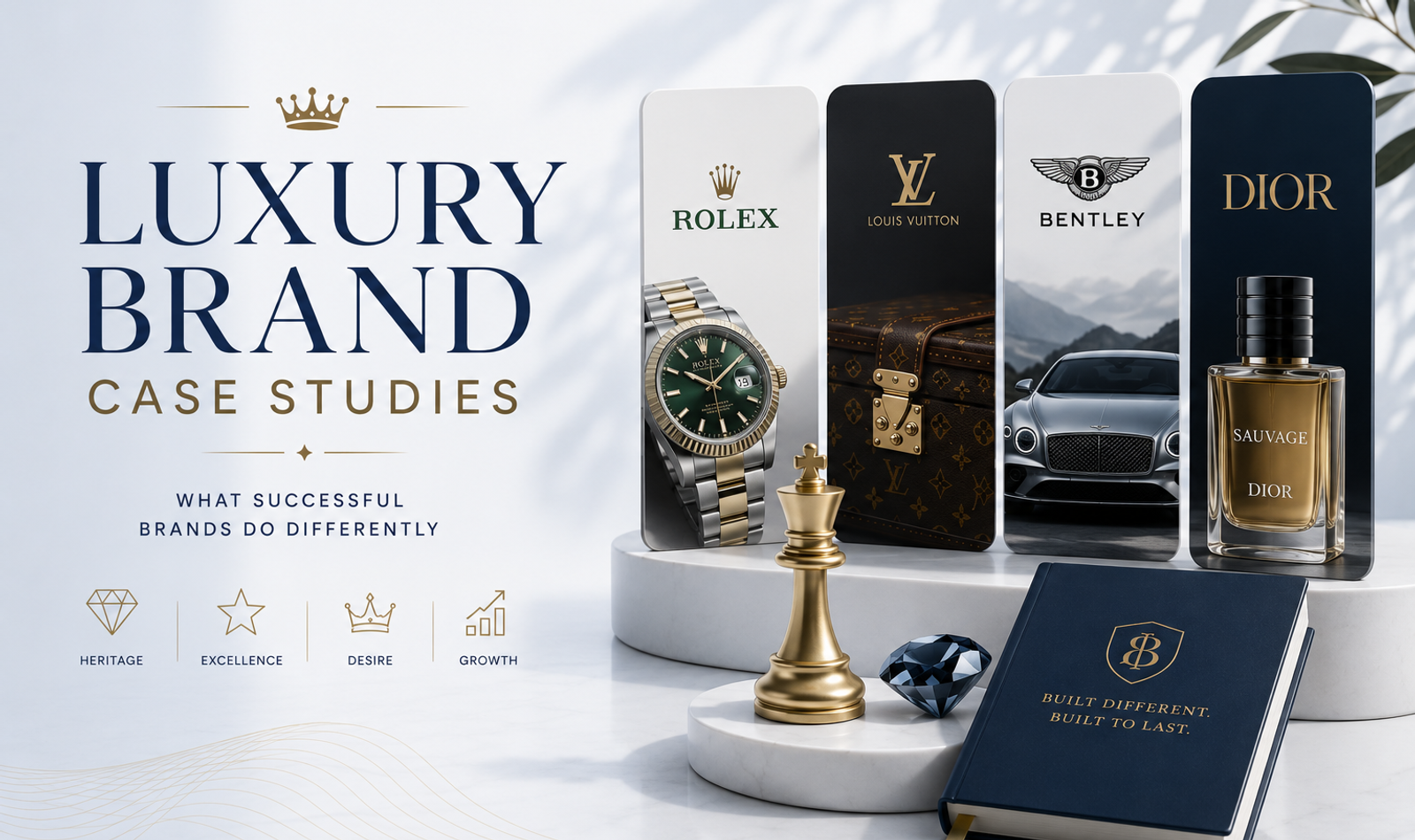
Luxury Brand Case Studies: What Successful Brands Do Differently
Luxury brands are not successful only because they sell expensive products or services. They succeed because they create meaning, trust, desire and consistency over time. A luxury brand becomes powerful when customers understand what it stands for, why it is different and why it deserves a premium place in their lives.
Many businesses try to enter the luxury market by copying surface-level signals. They use elegant fonts, muted colours, premium packaging, polished photography and high pricing. These elements may help a brand look refined, but they do not automatically create luxury value.
Successful luxury brands do something deeper.
They build strong positioning. They protect their identity. They create desire through storytelling. They use pricing with discipline. They deliver a consistent customer experience. They build cultural relevance without losing brand codes. They make customers feel that the brand is not easily replaceable.
This blog explores luxury brand case studies and explains what successful brands do differently. These examples are used as strategic learning references, not as insider reports. The goal is to understand the patterns that premium and luxury brands can apply when building stronger identity, communication, customer experience and long-term growth.
Why Luxury Brand Case Studies Matter
Luxury brand case studies help businesses understand how premium value is built in the real world.
A brand strategy framework explains what should be done. A case study shows how successful brands actually behave across positioning, product, marketing, pricing, storytelling, customer experience and expansion.
For premium brands in India, these lessons are especially useful.
The Indian luxury and premium market is growing across fashion, hospitality, weddings, real estate, beauty, automobiles, lifestyle, events, digital services and personal experiences. Businesses operating in experience-led categories can also study how professional events and weddings create premium perception through carefully controlled customer touchpoints.
However, the market is also becoming more competitive. Customers now compare brands through Instagram, Google Search, websites, PR coverage, reviews, creator content, events, referrals and offline experience. This makes an integrated PR, media and marketing strategy increasingly important for brands trying to establish authority.
This means a brand cannot depend only on visibility.
It must build trust and distinction.
Luxury case studies show that successful brands are not random. Their growth is usually the result of strong decisions repeated consistently over years.
What Successful Luxury Brands Have in Common
Successful luxury brands may belong to different industries, but they usually share some common qualities.
They have clear positioning. Customers know what the brand represents.
They have recognisable brand codes. Their colours, typography, packaging, product shapes, photography, tone and service style become familiar over time.
They protect pricing power. They do not depend heavily on discounts to create demand.
They use storytelling. They connect products and services with heritage, craft, culture, emotion or aspiration.
They focus on customer experience. Every touchpoint is treated as part of the brand.
They build trust through proof. Their value is supported by craftsmanship, expertise, legacy, quality, service or social validation.
They stay consistent while evolving. They adapt to modern platforms without losing their core identity.
These qualities are what make a luxury brand memorable.
Case Study One: Louis Vuitton — Heritage as a Growth Engine
Louis Vuitton is one of the most recognised luxury brands in the world because it has built its identity around heritage, travel, craftsmanship and recognisable brand codes.
The brand did not become powerful only through products. It became powerful by turning its history into a modern luxury story.
Its trunks, monogram, leather goods and travel associations create a clear world around the brand. Customers do not see only a bag or accessory. They see a symbol of travel, status, craft and global luxury culture.
The lesson for premium brands is simple.
Heritage can become a competitive advantage when it is communicated consistently.
A brand does not need to be 100 years old to use heritage. It can build around founder history, regional craft, cultural roots, family expertise, category experience or a strong origin story.
However, heritage must be made relevant.
Customers must understand why the story matters today.
For Indian luxury brands, this is especially powerful. India has deep craft, textile, hospitality, jewellery, wedding, design and cultural traditions. Premium experiences such as celebrity management can also become part of how brands connect cultural relevance with modern luxury positioning.
The key is not to tell history for the sake of it.
The key is to turn heritage into value.
What Louis Vuitton Does Differently
Louis Vuitton protects its brand codes.
The monogram, travel story, craftsmanship language and premium retail experience remain recognisable across markets.
The brand also balances history with modern culture. It collaborates with artists, designers and cultural voices without losing its core identity.
This balance is important.
Luxury brands must evolve, but they should not become unrecognisable.
For premium brands, the lesson is to define core brand codes early. These may include visual identity, tone, packaging style, product signature, service language or experience details.
When brand codes are repeated with discipline, customers begin to remember them.
Recognition builds brand equity.
Case Study Two: Hermès — Scarcity, Craft and Patience
Hermès is often studied for its focus on craftsmanship, scarcity and long-term brand patience.
The brand does not behave like a mass-market business. It does not depend on constant discounting, aggressive availability or trend-led communication. Instead, it builds value through craft, quality, controlled access and brand restraint.
This approach creates desire.
Customers do not feel that Hermès products are everywhere. They feel that access, craftsmanship and ownership carry meaning.
For luxury brands, scarcity can be powerful, but only when it is credible.
Scarcity should not be fake. It should come from genuine craft, limited production, personalised service, selective distribution or high-quality standards.
A new premium brand can use scarcity through appointment-led consultations, limited product drops, curated events, made-to-order systems, private previews or selective partnerships.
The lesson is not to become unavailable.
The lesson is to protect value through control.
What Hermès Does Differently
Hermès makes craftsmanship central to the brand story.
The customer understands that the product is not only expensive because of the logo. It is valuable because of the skill, time and quality behind it.
This is an important lesson for premium Indian brands.
Many businesses have strong service or product quality but fail to communicate the process behind it.
A luxury event company may have excellent planning systems but only show final décor. A premium hospitality brand may have strong guest service but only post room photos. A jewellery brand may use skilled craftsmanship but not explain the making process. A digital agency may deliver strong strategy but only show final visuals.
Luxury brands must show why they are valuable.
Process builds proof.
Case Study Three: Chanel — Strong Brand Codes and Emotional Identity
Chanel is an example of how powerful brand codes can build long-term recognition.
The brand is associated with black and white elegance, tweed, pearls, camellias, the interlocking logo, classic fragrance, Parisian sophistication and a strong feminine identity. These codes appear repeatedly across products, campaigns, retail spaces and communication.
Chanel’s strength is not only product design. It is consistency of meaning.
Customers know what the brand feels like.
This is one of the most important lessons in luxury branding.
A luxury brand must create a world, not just a product catalogue.
The world includes visuals, language, service, packaging, spaces, content, campaigns and customer emotions.
For Indian premium brands, this means defining a clear aesthetic and emotional territory.
A luxury wedding brand may own refined cultural grandeur. A boutique hospitality brand may own quiet escape. A premium beauty brand may own modern ritual and confidence. A luxury automotive service may own precision, comfort and trust.
When the brand world is clear, communication becomes stronger.
What Chanel Does Differently
Chanel repeats its codes without becoming boring.
This is a major luxury skill.
Many brands change their identity too often because they fear repetition. But repetition is what builds memory.
Luxury brands should not confuse consistency with lack of creativity.
A brand can create new campaigns, new products and new content while keeping its core codes intact.
For premium brands, this means using the same strategic identity across Instagram, website, packaging, PR, events, proposals and customer experience. A professionally designed website and digital marketing ecosystem should therefore extend the same visual and verbal identity customers encounter elsewhere.
When customers repeatedly experience the same brand feeling, trust becomes stronger.
Case Study Four: Rolex — Longevity, Performance and Trust
Rolex is a strong example of a luxury brand built around precision, achievement, durability and status.
Its products are positioned not only as watches but as symbols of performance, success and long-term value. The brand connects itself with exploration, sports, excellence and achievement.
The Rolex lesson is important because it shows how luxury can be built around trust and performance, not only fashion or aesthetics.
For many premium brands, especially in automotive, real estate, hospitality, digital services and events, trust is the real luxury.
Customers want reliability. They want confidence. They want to know that the brand will deliver what it promises.
Rolex shows the power of building a brand around consistency and performance.
A luxury brand does not always need to be loud. It needs to be dependable.
What Rolex Does Differently
Rolex protects long-term value.
The brand does not rely on constant novelty or discounts. It builds around durability, recognition and aspiration.
This creates pricing power.
For premium brands, the lesson is to build assets that last.
Do not create campaigns that disappear after a week. Build signature services, strong case studies, evergreen content, customer proof, recognisable visuals and consistent brand promises. A well-developed brand content and insights library can become a long-term authority asset rather than relying entirely on short-lived campaigns.
Longevity itself can become a luxury signal.
Customers trust brands that feel stable.
Case Study Five: Ritz-Carlton — Service as Luxury Positioning
Ritz-Carlton is a strong example of luxury built through service culture.
The brand is known for hospitality standards, guest attention and premium service behaviour. Its positioning is not only about beautiful properties. It is about how guests are treated.
This is a crucial lesson for service-led luxury brands.
Luxury is not only how a brand looks. It is how it behaves.
A customer may forget an advertisement, but they remember how they were treated during a high-value experience.
For hospitality, weddings, real estate, automotive, beauty, wellness and professional services, customer experience can be the strongest form of differentiation.
A premium brand must design the complete journey.
This includes enquiry response, consultation, proposal, booking, onboarding, delivery, support, feedback and follow-up.
Every step should reflect the brand promise.
What Ritz-Carlton Does Differently
Ritz-Carlton treats employees as carriers of the brand.
This matters because luxury experience is delivered by people.
A brand may have strong marketing, but if the team does not understand the service standard, the experience will fail.
For premium Indian brands, team training is essential.
Sales teams, hospitality staff, customer service teams, event managers, stylists, drivers, front desk executives, designers and account managers all shape perception. In high-touch experiences, professional guest management can become a direct expression of the brand’s service standard.
A luxury brand should create internal guidelines, tone standards, service scripts, escalation systems and customer care principles.
Luxury must be operational, not only visual.
Case Study Six: Taj Hotels — Indian Hospitality and Emotional Trust
Taj is one of India’s strongest hospitality brands because it combines heritage, service, emotional trust and Indian hospitality.
The brand has built meaning beyond rooms and properties. It represents warmth, legacy, service and a certain standard of Indian luxury.
This is important for Indian premium brands because it shows the value of cultural authenticity.
Luxury in India does not need to copy Western luxury codes.
Indian luxury can be warm, emotional, detailed, hospitable, craft-led, family-oriented, ceremonial and culturally rooted.
A brand that understands Indian customer psychology can create stronger relevance.
For example, a luxury wedding brand in India must understand family dynamics, rituals, guest hospitality, emotional expectations and status signals. Businesses creating these experiences can strengthen their offering through specialised events and weddings management.
A hospitality brand must understand warmth and personal attention. A fashion brand must understand craft, occasion, identity and cultural memory.
Luxury should be global in quality but local in understanding.
What Taj Does Differently
Taj creates emotional trust.
This is a powerful competitive advantage.
Customers do not only choose hospitality brands based on location or price. They choose based on confidence, reputation and how they expect to feel.
For premium brands, emotional trust can be built through consistent service, founder visibility, customer stories, reviews, PR, heritage, values and thoughtful communication.
Trust reduces customer hesitation.
In luxury, trust is often more important than aggressive promotion.
Case Study Seven: Sabyasachi — Cultural Luxury and Strong Storytelling
Sabyasachi is a strong Indian example of luxury positioning built through cultural storytelling, bridal aspiration, craftsmanship and a distinctive visual world.
The brand created a powerful identity around Indian craft, wedding culture, nostalgia, heritage-inspired fashion and emotional storytelling. It became more than a clothing label. It became part of the imagination of Indian luxury weddings.
This shows how a luxury brand can build desire through cultural depth.
Sabyasachi did not simply sell products. It created a world.
The photography, styling, jewellery, textiles, store design, campaign mood and brand language created a recognisable identity.
For Indian luxury brands, the lesson is clear.
Culture can be a luxury advantage when it is interpreted with refinement and consistency.
The brand does not need to use culture in a predictable way. It can modernise it, elevate it and create emotional meaning around it.
What Sabyasachi Does Differently
Sabyasachi owns a strong visual and emotional territory.
The brand is recognisable because it repeats its world with confidence.
It also understands the emotional value of weddings, family, memory and aspiration in India.
For premium brands in events, fashion, jewellery, hospitality and lifestyle, this is highly relevant.
Customers in India often buy luxury for occasions, identity, family pride, celebration and emotional milestones.
A successful luxury brand should understand the emotion behind the purchase.
When the brand connects with that emotion, it becomes more than a vendor.
It becomes part of the customer’s story.
Case Study Eight: Apple as Premium Strategy — Simplicity, Experience and Ecosystem
Apple is not always categorized as a traditional luxury brand, but it offers important premium brand lessons.
Its strength comes from simplicity, design consistency, ecosystem thinking, retail experience, packaging, product launch discipline and emotional clarity.
Apple does not only sell devices. It sells ease, creativity, status, design and a connected ecosystem.
The lesson for luxury brands is that simplicity can be powerful.
Premium customers do not always want complexity. They often want clarity, confidence and seamless experience.
A luxury brand website should be easy to understand. The buying journey should be smooth. Packaging should feel refined. Product or service information should be clear. Customer support should feel organized.
Luxury should not feel confusing.
It should feel effortless.
What Apple Does Differently
Apple makes the customer experience feel controlled from discovery to purchase to usage.
This is a key luxury lesson.
A brand cannot only focus on the product. It must design the full journey.
For premium Indian brands, this means simplifying service pages, enquiry forms, proposals, purchase flows, WhatsApp communication, payment processes and post-purchase care.
When the experience feels seamless, the brand feels more premium.
Case Study Nine: Mercedes-Benz — Status, Engineering and Lifestyle Expansion
Mercedes-Benz shows how a luxury automotive brand can combine engineering trust, status and lifestyle positioning.
The brand is associated with performance, safety, comfort, success and prestige. It has built meaning around both product excellence and social aspiration.
For automotive and mobility brands, the lesson is important.
Luxury positioning should connect rational and emotional value.
Customers may justify the purchase through performance, safety, technology or comfort. But they also feel the emotional value of status, confidence and identity.
A premium car rental, chauffeur-driven mobility or automotive service brand can use similar principles.
It should communicate reliability, comfort, professionalism and trust, while also making the customer feel elevated.
What Mercedes-Benz Does Differently
Mercedes-Benz has strong category authority.
The brand has built trust around engineering and prestige over many years.
For newer automotive brands, the lesson is to build proof consistently.
Show fleet quality, safety standards, chauffeur training, maintenance, customer testimonials, corporate use cases and service processes.
Luxury automotive communication should not only show cars.
It should show reliability, comfort and confidence.
What These Luxury Case Studies Teach Us
These brands belong to different categories, but their success patterns are similar.
They know what they stand for.
They repeat their brand codes consistently.
They make value visible.
They protect pricing.
They use storytelling to create meaning.
They invest in customer experience.
They build trust before pushing conversion.
They evolve without losing identity.
They use culture, craft, service, design or performance as competitive advantages.
They do not depend only on advertising.
They build brand equity over time.
This is the difference between looking premium and becoming truly luxury.
Lesson One: Successful Luxury Brands Own a Clear Position
A luxury brand must be clear about the space it wants to own.
Without positioning, marketing becomes generic.
A brand may say it is premium, elegant, exclusive or high-quality, but these words are not enough. The customer must understand the specific meaning.
A strong luxury position may focus on heritage, craft, quiet sophistication, cultural depth, performance, personalisation, service, innovation, privacy or emotional experience.
The brand should choose a position it can truly deliver.
A weak position creates confusion. A strong position creates memory.
Lesson Two: They Build Recognisable Brand Codes
Successful luxury brands repeat distinctive elements.
These may include colours, symbols, typography, photography style, packaging, product shapes, store design, tone of voice or service rituals.
Brand codes make the brand easier to recognise.
For new luxury brands, this is important from day one.
Do not change the identity every few months. Do not follow every trend. Do not create a new mood for every campaign.
Define the brand world and build it consistently.
Recognition is built through repetition.
Lesson Three: They Make Value Visible
Luxury customers need to understand value.
They may buy emotionally, but they still need reasons to trust the price.
Successful brands show their value through process, detail, craft, service, proof, heritage, materials, expertise, customer stories and experience.
A luxury brand should not hide everything behind vague words.
If the brand uses better materials, show them. If the service is more detailed, explain it. If the process is more careful, document it. If the experience is more personal, make it visible.
Modern formats such as premium films, campaign content and AI video and VFX production can also help make otherwise invisible aspects of process, craft and experience easier to communicate.
Visible value protects pricing power.
Lesson Four: They Protect Pricing Power
Successful luxury brands do not train customers to wait for discounts.
They use pricing as a signal of value.
This does not mean they never create offers, but they avoid weakening perception through constant price cuts.
Luxury brands should use added value, early access, private previews, exclusive experiences, loyalty benefits or personalised services instead of repeated discounting.
Pricing power is built through confidence.
If a brand constantly apologises for its price, customers will question it.
Lesson Five: They Treat Customer Experience as Strategy
Customer experience is not after-sales support. It is brand strategy.
Every customer interaction shapes perception.
Successful luxury brands design the journey carefully. The website, store, consultation, proposal, packaging, delivery, event flow, communication and follow-up all support the same promise.
Premium brands should map their full customer journey and identify where perception can improve.
A single weak touchpoint can damage luxury trust.
Lesson Six: They Use Storytelling to Create Emotional Meaning
Luxury brands succeed when they tell stories people want to be part of.
These stories may be about heritage, craft, identity, culture, achievement, romance, travel, innovation, family, community or self-expression.
Storytelling transforms a product or service into meaning.
A luxury wedding brand can tell stories of celebration and hospitality. A beauty brand can tell stories of ritual and confidence. A hospitality brand can tell stories of escape and belonging. A mobility brand can tell stories of comfort and reliability.
The story should match the brand’s true strengths.
Lesson Seven: They Balance Exclusivity and Accessibility
Luxury brands must manage access carefully.
If a brand becomes too available, it may lose desirability. If it becomes too inaccessible, it may limit growth.
Successful brands balance aspiration with customer access.
They use controlled distribution, private experiences, selective collaborations, appointment-led services, limited collections or curated communities.
Premium experiences can also use carefully selected personalities and talent through professional celebrity management to create cultural relevance without making the brand feel indiscriminate.
This creates a sense of value without completely blocking growth.
For premium Indian brands, this balance is important.
The brand should grow without becoming ordinary.
Lesson Eight: They Build Trust Through Third-Party Credibility
PR, media features, customer testimonials, expert recognition, awards, creator partnerships and word-of-mouth all help build trust.
Luxury customers often look for signals before making a decision.
They want to know that the brand is credible.
Successful brands use third-party validation wisely.
They do not depend only on paid ads.
For premium brands, this means building a PR and media marketing strategy, collecting reviews, creating case studies, working with aligned creators and showcasing customer proof.
Trust reduces friction.
Lesson Nine: They Stay Consistent While Evolving
Luxury brands must evolve with culture, platforms and customer behaviour.
However, evolution should not mean losing identity.
Successful brands modernise their campaigns, channels and collaborations while keeping their core codes intact.
A luxury brand can use Instagram, AI visuals, short-form video, influencer marketing, SEO and digital campaigns without becoming generic.
The key is to adapt expression, not abandon identity.
Consistency builds memory. Evolution keeps the brand relevant.
How Indian Premium Brands Can Apply These Lessons
Indian premium brands have a major opportunity.
They can build strong luxury identities by combining global execution standards with Indian cultural understanding.
A luxury brand in India can use craft, hospitality, emotion, celebration, family values, regional identity, design, service and modern aspiration as powerful brand assets.
However, the brand must avoid becoming generic.
It should define its unique position, build a recognisable identity, improve customer experience, communicate proof, use PR strategically and protect pricing power.
Brands operating across different markets should also consider how their positioning translates geographically. A structured DTS locations network demonstrates how services can be organised around different Indian markets while maintaining one overall brand identity.
Premium Indian customers are becoming more aware and selective.
They want brands that feel credible, refined and meaningful.
This creates a strong opportunity for brands that are willing to build properly.
Common Mistakes Luxury Brands Should Avoid
One common mistake is copying famous luxury brands.
Inspiration is useful, but imitation weakens identity.
Another mistake is focusing only on visuals.
Luxury must be delivered through product, service and experience.
A third mistake is changing the brand too often.
Customers need consistency to remember the brand.
Brands also make the mistake of discounting too much.
This weakens premium perception.
Another mistake is using generic luxury language without proof.
Words like exclusive, premium and world-class should be supported by specific evidence.
Finally, many brands ignore customer experience.
A luxury promise fails when service does not match the image.
Frequently Asked Questions
What are luxury brand case studies?
Luxury brand case studies are strategic examples that show how successful luxury brands build positioning, storytelling, pricing, customer experience and brand equity.
What do successful luxury brands do differently?
They build clear positioning, strong brand codes, emotional storytelling, premium customer experience, pricing power and consistent brand perception.
Why is brand positioning important in luxury?
Brand positioning helps customers understand what the luxury brand stands for, why it is different and why it deserves a premium price.
How do luxury brands build customer trust?
Luxury brands build trust through quality, consistency, customer experience, PR, testimonials, craftsmanship, founder credibility and strong proof points.
Why do luxury brands avoid frequent discounts?
Frequent discounts can weaken premium perception and train customers to wait for lower prices, reducing long-term pricing power.
How can Indian brands build luxury positioning?
Indian brands can build luxury positioning through cultural depth, craft, service excellence, premium identity, strong storytelling and consistent customer experience.
What is a luxury brand code?
A luxury brand code is a recognisable element such as colour, logo, typography, packaging, product detail, tone, visual style or service ritual.
How does storytelling help luxury brands?
Storytelling gives products and services emotional meaning. It helps customers connect with the brand beyond features and price.
What role does customer experience play in luxury branding?
Customer experience proves the brand promise. Every touchpoint must feel aligned with the luxury identity.
What is the biggest lesson from successful luxury brands?
The biggest lesson is consistency. Successful luxury brands repeat their identity, values, proof and experience over time until customers remember and trust them.
Conclusion
Luxury brand success is not accidental.
The most successful luxury brands build strong positioning, protect their identity, communicate value clearly and deliver consistent customer experiences over time.
They do not rely only on beautiful visuals or high pricing.
They create meaning.
Louis Vuitton shows the power of heritage. Hermès shows the value of craft and restraint. Chanel shows the strength of brand codes. Rolex shows the importance of longevity and trust. Ritz-Carlton shows that service can become luxury positioning. Taj shows the emotional power of Indian hospitality. Sabyasachi shows how cultural storytelling can create desire. Apple shows the value of simplicity and ecosystem thinking. Mercedes-Benz shows how performance and status can work together.
The common lesson is clear.
Luxury brands become powerful when every touchpoint supports the same promise.
For premium and luxury brands in India, the opportunity is strong. Customers are looking for brands that feel refined, trustworthy, meaningful and distinctive.
Double Trouble Studio helps luxury, premium, hospitality, lifestyle, event, fashion, beauty, automotive, real estate and service-led brands build stronger positioning, identity, storytelling, PR, digital marketing, website strategy, content systems and customer experience.
You can explore our work to understand how strategy and creative execution come together, learn more about Double Trouble Studio, or contact our team to discuss your brand requirements.
With the right strategy, a brand can move beyond looking expensive and start becoming truly valuable, memorable and trusted.
📩 info@dtsworld.in 📞 +91 80000 06021 📍 Andheri (West), Mumbai
Need this for your brand?
Let DTS build your next campaign.
From PR, celebrity management and events to websites, social media, SEO and AI video production — Double Trouble Studio helps brands grow with strategy and execution.
Discuss Your Requirement →