
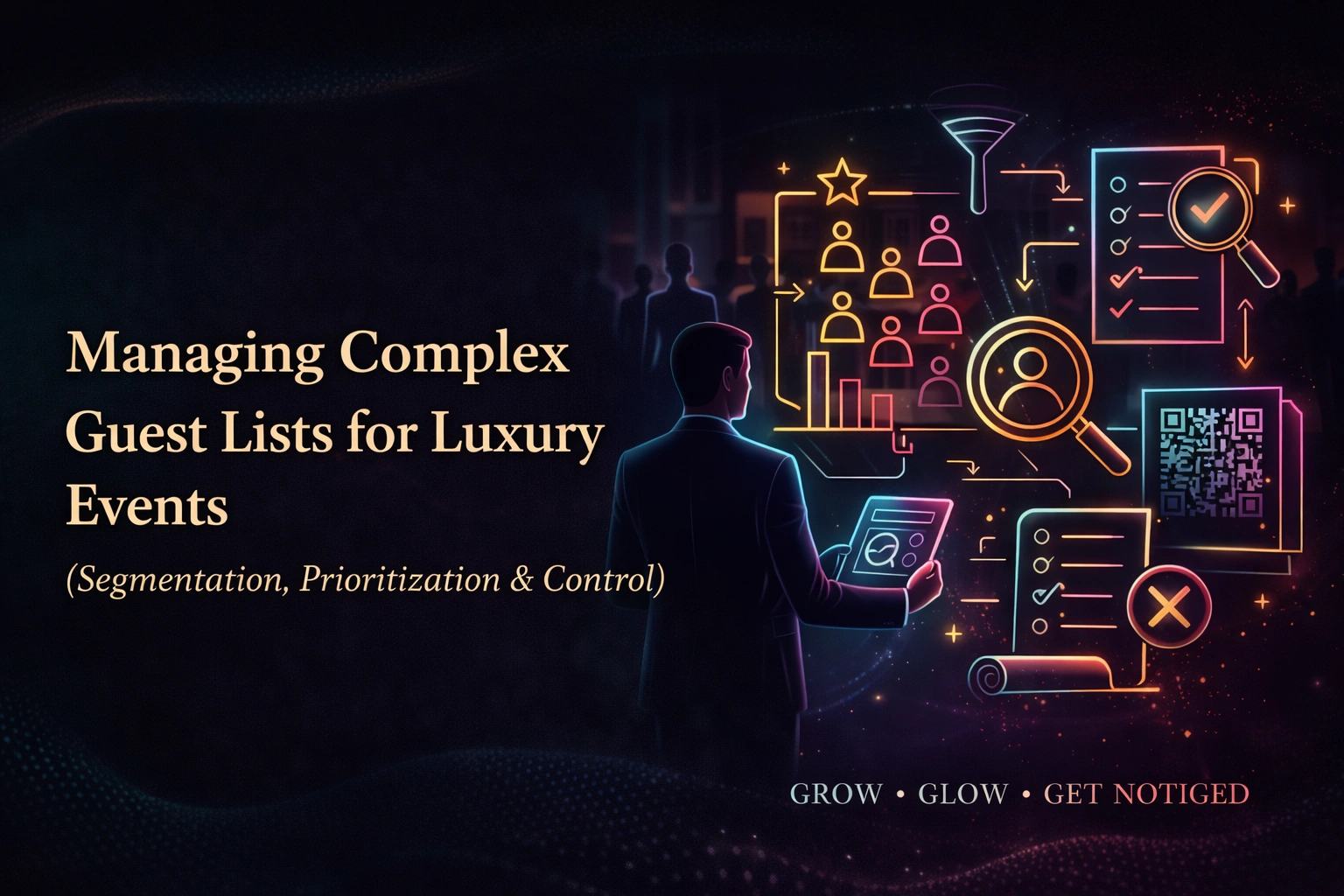
Managing Complex Guest Lists for Luxury Events (Segmentation, Prioritization & Control)
In luxury events, guest list management is far more than a logistical exercise. It is a strategic process that directly influences experience, flow, and overall success. High-end weddings and corporate galas often involve hundreds or even thousands of guests, each with different roles, expectations, and levels of importance. Managing this complexity requires more than organization. It requires structure, clarity, and precision.
A poorly managed guest list can create confusion, delays, and inconsistencies that affect every aspect of the event. From seating arrangements and hospitality to access control and personalization, every decision depends on how well the guest list is structured. In premium environments, where expectations are high and execution must be flawless, even small errors can have a significant impact.
In India’s growing luxury event landscape, guest list management has evolved into a strategic discipline. It is no longer about simply tracking attendance. It is about designing a system that supports segmentation, prioritization, and control. Because in luxury events, complexity must be managed without ever feeling complicated.
Understanding Guest Lists as a Strategic Foundation
A guest list is not just a collection of names. It is the foundation of the entire event ecosystem. Every operational decision, from invitations to on-ground execution, is influenced by how the guest list is structured and managed. Without a clear framework, planning becomes reactive and fragmented, leading to inconsistencies that are difficult to control.
Luxury events involve multiple layers of guests, including family members, corporate stakeholders, VIPs, and extended networks. Each group carries different expectations and requires a different level of attention. Treating all guests uniformly may simplify planning, but it compromises experience. Strategic guest list management ensures that these differences are recognized and addressed effectively.
To understand how guest list systems integrate into broader event planning frameworks, you can explore the complete guide here: 👉 http://dtsworld.in/blog/the-complete-guide-to-guest-management-for-premium-events-weddings
While that pillar resource explains overall guest management, this guide focuses specifically on handling complexity within guest lists.
The Challenge of Complexity in Luxury Events
Complexity in guest lists arises from multiple factors, including large volumes, diverse guest categories, and dynamic changes throughout the planning process. Unlike standard events, luxury weddings and corporate galas often involve overlapping relationships, hierarchical structures, and evolving priorities. This makes simple list management ineffective.
Changes are inevitable in such environments. Guest confirmations may fluctuate, last-minute additions may occur, and priorities may shift based on evolving requirements. Without a structured system, these changes can create confusion and disrupt planning. Complexity, if not managed properly, can quickly escalate into operational challenges.
The goal is not to eliminate complexity, but to control it. By implementing structured processes and clear categorization, planners can manage even the most intricate guest lists with precision. This ensures that complexity remains internal and does not affect the guest experience.
Guest Segmentation: Creating Structure Within Volume
Segmentation is the first step in managing complex guest lists effectively. It involves dividing the guest list into meaningful categories based on relevance, role, and expectations. This creates clarity and allows planners to design targeted strategies for each group.
In luxury events, segmentation may include categories such as immediate family, extended family, corporate clients, VIPs, and general guests. Each segment requires a different approach in terms of communication, hospitality, and access. Without segmentation, it becomes difficult to maintain consistency across these diverse groups.
Segmentation also supports decision-making. It allows planners to allocate resources more effectively and prioritize high-impact areas. By creating structure within volume, segmentation transforms a complex guest list into a manageable system.
Prioritization: Defining Levels of Importance
Once segmentation is established, the next step is prioritization. Not all guests hold the same level of importance, and recognizing this distinction is critical for effective planning. Prioritization ensures that key guests receive the attention and resources they require.
In luxury events, prioritization often aligns with social, familial, or corporate hierarchies. VIP guests, decision-makers, and high-value individuals must be identified early and managed with greater precision. Their experience often influences the overall perception of the event.
Prioritization also helps in managing constraints. When resources such as seating, space, or time are limited, decisions must be made strategically. A well-defined priority structure ensures that these decisions are aligned with the event’s objectives.
Control Systems: Maintaining Accuracy and Consistency
Control is what ensures that the guest list remains accurate and reliable throughout the planning process. Without proper control systems, even well-segmented and prioritized lists can become outdated or inconsistent.
Control involves maintaining a centralized system where all updates are recorded in real time. This ensures that every stakeholder has access to the same information, reducing the risk of miscommunication. It also allows planners to track changes and maintain visibility over the entire guest list.
In luxury events, where multiple teams and vendors are involved, control systems are essential for coordination. They ensure that every decision is based on accurate data, enabling seamless execution.
Managing RSVPs and Dynamic Updates
RSVP management is one of the most dynamic aspects of guest list control. Responses may change frequently, requiring continuous updates and adjustments. In large-scale events, this can become a complex process if not managed systematically.
A structured RSVP system ensures that confirmations, declines, and pending responses are tracked accurately. It also allows planners to anticipate attendance and make informed decisions regarding seating, catering, and logistics.
Dynamic updates must be handled with precision. Last-minute changes are inevitable, but they should not disrupt the overall structure. Effective management ensures that flexibility does not compromise control.
Integration with Seating and Hospitality Planning
Guest lists are closely linked to seating arrangements and hospitality strategies. Every decision in these areas depends on how well the guest list is organized. Segmentation and prioritization play a critical role in ensuring that seating is both functional and socially appropriate.
In luxury events, seating is not just about placement. It is about creating comfortable and meaningful interactions. Guests must be positioned in a way that aligns with relationships and expectations. This requires a deep understanding of the guest list.
Hospitality planning also relies on accurate guest data. Preferences, special requirements, and VIP needs must be integrated into service strategies. A well-managed guest list ensures that these elements are executed seamlessly.
Technology and Digital Guest List Management
Technology has transformed how guest lists are managed in modern luxury events. Digital platforms allow for centralized data management, real-time updates, and seamless coordination between teams. This significantly reduces the risk of errors and inconsistencies.
These systems enable planners to track RSVPs, manage segmentation, and update information instantly. They also support integration with other event systems, such as check-in and analytics tools. This creates a unified approach to guest management.
However, technology must be used strategically. It should simplify processes without adding unnecessary complexity. The focus should remain on clarity and efficiency.
Handling Last-Minute Changes Without Disruption
Last-minute changes are inevitable in luxury events. Guests may cancel, new attendees may be added, and priorities may shift. The ability to handle these changes without disruption is a key aspect of effective guest list management.
A structured system allows planners to adapt quickly while maintaining control. Changes can be integrated seamlessly without affecting overall planning. This ensures that the event remains stable even in dynamic situations.
Flexibility is important, but it must be supported by strong systems. Without structure, last-minute changes can create confusion and impact execution.
Common Mistakes in Managing Complex Guest Lists
One of the most common mistakes is treating the guest list as a static document. In reality, it is a dynamic system that requires continuous updates and monitoring. Failure to recognize this can lead to inaccuracies and inconsistencies.
Another issue is lack of segmentation. Without clear categorization, planning becomes generalized, reducing the effectiveness of strategies. This often results in uneven guest experiences.
Poor communication between teams is also a significant challenge. When different stakeholders work with outdated or inconsistent data, coordination breaks down. Recognizing these mistakes allows planners to implement better systems.
Why Structured Guest List Management Defines Luxury Events
Luxury events are defined by precision and attention to detail. Guests expect seamless experiences where every element feels intentional. This level of execution is only possible when the underlying systems are strong.
Structured guest list management ensures that every decision is informed and aligned. It creates clarity, reduces risk, and enhances overall efficiency. More importantly, it supports the delivery of personalized and consistent experiences.
In India’s competitive luxury event market, this level of structure is a key differentiator. It reflects professionalism and strategic thinking, setting high-end events apart from standard ones.
Conclusion: Structure Creates Seamlessness
Managing complex guest lists is not about simplifying the event. It is about structuring complexity in a way that remains invisible to guests. Segmentation creates clarity, prioritization defines focus, and control ensures consistency.
When these elements are aligned, guest list management becomes a powerful tool for enhancing experience. It supports every aspect of the event, from planning to execution.
Because in luxury events, seamless experiences are not accidental.
They are carefully structured.
Frequently Asked Questions (FAQs)
Q. What is guest list segmentation in luxury events?
Guest list segmentation involves categorizing guests into different groups based on their role, relationship, or importance. This helps planners design targeted strategies for communication, hospitality, and access, ensuring a more structured and effective approach.
Q. Why is prioritization important in managing guest lists?
Prioritization ensures that key guests receive the attention and resources they require. It helps planners make strategic decisions, especially when dealing with constraints such as seating or logistics, ensuring that the most important guests are managed effectively.
Q. How can technology improve guest list management?
Technology enables centralized data management, real-time updates, and seamless coordination. It reduces errors, improves accuracy, and allows planners to manage large guest lists more efficiently.
Q. What are the challenges of managing large guest lists?
Challenges include handling dynamic updates, maintaining accuracy, and coordinating between multiple teams. Without structured systems, these challenges can lead to confusion and operational issues.
Q. How do guest lists impact event experience?
Guest lists influence seating, hospitality, and overall flow. A well-managed guest list ensures that every guest is accommodated appropriately, enhancing comfort and satisfaction.
Q. How can planners handle last-minute changes effectively?
By using structured systems that allow for quick updates and adjustments. This ensures that changes can be integrated without disrupting the overall plan.
Q. What are common mistakes in guest list management?
Common mistakes include lack of segmentation, poor communication, and treating the guest list as a static document. These issues can lead to inconsistencies and affect the overall event experience.
Contact Us
If you are planning a luxury wedding or corporate event, managing guest lists requires more than organization. It requires strategy, structure, and precise execution.
From segmentation and prioritization to real-time control and coordination, every element must be aligned to ensure a seamless experience.
📩 hello@dtsworld.in 📞 +91 80000 06021 📍 Andheri East, Mumbai
👉 Streamline Your Guest List Management with DTS