
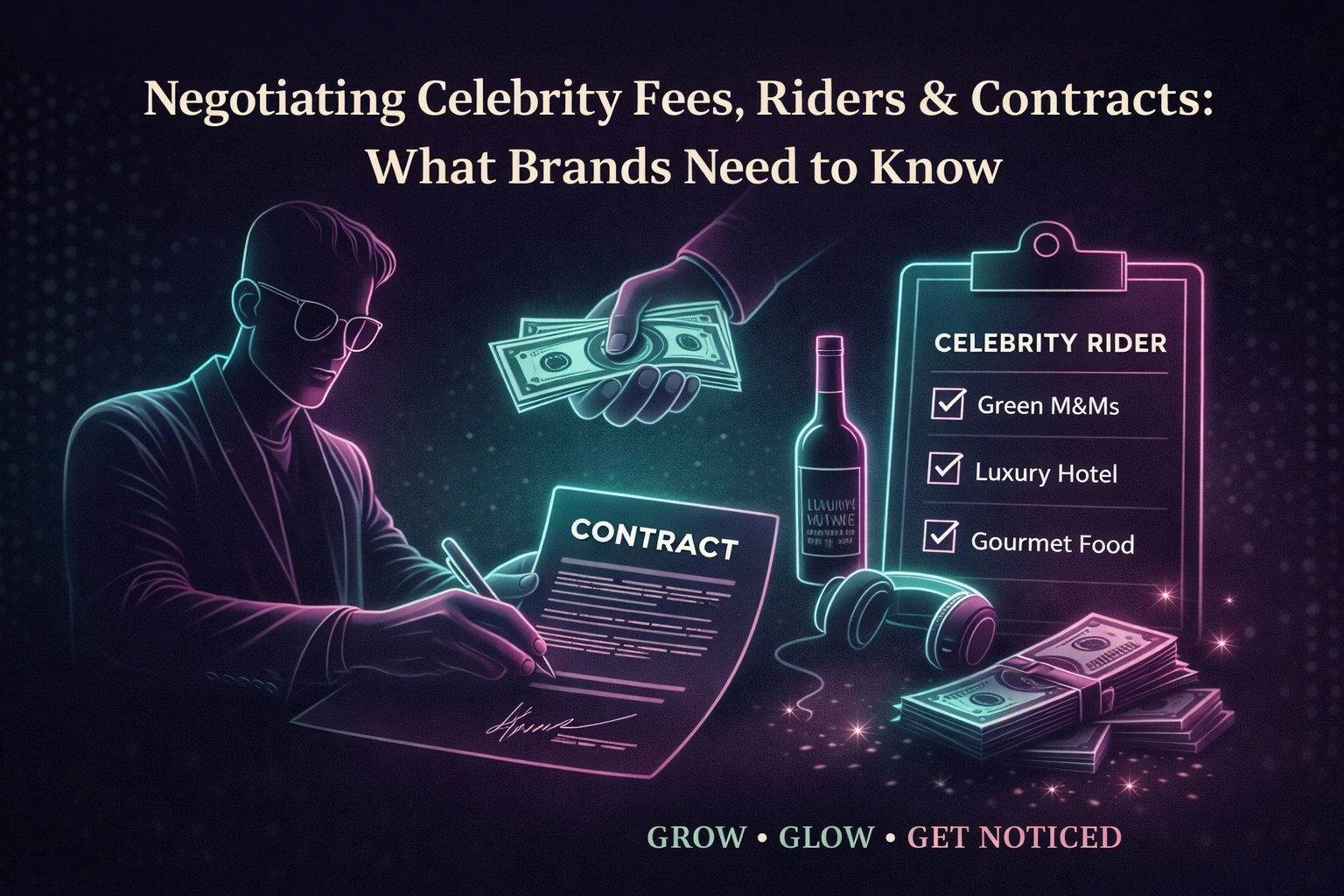
Negotiating Celebrity Fees, Riders & Contracts: What Brands Need to Know
In luxury events and high-stakes brand experiences, celebrity collaborations are often perceived through a single lens — the fee. Yet, in reality, the fee is only the visible layer of a much deeper structure. Behind every confirmed celebrity engagement lies a network of negotiations, contractual nuances, technical riders, and expectation frameworks that determine whether the collaboration succeeds or quietly unravels.
In 2026, celebrity negotiations have become significantly more complex. As public figures evolve into personal brands with defined market value, every appearance is governed by layered agreements that extend beyond presence. For luxury brands in India, where perception and precision are closely linked, understanding how to navigate these negotiations is no longer optional. It is foundational.
Because in premium environments, what is agreed on paper defines what unfolds on the ground.
Understanding Celebrity Fees Beyond the Headline Number
One of the most common misconceptions brands carry is that celebrity engagement is defined by a single quoted fee. In reality, this number is often just the starting point of a broader financial structure.
Celebrity fees are influenced by multiple variables, including the nature of the event, duration of engagement, visibility, audience profile, and usage rights. A short private appearance differs significantly from a high-visibility brand endorsement. Similarly, a closed-door corporate event carries different pricing dynamics compared to a widely amplified launch.
In many cases, what appears to be a fixed fee is actually a flexible framework. Negotiation is not about reducing cost arbitrarily but about aligning deliverables with budget. When brands approach this stage with clarity, they move from transactional bargaining to strategic structuring.
The Role of Riders in Defining Experience
Riders are often misunderstood as secondary attachments to contracts, when in reality, they are central to execution. A rider outlines the specific requirements a celebrity expects — from hospitality and travel arrangements to technical setups and privacy considerations.
In luxury environments, riders are not excessive demands. They are instruments of control. They ensure that the celebrity can perform or appear within conditions that align with their standards and public image.
For brands, overlooking rider details can lead to operational friction. Incomplete hospitality arrangements, inadequate technical setups, or overlooked preferences can create discomfort that impacts the overall experience. Conversely, when riders are respected and executed with precision, the collaboration feels seamless.
Understanding riders is not about compliance alone. It is about anticipating expectations before they surface.
Contracts: Where Clarity Replaces Assumption
Contracts are the backbone of celebrity collaborations. They translate conversations into enforceable agreements, ensuring that both parties operate with shared understanding.
In 2026, celebrity contracts have evolved into detailed documents that cover far more than basic appearance terms. They define timelines, deliverables, usage rights, exclusivity clauses, cancellation policies, and payment structures. Each clause plays a role in protecting both the brand and the celebrity.
For luxury brands, contractual clarity is directly linked to reputation. Ambiguity in agreements often leads to last-minute disputes, delayed deliverables, or misaligned expectations. When contracts are structured with precision, they eliminate uncertainty and create a foundation for smooth execution.
A well-drafted contract does not restrict creativity. It enables it by removing friction.
Negotiation as Strategic Alignment, Not Cost Reduction
Negotiation in celebrity management is often misunderstood as a process of lowering fees. In reality, effective negotiation is about aligning value. It involves understanding what the brand needs, what the celebrity offers, and how both can meet at a point that creates impact.
This may include adjusting deliverables, redefining engagement duration, or restructuring visibility components. For instance, a brand may choose to reduce on-ground time while incorporating digital amplification, or vice versa.
When negotiation is approached strategically, it becomes collaborative rather than adversarial. Both parties work toward a shared outcome, ensuring that the engagement delivers value beyond the immediate event.
In premium markets, negotiation is less about winning and more about aligning.
Hidden Complexities Brands Often Overlook
Despite increasing awareness, many brands still underestimate the layered nature of celebrity agreements. The most common challenges do not arise from major disagreements but from overlooked details.
Usage rights, for example, often create confusion. Without clear agreements, brands may assume they can use event footage for marketing, while celebrities may restrict such usage. Similarly, exclusivity clauses can limit a celebrity’s association with competing brands, impacting long-term campaigns.
Logistical expectations, payment timelines, and cancellation policies also carry significant weight. When these elements are not defined clearly, even a well-negotiated deal can face execution challenges.
The complexity is not in the negotiation itself but in the details that surround it.
The Importance of Timing and Preparation
Celebrity negotiations are highly time-sensitive. High-demand personalities operate on tightly managed schedules, and last-minute outreach often leads to limited availability or increased costs.
Preparation, therefore, becomes critical. Brands must approach negotiations with a clear brief, defined objectives, and realistic timelines. This not only improves the chances of securing the desired celebrity but also strengthens the negotiation position.
In 2026, preparation is often the differentiating factor between a confirmed collaboration and a missed opportunity.
Execution: Translating Agreements into Experience
Even the most well-negotiated contract holds value only when executed effectively. Execution is where agreements are tested against real-world dynamics.
Arrival coordination, hospitality arrangements, technical readiness, and schedule management must all align with the agreed terms. Any deviation can disrupt the experience and impact both the celebrity and the brand.
Luxury audiences are particularly sensitive to such disruptions. Delays, confusion, or mismanagement are quickly noticed and often remembered. Seamless execution, on the other hand, reinforces brand credibility.
In this context, negotiation and execution are not separate stages. They are interconnected processes that define the overall outcome.
Conclusion: Precision Creates Confidence
Negotiating celebrity fees, riders, and contracts is not a transactional task. It is a strategic process that shapes the entire collaboration. In India’s premium event landscape, where expectations are high and perception is critical, this process must be handled with clarity and discipline.
When brands understand the deeper structure behind fees, respect the role of riders, and approach contracts with precision, they create a foundation for successful execution. When they do not, even high-profile collaborations can fall short of their potential.
Because in luxury experiences, success is not defined by who you book.
It is defined by how well you structure the engagement.
Frequently Asked Questions (FAQs)
What is included in a celebrity fee?
A celebrity fee typically covers their appearance or engagement, but additional elements such as travel, hospitality, and usage rights may be negotiated separately.
What is a rider in celebrity contracts?
A rider outlines specific requirements related to hospitality, technical setup, travel, and personal preferences that must be fulfilled by the host.
Can celebrity fees be negotiated?
Yes. Fees can often be adjusted based on deliverables, duration, and visibility, provided the negotiation is approached strategically.
Why are contracts important in celebrity management?
Contracts ensure clarity on deliverables, timelines, and usage rights, reducing the risk of misunderstandings or disputes.
What is the biggest mistake brands make during negotiation?
Focusing only on cost instead of aligning expectations, deliverables, and execution requirements.
Design Your Celebrity Negotiation Strategy
If you are planning a premium event, brand campaign, or celebrity-led experience in India, negotiating fees, riders, and contracts requires more than discussion — it requires structure, clarity, and industry insight.
From fee structuring and rider analysis to contract negotiation and execution planning, our team ensures that every agreement is aligned with your brand positioning while minimizing risk and maximizing impact.
📩 hello@dtsworld.in 📞 +91 80000 06021 📍 Andheri East, Mumbai
👉 Design Your Celebrity Negotiation Strategy