
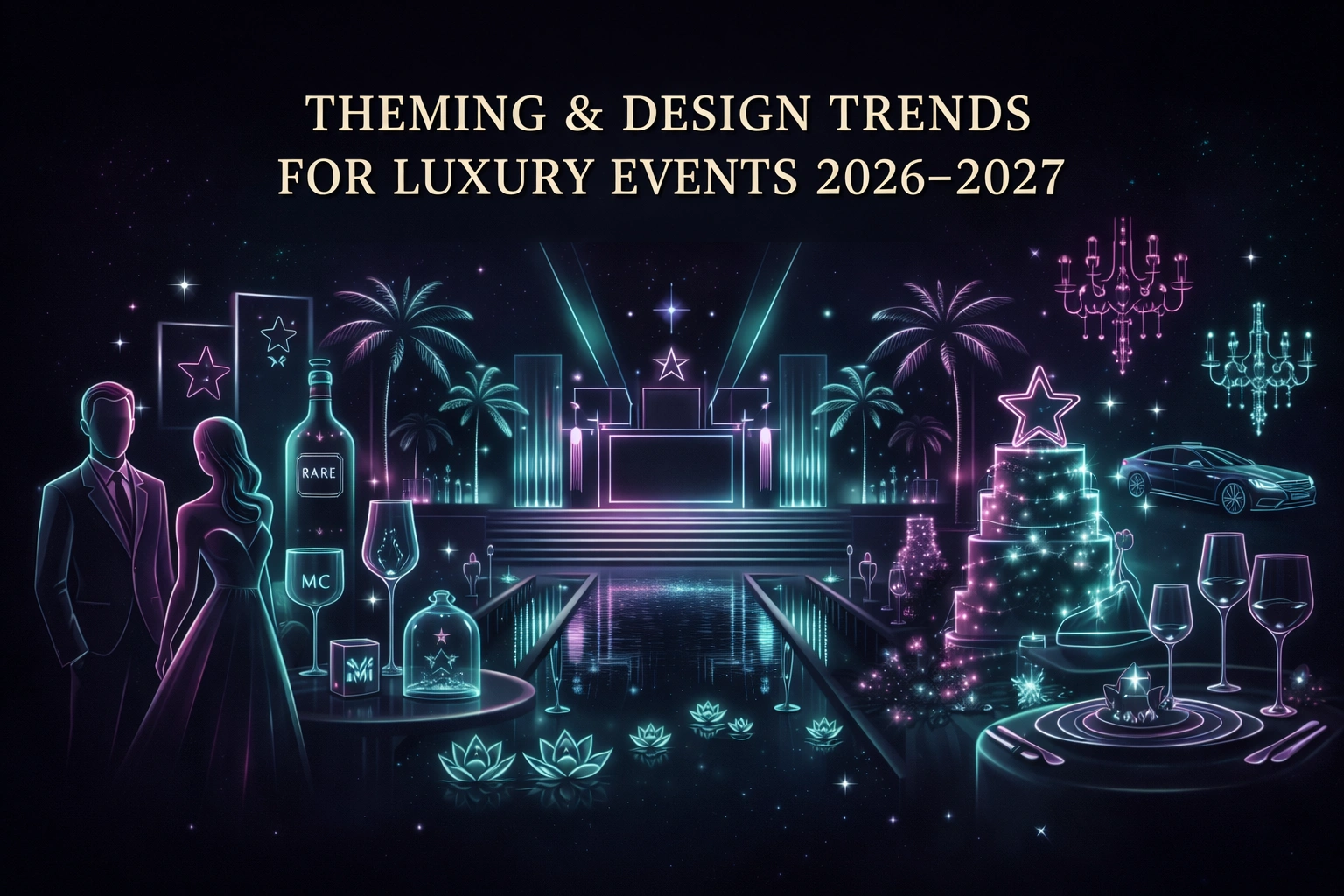
Theming & Design Trends for Luxury Events 2026–2027
In luxury events, design is no longer about decoration. It is about storytelling. Every element — from color palettes and materials to lighting and spatial flow — contributes to a cohesive narrative that defines how an event is perceived and remembered.
As we move into 2026–2027, the evolution of luxury event design is becoming increasingly intentional. Clients are no longer seeking visual grandeur alone. They are demanding experiences that feel immersive, personalized, and emotionally engaging. The focus has shifted from “how it looks” to “how it feels.”
In India’s premium event ecosystem, where weddings, brand launches, and curated experiences continue to grow in scale and sophistication, theming has become a strategic pillar.
Because in luxury environments, design is not just seen.
It is experienced.
The Shift from Aesthetics to Narrative-Led Design
One of the most defining trends in 2026–2027 is the move toward narrative-driven theming. Instead of standalone décor concepts, events are being designed around stories that unfold across multiple touchpoints.
This could mean a wedding where each function represents a different chapter of the couple’s journey, or a brand event where every design element reflects the identity of the product being launched. The theme is no longer confined to visuals. It extends to music, scent, lighting, and even guest interaction.
This shift creates a deeper level of engagement. Guests are not just observing the event. They are experiencing it as a cohesive story.
Narrative transforms design into memory.
Elevated Minimalism: Luxury Through Restraint
While opulence has long been associated with luxury events in India, a new form of minimalism is emerging. This is not simplicity driven by limitation, but restraint driven by intention.
Elevated minimalism focuses on fewer elements executed with precision. Clean layouts, refined color palettes, and high-quality materials replace excessive layering. Every element is deliberate, allowing space to become part of the design.
This approach creates a sense of calm sophistication. It shifts attention from quantity to quality, reinforcing the idea that luxury is defined by refinement rather than excess.
In 2026–2027, less is not less.
It is more controlled.
Immersive Environments and Spatial Design
Luxury events are increasingly moving toward immersive environments where guests feel transported into a different world. This is achieved through spatial design that integrates architecture, lighting, and movement.
Instead of static setups, spaces are designed to evolve. Entry experiences set the tone, transitions guide the journey, and focal points create moments of impact. Lighting plays a critical role, shaping mood and directing attention.
This trend is particularly prominent in destination weddings and high-end brand launches, where the venue itself becomes part of the storytelling.
Immersion ensures that guests do not just attend the event.
They step into it.
Cultural Fusion with Contemporary Expression
India’s rich cultural heritage continues to influence luxury event design, but it is being reinterpreted in more contemporary ways. Traditional motifs, textiles, and rituals are being blended with modern aesthetics to create unique visual languages.
This fusion allows events to feel rooted yet progressive. A heritage-inspired wedding may incorporate modern lighting techniques, while a contemporary event may draw subtle inspiration from classical design elements.
The balance between tradition and innovation creates depth. It allows events to resonate across generations while maintaining a distinct identity.
Cultural relevance enhances authenticity.
Personalization at Every Touchpoint
Personalization is becoming a defining factor in luxury design. Clients are moving away from generic themes toward concepts that reflect individual identity.
This extends beyond visual elements. Custom installations, curated guest experiences, and tailored design details create a sense of exclusivity. Even small elements, such as personalized welcome experiences or bespoke décor accents, contribute to the overall narrative.
In premium environments, personalization is not about customization alone.
It is about creating a sense of ownership.
Technology Integration Without Visual Disruption
Technology continues to play a significant role in event design, but its integration is becoming more subtle. Instead of overt displays, technology is being embedded seamlessly into the environment.
Projection mapping, dynamic lighting systems, and interactive installations are used to enhance the experience without overwhelming it. The goal is to support the narrative, not dominate it.
In 2026–2027, the most effective use of technology is the one that remains invisible.
It enhances without distracting.
Sustainable Luxury and Conscious Design
Sustainability is no longer a niche consideration. It is becoming an integral part of luxury event design. Clients are increasingly aware of environmental impact and are seeking ways to incorporate responsible practices without compromising aesthetics.
This includes the use of reusable materials, locally sourced elements, and efficient production methods. Sustainable design is being approached with the same level of creativity and precision as traditional luxury concepts.
The challenge lies in maintaining elegance while reducing waste.
In this evolving landscape, sustainability is becoming a marker of modern luxury.
The Importance of Cohesion Across Events
Luxury weddings and multi-day events require consistency across multiple functions. Each event may have a distinct theme, but they must all align within a broader narrative.
Cohesion ensures that the experience feels intentional rather than fragmented. Transitions between events are smooth, and the overall journey feels connected.
This approach requires careful planning and design alignment. Without it, even beautifully executed individual events can feel disconnected.
Cohesion creates continuity.
Conclusion: Design as Experience Architecture
Theming and design trends in 2026–2027 reflect a broader shift in how luxury events are conceptualized. Design is no longer an isolated element. It is part of a larger experience architecture that shapes perception at every stage.
From narrative-driven concepts to immersive environments and personalized details, the focus is on creating experiences that resonate emotionally and visually. In India’s premium event landscape, where expectations continue to evolve, this level of design thinking is becoming essential.
Because in luxury events, guests may forget specific details.
But they always remember how the experience made them feel.
Frequently Asked Questions (FAQs)
What are the biggest design trends for luxury events in 2026–2027?
Narrative-driven themes, immersive environments, elevated minimalism, and personalized experiences are among the leading trends.
How important is personalization in event design?
Personalization is critical, as it creates a unique identity and enhances guest engagement.
Is minimalism replacing traditional luxury décor?
Not replacing, but evolving it. Minimalism is being used to create more refined and intentional designs.
How is technology used in modern event design?
Technology is integrated subtly to enhance experience without dominating visual aesthetics.
Why is sustainability becoming important in luxury events?
Clients are increasingly conscious of environmental impact, making sustainable practices a key aspect of modern luxury.
Design Your Event Concept Strategy
If you are planning a luxury wedding, brand launch, or premium experience in India, theming and design should go beyond visuals — it should define the entire narrative.
From concept development and spatial design to execution and experience mapping, our team ensures that every element aligns with your vision while delivering a cohesive and immersive experience.
📩 hello@dtsworld.in 📞 +91 80000 06021 📍 Andheri East, Mumbai
👉 Design Your Event Concept Strategy