
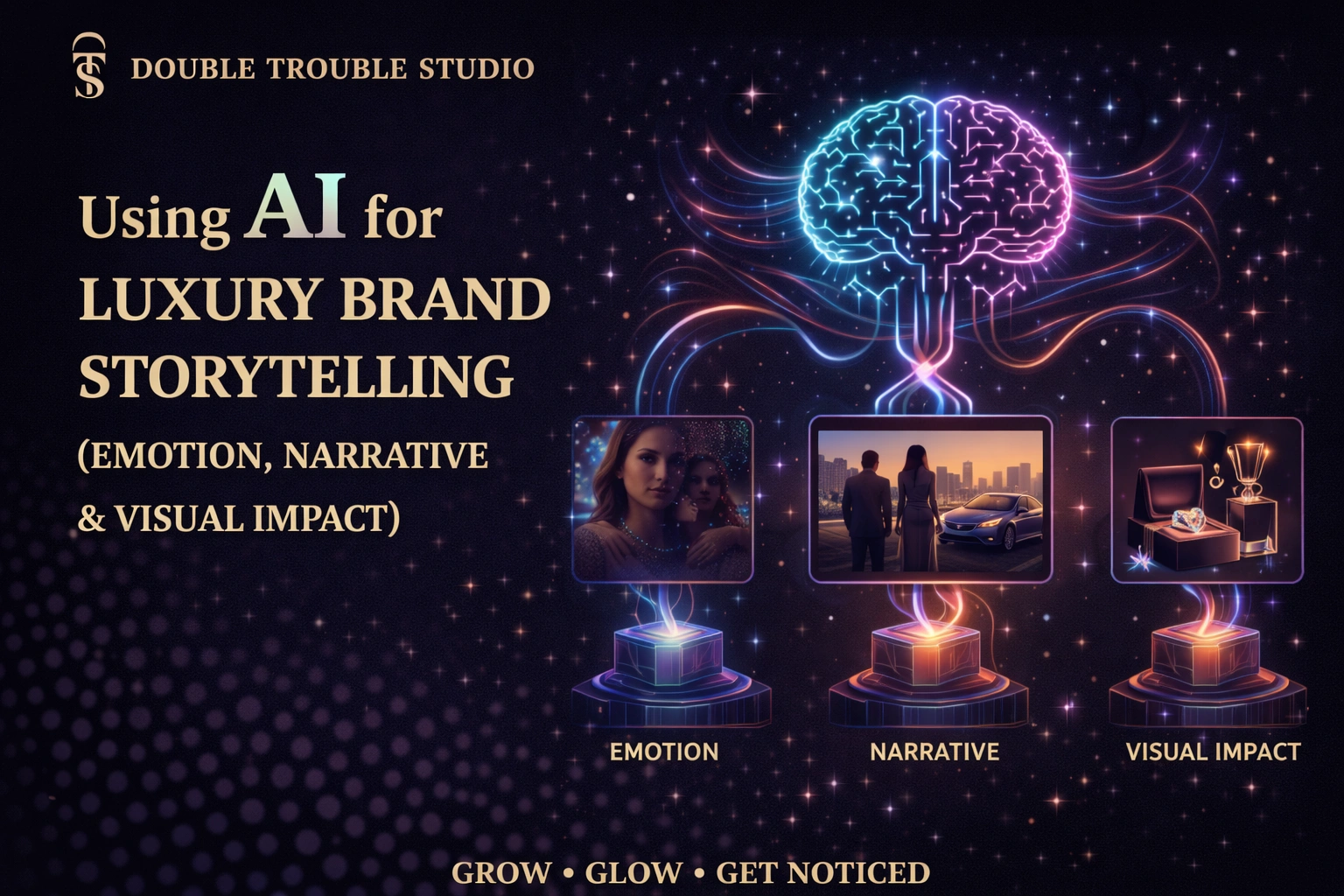
Using AI for Luxury Brand Storytelling (Emotion, Narrative & Visual Impact)
In 2026, storytelling continues to define the strength of luxury brands, but the way stories are created, structured, and delivered has evolved significantly due to artificial intelligence. Luxury has never been about products alone. It has always been about meaning, perception, and emotional connection. A luxury brand is not simply consumed; it is experienced through narratives that shape how audiences perceive value, identity, and aspiration. With the integration of AI into content creation, this storytelling process has expanded in both capability and complexity.
Artificial intelligence has made it possible to generate visuals instantly, simulate environments, adapt narratives across audiences, and accelerate production workflows. However, the availability of these capabilities does not automatically translate into effective storytelling. In fact, it introduces a new challenge. When storytelling becomes easier to produce, it becomes harder to maintain depth and distinction. Luxury brands must therefore approach AI not as a shortcut, but as a system that requires control, direction, and strategic alignment.
The role of AI in luxury storytelling is not to replace creativity, but to enhance how creativity is executed. It allows brands to explore ideas more efficiently, test visual directions before committing resources, and create consistent narratives across multiple platforms. At the same time, it demands a higher level of discipline. Without clear creative direction, AI-generated storytelling can become generic, repetitive, or disconnected from brand identity. This makes it essential for luxury brands to treat AI as an extension of their storytelling framework rather than as an independent solution.
The Role of Emotion in AI-Driven Luxury Storytelling
Emotion has always been at the core of luxury branding, and this remains unchanged in an AI-driven environment. Luxury purchases are rarely driven by necessity. They are driven by how the brand makes the audience feel. Whether it is a sense of exclusivity, aspiration, belonging, or prestige, emotion defines engagement and loyalty. The integration of AI into storytelling introduces new ways to construct and deliver these emotional experiences, but it does not redefine their importance.
AI enables brands to experiment with emotional tones more rapidly than ever before. Through variations in color grading, lighting, pacing, and composition, multiple emotional directions can be explored within a short timeframe. For instance, a brand can test whether a campaign should evoke calm sophistication through soft tones and slow transitions or create a sense of bold confidence through sharp contrasts and dynamic movement. This level of experimentation allows creative teams to refine their approach before finalizing a narrative.
However, the presence of options does not replace the need for clarity. Emotion must be defined before it is executed. If a brand does not have a clear understanding of the emotional response it aims to create, AI-generated variations can lead to inconsistency. The output may appear visually impressive, but it may fail to resonate with the audience because it lacks a coherent emotional direction.
Luxury storytelling requires emotional precision. Every element of the narrative, from visual composition to sound design, must contribute to the same feeling. AI can assist in achieving this alignment by enabling rapid iteration, but it cannot determine what the correct emotional direction should be. This responsibility remains with the brand’s creative leadership.
Another important consideration is the subtlety of emotion in luxury storytelling. Unlike mass-market content, which often relies on overt emotional cues, luxury narratives tend to be understated. The emotion is implied rather than explicitly stated. AI-generated content, if not carefully refined, can sometimes exaggerate visual or tonal elements, making the storytelling feel less sophisticated. This is why human oversight remains essential. It ensures that the emotional tone remains aligned with the brand’s identity and does not become overly stylized or artificial.
Narrative Structure in the Age of AI
Narrative structure is one of the most critical components of storytelling, and AI has introduced new ways to approach it. Traditionally, narratives are developed through a linear process involving scripting, storyboarding, and iterative refinement. Each stage requires time, collaboration, and creative judgment. AI has accelerated this process by enabling rapid ideation and visualization.
Creative teams can now generate multiple narrative concepts simultaneously, explore different story arcs, and visualize scenes before production begins. This allows for faster decision-making and reduces uncertainty. However, it also introduces the risk of fragmentation. When multiple narrative options are available, there is a tendency to combine elements from different directions, resulting in a story that lacks coherence.
Luxury storytelling cannot rely on fragmented narratives. It requires a clear and deliberate structure. The beginning of the story must establish context and intrigue, the middle must develop the narrative and deepen engagement, and the conclusion must reinforce the brand’s identity. Each stage must feel connected, creating a seamless progression that guides the audience.
AI can support this process by providing visual references and structural suggestions, but it cannot replace narrative judgment. The ability to determine what should be included, what should be omitted, and how the story should flow is a human decision. This is particularly important in luxury branding, where storytelling often relies on subtle cues rather than explicit messaging.
Another important aspect of narrative structure is pacing. Luxury content often uses slower pacing to create a sense of refinement and exclusivity. AI-generated content, on the other hand, may default to faster pacing due to optimization algorithms designed for engagement. This difference must be managed carefully. The pacing of the narrative should reflect the brand’s positioning rather than platform trends.
Narrative depth is also critical. AI can generate visually compelling sequences, but without a strong underlying story, these sequences may lack meaning. Luxury brands must ensure that their narratives are not only visually impressive but also conceptually strong. This requires a clear understanding of the brand’s identity and how it should be communicated through storytelling.
Visual Impact: Enhancing Aesthetics While Preserving Authenticity
Visual impact is one of the areas where AI has had the most noticeable influence. Generative tools can create high-quality visuals, simulate environments, and enhance footage with remarkable precision. This has expanded the possibilities for luxury storytelling, allowing brands to explore creative directions that were previously limited by budget or logistics.
However, visual impact in luxury branding is not defined by complexity alone. It is defined by alignment with identity. A visually striking scene that does not reflect the brand’s positioning can create confusion rather than engagement. AI-generated visuals must therefore be evaluated not only for their aesthetic quality but also for their relevance.
One of the challenges with AI-generated visuals is maintaining authenticity. While AI can simulate textures, lighting, and motion, these simulations may lack the subtle imperfections that create realism. Luxury audiences are particularly sensitive to these details. They may not consciously identify them, but they influence how the content is perceived.
To address this, many luxury brands adopt hybrid approaches. AI is used for concept development and enhancement, while real-world elements are incorporated to maintain authenticity. This combination allows brands to benefit from AI’s flexibility while preserving the depth of traditional production.
Consistency is another critical factor in visual impact. AI enables the creation of multiple content variations, but these variations must remain aligned with the brand’s visual identity. Color palettes, composition styles, and lighting techniques must be consistent across all outputs. This requires clearly defined guidelines and centralized creative direction.
Visual storytelling in luxury branding is not about creating impressive images. It is about creating images that communicate meaning. AI can enhance visual execution, but it must be guided by a clear understanding of what the brand represents.
Personalization and the Risk of Fragmentation
One of the most powerful capabilities of AI is personalization. Content can be adapted to different audiences, platforms, and contexts, allowing brands to create more relevant experiences. In luxury branding, this capability must be used carefully.
Personalization can enhance engagement by tailoring narratives to specific audience segments. For example, a brand may present different aspects of its identity to different groups, emphasizing heritage for one audience and innovation for another. This allows the brand to connect with diverse audiences while maintaining relevance.
However, excessive personalization can lead to fragmentation. If the brand presents different narratives across segments without a consistent core identity, it risks creating confusion. The audience may struggle to understand what the brand represents, weakening perception.
Luxury brands must therefore establish boundaries for personalization. Core narrative elements must remain consistent, while variations should occur within defined limits. AI can support this by applying structured parameters, but these parameters must be defined strategically.
Consistency remains the foundation of luxury branding, even in an AI-driven environment.
Challenges and Strategic Considerations
The integration of AI into luxury storytelling introduces several challenges that must be addressed strategically. One of the most significant risks is the loss of distinctiveness. As more brands adopt similar tools, content can begin to look similar, reducing differentiation.
Another challenge is overproduction. AI makes it easier to create large volumes of content, but luxury branding relies on selectivity. Excessive output can reduce exclusivity and weaken perception.
There is also the risk of superficial storytelling. The ability to generate content quickly can lead to narratives that prioritize visual appeal over depth. Luxury storytelling requires substance, not just style.
Addressing these challenges requires discipline. AI must be used with intention. It must support the brand’s strategy rather than drive it.
Frequently Asked Questions (FAQs)
What is AI storytelling in luxury branding?
Ans: AI storytelling refers to the use of artificial intelligence tools to enhance narrative creation, visual execution, and content adaptation while maintaining emotional depth and brand identity.
Can AI replace human creativity in storytelling?
Ans: No, AI can assist in generating ideas and visuals, but human creativity is essential for defining narrative direction and emotional resonance.
How does AI improve storytelling efficiency?
Ans: AI accelerates ideation, visualization, and production processes, allowing brands to explore and refine concepts more quickly.
What are the risks of using AI in luxury storytelling?
Ans: Risks include loss of distinctiveness, overproduction, and potential misalignment with brand identity.
How can luxury brands maintain quality with AI?
Ans: By combining AI capabilities with strong creative direction, defined guidelines, and disciplined execution.
Conclusion: Storytelling Beyond Technology
AI has transformed the way stories are created, but it has not changed what makes storytelling effective in luxury branding. Emotion, narrative, and visual impact remain the core elements that define success.
The value of AI lies in its ability to enhance these elements, not replace them. When used strategically, it enables brands to explore ideas more efficiently, execute visuals with precision, and maintain consistency across platforms.
However, technology alone does not create meaning.
Meaning is created through intention.
Luxury storytelling will continue to evolve as AI advances, but its foundation will remain the same. It will always depend on clarity of identity, depth of narrative, and precision of execution.
Because in premium markets, storytelling is not about what is created.
It is about what is remembered.
Design Your AI Storytelling Strategy
If you are creating high-end brand content, integrating AI into storytelling requires both technical capability and strategic clarity.
From narrative development and visual direction to production and execution, our team ensures that your storytelling reflects depth, consistency, and premium perception.
📩 hello@dtsworld.in 📞 +91 80000 06021 📍 Andheri East, Mumbai
👉 Design Your AI Storytelling Strategy