
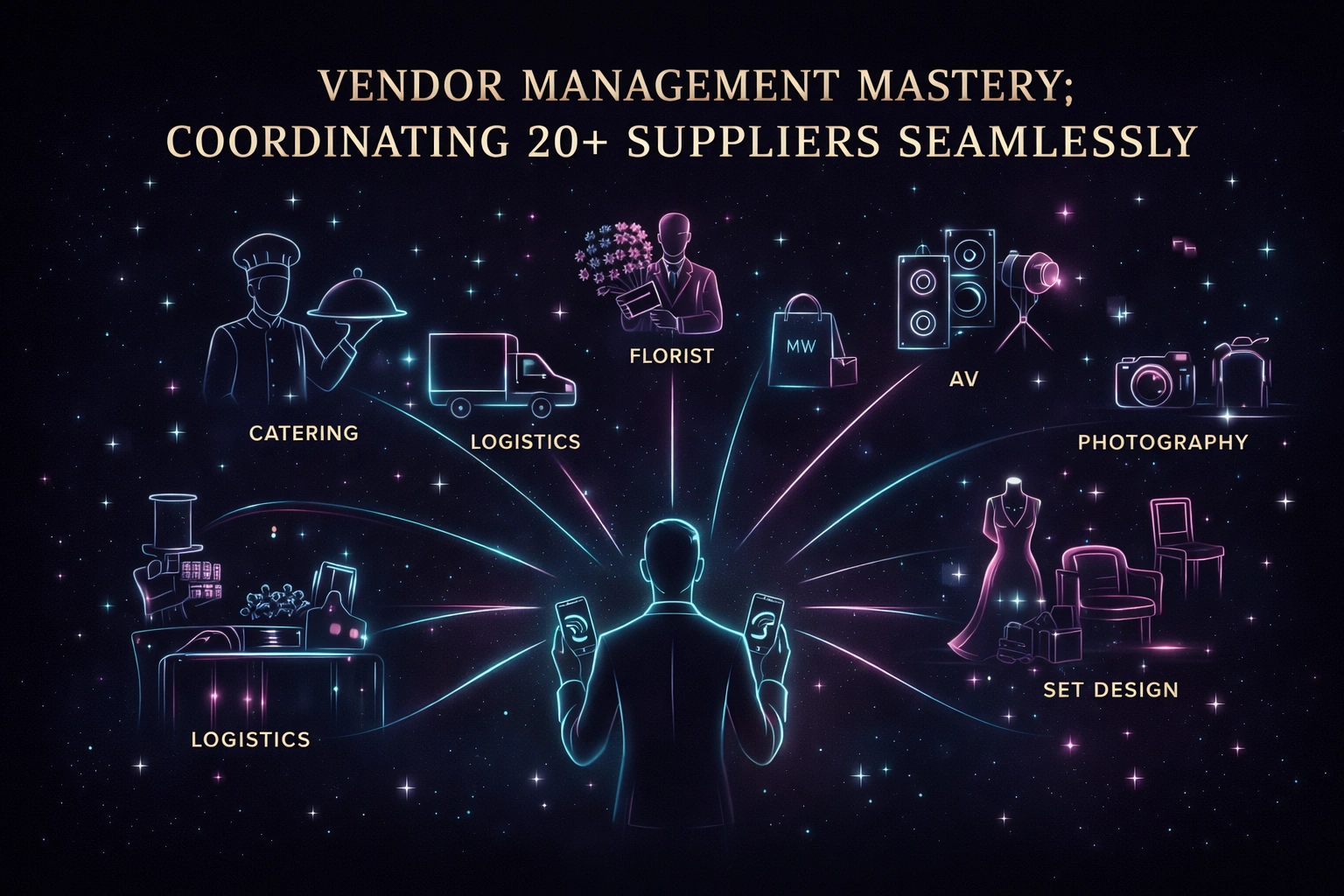
Vendor Management Mastery: Coordinating 20+ Suppliers Seamlessly
In luxury weddings and high-profile events, the final experience is never the result of a single team. It is the outcome of multiple specialists working together — planners, decorators, caterers, production teams, artists, logistics providers, and more. In many premium events, this network can easily exceed twenty vendors, each operating within their own timelines, priorities, and systems.
What guests experience as seamless coordination is, in reality, the result of disciplined vendor management. When alignment exists, execution feels effortless. When it does not, even the most well-designed event can appear fragmented.
In 2026, as events in India continue to grow in scale and complexity, vendor management has evolved into a strategic function rather than an operational task. It is no longer about managing people.
It is about managing interdependence.
The Complexity Behind Multi-Vendor Environments
Every vendor in an event ecosystem operates with a specific role, but no role exists in isolation. The decorator depends on production timelines, the caterer relies on layout planning, and entertainment schedules must align with technical setups. A delay in one area can create a ripple effect across the entire event.
This interconnected structure makes vendor management inherently complex. Coordination is not just about communication. It is about understanding how each function influences the other.
In luxury environments, where expectations are high and timelines are tight, this complexity must be managed proactively. Reactive coordination leads to visible disruptions, while structured planning ensures continuity.
Centralized Planning: Creating a Single Source of Truth
One of the most critical elements in vendor management is centralized planning. Without a unified system, information becomes fragmented, leading to misalignment and confusion.
A central planning framework ensures that all vendors operate with the same set of information. Timelines, layouts, deliverables, and responsibilities are clearly defined and accessible. This reduces dependency on constant follow-ups and allows teams to work with clarity.
In premium events, centralized planning acts as the backbone of coordination. It brings structure to complexity and ensures that every moving part aligns with the overall vision.
Role Definition and Accountability
Clarity of roles is essential when managing multiple vendors. Each team must understand not only what they are responsible for but also how their work integrates with others.
Ambiguity creates overlap, and overlap leads to conflict. When responsibilities are clearly defined, vendors can operate with confidence, reducing the need for constant intervention.
Accountability also becomes easier to manage. When every deliverable is assigned and tracked, issues can be identified and addressed before they escalate.
In high-profile events, clarity is not restrictive.
It is empowering.
Communication: Structured, Not Constant
A common misconception in vendor management is that more communication leads to better coordination. In reality, unstructured communication often creates noise rather than clarity.
Effective vendor management relies on structured communication systems. Scheduled updates, defined reporting formats, and clear escalation channels ensure that information flows efficiently.
This approach minimizes confusion and allows teams to focus on execution rather than interpretation. It also ensures that critical updates are not lost in informal conversations.
In luxury environments, communication is not about frequency.
It is about precision.
Timeline Synchronization Across Teams
Every vendor operates within a timeline, but these timelines must align with each other. Synchronization ensures that dependencies are managed and that transitions between tasks are seamless.
For example, production setups must be completed before décor installation begins, and both must align with rehearsal schedules. Catering timelines must consider guest flow and event sequencing.
When timelines are synchronized, execution flows naturally. When they are not, delays become inevitable.
In premium events, time is not just managed.
It is orchestrated.
On-Ground Coordination: Managing Real-Time Dynamics
No matter how detailed the planning, execution introduces variables that cannot always be predicted. On-ground coordination ensures that these variables are managed without disrupting the experience.
A dedicated coordination team acts as the central point of control, managing communication between vendors and ensuring that timelines remain intact. Decisions are made in real time, often within seconds, to maintain flow.
The goal is not to eliminate challenges but to handle them discreetly. Guests should never feel the adjustments happening behind the scenes.
Seamlessness is maintained through control.
Conflict Resolution and Vendor Alignment
In multi-vendor environments, conflicts are inevitable. Differences in priorities, timelines, or expectations can create friction. The key is not to avoid conflict but to manage it effectively.
Structured alignment meetings, clear escalation protocols, and proactive issue resolution ensure that conflicts do not impact execution. Vendors must be aligned not just individually but collectively.
In luxury events, alignment is more important than agreement.
It ensures that all teams move toward a shared outcome.
The Role of Experience and Leadership
Vendor management at scale requires leadership. It is not just about systems and processes but also about decision-making and experience.
An experienced team can anticipate challenges, understand vendor dynamics, and make informed decisions under pressure. This level of insight cannot be replaced by planning alone.
Leadership brings cohesion to complexity.
Post-Event Evaluation and Relationship Building
Vendor management does not end with execution. Post-event evaluation plays a critical role in refining processes and building long-term relationships.
Feedback, performance reviews, and structured debriefs help identify areas of improvement. Strong vendor relationships also create opportunities for better collaboration in future events.
In premium environments, consistency is built over time.
Relationships are part of that consistency.
Conclusion: Coordination as a Competitive Advantage
Managing multiple vendors is one of the most challenging aspects of luxury event planning. Yet, when executed effectively, it becomes a competitive advantage.
In India’s premium event landscape, where scale and expectations continue to rise, seamless vendor coordination is what differentiates exceptional events from average ones. It ensures that every element aligns, every transition flows, and every detail contributes to a cohesive experience.
Because in luxury events, guests may notice the décor, the food, or the entertainment.
But what they truly remember is how seamlessly everything came together.
Frequently Asked Questions (FAQs)
How many vendors are typically involved in a luxury event?
Large-scale luxury events can involve 15 to 30 or more vendors, depending on complexity.
What is the biggest challenge in vendor management?
Coordinating timelines and dependencies across multiple teams without causing delays or conflicts.
Why is centralized planning important?
It ensures that all vendors operate with consistent information, reducing confusion and misalignment.
How can conflicts between vendors be managed?
Through clear communication, defined roles, and structured escalation processes.
What ensures seamless execution?
Strong planning, synchronized timelines, and experienced on-ground coordination.
Design Your Vendor Management Strategy
If you are planning a luxury wedding, corporate event, or multi-day celebration in India, managing multiple vendors requires more than coordination — it requires structured systems and experienced leadership.
From vendor curation and timeline synchronization to on-ground management and execution control, our team ensures that every supplier operates in alignment, delivering a seamless and refined experience.
📩 hello@dtsworld.in 📞 +91 80000 06021 📍 Andheri East, Mumbai
👉 Design Your Vendor Management Strategy