
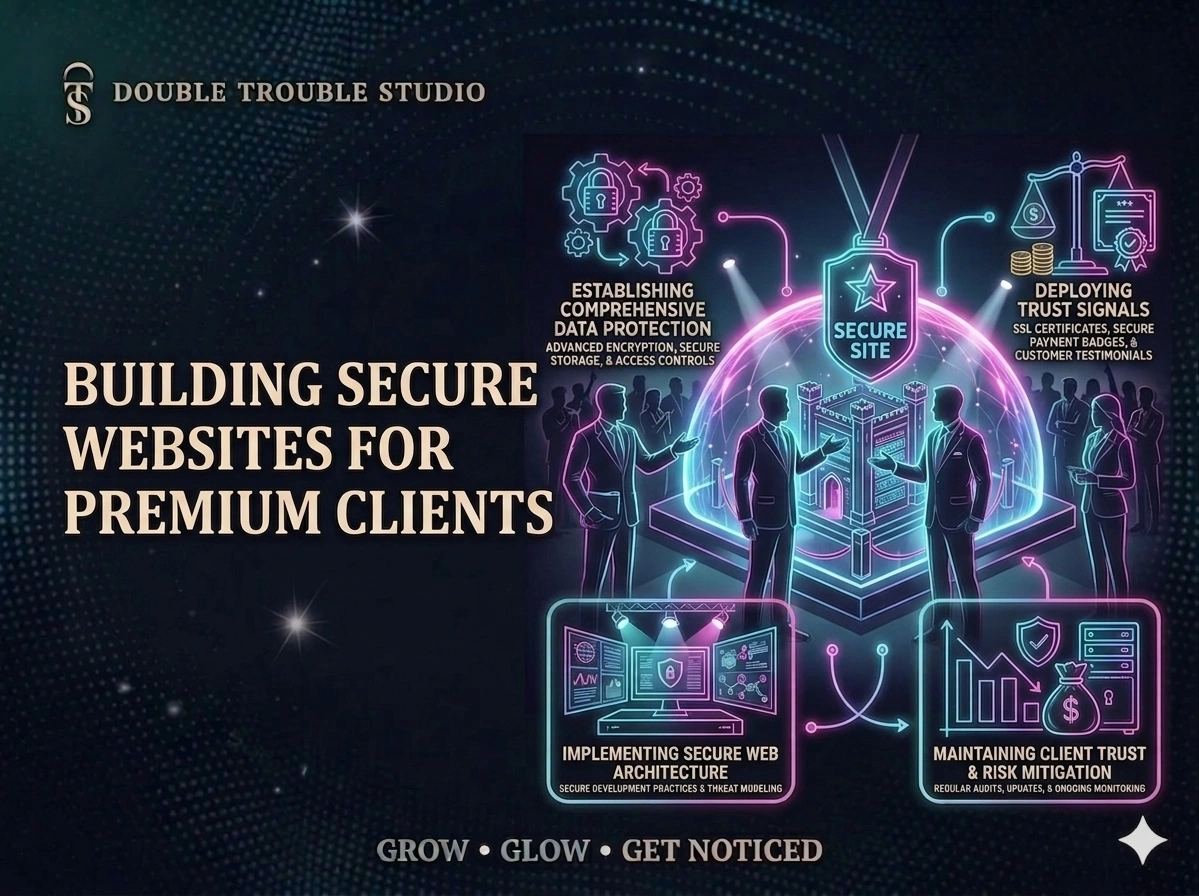
Building Secure Websites for Premium Clients (Data Protection & Trust Signals)
In 2026, website security is no longer a backend technical concern that operates invisibly behind design and functionality. For premium and luxury brands, it has become a visible component of brand perception, closely tied to brand positioning.
Clients interacting with high-end services are not only evaluating aesthetics and experience; they are also evaluating how safe, private, and trustworthy the digital environment feels, similar to expectations in UX design.
A luxury website is not simply a platform for information or conversion. It is a controlled environment where clients share sensitive details, often managed through secure website systems.
This transforms security from a technical layer into a strategic pillar. Data protection, privacy frameworks, and trust signals must be integrated into the website experience in a way that aligns with the brand’s positioning, supported by content strategy.
Because in premium markets, trust is not assumed.
It is demonstrated.
The Role of Data Protection in Luxury Digital Experiences
Data protection is the foundation of website security, but in the context of premium brands, it carries additional significance.
Clients engaging with luxury services often share information that goes beyond standard transactional data, making secure infrastructure essential.
Websites must be built using frameworks that prioritize encryption, secure hosting environments, and controlled access systems, aligned with web development practices.
However, technical implementation alone is not sufficient.
Data protection must also be communicated effectively. Users should feel confident that their data is secure without disrupting the experience, similar to user journey design.
Privacy policies and consent mechanisms must be clear yet unobtrusive.
Another important aspect is data minimization. Collecting only necessary information enhances trust and reduces risk.
Data protection is not static.
It requires continuous updates, aligned with performance monitoring.
Privacy as a Core Component of Brand Experience
Privacy extends beyond technical safeguards.
For premium clients, privacy is an expectation, closely linked with brand credibility.
Luxury brands often operate in environments where discretion is critical. This expectation carries into digital interactions.
A secure website must ensure responsible internal handling of data, supported by structured systems.
Transparency plays a key role. Users must understand how data is used without feeling overwhelmed.
Compliance with regulations also reinforces trust and professionalism.
Privacy enhances engagement.
It builds confidence in interaction.
Trust Signals: Communicating Security Without Disruption
Trust signals are visible indicators of credibility.
In luxury branding, they must be subtle and aligned with design, similar to visual identity strategy.
SSL certificates, secure icons, and privacy badges must be integrated carefully.
Content-based trust signals such as testimonials and case studies also contribute to credibility, supported by case studies.
Performance is another trust signal. Smooth interaction and fast loading reinforce reliability, aligned with technical SEO.
Trust signals are not isolated elements.
They are embedded across the experience.
Secure User Interactions and Transaction Systems
User interactions are one of the most sensitive aspects of website security.
Forms, bookings, and payments require secure systems, often aligned with conversion systems.
Input validation, encryption, and secure transmission are essential.
Payment systems must integrate trusted gateways and comply with standards.
Authentication systems, including multi-factor authentication, enhance protection.
User interactions should feel effortless.
But remain protected.
Backend Security and Continuous Monitoring
Backend security ensures actual protection.
Server management, database security, and monitoring systems form the foundation, supported by technical systems.
Regular updates and patches prevent vulnerabilities.
Monitoring enables real-time threat detection.
Backup systems ensure continuity in case of failure.
Backend security may be invisible.
But it is critical.
Balancing Security with User Experience
One of the biggest challenges is balancing security with usability.
Excessive security creates friction.
Insufficient security creates risk.
Luxury websites must integrate security seamlessly, aligned with UX strategy.
The objective is to make users feel safe without disrupting experience.
Security should feel natural.
Not restrictive.
Long-Term Trust and Brand Reputation
Security is an ongoing commitment.
For premium brands, maintaining security over time protects reputation, aligned with brand perception.
Continuous improvement, audits, and updates ensure long-term effectiveness.
Transparency in communication reinforces trust.
Consistency builds credibility.
Conclusion: Security as a Reflection of Trust
In 2026, building secure websites is not just about protecting data.
It is about protecting perception.
For luxury brands, security reflects professionalism and reliability, forming a key part of digital strategy.
Data protection, privacy, and trust signals must work together to create a seamless and secure environment.
Because in premium markets, trust is not given easily.
But once earned, it defines long-term success.
Build Your Secure Website
If you are creating or upgrading your website, security must be integrated from the ground up.
From data protection frameworks and secure systems to trust signal integration and performance optimization, our team ensures that your website delivers both safety and premium experience.
📩 hello@dtsworld.in 📞 +91 80000 06021 📍 Andheri East, Mumbai
👉 Build Your Secure Website Strategy