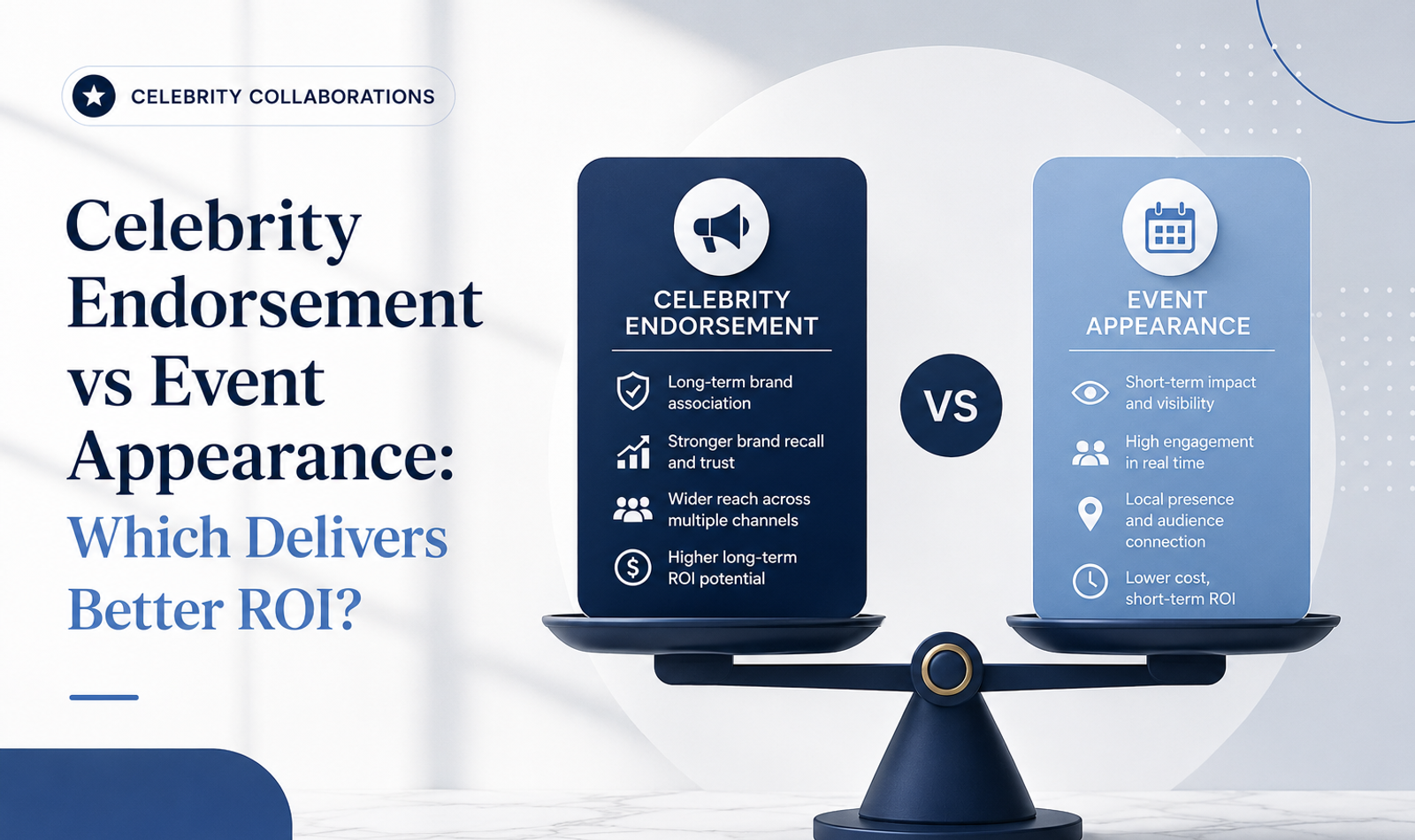
Celebrity Endorsement vs Event Appearance: Which Delivers Better ROI?
Celebrity partnerships can create attention, credibility and emotional connection, but not every celebrity association produces the same type of value.
A long-term endorsement campaign and a one-time event appearance may involve the same celebrity, yet their commercial roles are very different.
An endorsement connects the celebrity publicly with a brand, product or service. The celebrity may appear in advertising, social media content, campaign films, outdoor media, ecommerce pages or promotional communication. The association may continue for several months or years.
An event appearance is usually linked to a particular date, location and experience. The celebrity may attend a launch, perform, speak, present an award, interact with selected guests or participate in photographs and media activity.
An endorsement is primarily a communications and brand-association asset.
An event appearance is primarily a live experience and attention-generation asset.
Neither model automatically delivers better return on investment.
The correct choice depends on what the brand is trying to achieve, how the celebrity will be used, which audience must be influenced and how the outcome will be measured.
A business seeking sustained national visibility may benefit more from an endorsement. A brand launching a flagship store, luxury property or high-profile event may create stronger immediate value through a well-managed appearance.
The mistake is to compare both models only through the celebrity fee.
True ROI depends on the complete cost, rights received, audience quality, content value, media distribution, customer action and duration of commercial impact.
Brands should therefore begin by defining the business objective before selecting the celebrity format.
What Is a Celebrity Endorsement?
A celebrity endorsement is a commercial association in which a public figure supports, represents or appears to recommend a brand, product, service or campaign.
The endorsement may involve traditional advertising, social media, digital films, photography, public relations, retail displays, packaging or live promotional activity.
The exact relationship depends on the contract.
Some celebrities appear in one campaign for a limited period. Others become long-term brand ambassadors and participate in several launches, content shoots and public activities.
An endorsement is valuable because it can transfer part of the celebrity’s recognition, reputation and emotional meaning to the brand.
A recognised athlete may communicate discipline and performance. An established actor may provide broad cultural familiarity. A respected public personality may add credibility and trust.
However, this transfer is not automatic.
The celebrity must make sense for the product, audience and brand position. When the association appears forced, customers may remember the celebrity but fail to connect the message with the company.
Endorsement ROI therefore depends on both reach and strategic fit.
What Is a Celebrity Event Appearance?
A celebrity event appearance involves the public figure attending or participating in a specific event.
The appearance may take place at a product launch, wedding, corporate gathering, store opening, awards ceremony, private celebration, conference, public initiative or entertainment event.
The celebrity may walk a red carpet, deliver a speech, perform, present an award, meet selected guests, participate in photographs or create agreed social content.
The commercial value is concentrated around the event period.
Attention may begin when the celebrity is announced, increase during the event and continue through photographs, press coverage and social sharing afterwards.
Unlike an endorsement, an appearance does not automatically imply that the celebrity supports or recommends the brand.
A celebrity can attend an event without becoming its ambassador.
The organiser must avoid using the celebrity’s attendance later in a way that suggests a broader endorsement unless those rights were negotiated.
An event appearance is most effective when the physical presence contributes directly to the event objective.
It may increase attendance, elevate guest perception, attract media, reward stakeholders or create premium content.
The Fundamental Difference Between the Two Models
The central difference is the nature of the value being purchased.
With an endorsement, the brand generally pays for an ongoing association and the licensed use of the celebrity’s identity across defined communication channels.
With an appearance, the organiser primarily pays for the celebrity’s time, presence and agreed on-site activity.
An endorsement is usually designed to influence a wider audience over a longer period.
An appearance is usually designed to create concentrated attention within a particular moment or environment.
This distinction affects fees, contracts, production, risk and measurement.
An endorsement may require campaign development, multiple shoots, usage rights, category exclusivity and content approval.
An appearance may require travel, hospitality, vehicles, security, backstage facilities, technical production and detailed on-site coordination.
Both can create content, but the content rights may be different.
Both can generate awareness, but the timing and distribution are different.
The brand should choose the format according to the commercial problem it needs to solve.
Begin With the Business Objective
The first question should not be which celebrity is available.
It should be what the brand needs the partnership to accomplish.
A brand may want to increase recognition in a new market, reposition itself as premium, launch a product, generate store visits, attract event registrations, strengthen dealer confidence or produce campaign content.
These objectives require different solutions.
An endorsement may be more suitable when the objective is sustained brand recognition or repeated product communication.
An event appearance may be more suitable when the objective is attendance, public relations, guest engagement or launch-day attention.
Some campaigns may benefit from both.
A celebrity can become the face of a campaign and later appear at the launch. In this model, the endorsement creates reach while the event creates a physical moment and additional publicity.
However, the combined model is more expensive and operationally complex.
The business should not add both simply because the celebrity is available. Each element should have a defined purpose.
Comparing Awareness Potential
Celebrity endorsements generally have greater potential for repeated awareness.
The campaign can appear across several platforms and continue throughout the agreed term. Customers may encounter the celebrity through video advertising, social media, outdoor media, press coverage and retail communication.
Repetition can improve recognition when the campaign has enough media support.
The celebrity becomes associated with the brand through multiple exposures rather than one moment.
An event appearance creates a shorter awareness window.
The announcement may generate anticipation, while live photographs and media coverage create attention around the date. The brand may extend this period by releasing content before and after the event.
However, the appearance itself usually provides less sustained exposure unless additional usage and content rights have been negotiated.
The awareness comparison therefore depends heavily on media distribution.
An endorsement without a sufficient media budget may receive less actual visibility than a highly publicised event.
Similarly, a celebrity appearance without strong media planning may remain meaningful only to the people physically present.
Comparing Audience Reach
Endorsements can reach larger audiences because campaign content can be distributed repeatedly and geographically.
The brand can use television, digital advertising, social platforms, outdoor media and retail channels according to the licensed rights.
Reach can also be targeted through paid media.
An event appearance naturally reaches the guests and participants present at the venue.
Additional reach comes from press, livestreams, celebrity posts, brand content and guest sharing.
The event may generate substantial exposure when it has a strong concept, recognised host or major public relevance.
However, estimated reach should not be confused with meaningful attention.
A social post may be technically visible to millions but receive limited active engagement. An event may reach fewer people while creating stronger relationships with investors, buyers, dealers or premium customers.
The value of reach depends on who receives the message.
A smaller high-value audience may produce greater commercial return than a large general audience.
Comparing Brand Trust
Endorsements can strengthen trust when the celebrity has credible relevance to the category.
A respected athlete supporting a performance product may provide a natural connection. A trusted actor representing a long-established brand may reinforce familiarity and recognition.
The endorsement becomes more persuasive when the celebrity’s association appears genuine.
Customers may question the campaign when the celebrity has no believable relationship with the product or appears in too many unrelated advertisements.
An event appearance can also create trust, but in a different way.
The celebrity’s presence may demonstrate that the event, organisation or launch has importance and influence. Guests may perceive the brand as better connected, more established or more prestigious.
However, attendance alone does not necessarily communicate product approval.
Brands should not overstate what the appearance means.
If trust transfer is a major objective, an explicit and well-aligned endorsement usually creates a stronger foundation than simple attendance.
If stakeholder confidence and event prestige are the priorities, an appearance may be highly effective.
Comparing Emotional Impact
A live appearance can create strong emotional impact.
Guests experience the celebrity in the same physical environment. The moment may feel exclusive, memorable and socially valuable.
A performance, speech or unexpected arrival can become the most discussed part of an event.
This emotional intensity can be difficult to reproduce through advertising alone.
Endorsements create emotion through storytelling, cinematography, music, repeated association and the celebrity’s public personality.
The campaign can be designed carefully and delivered to a large audience, but customers do not receive the same sense of physical participation.
The stronger option depends on the type of emotional response required.
An event is powerful for immediacy, exclusivity and shared experience.
An endorsement is powerful for repeated aspiration, identity and brand association.
Comparing Content Value
A celebrity endorsement normally produces a defined library of campaign assets.
These may include photographs, films, social videos, voice recordings, interviews and short-form content.
The brand can use these assets according to the agreed media, territory and duration.
A strong campaign library can create value across websites, advertising, sales presentations, retail displays and social channels.
An event appearance can also generate valuable content.
Red-carpet photographs, stage videos, guest interactions, behind-the-scenes material and media interviews may provide several weeks of communication.
However, content rights should never be assumed.
The organiser may have permission to document the event but not to use the celebrity’s image in commercial advertisements.
The contract should define which content can be published, where it can appear and for how long.
If content creation is a major objective, the brand should compare not only the appearance fee but also the rights attached to the resulting material.
Comparing Control Over the Message
An endorsement campaign gives the brand greater ability to develop a planned message.
Scripts, visual concepts, product placement and calls to action can be agreed before production.
The celebrity team will usually have approval rights, but the final communication can still be designed around a clear campaign objective.
An event appearance involves more live variables.
The host, guests, media, schedule and venue environment may affect what happens. The celebrity may deliver agreed remarks, but the brand has less control over every public interaction.
Live moments can feel more authentic, yet they also create a greater risk of unpredictable questions, technical problems or schedule changes.
Brands needing precise product communication usually benefit more from an endorsement or controlled campaign shoot.
Brands seeking energy, public attention and experiential value may accept the lower level of control associated with a live appearance.
Comparing Cost Structure
Celebrity endorsement costs are often higher because the brand is purchasing association, deliverables, usage rights and possibly exclusivity.
The total budget may include the celebrity fee, agency commission, taxes, creative development, production, post-production, media distribution and campaign renewal.
Usage rights can materially affect the fee.
A digital-only campaign in one country for three months will generally have a different commercial structure from a global all-media campaign lasting two years.
Event appearance costs may appear lower, but the headline fee is only one component.
The organiser may also pay for flights, hotels, luxury vehicles, security, green rooms, hospitality, stage production, technical riders and on-ground coordination.
A live performance may require musicians, dancers, equipment and additional crew.
The correct comparison is therefore total campaign cost against expected business value.
The brand should not compare an endorsement fee with an appearance fee while ignoring media, production or event operations.
Comparing Duration of Value
Endorsements usually provide longer commercial duration.
The brand can run approved content throughout the licensed period and build recognition through repetition.
The association may continue influencing customers even after the active campaign ends, especially when it becomes strongly connected with the brand.
Event appearances create concentrated value around a particular date.
The event can continue generating content and press afterwards, but the strongest attention often declines quickly.
The brand may extend the value through a structured content-release plan, case study, highlight film and public relations follow-up.
The comparison should consider how quickly the business needs results.
An event may create immediate impact, while an endorsement can build cumulative value over time.
Comparing Conversion Potential
Celebrity endorsements can support conversion when the campaign connects recognition to a relevant offer and customer journey.
The content may direct customers towards a product page, store, booking platform or lead form.
Repeated exposure can help customers remember the brand when they become ready to act.
However, celebrity visibility alone does not guarantee conversion.
The product, pricing, website, distribution and offer must still be competitive.
Event appearances can create high conversion within a concentrated audience.
A property launch may generate private-viewing requests. A store opening may increase footfall. A corporate event may strengthen dealer or investor relationships.
Guests may already have strong intent, making the event audience commercially valuable.
The better model depends on whether conversion is expected from a broad public audience or a selected high-intent group.
Comparing Lead Quality
An endorsement may generate a high volume of attention and enquiries, but lead quality can vary.
Some people may respond primarily because of the celebrity rather than genuine interest in the brand.
The campaign and landing page should qualify customers through clear product, location and pricing information.
An event appearance can produce fewer but more valuable leads when the guest list is strategically curated.
A luxury property event attended by selected buyers may create stronger opportunities than a general mass campaign.
Similarly, a B2B launch featuring a recognised public figure may increase attendance among important partners and decision-makers.
Lead quality depends on audience selection, not merely celebrity status.
The brand should evaluate the value of each qualified opportunity rather than only counting total responses.
Comparing Public Relations Value
Event appearances can generate strong public relations value because they create a specific news moment.
The celebrity arrival, speech, performance and guest interaction provide photographs and narratives that publications can cover.
A strong event concept may attract local, trade or entertainment media.
Endorsements can also generate press, especially when the partnership is significant or strategically unexpected.
The announcement may create an initial media moment, while later campaign activity sustains attention.
However, ordinary endorsement announcements may receive limited editorial interest if they do not provide a meaningful story.
Event PR is generally strongest around immediacy and spectacle.
Endorsement PR is strongest when the partnership has cultural, commercial or category significance.
Comparing Social Media Performance
An endorsement can include planned posts on the celebrity’s platforms, brand platforms or both.
The content can be optimised for platform formats and distributed at strategically selected times.
Paid promotion may extend its reach where permitted.
Event appearances can create spontaneous social activity from guests, media and fans.
This may feel more organic because several people document the same live moment.
However, spontaneous activity is less controlled and may not communicate the intended message consistently.
The brand should distinguish between social visibility and commercial results.
High views or trending attention do not automatically produce qualified customers.
Tracking links, campaign codes, landing pages and platform analytics can help connect engagement to business action.
Comparing Exclusivity
Endorsement contracts frequently include category exclusivity.
This prevents the celebrity from supporting direct competitors during the agreed period.
Exclusivity can strengthen association because customers see a clearer relationship between the celebrity and brand.
It also increases cost because the celebrity loses other commercial opportunities.
Event appearances may not include exclusivity.
The celebrity may attend events for several brands in different or even related categories, depending on the contract.
An appearance can therefore create prestige without creating a distinctive long-term association.
Brands seeking ownership of the celebrity-category connection may receive more value from an endorsement.
Brands needing only one high-impact moment may not need to pay for extensive exclusivity.
Comparing Operational Complexity
Endorsements are operationally complex during planning and production.
The campaign may involve creative concepts, scripts, styling, shoots, content approvals, legal review, product claims and media deployment.
Once approved assets are produced, the brand can distribute them according to the plan.
Event appearances involve intense real-time coordination.
Travel, vehicles, hotels, security, green rooms, stage cues, media access, guest interaction and departure must all work on a fixed date.
There is limited opportunity to correct problems after the moment passes.
Endorsement risk is often spread across a longer production process.
Event risk is concentrated within a short operational window.
The brand should consider its internal capability and whether it has experienced partners to manage the chosen format.
Comparing Reputation Risk
Both models carry reputation risk.
In an endorsement, the brand and celebrity become publicly connected for a longer period. Future controversy involving either party can affect the other.
The contract may include reputation and conduct provisions, but these clauses cannot remove every public impact.
The brand should conduct due diligence before confirming the partnership.
An event appearance creates a shorter association, but risk remains.
Poor crowd control, unapproved sponsor activity, technical failure or disrespectful guest behaviour can damage the celebrity relationship and brand image.
Live media questions can also create unpredictable moments.
The risk profile is therefore different rather than necessarily lower.
Endorsement risk relates strongly to long-term association and public identity.
Appearance risk relates strongly to operations, live behaviour and event control.
When Celebrity Endorsement Usually Delivers Better ROI
An endorsement is generally more suitable when the brand wants sustained recognition across a larger market.
It can be effective for launching a national product, entering a new category, changing public perception or creating a strong brand-memory structure.
Endorsement is also valuable when the company needs reusable campaign assets across several platforms.
The brand receives greater benefit when it has sufficient distribution and media investment to use those assets repeatedly.
An endorsement may deliver stronger ROI when the celebrity has a natural category connection and the customer decision depends on trust or aspiration.
It is especially useful when the brand can maintain consistent availability, distribution and customer experience throughout the campaign.
There is little value in creating demand for a product that customers cannot find or purchase easily.
When an Event Appearance Usually Delivers Better ROI
An event appearance is often more suitable when the objective is concentrated attention.
It can strengthen a product launch, flagship opening, awards event, private celebration, corporate gathering or stakeholder experience.
The appearance may create valuable ROI when guest quality matters more than mass reach.
A well-curated event can influence investors, luxury buyers, dealers, business partners, media and community leaders within one environment.
Event appearances also work well when the celebrity’s physical presence is itself the experience.
A live performance, conversation or award presentation cannot be replaced fully by campaign imagery.
The appearance generates stronger value when the event has a clear concept, disciplined guest list, media plan and post-event content strategy.
Simply placing a celebrity in the room without integrating them into the programme may create limited return.
When a Combined Strategy Works Best
Some brands benefit from combining endorsement and appearance.
The celebrity may first appear in a campaign and then attend the official launch. Campaign content builds awareness before the event, while the live appearance creates publicity and stakeholder engagement.
The event can produce additional content that extends the endorsement.
This integrated model can strengthen message consistency because the same celebrity appears across paid media, public relations, social communication and physical experience.
However, every element must be included in the agreement.
The brand should define appearance duration, stage role, social content, press interaction, campaign rights and event recording.
The combined model requires a larger budget and more coordination.
It should be used when each stage contributes to a measurable objective rather than simply increasing the visibility of the partnership.
How to Calculate Celebrity Endorsement ROI
A basic financial ROI calculation compares the value generated with the total investment.
However, celebrity endorsements influence several outcomes that may not convert into immediate revenue.
The brand should establish a measurement framework before launch.
Direct commercial measures may include sales, qualified leads, bookings, retailer orders and customer acquisition.
Digital measures may include landing-page visits, product views, completed forms, purchases and campaign-code use.
Brand measures may include aided awareness, message recall, consideration and changes in branded search.
Media measures may include reach, completed video views, engagement and earned editorial coverage.
The complete cost should include the celebrity fee, rights, exclusivity, agency commission, taxes, production and media.
Revenue attributed to the campaign should not be measured only through the final click.
Customers may encounter the celebrity campaign several times before purchasing through another channel.
The brand should examine assisted conversions and changes across the campaign period.
How to Calculate Event Appearance ROI
Event ROI begins with the purpose of the event.
For a ticketed event, revenue may include ticket sales, sponsorship and hospitality packages.
For a product or store launch, measures may include attendance, footfall, media coverage, social content, enquiries and post-event sales.
For a luxury property event, the most important outcomes may be qualified buyer meetings, site visits and eventual bookings.
For a corporate event, the objective may involve partner retention, dealer motivation, employee engagement or stakeholder relationships.
The total cost should include the celebrity fee, travel, accommodation, vehicles, hospitality, security, technical production, coordination and content rights.
Media value can be considered, but it should not be inflated by assigning unrealistic advertising values to every mention.
The strongest event measurement connects guest activity to subsequent business outcomes.
Registration systems, customer relationship management records, tracking links and post-event follow-up can help establish this connection.
Measure Incremental Impact
Brands should attempt to understand what changed because of the celebrity association.
Sales may rise during a campaign for several reasons, including seasonality, discounts, distribution changes and increased advertising spend.
The brand should compare performance with an appropriate baseline.
This may involve previous periods, similar locations, non-exposed audiences or matched campaign groups.
The objective is not to claim perfect causation.
It is to separate the likely celebrity contribution from other commercial factors.
For events, the brand can compare attendance, lead quality, press interest and stakeholder participation against similar events without celebrity involvement.
Incremental measurement creates a more credible understanding of ROI.
Measure Brand Lift
Some celebrity investments are designed primarily to change perception rather than generate immediate sales.
Brand-lift research can examine awareness, familiarity, consideration, preference and message association before and after the campaign.
The study should test whether customers remember the brand, not only the celebrity.
A campaign can receive substantial attention while producing weak brand recall.
This usually happens when the creative concept focuses more heavily on the celebrity than on the product or message.
The celebrity should attract attention, but the brand must remain central to the communication.
For event appearances, guest surveys and stakeholder interviews can measure changes in perception, satisfaction and intent.
Measure Earned Media Carefully
Celebrity partnerships often generate press and social mentions.
Earned media can extend reach beyond paid distribution, but measurement should focus on quality as well as quantity.
The brand should examine publication relevance, audience, message accuracy, prominence and referral traffic.
A large number of copied announcements may provide less value than one detailed feature in a respected publication.
Social mentions should be evaluated according to sentiment and relevance.
Not every mention strengthens the brand.
The business should avoid treating theoretical advertising-equivalent value as guaranteed revenue.
Earned media is one part of ROI, not a substitute for business outcomes.
Track Content Reuse Value
Endorsement assets can create value across several departments.
The campaign may support paid advertising, social media, ecommerce, presentations, retail, public relations and dealer communication.
The brand can estimate the cost of producing equivalent assets separately and compare this with the licensed celebrity content.
However, reuse should remain within the contract.
An event appearance can also produce reusable content when rights are negotiated.
A single event may generate photographs, interviews, short videos and behind-the-scenes communication.
The brand should plan the content before the event rather than attempting to find uses for random footage afterwards.
Evaluate Audience Fit
A celebrity with greater fame does not always produce better ROI.
The brand should compare the celebrity’s audience with its actual customer profile.
Geography, language, age, interests, purchasing ability and cultural relevance all matter.
A regional celebrity may outperform a national figure for a city-specific launch.
A specialist athlete may create stronger credibility for a performance brand than a general entertainer with a larger audience.
The brand should also examine the celebrity’s previous commercial associations.
Frequent endorsements across unrelated categories can reduce distinctiveness.
Audience fit should be evaluated before fee negotiation, not used later to justify a selection based only on fame.
Evaluate Brand-Celebrity Fit
The association should feel believable.
Customers should be able to understand why the celebrity and brand belong together.
Fit may come from lifestyle, expertise, public personality, geography, values or professional background.
A weak fit forces the creative campaign to work harder and can produce short-lived attention.
A strong fit can make even a limited partnership feel more authentic.
For event appearances, the celebrity should also suit the occasion.
A popular performer may create energy at a celebration, while a respected leader or athlete may be more suitable for a conference or social initiative.
The correct personality depends on the audience experience the organiser wants to create.
Consider Opportunity Cost
The celebrity budget could be invested in other marketing activities.
Brands should compare the expected return with alternative uses such as media, creators, customer experience, content production, search marketing or multiple regional events.
An expensive endorsement may leave insufficient budget to distribute the campaign.
A costly event appearance may reduce investment in guest experience, production or post-event follow-up.
The right celebrity strategy must fit within the complete marketing system.
The objective is not to secure the biggest available name. It is to allocate resources in a way that creates the strongest overall outcome.
Consider the Buying Cycle
The customer’s buying cycle influences which model may work better.
Fast-moving consumer products may benefit from broad repeated endorsement visibility because customers can act quickly.
Luxury property, architecture, hospitality and high-ticket services involve longer consideration.
For these categories, a celebrity may create awareness, but detailed content, trust and personal consultation still drive conversion.
A private event appearance can be valuable when it brings qualified decision-makers into a controlled sales environment.
The brand should not expect one celebrity moment to complete a complex buying journey.
The partnership should support the stage where it can create the most influence.
Consider Geographic Scope
An endorsement can be licensed across cities, countries or regions, making it suitable for brands with broad distribution.
The cost rises as territory and media rights expand.
An event appearance is geographically concentrated, although digital and press coverage may extend beyond the location.
This concentration can be an advantage for local launches.
A retail centre, hotel, property project or regional brand may create strong local attention through the right celebrity visit.
The brand should compare geographic relevance rather than assuming national reach is always more valuable.
Consider Media Budget
An endorsement requires sufficient media support.
Hiring a celebrity and producing a campaign does not guarantee that the audience will see it.
The brand must budget for distribution across the channels where its customers spend attention.
Without media support, the endorsement may depend too heavily on one celebrity post or organic reach.
An event appearance also needs promotion.
Pre-event announcements, media invitations, content teams and post-event distribution extend its impact.
The fee should not consume the complete activation budget in either model.
Consider Contractual Flexibility
Endorsement contracts are often more restrictive because they involve intellectual property, usage and category exclusivity.
Changes to products, claims or campaign materials may require approval.
Renewals and extensions can create additional costs.
Event contracts are concentrated around a particular date and operational scope.
They may provide less ongoing flexibility but involve significant cancellation and rescheduling risk.
The brand should understand what happens if the campaign changes, the event moves or market conditions shift.
Contract flexibility contributes to practical ROI because unused rights and expensive changes reduce value.
Consider Compliance Requirements
Celebrity endorsements must reflect truthful, supportable claims.
Material brand relationships should be disclosed according to applicable requirements and platform rules.
The brand should include disclosure language and approval responsibilities in the contract.
An event appearance can also create endorsement implications when content suggests that the celebrity recommends the product.
The organiser should avoid converting attendance into an unauthorised testimonial.
If the celebrity speaks about the product, the statement should be approved and accurate.
Compliance protects both reputation and commercial value.
A campaign facing complaints or removal can lose much of its expected return.
Common ROI Measurement Mistakes
One common mistake is measuring only impressions.
Impressions show potential exposure but do not reveal whether the audience noticed, remembered or acted.
Another mistake is attributing every sale during the campaign to the celebrity.
Seasonality, promotions and distribution may also influence performance.
Brands may also ignore production, rights, travel and media costs when calculating investment.
For events, organisers sometimes treat guest photographs and social posts as proof of business success without tracking leads or follow-up.
Another mistake is comparing a one-day appearance with a twelve-month endorsement without adjusting for duration and objective.
The measurement framework should reflect the role each format was designed to perform.
A Practical Decision Framework
A brand should choose an endorsement when it needs sustained visibility, repeated campaign assets and a clear public association with the celebrity.
The model is stronger when the business has broad distribution, sufficient media budget and a product or service that fits the celebrity naturally.
A brand should choose an event appearance when it needs concentrated attention, stakeholder engagement, media coverage or a memorable live experience.
The model is stronger when the audience can be selected carefully and the appearance is integrated into the programme.
A combined strategy may be appropriate when the celebrity will support both a wider campaign and an important launch moment.
Before making the decision, the brand should compare total cost, audience fit, rights, duration, risk, operational capacity and measurable outcomes.
The selection should be made according to commercial purpose rather than celebrity popularity alone.
Frequently Asked Questions
What is the difference between a celebrity endorsement and an event appearance?
A celebrity endorsement is a longer commercial association where the celebrity publicly supports or represents a brand, product, service or campaign. An event appearance is usually a one-time presence at a launch, award night, corporate event, private celebration, store opening or brand experience. Endorsements build repeated communication, while event appearances create focused attention around a specific moment.
Which gives better ROI: celebrity endorsement or event appearance?
Neither option automatically gives better ROI. A celebrity endorsement may deliver stronger long-term visibility and brand association, while an event appearance may create immediate attention, public relations value and stakeholder engagement. The better choice depends on the brand objective, target audience, usage rights, budget, media plan and measurement strategy.
When should a brand choose a celebrity endorsement?
A brand should choose a celebrity endorsement when it wants sustained awareness, repeated campaign visibility, reusable content assets and a clear public association with the celebrity. It is especially useful for product launches, national campaigns, brand repositioning, ecommerce promotion and categories where celebrity credibility can influence customer trust.
When should a brand choose a celebrity event appearance?
A brand should choose a celebrity event appearance when it wants concentrated attention around a specific date, location or experience. This works well for luxury property launches, store openings, weddings, award nights, corporate events, product launches, press events and stakeholder gatherings where the celebrity’s physical presence increases prestige and media interest.
Is a celebrity endorsement more expensive than an event appearance?
A celebrity endorsement is often more expensive because it usually includes usage rights, campaign deliverables, media rights, exclusivity and longer association. An event appearance may appear more affordable, but the total cost can include travel, hotels, luxury vehicles, security, hospitality, technical production, stage requirements and coordination. ROI should be calculated using the full cost, not only the celebrity fee.
Can an event appearance be used as an endorsement later?
No, not unless the contract allows it. A celebrity attending an event does not automatically mean they endorse the brand. The organiser should not use event photographs, videos or quotes later in advertising or promotional campaigns unless usage rights have been clearly negotiated. This is important for legal clarity and brand credibility.
How do celebrity endorsements build brand trust?
Celebrity endorsements build trust when the celebrity has a natural connection with the brand, product or audience. A well-matched celebrity can transfer familiarity, aspiration, credibility or emotional value to the brand. However, the association must feel believable. A forced or overused celebrity partnership may create attention without meaningful trust.
How do event appearances create business value?
Event appearances create value by increasing event attendance, improving guest perception, attracting media coverage, generating social content and creating memorable live experiences. They can also help influence investors, buyers, dealers, partners, luxury customers or stakeholders when the guest list is carefully curated.
What should brands measure for celebrity endorsement ROI?
Brands should measure sales, qualified leads, bookings, website traffic, product-page visits, campaign-code usage, branded search growth, social engagement, video views, brand recall and media coverage. The measurement should also include total cost, including celebrity fee, production, media, usage rights, agency commission and exclusivity.
What should brands measure for event appearance ROI?
For event appearances, brands should measure attendance, guest quality, press coverage, social mentions, event content performance, qualified leads, showroom visits, store visits, registrations, sponsorship value, post-event sales and stakeholder engagement. The strongest event ROI comes when the appearance is connected to a clear business objective and follow-up plan.
Can a brand use both endorsement and event appearance together?
Yes, a combined strategy can work well when the celebrity appears in a campaign and also attends a launch or event. The endorsement builds wider awareness, while the appearance creates a physical moment and public relations value. However, this model requires a larger budget, clear contracts, usage rights, content planning and strong coordination.
What is the biggest mistake brands make with celebrity ROI?
The biggest mistake is choosing a celebrity only because they are famous. Fame alone does not guarantee commercial value. Brands should evaluate audience fit, brand alignment, usage rights, content value, media plan, operational cost and measurable outcomes before confirming a celebrity endorsement or appearance.
Conclusion
Celebrity endorsements and event appearances can both produce strong ROI, but they create value in different ways.
An endorsement offers sustained association, repeated communication and greater potential for wide media distribution.
It is generally more suitable when a brand wants to build recognition, transfer celebrity credibility, launch across several markets or create reusable campaign assets.
An event appearance delivers concentrated impact.
It can increase attendance, strengthen public relations, engage selected stakeholders and create a memorable experience around a particular moment.
The better option depends on the objective.
A brand seeking broad consumer awareness may benefit more from an endorsement. A business launching a luxury property, flagship venue or major event may receive greater immediate value from a carefully managed appearance.
The fee alone does not determine ROI.
Brands must consider production, media, usage rights, exclusivity, travel, hospitality, security and operational costs.
They should also evaluate audience quality, strategic fit and the duration of commercial value.
Measurement should begin before the celebrity is booked.
The business should identify meaningful outcomes such as qualified leads, purchases, bookings, registrations, store visits, brand lift or stakeholder engagement.
Reach and social attention provide useful context, but they should not become the only definition of success.
The strongest celebrity investment is one that connects the right personality, format and audience to a clear business objective.
Celebrity involvement can attract attention, but strategy determines whether that attention becomes lasting brand value.
When the partnership is well aligned, professionally contracted and accurately measured, either an endorsement or an event appearance can deliver meaningful return.
The correct choice is not the one that creates the biggest moment.
It is the one that creates the most valuable outcome for the brand.
Ready to Plan the Right Celebrity Strategy for Your Brand?
Your celebrity partnership should do more than create attention. It should match your brand objective, reach the right audience, protect your positioning and deliver measurable value through the right format.
At Double Trouble Studio, we help brands plan and execute celebrity endorsements, event appearances, PR campaigns, brand launches, guest management, media strategy, digital marketing, AI video and complete creative growth solutions.
For celebrity endorsement strategy, event appearances, celebrity management, PR, brand launches, guest management, digital marketing, AI video and creative campaign planning, connect with us today.
📩 info@dtsworld.in 📞 +91 80000 06021 📍 Andheri West, Mumbai
Need this for your brand?
Let DTS build your next campaign.
From PR, celebrity management and events to websites, social media, SEO and AI video production — Double Trouble Studio helps brands grow with strategy and execution.
Discuss Your Requirement →