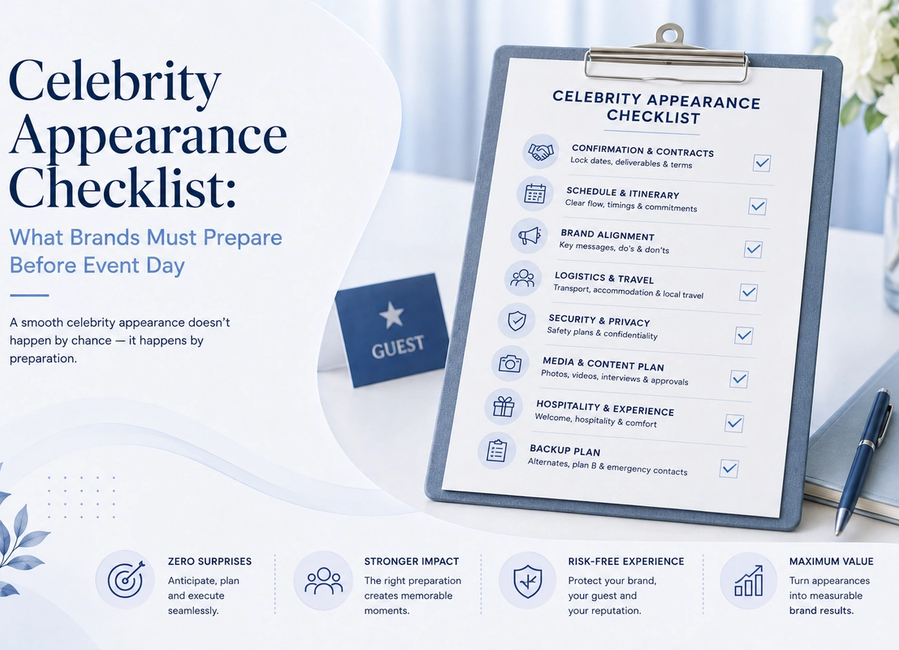
Behind the Scenes of Celebrity Management: Coordination, Security and Experience Design
A successful celebrity appearance may look effortless to the audience.
The celebrity arrives at the correct moment, walks through the venue confidently, completes the planned stage activity, meets selected guests and leaves without visible confusion.
Behind that smooth public moment is a detailed management system involving contracts, representatives, travel, transport, hospitality, security, production, guest relations and real-time decision-making.
Celebrity management is often misunderstood as the simple act of contacting a famous person and confirming their availability.
In reality, booking the celebrity is only the beginning.
Once commercial terms have been agreed, the management team must translate the contract and rider into a complete experience. Every movement must be planned from the celebrity’s first arrival in the city to their final departure.
The celebrity’s personal team needs accurate information. The venue needs access instructions. Security teams need movement routes and restricted zones. Production teams need stage timings and technical requirements.
Sponsors need to understand what access they have purchased. Media teams need to know whether interviews are permitted. Guests need realistic expectations regarding photographs and personal interaction.
When one part of this system operates independently, problems can appear quickly.
A vehicle delay can affect the stage programme. An unapproved sponsor request can create conflict backstage. A crowded green room can become a security concern. An unauthorised video can create legal and reputational problems after the event.
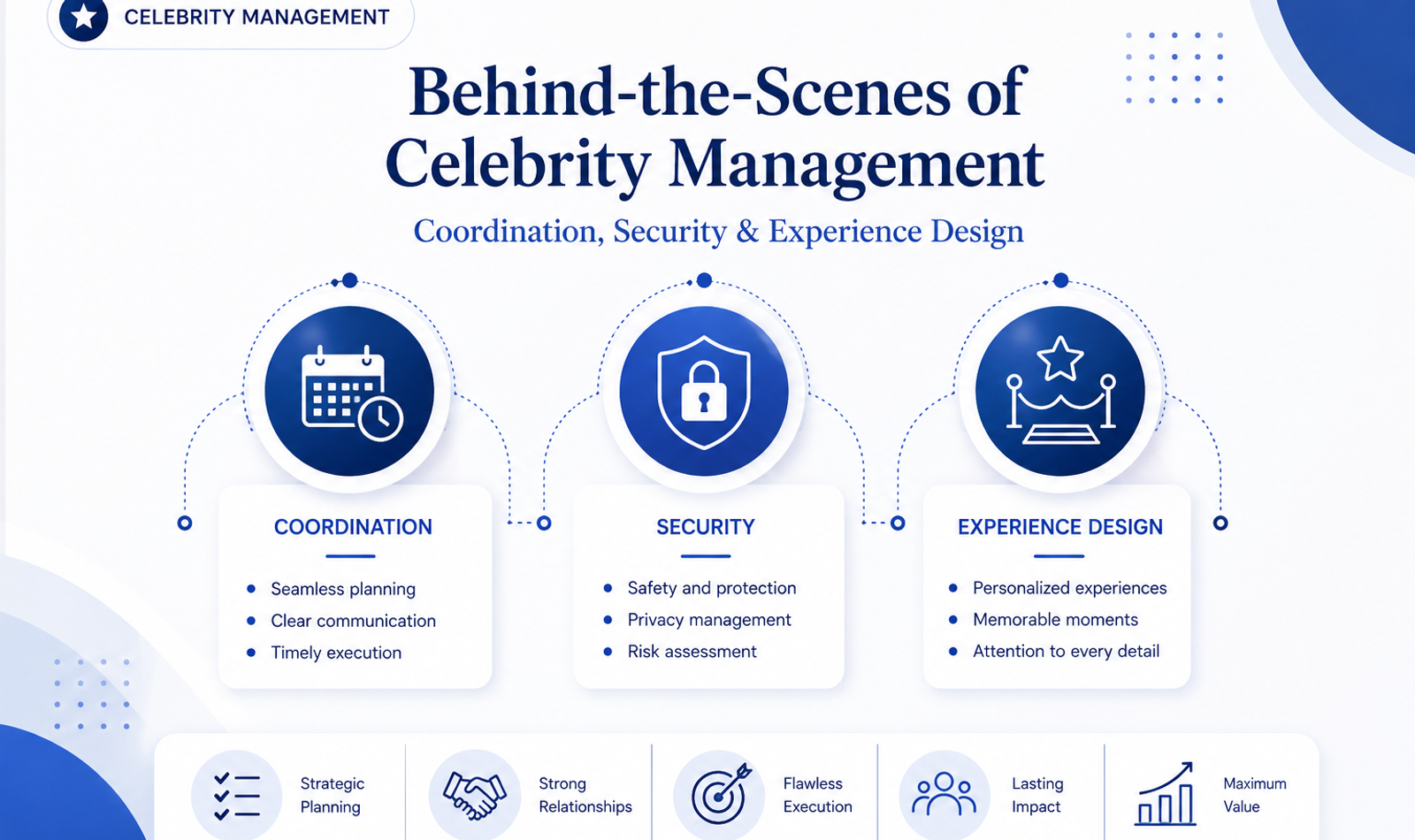
Professional celebrity management is therefore based on three connected disciplines: coordination, security and experience design.
Coordination ensures that people, schedules and information remain aligned.
Security protects the celebrity, guests, staff, venue and movement environment.
Experience design makes every interaction feel appropriate to the celebrity’s professional status and the brand’s intended level of service.
The best management teams make this complexity invisible.
Celebrity Management Begins Before Contact Is Made
The behind-the-scenes process begins before the first representative is contacted.
The organiser or brand must define why a celebrity is required and what role the person will perform.
A celebrity may be needed for an event appearance, performance, campaign shoot, awards presentation, product launch, private celebration, public initiative or media engagement.
Each role creates different commercial and operational requirements.
A celebrity attending an event for forty-five minutes requires a different management plan from an artist delivering a ninety-minute live performance.
A brand ambassador filming a campaign requires production schedules, styling, approvals and usage rights. A keynote speaker requires briefing, speech preparation and stage-support planning.
The brand must also understand what the celebrity is not expected to do.
Attendance does not automatically include performance. A stage appearance does not automatically include media interviews. Event photography does not automatically create advertising rights.
Clear scope at the beginning prevents operational confusion later.
Defining the Celebrity’s Role
The role should be described in specific activities rather than general language.
Instead of requesting a celebrity presence, the brief may ask for venue attendance, a ten-minute stage conversation, one award presentation and photographs with five approved individuals.
A performance brief may define the number of songs, performance duration, rehearsal, sound check and recording permissions.
A campaign brief may define the number of films, photographs, social posts, interviews and public appearances.
The brand should explain the audience, event format, location, sponsors and purpose of the association.
This information helps the celebrity’s representatives evaluate relevance, availability and risk.
It also provides the foundation for accurate budgeting.
Talent Selection Is an Operational Decision
Celebrity selection is often discussed as a marketing decision, but it is also an operational decision.
The chosen celebrity must suit the format of the engagement.
A public figure may have strong media appeal but limited interest in guest interaction. Another may be highly effective in moderated conversations but not suitable for a performance-led event.
The management team should consider stage ability, communication style, travel availability, entourage size, security profile and representative quality.
A celebrity with a complex travel party and production rider may require significantly more planning than another personality with a similar fee.
The complete operational demand should be considered before the booking is confirmed.
Moving From Enquiry to Representation
Once suitable names have been shortlisted, the management team identifies the correct authorised representative.
Celebrities may have separate agents for endorsements, events, performances, films, public relations and digital collaborations.
The person handling media interviews may not be authorised to negotiate a commercial event booking.
Verification protects the brand from fake agents, outdated contacts and unauthorised intermediaries.
The management team confirms the representative’s company, official contact information, authority and contracting structure.
A professional enquiry is then sent with the event or campaign brief, proposed date, role, location, usage and budget range.
This first communication sets the tone for the complete relationship.
A clear, professional approach is more likely to receive serious consideration than a vague request for collaboration.
Commercial Coordination Behind the Booking
When the celebrity is interested, the negotiation moves beyond the headline fee.
The parties discuss appearance duration, stage activities, content, usage rights, exclusivity, travel, accommodation, vehicles, security, hospitality and payment.
Every addition affects cost and execution.
A sixty-minute appearance may include only one public stage activity. Additional interviews, sponsor photographs and social posts may require separate commercial approval.
The management team must ensure that the brand understands the difference between the celebrity’s fee and the total activation cost.
The complete budget may include taxes, agency commissions, travel, hotel rooms, local transport, technical production, security, styling and backstage infrastructure.
Only after this complete cost is understood should the final commitment be made.
Translating the Contract Into Operations
The signed contract is not simply a legal document stored by the finance or legal department.
It becomes an operational document.
The celebrity-management lead should review every commitment and restriction with the event, production, security, public-relations and hospitality teams.
A contract may specify the appearance duration, but the operations team must decide how that time is protected within the programme.
It may approve photographs with selected individuals, but the guest-relations team must prepare the approved list and sequence.
It may allow event coverage but prohibit paid advertising. The content team must understand this distinction before publishing any footage.
The rider may request a private green room and dedicated vehicle. The venue and transport teams must convert those requirements into confirmed arrangements.
Professional management turns contractual language into assigned tasks.
The Importance of a Responsibility Structure
Celebrity appearances involve many stakeholders.
The client, event agency, venue, talent representative, security team, production company, public-relations team, transport provider and hospitality staff may all be involved.
Without a responsibility structure, each team may assume another person is handling an important detail.
The management plan should identify who is responsible for every key activity.
One person books the travel. Another monitors the flight. One person inspects the green room. Another controls backstage access.
One person gives the stage movement instruction. Another confirms that the vehicle is ready for departure.
Responsibility should also include accountability and escalation.
If a flight is delayed, the travel coordinator informs the celebrity-management lead. The management lead then communicates one approved update to the event director, client and stage team.
This prevents several departments from contacting the celebrity’s manager independently.
Appointing the Celebrity Management Lead
One experienced professional should act as the primary coordination lead.
This person becomes the main operational connection between the organiser and the celebrity representative.
The lead should understand the contract, rider, schedule, access plan and decision-making structure.
They should have enough authority to reject unapproved requests and make necessary operational adjustments.
The management lead should not be assigned several unrelated event responsibilities during the celebrity’s active period.
Celebrity coordination requires continuous awareness.
A transport delay, guest-access issue or programme change may require an immediate response.
When the lead is distracted by general event responsibilities, small problems can develop into larger ones.
Creating a Master Coordination Document
A master coordination document can bring together the key operational information.
It may include representative contacts, travel party, flight or train details, hotel, vehicles, driver contacts, arrival routes, event schedule, green-room requirements, stage activities and departure plans.
It should also identify content permissions, media restrictions, sponsor obligations and emergency contacts.
Sensitive information should be protected and shared according to operational need.
The complete document should not be placed in a large general staff group.
Security teams may need movement details. Hospitality teams may need room requirements. The production team may need stage timing.
Each department should receive the information required for its role without unnecessary exposure of private details.
Version Control Prevents Confusion
Celebrity schedules can change during planning.
Flight times may be adjusted. Stage activities may be shortened. A media interview may be removed or added.
The management team should maintain one current version of the schedule and supporting documents.
Every update should have a clear date or version number.
Old versions should be removed from active staff groups.
A frequent event-management failure occurs when transport, stage and security teams each work from a different schedule.
Version control may appear administrative, but it is essential for real-time coordination.
Designing the Complete Celebrity Journey
Experience design begins by looking at the engagement from the celebrity’s perspective.
The journey does not begin on the stage.
It begins with the first professional communication and continues through travel, arrival, hotel, transport, venue movement, hospitality, performance, guest interaction and departure.
Every touchpoint contributes to the celebrity’s perception of the brand or organiser.
A premium event can lose credibility through a disorganised airport pickup or poor hotel check-in.
A modest event can feel highly professional when movement, communication and hospitality are handled carefully.
Experience design is therefore not only about expensive items.
It is about reducing uncertainty, protecting time and maintaining consistency.
Travel Planning
Travel should be planned according to the contract, rider and celebrity’s professional schedule.
The team confirms the date, departure city, preferred travel timing, travel class, baggage and accompanying party.
The exact names used in bookings should match official identity documents.
Where the organiser is responsible for tickets, approval should be obtained before non-refundable bookings are made.
The management team should understand change, cancellation and baggage conditions.
A celebrity may travel with a manager, assistant, security officer, stylist, makeup artist, musicians or technical crew.
The party size affects flights, hotel rooms, vehicles, credentials and backstage access.
The team should never assume that the celebrity will travel alone.
Monitoring Travel in Real Time
The travel coordinator should monitor the journey without repeatedly disturbing the celebrity or manager.
Flight delays, terminal changes and weather conditions should be communicated through a controlled process.
If the celebrity’s arrival time changes, the event schedule may need adjustment.
The stage team should not receive speculative updates from several sources.
One verified status should move through the chain of command.
For high-risk or time-sensitive appearances, alternative flight, road or rail options may be identified in advance.
Contingency planning does not eliminate disruption, but it reduces reaction time when a change occurs.
Airport and Station Reception
The arrival team should reach the pickup location early.
The greeter should know the celebrity representative, travel party and luggage requirements.
The main vehicle and any support vehicles should already be positioned according to local access rules.
A large welcoming group is usually unnecessary unless specifically requested.
Crowded receptions can attract attention, delay movement and create security complications.
The experience should feel calm and organised.
The greeter should avoid personal requests for photographs or autographs. Every operational staff member represents the professionalism of the organiser.
Vehicle Experience
The vehicle should match the agreed standard and the needs of the travel party.
It should be clean, reliable and prepared before pickup.
The driver should know the route, destination entrance, parking location and alternative route.
They should not begin researching the location after the celebrity enters the vehicle.
The main vehicle may carry the celebrity, manager and personal security officer. Additional vehicles may be required for luggage, assistants, styling staff or technical personnel.
For major or time-sensitive engagements, a backup vehicle may be positioned nearby.
Water, temperature and basic comfort should be checked without turning the vehicle into an unnecessarily decorative display.
The luxury of the transport experience comes primarily from reliability, privacy and smooth movement.
Hotel Coordination
The hotel should be selected according to the contract and practical event requirements.
Location matters as much as category.
A highly luxurious hotel located far from the venue may create avoidable traffic risk.
The organiser should confirm room types, accompanying guests, check-in arrangements, payment responsibility and privacy controls.
Where possible, registration should be completed before arrival.
The celebrity should not wait at a public reception desk while payment or identification problems are resolved.
Only approved hotel personnel should know room details.
Room numbers should not be shared in large groups.
The hotel room, suite and rider requirements should be inspected before arrival.
The Hotel as a Secure Transition Point
The hotel is often more than accommodation.
It may function as a preparation, styling and rest location between travel and the event.
The management plan should identify whether the celebrity will change, rehearse, dine or receive approved visitors at the hotel.
Departure timing must account for lifts, lobby movement, vehicle positioning and traffic.
A member of the coordination team may remain at the hotel to manage communication with the venue.
This prevents the celebrity from leaving before the venue is ready or arriving while a public entrance remains uncontrolled.
Venue Recce and Movement Design
A physical venue recce is one of the most important behind-the-scenes activities.
The management lead, security lead, production representative and venue manager should walk the complete celebrity route.
The route begins at the vehicle drop-off and continues through the private entrance, green room, stage, media area, photography location and exit.
The team should examine narrow corridors, stairs, lifts, public areas, technical equipment and emergency exits.
A route that appears private on a plan may pass through a working kitchen, service corridor or crowded lobby.
A route that appears short may become difficult when guests and photographers gather nearby.
The recce allows the team to identify problems before the celebrity arrives.
Primary and Alternative Routes
Every important movement should have a primary route and an alternative.
The main entrance may become visible to guests or media. A corridor may become blocked by equipment. A lift may stop functioning.
Security and coordination teams should know the alternative without needing a long discussion.
The alternative route should also be checked for lighting, surface safety and emergency access.
A private route is not automatically a safe route.
The team must consider both intentional security risk and accidental physical hazards.
Designing the Arrival Moment
The celebrity’s venue arrival may be private or intentionally public.
A private arrival should use a controlled vehicle area with direct access to the protected route.
A public arrival may include a red carpet, photography and media.
These two formats require different planning.
A public arrival should have defined time, barriers, photographer positions, branding, lighting and an exit route.
The celebrity should not remain trapped at the red carpet because organisers continue adding photographs.
If the arrival is private, staff should not create an informal welcome line that attracts guests and phones.
The arrival style should match the approved event concept.
Green Room Experience Design
The green room is the celebrity’s main private environment at the venue.
It should be prepared as a functional, secure and comfortable space.
The room should contain the agreed furniture, mirrors, lighting, refreshments, temperature control, power points and washroom access.
It should not be used for storage or general staff activity.
The rider should be fulfilled accurately without unnecessary improvisation.
A management representative should inspect the room before arrival.
Missing items should be corrected before the celebrity enters rather than discussed publicly in front of the talent team.
Protecting the Green Room
Green-room access should be based on operational need.
The room is not a networking lounge for clients, sponsors, senior organisers or family members.
Security should receive a list of approved visitors.
Last-minute requests should go through the celebrity-management lead and representative.
Where necessary, a security officer should remain outside the room.
Staff should not photograph the room, personal belongings or celebrity preparation.
Privacy inside the green room helps the celebrity prepare and keeps the public appearance controlled.
Hospitality as Thoughtful Service
Hospitality should reflect the agreed rider and the practical needs of the celebrity.
More is not always better.
Excessive food, gifts and decorations may create clutter without improving the experience.
The strongest hospitality feels considered.
Dietary preferences are confirmed in advance. Food arrives at the right time. Beverages are fresh. The room remains clean and organised.
The celebrity and team should know whom to contact for assistance without being interrupted continuously by different hospitality staff.
Experience design should reduce friction rather than create a performance around service.
Security Begins With Risk Assessment
Celebrity security should be proportionate to the event.
A private dinner with controlled guests requires a different plan from a public launch in a shopping centre.
The security team should consider audience size, access type, alcohol, media, venue layout, celebrity profile and any known concerns.
Security is not created simply by assigning several guards.
It requires role clarity, access control, movement routes, communication and emergency planning.
The celebrity may have personal protection personnel. Their team should coordinate with local security before arrival.
The personal security officer focuses on the celebrity, while venue security manages the wider environment.
Crowd Management Rather Than Reaction
Professional crowd management attempts to predict how people will move and behave.
A celebrity’s arrival can cause guests to leave seats, block aisles, approach restricted areas or gather around exits.
The event team should anticipate these movements.
Barriers, ushers, credentials, controlled pathways and announcements may be used to maintain safe flow.
Emergency exits must remain clear.
The celebrity should not be moved through a dense group simply because the planned route was not protected in time.
Crowd management protects the audience and the celebrity together.
Access-Control Systems
Access control should be simple enough for staff to enforce.
Colour-coded credentials, zone labels or approved access lists can identify who may enter backstage, the green room, technical areas and the vehicle zone.
Security personnel should understand the system before the event opens.
Senior status should not become an automatic reason for entry.
A person claiming to know the organiser should not be admitted without verification.
The celebrity representative may also provide a list of approved visitors.
One authorised person should make decisions about last-minute additions.
The Security Briefing
Before arrival, security should receive the current schedule, vehicle details, travel party, routes, access list and emergency procedures.
The briefing should identify the command structure and communication channels.
Security should know whether photography, media, meet-and-greet activity or public arrival is planned.
The team should also understand the level of physical interaction permitted.
Security personnel should be calm and professional.
Aggressive behaviour can damage the guest experience and create unnecessary attention.
The aim is controlled movement, not visible confrontation.
Communication Systems
Radios are often more reliable than telephone calls in loud venues.
Key personnel should have access to the same operational communication system.
The celebrity lead, security lead, transport coordinator, stage manager and venue manager should be able to communicate immediately.
Radio language should be concise and professional.
Sensitive personal details should not be announced over open channels.
The team should also establish a backup when radio or mobile coverage fails.
A physical command point and designated messengers may be useful for large venues.
The Celebrity Run Sheet
The celebrity run sheet should cover the complete operational period.
It may include hotel departure, travel, venue arrival, green-room preparation, stage briefing, public appearance, photography, media and departure.
The document should distinguish internal operational timings from public programme timings.
Transition time should be realistic.
A celebrity cannot move instantly from a vehicle to the stage, particularly when security, styling or briefing is required.
Buffer time is necessary, but excessive waiting should be avoided.
Accurate call times show respect for the celebrity’s schedule.
Protecting the Contracted Window
The wider event programme may run late.
The celebrity’s contracted departure time may still remain fixed because of travel, another engagement or personal commitments.
The stage and event directors should understand this before the event begins.
If earlier activities are delayed, less important programme items may need to be shortened or moved.
The celebrity should not automatically be expected to extend their appearance because of organiser delays.
Waiting-time and overtime provisions should already be understood.
Expectation management prevents the client from feeling surprised when the celebrity leaves at the agreed time.
Stage Coordination
The celebrity should move towards the stage only after the stage manager confirms readiness.
The microphone, host, lighting, presentation and entry route should be prepared.
The celebrity should not wait visibly beside the stage while technical problems are resolved.
The stage manager controls the programme. The celebrity manager controls the talent movement.
Both must confirm before the transition begins.
Any change to the celebrity’s stage role should be approved through the representative.
The host should not add surprise questions, performances or sponsor requests.
Technical Preparation
Microphones, playback, videos, teleprompters and physical unveiling mechanisms should be tested.
Backup systems should be available.
Names, titles and pronunciations should be confirmed.
For live performers, the technical rider may include sound, monitors, lighting, instruments, stage size and crew requirements.
A sound check should be scheduled properly.
Recording and livestreaming should remain within the permissions agreed in the contract.
A production failure affects both the event and the celebrity’s professional reputation.
Host Briefing
The host plays an important role in expectation control.
They should receive an approved introduction, stage format and time limit.
Jokes, personal questions and spontaneous audience requests should be avoided unless approved.
A host may create an uncomfortable situation by publicly asking the celebrity to perform, stay longer or meet additional guests.
Even when the celebrity agrees politely, the request can disrupt contractual and security planning.
The host should know how to adjust if the celebrity is delayed or the stage segment changes.
Photography Experience Design
Celebrity photography should be curated rather than uncontrolled.
The event may include solo photographs, client photographs, sponsor photographs and award-recipient photographs.
The approved list should be prepared in advance.
One photo coordinator should call people in sequence.
The photography area should have suitable light, brand visibility and clear movement.
Guests should enter from one direction and exit from another when possible.
Repeatedly adding people can extend the session and create crowding.
A controlled process protects the celebrity’s time while providing the photographs that matter commercially.
Meet-and-Greet Design
Meet-and-greet sessions require clear capacity and flow.
The number of guests, duration and interaction format should be agreed in the contract.
Guests should understand the process before entering.
One greeting and one professional photograph may be the agreed experience.
Personal phone photography, long conversations and additional companions can delay the session.
Accessibility needs should be considered, particularly for children, older guests or people with mobility requirements.
The experience should feel warm and respectful without becoming disorganised.
Sponsor Experience
Sponsors may have purchased benefits connected to the celebrity, but those benefits must match the talent agreement.
The management team should review sponsor promises before packages are finalised.
Approved benefits may include stage acknowledgement, logo visibility or one photograph with nominated representatives.
Product placement or direct interaction may create endorsement implications.
Category conflicts must also be checked.
A celebrity should not be handed an unapproved competitor product on stage because a sponsor requested last-minute visibility.
The sponsor experience should be valuable without misrepresenting the celebrity’s relationship with the brand.
Media Experience
Media interaction should be structured according to approval.
The celebrity’s publicist or manager may review publications, interviewers, topics and duration.
A red-carpet question line is different from a private interview or press conference.
Journalists should remain within controlled media areas.
They should not follow the celebrity into backstage spaces.
The management team should prepare accurate information about the event and celebrity role.
Media coverage should not imply a long-term endorsement when the person attended only as an event guest.
Content Capture and Rights
The official content team should know exactly what may be captured and published.
Event documentation, organic social coverage, news use and paid advertising are different forms of use.
A celebrity’s presence in a photograph does not automatically create permanent advertising rights.
The contract should define approved platforms, duration, territory and editing.
The content team should maintain a list of assets requiring celebrity approval.
Sponsors and external vendors should also receive usage restrictions.
Unauthorised content use can damage the relationship after an otherwise successful event.
Social Media Coordination
When social deliverables are included, the celebrity team and brand should agree on format, timing, tags, captions and advertising disclosure.
A Story, Reel, collaboration post and feed photograph are different deliverables.
The management team should not repeatedly ask for additional posts during the event.
Approved content may need to be provided quickly for real-time publication.
A designated digital lead should coordinate with the celebrity representative.
Where promotional content involves a material connection, the appropriate disclosure should be visible and understandable.
Experience Design for the Client
The client also requires management.
They should receive a simple written summary of what has been confirmed.
This includes appearance duration, stage role, approved photographs, media and social deliverables.
The summary should also explain what is not included.
Clear communication prevents senior stakeholders from expecting unlimited interaction.
The celebrity manager should not become the person refusing surprise requests in front of the client.
The organising agency should manage those expectations well before arrival.
Experience Design for Guests
Guests should understand the nature of the celebrity’s participation.
Event promotion should not imply that every attendee will meet the celebrity personally.
Phrases such as special appearance or live performance can communicate the format accurately.
When guest interaction is limited, ushers and guest-relations teams should explain the process respectfully.
Guest disappointment often results from promotional promises rather than the celebrity’s behaviour.
Accurate communication protects the audience experience.
Experience Design for the Celebrity
The celebrity experience should feel calm and predictable.
The person should know where they are going, what will happen next and who is responsible.
They should not receive conflicting requests from several organisers.
Waiting should be minimised. Privacy should be protected. Agreed hospitality should be ready.
The stage activity should match the approved brief.
A well-managed experience makes the celebrity more comfortable and often produces a stronger public appearance.
Professionalism also improves the likelihood of future collaboration.
Managing Last-Minute Requests
Last-minute requests are common.
A sponsor may want an extra photograph. The client may want the celebrity to present another award. A journalist may request a quick interview.
The celebrity-management lead should assess each request against the contract, schedule, security and representative approval.
The lead should not promise the request before checking.
Some small changes may be possible. Others may require additional fees or may be refused.
A calm professional refusal is better than pressuring the celebrity publicly.
Approved changes should be communicated to every affected department.
Contingency Planning
Celebrity management should assume that some plans will change.
Travel may be delayed. Traffic may increase. Equipment may fail. Guests may enter restricted areas. Weather may affect outdoor movement.
The team should identify likely problems and create alternatives.
The run sheet may include flexible programme items that can be moved when the celebrity is delayed.
Backup microphones, vehicles and routes should be available where proportionate.
The event should have a clear communication plan for cancellation, postponement or reduced appearance.
Contingency planning allows the event to respond calmly rather than improvise under pressure.
Medical and Emergency Coordination
The celebrity-management lead should know the event’s medical and emergency procedures.
First-aid facilities, ambulance access, exits and assembly points should be identified during the recce.
Personal medical information should remain confidential and be shared only with relevant professionals.
Emergency movement may require a route different from the standard departure route.
Security and venue teams should know who takes command during an emergency.
Celebrity vehicles and production equipment must not obstruct emergency access.
Departure Planning
Departure should be planned before the celebrity reaches the venue.
The vehicle should be positioned, inspected and ready before the public segment ends.
The exit route should be checked for guests, media and obstacles.
The departure time and route should not be announced publicly.
Approved final photographs should be completed before movement begins.
The celebrity should not wait near the exit while staff search for a driver or luggage.
Once the vehicle leaves, the transport team should confirm arrival at the next destination.
Why Departures Become High-Risk Moments
Guests often recognise that the celebrity is leaving and move towards doors or vehicle areas.
Event staff may also relax after the stage appearance is complete.
This combination can make departure less controlled than arrival.
Security and guest-services teams should remain active until the celebrity has left safely.
The same level of attention applied to the arrival route should be applied to the exit.
Post-Event Content Management
The work continues after departure.
The content team organises approved photographs and footage.
The celebrity representative may need to approve selected images, captions or edits before publication.
The brand should separate assets approved for organic event coverage from those licensed for paid commercial use.
Usage expiry dates should be recorded.
Sponsors and vendors should receive only the files and permissions relevant to them.
A successful event can still create conflict when content is reused incorrectly afterwards.
Financial and Contractual Closure
Outstanding payments, reimbursements and invoices should be processed according to the agreement.
The management team should confirm whether every contracted deliverable was completed.
Any change or incomplete item should be documented.
The final payment should not be delayed because internal departments failed to communicate.
Financial closure contributes to the long-term professional relationship.
Post-Event Debriefing
An internal debrief should review the complete journey.
The team can examine travel, hotel, vehicles, security, hospitality, stage movement, photography, media, content and departure.
The objective is to identify what worked and what should change.
Feedback may also be requested from the celebrity representative.
This information can improve future bookings and supplier selection.
The debrief should focus on systems rather than personal blame.
Confidentiality After the Event
Celebrity privacy obligations do not end when the person leaves.
Staff should not publish travel information, hotel details, private conversations or backstage photographs.
Personal documents and contact information should be removed from shared folders when they are no longer required.
Contracts, payment records and approved assets should be stored securely.
Professional discretion is one of the most valuable qualities a celebrity-management company can demonstrate.
Common Behind-the-Scenes Failures
A common failure is treating the celebrity booking as complete once the contract is signed.
Another is giving several organisers direct access to the celebrity manager.
This produces conflicting instructions and informal promises.
Poor version control can leave transport and stage teams working with different schedules.
Unreviewed riders can create last-minute hotel, vehicle and production costs.
Crowded green rooms and uncontrolled backstage access damage privacy.
Unrealistic programmes create excessive waiting and pressure to extend the contracted time.
Hosts and sponsors may introduce unapproved requests publicly.
Content teams may use appearance footage as endorsement advertising without permission.
Departure may be ignored because attention shifts to the next event activity.
These failures are rarely unavoidable. They usually reflect missing responsibility, communication or expectation management.
Technology in Celebrity Coordination
Technology can support the management process when used carefully.
Shared operational dashboards can record confirmed schedules, vehicles, contacts and approvals.
Digital credential systems can improve access control.
Live traffic and travel monitoring can support transport decisions.
Event communication systems can connect stage, security and coordination teams.
However, technology should not expose sensitive information.
Travel schedules, room numbers and personal contact details should be restricted.
A shared link accessible to every temporary worker can create more risk than efficiency.
The system should support the chain of command rather than replace it.
The Human Side of Celebrity Management
Celebrity management is ultimately a people-focused profession.
The celebrity, client, representative, guest and event worker may all experience pressure during a high-profile engagement.
The management team must communicate clearly without becoming rigid or confrontational.
It should protect contractual boundaries while maintaining hospitality.
The best coordinators remain calm when plans change.
They listen, assess and communicate decisions without creating unnecessary drama.
Technical planning matters, but emotional intelligence often determines how successfully the plan is delivered.
Coordination as a Brand Signal
The way a brand manages a celebrity communicates its own level of professionalism.
A luxury company claiming exceptional service should not provide disorganised transport, unclear communication or uncontrolled backstage movement.
Celebrity management becomes an extension of the brand experience.
The representative and celebrity observe how the team handles time, privacy and detail.
A strong experience can build a long-term relationship and encourage future collaboration.
A poor experience can damage the brand’s reputation within the wider talent-management network.
Security as Hospitality
Security is sometimes treated as a visible barrier between the celebrity and guests.
Professional security should instead support the experience.
It should create safe access without making guests feel threatened.
Clear pathways, informed ushers and controlled schedules can reduce the need for physical intervention.
Security personnel should understand the event tone and guest profile.
The objective is to prevent pressure and confusion before they develop.
When security is integrated into hospitality and movement planning, it becomes less disruptive and more effective.
Experience Design as Risk Reduction
Experience design is not merely aesthetic.
A well-designed journey reduces operational risk.
A private check-in prevents public waiting. A prepared green room prevents staff movement and last-minute procurement.
A clear photography sequence prevents crowding. A controlled exit prevents guests from gathering around the vehicle.
Thoughtful service and risk management often produce the same solution.
The celebrity feels cared for because the process is organised.
The event becomes safer because fewer decisions are being improvised.
A Practical Behind-the-Scenes Celebrity Management Workflow
The process begins with the event or campaign objective.
The celebrity’s role, duration, activities and content expectations are defined.
Suitable personalities are shortlisted according to fit and operational suitability.
Authorised representatives are verified and approached through a professional brief.
The parties negotiate the fee, deliverables, rights, travel, hospitality, security and rider.
A written agreement is signed, and the complete operational requirements are distributed through a controlled internal process.
One celebrity-management lead is appointed.
Travel, hotel, vehicles and the complete travelling party are confirmed.
A venue recce identifies arrival, green-room, stage, media, photography, emergency and departure routes.
Security completes a proportionate risk and access plan.
The management team creates the master schedule, responsibility structure, contact sheet, access list and contingency plan.
The client, sponsors, host, production team and guest-relations staff receive expectation briefings.
Travel is monitored, and one verified update system is maintained.
The celebrity is received, transported and moved through prepared environments.
Every stage, media, photography and guest activity remains within the confirmed scope.
Departure is managed through a ready vehicle and protected route.
After the appearance, content approvals, financial closure, reporting and debriefing are completed.
Confidential information and usage periods continue to be managed after the public event has ended.
Conclusion
The behind-the-scenes work of celebrity management is a complex combination of commercial coordination, logistics, security, hospitality and human experience.
The public sees the final appearance.
The management team sees the complete journey that makes the appearance possible.
Professional coordination begins with a clear scope and written agreement. The celebrity’s activities, duration, photographs, media, social content and recording rights must be defined before operations begin.
The contract and rider are then converted into assigned responsibilities.
One celebrity-management lead should control communication and connect travel, venue, stage, security, hospitality and content teams.
Every movement should be planned from arrival in the city to final departure.
Travel should be monitored. Vehicles and drivers should be briefed. Hotel check-in and privacy should be prepared.
The venue should be physically inspected, with primary and alternative routes confirmed.
Security should be based on the event’s actual risk rather than celebrity status alone.
Access control, crowd movement, communication and emergency planning protect both the celebrity and the audience.
Experience design makes the operational system feel calm and premium.
A prepared green room, accurate schedule, controlled photography session and smooth departure reduce uncertainty while demonstrating respect for the celebrity’s time.
Clients, sponsors, guests and media also require expectation management.
Unapproved access, surprise stage requests and unauthorised content use can damage an otherwise successful engagement.
The strongest celebrity-management teams anticipate these situations before they occur.
Their work is visible through the absence of confusion.
The celebrity knows what happens next. The representative receives one clear line of communication. Security understands the route. Production understands the cue. Guests understand the format.
When coordination, security and experience design work together, a high-profile appearance feels effortless.
That effortless feeling is not created by luck.
It is the result of detailed planning, disciplined communication and careful management behind the scenes.
Need this for your brand?
Let DTS build your next campaign.
From PR, celebrity management and events to websites, social media, SEO and AI video production — Double Trouble Studio helps brands grow with strategy and execution.
Discuss Your Requirement →