Managing Celebrity Appearances at Events: Contracts, Logistics and Expectations
A celebrity appearance can transform the perceived importance of an event.
The presence of a recognised actor, musician, athlete, creator or public personality can attract media attention, increase guest interest, strengthen sponsor visibility and create a memorable experience.
However, the appearance will deliver value only when the commercial agreement and operational execution are managed carefully.
Many celebrity-event problems do not begin on the event day. They begin during the initial discussion.
The organiser may assume that an appearance includes a speech, social media post, press interview and photographs with important guests. The celebrity’s team may understand the agreement as a short stage appearance with no media activity.
A sponsor may believe that supporting the event guarantees a photograph with the celebrity. The talent contract may contain no such obligation.
The event team may announce a ninety-minute appearance publicly even though the confirmed contract provides only forty-five minutes within the venue.
These differences create disappointment, pressure and conflict.
Professional celebrity appearance management begins by separating assumptions from confirmed obligations.
The contract should define exactly what the celebrity will do, for how long, at which location and under which conditions. The rider should explain the required travel, hospitality, technical and security arrangements.
The operational team must then translate those documents into a detailed movement plan, schedule and communication system.
Expectations also need to be managed across the client, sponsors, guests, media, venue and production teams.
A celebrity’s presence should never be treated as unlimited access.
Time, photographs, interviews, stage interactions and content rights are commercial deliverables. They must be agreed rather than added informally during the event.
When contracts, logistics and expectations are aligned, the appearance can feel effortless. When they are not aligned, even a confirmed booking can become difficult to deliver.
What Is a Celebrity Event Appearance?
A celebrity event appearance is a contracted engagement in which a public figure attends or participates in a particular event for a defined purpose and period.
The event may be a corporate gathering, wedding, awards ceremony, store launch, hospitality opening, private celebration, conference, brand activation, social initiative or public festival.
The celebrity may be required to attend, walk a red carpet, appear on stage, speak, present an award, perform, interact with selected guests or participate in approved photography.
These activities are not automatically included together.
A celebrity attending an event is different from a celebrity performing at the event.
A stage appearance is different from a formal speech.
A photograph with the event host is different from an open meet-and-greet.
Attendance is also different from endorsement.
The fact that a celebrity is present at a brand event does not automatically mean that the person publicly recommends the brand or product.
The exact commercial meaning should be reflected in the contract and public communication.
A detailed comparison of celebrity endorsement versus event appearance ROI can help brands understand the difference between attendance, endorsement and long-term commercial association.
Start With the Purpose of the Appearance
Before approaching a celebrity, the organiser should define why the person is needed.
The objective may be to increase event attendance, generate public relations, entertain guests, attract sponsors, strengthen stakeholder relationships or create a premium experience.
Different objectives require different celebrity roles.
A product launch may require a short stage interaction, approved photographs and media engagement.
A private wedding may require a performance but no promotional activity.
A conference may benefit from a keynote speaker or moderated conversation rather than a red-carpet appearance.
An awards ceremony may require the celebrity to present a particular category.
The organiser should not select a celebrity first and then create random activities to justify the booking.
The role should support the event objective and suit the personality’s strengths.
A celebrity known primarily for performance may not be the right choice for a detailed business discussion. A respected athlete or entrepreneur may provide more meaningful value for a leadership event than a general entertainment personality.
Clear purpose improves talent selection, contract negotiation and event planning.
A structured celebrity selection strategy for luxury brands can help organisers compare brand fit, audience alignment, credibility and commercial value before approaching talent.
Prepare a Complete Appearance Brief
The initial brief should give the celebrity representative enough information to assess the opportunity properly.
It should identify the organiser, client, event name, date, city, venue and expected audience.
The brief should explain whether the event is private, invitation-only, ticketed, open to the public or being broadcast.
The celebrity’s proposed role should be stated precisely.
The brief may request a sixty-minute presence including a ten-minute stage appearance, one award presentation, photographs with the hosts and a controlled media interaction.
The organiser should also disclose important sponsors, product categories and other celebrities expected to attend.
Potential commercial conflicts should be identified early.
The brief should describe recording, livestreaming and promotional expectations.
If event footage will be used in advertising, this should be discussed during negotiation rather than after the appearance.
The estimated budget and responsibility for travel, accommodation and local transport should also be addressed.
A complete brief allows the representative to provide a more accurate commercial proposal.
Verify the Authorised Representative
The organiser should negotiate through a verified talent agent, manager, booking agency, celebrity-management company or authorised legal representative.
A personal introduction can help begin the conversation, but it should not replace formal verification.
The organiser should confirm the representative’s name, organisation, official email address and authority to negotiate the specific appearance.
Celebrities may use different representatives for endorsements, performances, appearances, films, digital content and publicity.
A publicist who handles interviews may not have authority to confirm an event booking.
The contracting and invoicing entity should also be identified before payment.
Bank details should match the agreed entity or documented payment instructions.
Any sudden change in account information should be confirmed independently.
A verified communication chain protects the organiser from impersonation, unauthorised intermediaries and conflicting terms.
Professional guidance on how to source and approach celebrities through agencies or direct contact can help organisers verify representatives and reduce booking risk.
Use a Written Celebrity Appearance Contract
The appearance should be confirmed through a written agreement.
Verbal discussions and messaging applications may record certain decisions, but they rarely provide the complete protection required for a high-value event.
The contract should identify the parties, date, venue, appearance scope, fee, payment schedule, travel responsibilities, rider and cancellation terms.
It should define the celebrity’s exact activities and time commitment.
The agreement should also address photography, recording, media, content usage, confidentiality, security, approvals and sponsor conflicts.
The organiser should not depend on a one-page invoice as the complete agreement.
An invoice may confirm the fee but not the operational and intellectual-property terms.
A deal memo can record the principal points while the full agreement is being prepared, but the parties should understand whether the memo is binding.
The final contract should be signed before the organiser announces the celebrity publicly or makes major non-refundable commitments.
The commercial framework should also reflect the principles covered in negotiating celebrity fees, riders and contracts.
Define the Appearance Duration Correctly
Appearance duration is one of the most common sources of disagreement.
The contract should explain when the celebrity’s committed time begins and ends.
Does the appearance period begin when the celebrity arrives at the venue gate, enters the green room or steps onto the public stage?
Does time spent waiting because the programme is delayed count towards the contracted duration?
Is red-carpet activity included?
Are press interviews included within the same time?
These questions should be answered before the event.
An organiser may assume that a one-hour appearance means one full hour in front of guests. The celebrity team may calculate the hour from venue arrival to departure.
The agreement should also address overtime.
If the organiser requests the celebrity to remain beyond the confirmed period, the representative may require an additional fee.
The event schedule should protect the contracted window rather than expecting the celebrity to absorb delays created elsewhere in the programme.
Separate Presence, Stage Time and Performance
Celebrity presence at the venue should not be confused with stage time.
A celebrity may spend part of the contracted period in the green room preparing or waiting for the programme cue.
The contract should specify the expected public-facing duration.
If a performance is included, its length and format should be documented separately.
A musical performance may involve a set number of songs or minutes. A comedy performance may involve one defined set. A speaking appearance may involve a keynote or moderated discussion.
Rehearsal and sound-check time should also be identified.
A celebrity booked for an appearance should not be asked to perform spontaneously unless this is approved and commercially agreed.
Similarly, a performer should not automatically be expected to deliver speeches, sponsor messages or extensive guest interaction beyond the performance scope.
Define the Stage Role
The organiser should describe exactly what will happen on stage.
The celebrity may be required to enter with the host, light a ceremonial lamp, present an award, unveil a product, participate in a conversation or deliver prepared remarks.
Each activity should be included in the run sheet.
The celebrity team should receive the host’s name, important pronunciations and relevant background information.
Any script or talking points should be submitted for approval in advance.
The organiser should not add surprise questions, political statements, product claims or personal references during the live programme.
Live events benefit from natural energy, but improvisation should remain within agreed boundaries.
The stage manager, host and celebrity coordinator should work from the same final version of the programme.
Define Photography Expectations
Photography should be treated as a controlled deliverable.
The agreement should identify which photographs are included.
These may involve photographs with the event host, client family, senior leadership, selected sponsors or award recipients.
The number of combinations should be realistic for the time available.
An organiser should not promise photographs to dozens of guests when the contract includes only a brief photo opportunity.
Open photography creates crowding, delays and security problems.
A photo list should be prepared before the event.
One authorised coordinator should call people in the correct order.
Guests should not be allowed to introduce additional family members or colleagues without approval.
The photography location should have suitable lighting, brand placement and a clear entry and exit route.
Define Meet-and-Greet Expectations
A meet-and-greet is not the same as general attendance.
If a meet-and-greet is required, the contract should define the number of guests, duration and interaction format.
The organiser should create a confirmed guest list.
Guests should understand that the session may include one greeting and one photograph rather than a long personal conversation.
The process should protect the celebrity’s personal space and the event timeline.
A separate entry and exit route can help maintain flow.
The organiser should avoid selling or promising celebrity access unless it has been approved expressly.
Sponsors may request private interaction as part of their packages. These benefits should not be sold before the talent contract confirms them.
For high-profile events, professional guest management services can help control access, interaction lists and VIP movement.
Define Media Interaction
Press activity must be agreed before the event.
The organiser should specify whether the celebrity will participate in a red-carpet question line, one-on-one interview, press conference or no media activity.
The celebrity’s publicist or manager may need to approve the publications, interviewers and topics.
A two-minute red-carpet interaction is not the same as a detailed interview.
The organiser should not allow journalists to follow the celebrity into backstage or private areas.
If the celebrity is asked questions about the brand, the approved role and messaging should be clear.
The celebrity should not be presented as an endorser merely because they attended the event.
Media statements should describe the association accurately.
A coordinated PR and media marketing strategy can help align press access, messaging, coverage and brand positioning.
Define Social Media Deliverables
A social media post is not automatically included with an appearance.
If the brand expects a Story, Reel, collaboration post, tag or mention, it should be included as a separate deliverable.
The agreement should specify the platform, format, publication timing, caption requirements, disclosure and minimum live period.
The organiser should also clarify whether the celebrity will permit event photography to appear on the brand’s social channels.
Organic posting and paid advertising are different uses.
The brand should not boost, whitelist or convert appearance content into advertisements unless the relevant rights have been negotiated.
When promotional content involves a material relationship, the required disclosure should be planned before publication.
Clarify Recording and Livestream Rights
The organiser should explain whether the event will be photographed, filmed, livestreamed, televised or recorded for later distribution.
Permission to attend or perform does not automatically provide unrestricted recording rights.
The contract should identify what may be recorded and how the footage may be used.
A short event highlight, internal corporate film, news clip and paid commercial advertisement are different uses.
For performances, music and other third-party rights may also need to be cleared.
The organiser should not assume that the celebrity can grant rights to every song, film clip or creative work used during the appearance.
The agreement should define the permitted platforms, territory and duration.
If the content is intended only for event documentation, the brand should not later repurpose it into a sales campaign without additional permission.
Legal, disclosure and content-right considerations can also be reviewed through legal and PR essentials for Bollywood, influencers and celebrities.
Set the Professional Fee and Complete Cost
The headline appearance fee is only one part of the total investment.
The complete cost may include agency commission, taxes, travel, accommodation, vehicles, security, styling, hair and makeup, hospitality, technical production and event coordination.
The organiser should ask whether the quoted fee includes representative commission and applicable taxes.
Payment milestones should be documented.
A booking advance may be required to block the date. The remaining amount may be due before the event or according to specific milestones.
The organiser should not transfer a substantial payment without a signed agreement, verified invoice and confirmed payment details.
At the same time, the organiser should understand that the date may not be considered confirmed until the required advance has been received.
Review the Rider Before Final Confirmation
The celebrity rider describes the operational requirements attached to the appearance.
It may cover travel, accommodation, vehicles, hospitality, green rooms, security, styling and technical requirements.
The rider can change the total cost significantly.
A celebrity may travel with a manager, security officer, assistant, stylist or makeup artist.
A performer may travel with musicians, dancers and technical crew.
The organiser should confirm the complete party size.
The rider should be reviewed by production, venue, hospitality and transport teams before the booking is finalised.
If a requirement cannot be provided, the organiser should discuss an approved alternative.
The team should not wait until the event week to discover that the venue cannot support the required stage, sound system or private access route.
Plan Travel in Detail
Travel responsibilities should be clearly assigned.
The contract or rider should state whether the organiser or celebrity team books flights, trains or private aviation.
Travel class, baggage allowance, accompanying passengers and preferred timings should be confirmed.
Names should match official travel documents.
The organiser should understand change and cancellation conditions before purchasing tickets.
Celebrity schedules can change because of filming, performances, sporting commitments or other professional obligations.
Travel information should remain confidential and should be shared only with authorised personnel.
A designated travel coordinator should monitor the journey and update the central event coordinator.
Arrange Professional Airport or Station Reception
The pickup process should be planned before the celebrity begins travelling.
The vehicle, driver, greeter and terminal access should be confirmed.
The greeter should be professional and familiar with the celebrity’s representative.
A large welcome group should not be sent unless it has been requested.
Crowded receptions can attract unnecessary public attention and delay movement.
The team should know how luggage will be handled.
A separate luggage vehicle may be necessary for a larger party or performance equipment.
The pickup coordinator should have a backup plan if the arrival gate changes or the vehicle cannot access the intended area.
The objective is a calm and efficient transition from arrival to transport.
Select and Brief Vehicles
Vehicles should match the rider and travel-party requirements.
The main vehicle should be clean, reliable and appropriately presented.
The driver should know the route, hotel entrance, venue gate and backup route before pickup.
The organiser should not depend entirely on live navigation after the celebrity enters the car.
Additional vehicles may be required for security, management, styling staff, luggage or equipment.
The drivers should understand confidentiality and professional behaviour.
They should not request photographs, autographs or private conversation.
For time-sensitive appearances, a backup vehicle can reduce operational risk.
The transport team should also monitor traffic and road restrictions throughout the event period.
Manage Hotel and Accommodation Requirements
The hotel booking should match the agreed property category, room type and privacy requirements.
The organiser should confirm rooms for the complete approved travel party.
Check-in should be prepared before arrival where possible.
The celebrity should not be required to wait publicly while documents and payment are processed.
Room numbers and personal information should be shared only with authorised staff.
The hotel should be briefed about visitor control, room-service arrangements, early check-in and late checkout.
The room and rider items should be inspected before the celebrity arrives.
One hotel coordinator should remain available throughout the stay.
Conduct a Full Venue Recce
A physical venue recce is essential.
Representatives from security, production, transport, hospitality and celebrity coordination should walk the complete movement route.
The recce should begin at the vehicle drop-off point and continue through the entrance, green room, stage, photography area, media area and departure point.
The team should identify public corridors, narrow access points, lifts, stairs, cables, wet areas and poorly lit sections.
A route that appears short on a floor plan may become difficult when guests and production equipment are present.
Alternative movement routes should be identified.
The team should also confirm emergency exits and ensure that celebrity vehicles do not block emergency access.
Create a Detailed Movement Plan
The movement plan should cover every transition.
It should explain who receives the celebrity at the vehicle, who escorts the party to the green room, who gives the stage cue and who manages the departure.
The plan should identify restricted zones and access permissions.
The celebrity should not be left standing in a public corridor waiting for the programme.
Movement should begin only after the next location is confirmed ready.
The security team should check the route immediately before use.
Guest crowds, photographers and equipment can change the environment after the initial recce.
The plan should include a primary and backup route.
Detailed on-site guest flow, registration, entry and seating planning can help protect both celebrity movement and the wider guest experience.
Prepare a Minute-by-Minute Run Sheet
The celebrity run sheet should include travel, hotel departure, venue arrival, green-room preparation, briefing, stage movement, photography, media interaction and departure.
Transition and buffer time should be realistic.
The celebrity should not be asked to arrive several hours early simply because the wider event schedule is uncertain.
At the same time, the plan should allow enough time for security movement, styling and briefing.
The run sheet should distinguish between internal operational time and public programme time.
The detailed celebrity schedule should not be circulated to every event worker.
Only the information needed for each role should be shared.
Appoint One Celebrity Coordination Lead
One experienced person should manage the appearance on behalf of the organiser.
This person should understand the contract, rider, payment status, schedule, venue and approval structure.
The celebrity representative should not receive conflicting instructions from several members of the organising team.
The coordination lead should have authority to communicate decisions and escalate issues.
They should remain focused on the celebrity operation rather than managing unrelated event areas simultaneously.
Supporting team members can handle travel, hospitality, stage and media, but information should flow through a clear structure.
Create a Chain of Command
The event should define who has authority over each area.
The event director controls the overall event.
The celebrity coordination lead manages the talent relationship and appearance scope.
The security lead controls security decisions and protected movement.
The stage manager controls the programme and technical cues.
The transport lead manages vehicles and route timing.
The hospitality lead manages the green room, hotel and rider fulfilment.
These teams should cooperate without issuing instructions outside their authority.
For example, a sponsor manager should not approve an extra celebrity photograph directly.
A stage host should not add an interview without speaking to the celebrity coordinator.
A clear chain of command prevents last-minute promises.
Complex event teams can also benefit from structured vendor management and supplier coordination.
Build a Proportionate Security Plan
Security planning should reflect the actual event risk.
The team should consider the venue, audience size, public access, alcohol service, media presence, ticketing, celebrity profile and local conditions.
A private boardroom appearance requires a different plan from an open concert or shopping-centre launch.
The celebrity may travel with personal security.
Their team should coordinate with the venue and event-security lead before the event.
The personal security officer focuses on the celebrity, while local security manages the wider environment.
Access points, vehicle areas, green rooms and stage routes should be controlled.
Security should also protect guests and emergency routes.
The objective is controlled movement, not unnecessary aggression or visible chaos.
Control Access to Backstage Areas
Backstage access should be limited to people with an operational need.
Clients, sponsors and senior guests may feel entitled to enter, but unrestricted access can create crowding and privacy concerns.
Credentials should identify the zones each person may enter.
A list of approved backstage visitors should be provided to security.
Last-minute additions should require approval from the designated authority.
The green room should never become an informal networking space.
The organiser should provide a separate hospitality area for guests and sponsors when appropriate.
Prepare the Green Room
The green room should be clean, secure and ready before arrival.
It should contain the items listed in the rider.
These may include seating, mirrors, suitable lighting, refreshments, water, towels, temperature control, charging points, internet and private washroom access.
The room should not be used for storage or staff meetings.
A security officer may be positioned outside the entrance.
Only approved people should enter.
The celebrity’s personal items should not be photographed or handled casually.
The room’s location should support quick stage movement while maintaining privacy.
Manage Client Expectations
The client should receive a written summary of what the celebrity has agreed to do.
This summary should use clear language.
It can state the confirmed appearance duration, stage role, photographs, media activity and social deliverables.
It should also identify what is not included.
This may include open guest access, unapproved sponsor photographs, extra interviews, product endorsements or extensions beyond the agreed time.
Managing expectations early is easier than refusing requests in front of the celebrity.
The organiser should not allow commercial teams to sell benefits that have not been confirmed.
Manage Sponsor Expectations
Sponsors frequently expect celebrity access because they have invested in the event.
Their entitlements must be documented before sponsorship packages are sold.
A sponsor may receive logo visibility, an approved stage acknowledgement or one photograph with a nominated representative.
These benefits should be included in the celebrity contract where necessary.
The organiser must review category conflicts.
A celebrity associated with one automobile, beverage, fashion or technology company may be unable to pose with a competing sponsor’s product.
Sponsor branding on photo walls and stages should be reviewed before the event.
An unapproved product should not be placed in the celebrity’s hands on stage.
Manage Guest Expectations
Guests should understand whether the celebrity will be generally accessible.
Event invitations and announcements should avoid language that implies unlimited interaction.
The organiser may say that the celebrity will make a special appearance or participate in a defined programme.
It should not promise that every guest will receive a photograph.
VIP guests and family members should also follow the approved interaction plan.
Creating exceptions repeatedly can make the schedule impossible to maintain.
One guest-relations lead should communicate the process respectfully and consistently.
For complex guest lists, the team can apply the principles in managing complex guest lists for luxury events.
Manage Host Expectations
The event host should receive a written briefing.
The host should know the celebrity’s correct name, designation, stage role and approved introduction.
Questions, jokes and requests should remain within the agreed format.
The host should not pressure the celebrity to sing, dance, reveal personal information or stay longer.
Spontaneous public requests can place the celebrity in an uncomfortable position and create contractual conflict.
The host should also know how to respond if the celebrity is delayed or the sequence changes.
Coordinate With the Stage Manager
The celebrity coordinator and stage manager should communicate directly.
The stage manager should confirm that the host, microphone, lighting, presentation and stage access are ready before the celebrity leaves the green room.
The celebrity should not wait visibly beside the stage while technical problems are corrected.
Programme delays should be communicated honestly to the representative.
The stage manager should know the contracted departure time and should adjust the wider programme where possible.
The celebrity’s stage segment should not expand simply because previous programme items ended early or the host wants more content.
Test Technical Requirements
Every technical element connected to the appearance should be tested.
This includes microphones, playback, presentations, teleprompters, confidence monitors, lighting and stage entrances.
Backup microphones should be available.
If the celebrity is unveiling a product or lighting a ceremonial lamp, the physical action should be tested.
The celebrity should not discover on stage that an object cannot be opened, a video does not play or a microphone is inactive.
For performances, the complete technical rider and sound check should be completed.
Approved substitutes should be documented when exact equipment is unavailable.
Plan Red-Carpet Movement
A red carpet should have a clear entry, photography point, media section and exit.
Photographers should remain within controlled positions.
The celebrity should not be surrounded from every direction.
The organiser should define the photograph sequence.
This may include solo photographs, photographs with hosts and one sponsor combination.
Media questions should be limited to the approved format.
The red carpet should not delay the main appearance.
A photo coordinator and security lead should control the movement together.
Plan the Departure
Departure deserves the same attention as arrival.
Guests often gather near exits after the celebrity’s public segment ends.
The vehicle should be positioned and ready before the celebrity begins moving.
The departure route should be checked again.
The organiser should not announce the exit route or exact departure time publicly.
Luggage and accompanying staff should already be accounted for.
The celebrity should not be delayed while the team searches for a driver or processes an unplanned final photograph.
The transport coordinator should confirm arrival at the hotel, airport or next destination.
Prepare for Event Delays
Event delays are common, but they should not automatically reduce the celebrity’s personal commitments elsewhere.
The contract should explain how waiting time affects the appearance duration.
The operational plan should identify which programme elements can be moved or shortened if the celebrity is delayed.
The host should have suitable holding content.
The organiser should avoid repeatedly telling the representative that the programme will begin in two minutes when the stage is clearly not ready.
Accurate updates build trust and help the celebrity team make informed decisions.
Prepare for Celebrity Travel Delays
Flights, weather, traffic and professional schedules can affect arrival.
The event should have a response plan.
The travel coordinator should monitor the journey and update the event director, stage manager and client through one channel.
The organiser may move speeches, entertainment or awards to protect the programme.
Public announcements should be controlled.
The event should not create panic by announcing detailed travel difficulties unnecessarily.
If the appearance becomes impossible, communication should follow the contract and crisis plan.
Prepare for Cancellation or Postponement
The agreement should define cancellation and postponement terms.
It should explain what happens to the advance, final payment, travel costs and event expenses.
A postponement should be subject to the celebrity’s availability on the new date.
The organiser should not assume that the booking can be transferred automatically.
If the celebrity cancels, the contract may provide for a refund, rescheduling or another agreed remedy.
An alternative celebrity should not be substituted without client approval.
The brand should also prepare public communication that avoids accusations before the facts and contractual position are understood.
A structured celebrity crisis management and brand protection plan can support communication and decision-making when cancellations or controversies occur.
Prepare Medical and Emergency Plans
The celebrity coordinator should know the event’s medical and emergency procedures.
First-aid locations, ambulance access, emergency exits and assembly points should be identified.
Any personal medical information provided by the celebrity team should remain confidential and be shared only with relevant professionals.
The emergency evacuation route may differ from the normal departure route.
Celebrity vehicles must not block emergency lanes.
Security, venue and medical teams should understand who takes control during an emergency.
Protect Privacy and Personal Data
Travel documents, phone numbers, hotel details, room numbers and private requests should not be circulated widely.
Each team should receive only the information required for its role.
Large messaging groups should not contain complete travel and accommodation records.
Staff should be instructed not to publish real-time location updates or backstage photographs.
Vendors, drivers and temporary staff may also require confidentiality instructions.
Professional discretion is an essential part of celebrity-management quality.
The organiser should also follow appropriate guest data privacy practices for luxury events.
Control Staff Photography and Social Posting
Event workers often want personal photographs with celebrities.
This behaviour should be addressed during staff briefing.
Security officers, drivers, hospitality staff, technicians and coordinators should not request selfies or autographs while working.
Backstage photography should be prohibited unless authorised.
Real-time posting can reveal private locations and movement.
The organiser should identify which official content team is permitted to capture material.
Clear rules protect the celebrity and the professionalism of the event.
Communicate Content Rights Internally
The marketing team should understand what the contract permits.
A photographer may capture hundreds of images, but the brand may be allowed to publish only selected approved photographs.
The event team should identify which assets require celebrity approval.
The agreement may permit organic event coverage but not paid promotion.
All authorised users, including sponsors and vendors, should receive usage restrictions.
The brand may be responsible when a sponsor continues using celebrity content outside the agreed scope.
A central asset folder can contain approved files, permitted uses and expiry dates.
Separate Event Coverage From Endorsement Advertising
The brand should communicate the celebrity’s involvement accurately.
“Celebrity X attended the launch” is different from “Celebrity X recommends our product.”
Event coverage can document a genuine appearance.
Endorsement advertising presents a stronger commercial association.
If endorsement rights were not purchased, the brand should not create captions, advertisements or edited videos that imply ongoing support.
This distinction protects both legal rights and audience trust.
Handle Last-Minute Requests Professionally
Clients and sponsors often make additional requests after the celebrity arrives.
The coordinator should listen respectfully but avoid promising immediate approval.
The request should be assessed against the contract, schedule, safety and celebrity representative’s decision.
A small change may be possible. Another request may require additional commercial terms or may be refused.
The organiser should not pressure the celebrity publicly.
Any approved change should be confirmed clearly so that the stage, photography and security teams receive the same instruction.
Keep Communication Centralised
Several teams may participate in the event, but the celebrity representative should not receive messages from all of them.
The coordinator should centralise schedule, access and deliverable communication.
Important verbal discussions should be confirmed in writing.
The final run sheet, photo list, media list and contact sheet should be version-controlled.
Old documents should not continue circulating after changes are approved.
A central communication structure reduces duplication and contradiction.
Conduct a Pre-Event Briefing
A final operational briefing should take place before the event.
The coordinator should review the schedule, routes, access lists, rider, stage activity, media, photography and contingency plans.
Every department should understand the appearance scope.
Security should know the approved visitors.
The stage team should know the exact cue and duration.
Hospitality should confirm the green room.
Transport should confirm drivers and vehicles.
The client team should understand which additional requests are not permitted.
This briefing is the last opportunity to identify gaps before the celebrity arrives.
Conduct a Post-Event Review
After departure, the organiser should confirm that all contracted activities were completed.
Outstanding payments and reimbursements should be processed according to the agreement.
Approved images and footage should be organised.
The marketing team should not publish material before required approvals are received.
The organiser can request feedback from the celebrity representative about travel, hospitality, security and coordination.
An internal debrief should review what worked and what needs improvement.
The purpose is not to assign blame. It is to strengthen future celebrity operations.
A structured post-event guest follow-up process can also help organisers measure stakeholder response and protect long-term relationships.
Common Celebrity Appearance Management Mistakes
One common mistake is treating a celebrity appearance as an informal VIP visit rather than a contracted commercial engagement.
Another is failing to define when the appearance duration begins.
Organisers frequently promise photographs and guest access that were never included in the agreement.
Sponsors may be offered celebrity benefits without talent approval.
Event teams may assume that social media posting is included with the appearance fee.
Another major mistake is treating event recording as automatic permission for advertising use.
Poor route planning can expose the celebrity to uncontrolled crowds.
Green rooms may become full of unauthorised guests.
The event programme may run late while the organiser assumes the celebrity will extend the departure time.
Staff may publish private travel or backstage content.
Finally, several organisers may give conflicting instructions to the celebrity representative.
Most of these problems can be prevented through clear contracts, central coordination and early expectation management.
A Practical Celebrity Event Appearance Workflow
The process begins with the event objective and defined celebrity role.
The organiser prepares a complete brief covering the event, audience, date, location, activities, media and budget.
Suitable celebrities are shortlisted, and authorised representatives are verified.
Commercial discussions cover the fee, duration, stage role, photography, media, social content, recording and usage.
The complete rider is requested and reviewed.
A written contract is signed, and payment follows the agreed schedule.
Travel, accommodation, vehicles and security are arranged.
A venue recce confirms arrival, green-room, stage and departure routes.
The organiser appoints one celebrity coordination lead and establishes a chain of command.
A detailed run sheet, access list, photo list, media plan and contingency plan are prepared.
The client, sponsors, hosts and event teams receive clear expectation briefings.
Technical systems and rider items are checked before arrival.
The celebrity is received, escorted and briefed through controlled communication.
Every public activity remains within the confirmed scope.
The departure vehicle and route are prepared in advance.
After the appearance, approved content, payments, reporting and debriefing are completed.
Professional event and wedding management services can connect these contractual and operational responsibilities through one coordinated execution system.
Conclusion
Managing celebrity appearances at events requires contractual clarity, operational discipline and realistic expectation management.
The first responsibility is to define the appearance correctly.
Attendance, stage activity, performance, photography, media interaction, social posting and endorsement are different deliverables.
The contract should explain exactly what the celebrity will do and how the committed time is calculated.
Recording, livestreaming and future content use should be negotiated before the event.
The organiser should never assume that an appearance or performance fee provides unlimited commercial rights.
The rider must be reviewed early because travel, accommodation, vehicles, security, green rooms and technical requirements affect the complete budget.
One experienced celebrity coordination lead should manage communication between the representative and event teams.
Travel, venue arrival, green-room access, stage movement and departure should be planned as one connected journey.
Security should be based on the event’s actual risk and should protect the celebrity, guests and emergency operations together.
Client, sponsor and guest expectations must be controlled before the event.
Photographs, meet-and-greet access and extra stage activity should not be promised casually.
The host, media and production teams should understand the limits of the agreement.
Contingency planning is equally important.
Traffic, programme delays, technical failures and travel disruption can affect the schedule. Clear authority and alternative plans allow the event to respond without appearing disorganised.
The appearance should continue to be managed after the celebrity leaves.
Content approvals, payment, usage restrictions and internal review remain part of the engagement.
A professionally managed celebrity appearance feels calm and effortless to the audience because complexity has been handled behind the scenes.
When contracts, logistics and expectations are aligned, the organiser protects the celebrity relationship, the client’s investment and the reputation of the event.
📩 info@dtsworld.in 📞 +91 80000 06021 📍 Andheri West, Mumbai
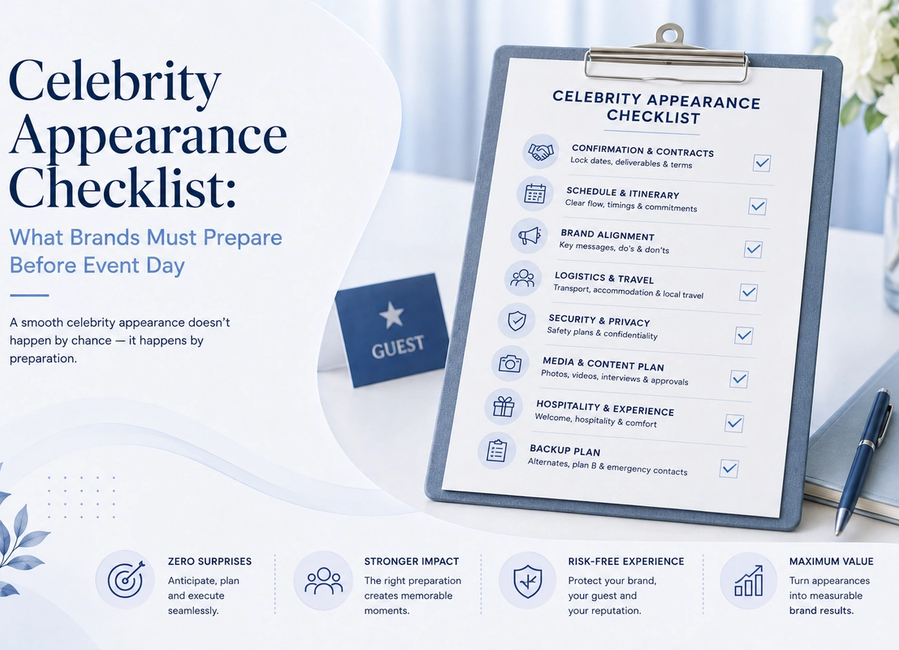
Related reading: Celebrity security & logistics at events · Celebrity appearance checklist.
Need this for your brand?
Let DTS build your next campaign.
From PR, celebrity management and events to websites, social media, SEO and AI video production — Double Trouble Studio helps brands grow with strategy and execution.
Discuss Your Requirement →